
#On the Workshops of Florence
The Ivory Revolt of Florence occurred in A.S. 44, one year before the Sundering broke the continent open and taught Europe, with admirable economy, the market value of destroyed sanctuaries. The Rationalist Republic had already passed from argument into appetite. Pamphlets had become writs. Writs had become seizures. Seizures had become public fires with programmes, benches, lectures, and the usual academic confidence that vandalism becomes science when described by a man with clean cuffs.
Florence was rich in small crucifixes. This sounds, to the brutal ear, like a minor fact. The brutal ear is wrong. A city may keep its faith in cathedrals when cathedrals stand; when cathedrals are watched, faith withdraws into kitchens, pockets, marriage chests, workshop drawers, hems, cradles, and the hollow beneath a bench where a carved saint no longer than a finger waits beside spare awls. Florence's artisans understood scale. A state can confiscate a bell. It finds a thousand ivory crucifixes more irritating.
The ivory-workers, joiners, turners, gold-beaters, lace-tool makers, and cabinet carvers of the Oltrarno had spent three decades preserving what the Rationalists called obsolete devotional matter. They carved crucifixes from old tusk, bone, boxwood, horn, and, in poorer shops, chalk boiled in glue and polished until it could deceive a grieving widow at three paces. Some were sold. Many were given. A few were hidden inside furniture destined for secular magistrates, a joke so dangerous that even I admire it with caution.
#On the Confiscation Writ
The Rationalist Prefecture of Civic Clarification (Unregistered) entered Florence under the authority of the Edict of Rational Allocation, that tidy little machine by which the Desecrations acquired receipts. The order was phrased with secular softness: workshop devotional objects were to be surrendered for cataloguing, de-ritualisation, and eventual educational display. A cross behind glass, a lecturer in front of it, a child told to laugh at what his grandmother kissed. Civilization, by Rationalist measure.
The guards came at dusk because cowards and competent officials both prefer dusk. They carried printed schedules listing districts by craft and household. They had boxes lined in grey cloth. They had two anatomy lecturers from Pisa, one municipal notary, thirty-six Republican Guards, and a cart fitted with locked drawers for portable superstition. They expected muttering. They expected tears. They expected compliance, because the Republic had mistaken patience for submission.
At the shop of Matteo Bellandi, ivory carver, widow's son, father of four, the first guard placed a hand on a bench crucifix and lost two fingers to a gouge chisel.
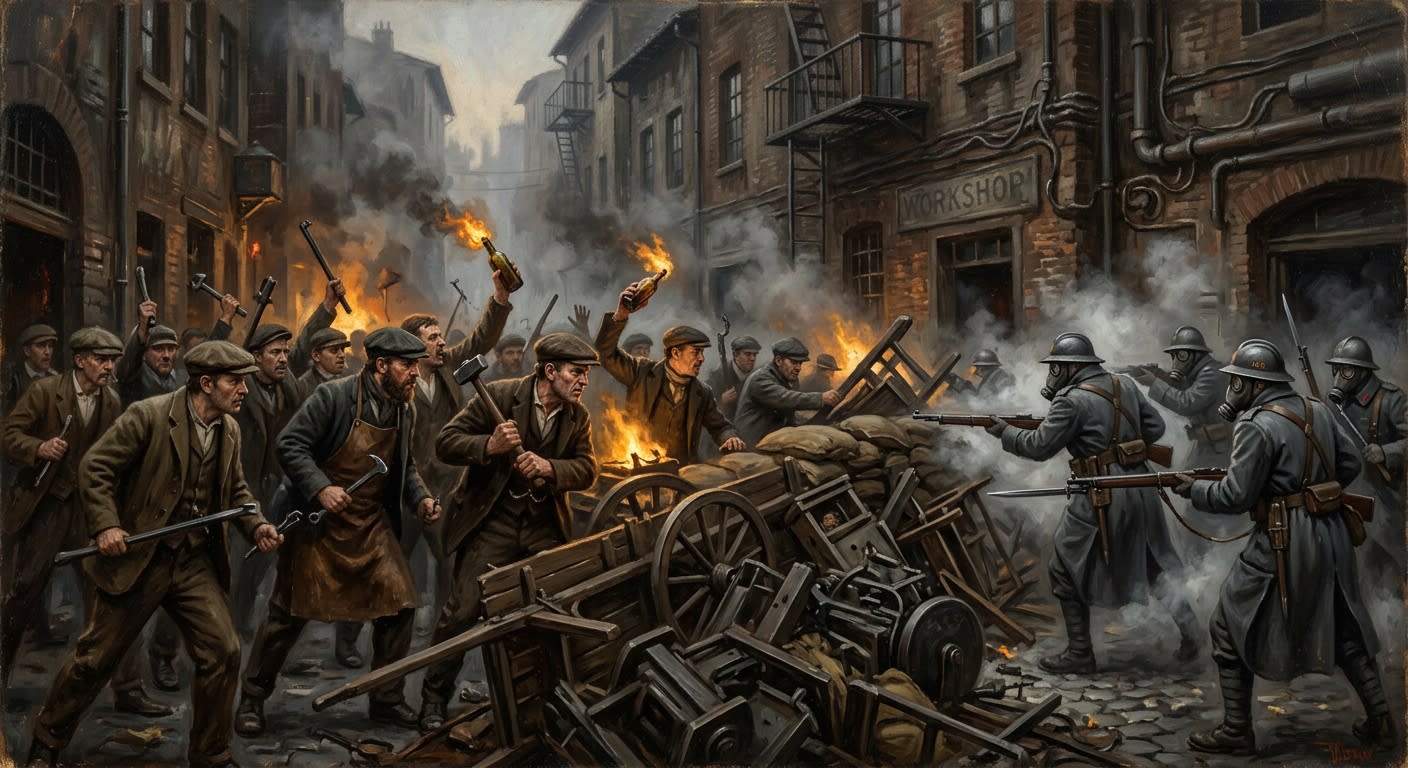
From there the revolt passed through the workshops faster than a bell could carry alarm. Apprentices barred doors with timber clamps. Old women brought lamp oil to upper windows. Gold-beaters hammered plates into noise-signals. Lace-tool makers threw needles by the fistful from balconies. A turner's guild dragged lathe frames across Via dei Serragli and built a barricade of unfinished chair legs, devotional boxes, and one Rationalist cart whose grey-lined drawers had been emptied into the street and filled with stones.
Several Rationalist summaries describe the Florence action as a spontaneous riot caused by trade resentment and price controls.
Corrected. Price controls make men curse. Confiscated crucifixes make men pick up chisels with intent. The distinction is available to anyone whose education has survived contact with reality.
#On the Night of Chisels
The workshops held until dawn. This is the number that matters. No regiment came. No bishop blessed the barricades. No saint descended through the smoke with a flaming writ. Florence's artisans fought with shop tools, shutter bolts, glue pots, knives used for trimming veneer, awls meant for leather, chisels meant for ivory, and the particular fury of people whose last private shrine has been touched by an official hand.
The Rationalist Guards answered in the Republic's dialect: volleys, bayonets, fire, and minutes. Every alley became a docket. Every bench became evidence. Every dead apprentice received, where the notary's ink survived, a mark beside his craft. The Republic counted bodies by trade category because murder always looks cleaner when sorted.
FLORENCE PREFECTURAL RETURN, A.S. 44 — PARTIAL COPY Ivory carvers: ███ corrected. Joiners: ███ corrected. Gold-beaters: ██ corrected. Apprentices under sixteen: entered under household responsibility. Objects recovered: ███████ devotional articles; ███ boxes; ██ suspected reliquary fragments. Recommendation: public burning after breakfast; lecture attendance compulsory. Bureau note, A.S. 92: copy smells faintly of myrrh. Do not store near open flame.
By first light the barricades had gone quiet. Every artisan identified as armed lay dead, dying, or silent in a way even the Republic understood. The surviving crucifixes were piled in the square. Some burned. Some cracked. Some refused the fire and were broken with rifle butts while the lecturers explained material density to a crowd that had stopped listening. Florence wept. The Rationalists wrote urban disorder and congratulated themselves on brevity.
#On the Chisels Under Glass
The Synod recovered forty-three workshop tools after the Concordat pacification of Tuscany (Unregistered): twenty-one chisels, nine awls, six gouges, four burnishers, two ivory knives, and one little hammer whose handle bears four thumb-grooves worn by a man who must have gripped it daily for thirty years. The Bureau of Relics classified them as Instruments of Spontaneous Witness, Category Two. The phrase is poor poetry and sound procedure. They glow faintly when handled by the devout. They remain dull in the hands of skeptics, accountants, and nearly everyone from Tithes.
The glow is not dramatic. It is a workman's glow: pale at the edge, warm near the haft, like a candle seen under a door. Several Examiners attempted to test whether the luminescence corresponds to hand temperature, prayer cadence, or residual ivory dust. The tools responded to piety and contempt with perfect administrative inconvenience. One chisel warmed in the hand of a blind pensioner who knew no Latin and cooled in the hand of an Archon-Custodian who knew too much.
The tools are kept in the Uffizi reliquary room (Unregistered), or in the structure occupying that name after fire, seizure, reallocation, and three committees made the word Uffizi less a building than a bureaucratic apology. Pilgrims press their palms to the glass. Artisans leave shavings. Children are told that tools remember the work for which hands were killed. This teaching is approved, though Doctrine prefers the wording the work for which hands were martyred, because Doctrine dislikes admitting that hands can be killed before a full theological review.
An early Bureau of Records catalogue listed the relic group as “forty-seven implements.”
Revised to forty-three. Four objects were later identified as ordinary workshop debris added by an overzealous local curator. They have been removed from display and returned to useful obscurity. The curator's zeal was commended. His counting was not.
#On the Use of the Revolt
The Ivory Revolt is taught with the Night of Crowns, the Massacre at Saint-Malo, the Siege of Toledo, and the Bonfires of Purification as part of the Republic's long assault upon the private custody of faith. Its lesson is deliberately small. A cathedral impresses the coward and invites the cannon. A pocket crucifix survives by intimacy. A chisel has no theory of martyrdom. It cuts what is placed before it.
The Bureau admires this. We admire it because it embarrasses our usual machinery. No writ summoned those artisans. No catechism article instructed them to bleed on their benches. No Bureau permitted their courage. They saw the hand reaching for the cross and struck it. Later offices, mine included, arrived with seals, categories, glass, custody rules, pilgrim fees, authenticity findings, approved hymns, and a tolerable exhibit label. We are very good at arriving after courage with paperwork.