
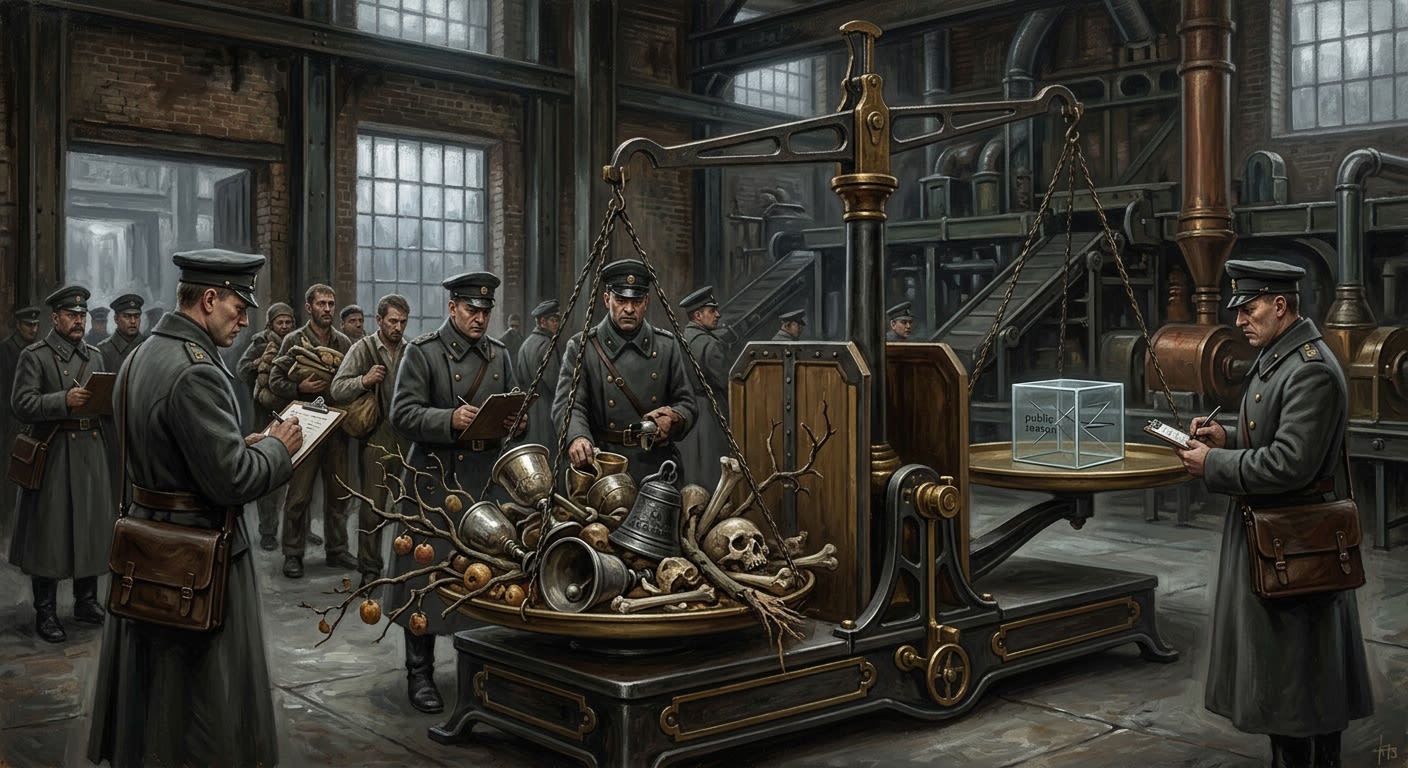
#On the Law That Weighed the Creator by the Ounce
The Edict of Rational Allocation was the Rationalist Republic's confiscation gospel: altar gold became treasury metal, monastery orchards prefectural acreage, reliquaries bullion lots, bells cannon, and a small unoccupied cross in a Florentine drawer an offence against public reason. It was issued after the Treaty of Regensburg in A.S. 30, under the Concordats of Governance, and remained active until central authority broke at the Sundering. Earlier seizures do not date this exact edict before A.S. 30.
Its premise was simple enough for a clerk and wicked enough for a philosopher. Sacred property was idle property. Idle property injured the common welfare. The Republic, being the sole interpreter of common welfare and already drunk on its own clean handwriting, would reassign such property toward rational use.
The Edict sits inside the Desecrations as budget sits inside murder. Before it, shrines burned under slogans, mobs, pamphlets, bonfires, lecturers, and the fashionable cruelty of men who had discovered that the pious could be made to look provincial under sufficient gaslight. After it, sacred destruction acquired schedules, receipt books, weight tables, appeal windows, liquidation orders, auction lots, and prefectural seals. The programme did not grow more violent. It grew more honest about being a programme.
#On Regensburg and the Price of Melted Bells
The Treaty of Regensburg made the Republic lawful in its own eyes, which is to say dangerous. The old crowns were dissolved into prefectural schedules. The Holy See of Vienna was emptied by swordpoint and then by committee. Thirty-seven Philosophical Prefectures inherited churches they did not believe in, monasteries they envied, fields they had never ploughed, libraries they could not read without sneering, and treasuries whose gold embarrassed their theories by being useful.
The Edict answered this embarrassment. Every diocese was ordered to submit property registers. Every abbey was required to declare its lands, livestock, rents, plate, bells, stored grain, manuscript holdings, burial rights, toll claims, and “ritual-metal accumulations.” That last phrase deserves burial in quicklime. It meant chalices. It meant altar candlesticks. It meant reliquary casings kissed smooth by grandmothers. It meant the silver hand of a saint whose actual hand had been burned two centuries before and had caused less trouble in ash than in metal.
Allocation officers travelled with scales, inventory slates, Republican Guards, and local notaries trained to write the word voluntary while avoiding eye contact. Bells were measured by diameter, lip thickness, alloy, rope condition, tower access, and melting yield. The old names were entered in a side column “for cultural recovery,” then struck from production copies. Saint Adelric became Bronze Lot 19-C. Our Lady of the East Gate became Firing Metal Reserve 4. The Matin Bell of Worms became thirty-two artillery throat rings and one clerk's promotion.
Rationalist teaching sheets described the Edict as “the liberation of hoarded wealth from superstitious enclosure.”
Corrected. Liberation does not arrive with guards, carts, inventory hooks, and a lecturer explaining to a parish widow that her husband's memorial candlestick has entered the public good.
#On the Tables of Use
The Edict's central table divided sacred property into four classes. Productive land passed to prefectural management. Precious metal passed to liquidation and minting. Structures passed to public instruction, storage, barracks, courts, or demolition. Objects lacking material value but retaining “irrational attachment” passed to educational display or purification fire.
There is no cruelty quite like a tidy table. Land that had fed poorhouses now served yield forecasts. Monastery vineyards became agricultural demonstration parcels. Convent laundries became military cloth depots. Abbey bee-yards were reassigned to wax production for secular offices, which is how candles made for altars ended by lighting interrogation rooms. The Republic called this efficiency. I concede the word, provided one may also call a knife efficient when it enters the correct rib.
The fourth class produced the worst theology. Rationalists insisted bones were bones, cloth was cloth, prayer-books were paper, and a child's pocket cross was carved matter plus sentiment. Sentiment, in the Edict's language, was “misdirected civic attachment.” Misdirected attachment required correction. Correction required display. Display required labels. The Republic never tired of labels.
A rib of Saint Romuald under glass became Representative Medieval Femur Claim, Unverified. A pilgrim badge from Lyon became Tin Alloy Token of Group Delusion. A worn devotional statue became Maternal Fertility Figure, Late Superstition Period, a label whose confidence outstripped the inspector's knowledge.
#On the Lumen and the Coinage of Theft
Allocation fed the Lumen. This must be understood plainly. The Republic's coin, stamped with a compass and the motto RATIO SOLA, did not merely fund its state. It carried the melted Church in its little secular mouth. Chalice silver travelled through markets as grocery change. Reliquary gold paid Republican Guards. Bell bronze entered artillery accounts. A man buying onions in Vienna might pass, without knowing it, a sliver of his grandmother's altar rail across a stall board.
The Bureau of Tithes confiscates surviving Lumens in A.S. 201 with pious severity and professional nostalgia. One can see why. The coin is detestable, efficient, beautifully struck, and morally diseased: everything a fiscal office secretly admires and publicly condemns.
The minting schedules were brutal. Allocation returns from Cologne, Prague, Lyon, Rouen, and Florence record metal weights with a sensual precision absent from their casualty lists. Human beings disappear in Rationalist records by category. Silver persists by ounce. The Republic could misplace a monk but never a candlestick.
The Edict also created auction channels for confiscated goods whose destruction proved less profitable than resale. “Uncertain devotional curios” passed to museums, academies, private philosophical collections, medical cabinets, and, in Amsterdam's cleaner rooms, wealthy skeptics who liked owning the things they claimed to despise. The Rationalist elite discovered the oldest vice of iconoclasts: after smashing the shrine, they keep the prettiest fragments.
#On Florence and the Rebellion of Small Crosses
The Edict reached Florence late because Florence is a city of drawers, workshops, side chapels, bargaining hands, clever hinges, and artisans who can hide an unoccupied cross inside a chair leg so neatly that a prefectural inspector may sit above it for years without noticing. By A.S. 44 the Republic had tired of missing things. The Rationalist Prefecture of Civic Clarification issued a workshop confiscation writ under Allocation authority, targeting ivory crosses, pocket saints, devotional plaques, relic boxes, and “miniature superstition objects of private persistence.”
Private persistence. There is the wound. The Republic could occupy cathedrals, seize abbeys, melt bells, and gut treasuries. A cross small enough for a sleeve defeated its philosophy by existing without permission.
The Ivory Revolt began when Guards touched Matteo Bellandi's bench cross and lost fingers to a gouge chisel. By dawn, the workshop districts had answered the Edict with awls, lamp oil, chisels, shutters, glue pots, chair legs, and the fury of people whose last private altar had been inventoried. The Republic filed the dead under urban disorder. Florence filed them under martyrdom. The Bureau of Relics later received forty-three tools classified as Instruments of Spontaneous Witness.
FLORENCE PREFECTURAL ALLOCATION ADDENDUM — A.S. 44 Objects recovered: ███████ devotional miniatures. Workshops corrected: ███. Implements seized from hostile craftsmen: forty-three retained for metallurgical curiosity. Note in later hand: the implements glowed during transfer. Second note: do not mention glow in Allocation compliance lectures.
The Edict was meant to make sacred property legible. Florence proved that intimacy resists legibility better than grandeur. A cathedral can be surveyed. A pocket cross must be betrayed.
#On the Desecration of Usefulness
The Rationalists did not hate usefulness. They worshipped it. This is why the Edict remains spiritually poisonous even in copies kept under Synodal lock. It offers the mind a delicious temptation: if a thing can be used otherwise, its current sanctity starts to look like waste to the untrained soul. If a reliquary's gold can feed artillery, why leave it around a bone? If a cloister can house students, why leave it to sisters? If a bell can become cannon, why allow it to ring?
The Bureau answers with Doctrine, and Doctrine answers with ownership. A consecrated thing is not idle. It is occupied. It is not unused. It is assigned upward. The fact that a chalice does not plough a field does not place it below a plough. The fact that a bell does not pierce armour does not make it inferior to a gun. The Rationalist error was not measurement alone. It was measuring only the part of the object available to unbelieving hands.
Several post-Concordat Synodal lectures state that the Edict failed because its allocations were economically unsound.
Corrected. The allocations were often economically sound. That is precisely why the Edict must be hated with discipline. Evil does not become tolerable because the accounts balance.
The Synod has inherited enough Rationalist instruments to speak carefully here. We use their survey tables after baptism. We study their prefectural chains after correction. We keep some of their weight standards because bread does not become holier when measured badly. Reason serves. Reason kneels. Reason may carry the censer; it may not climb onto the altar and name itself smoke.
#On the Sundering's Audit
On 1 November A.S. 45 the Sundering opened, and the Edict of Rational Allocation received its final audit. The Republic had converted sanctuaries into lecture halls. The lecture halls offered no ward. It had melted bells into cannon. The cannon misfired, cracked, or roared uselessly at things that did not respect ballistics. It had ground relic ash into mortar. The mortar split. It had liquidated devotional networks, scattered clergy, mocked hidden cells, and taught a generation to believe that a saint's name was cultural debris. When Hell walked out of the east, the debris would have been useful.
The Edict had allocated Europe away from its defences. That is the verdict. Every stripped altar was a missing barricade. Every melted bell was a silence in which panic could breed. Every confiscated reliquary was a ward unmade. Every closed monastery was a storehouse of courage sold for coin. The Republic believed it was freeing wealth. It was pawning armour before battle.
Surviving copies of the Edict are kept in the Forbidden Stacks, wrapped in black vellum and chained flat. Parchment rarely flees, though I would not put ambition past it. Certain documents should be taught posture. The margins carry notes from Rationalist clerks, Synodal auditors, Purity examiners, Tithes appraisers, and one anonymous hand that wrote beside the bell schedule: we needed those.
I know the hand. I will not name it. The confession is sufficient.