
#On the Removal of Seven Mitres
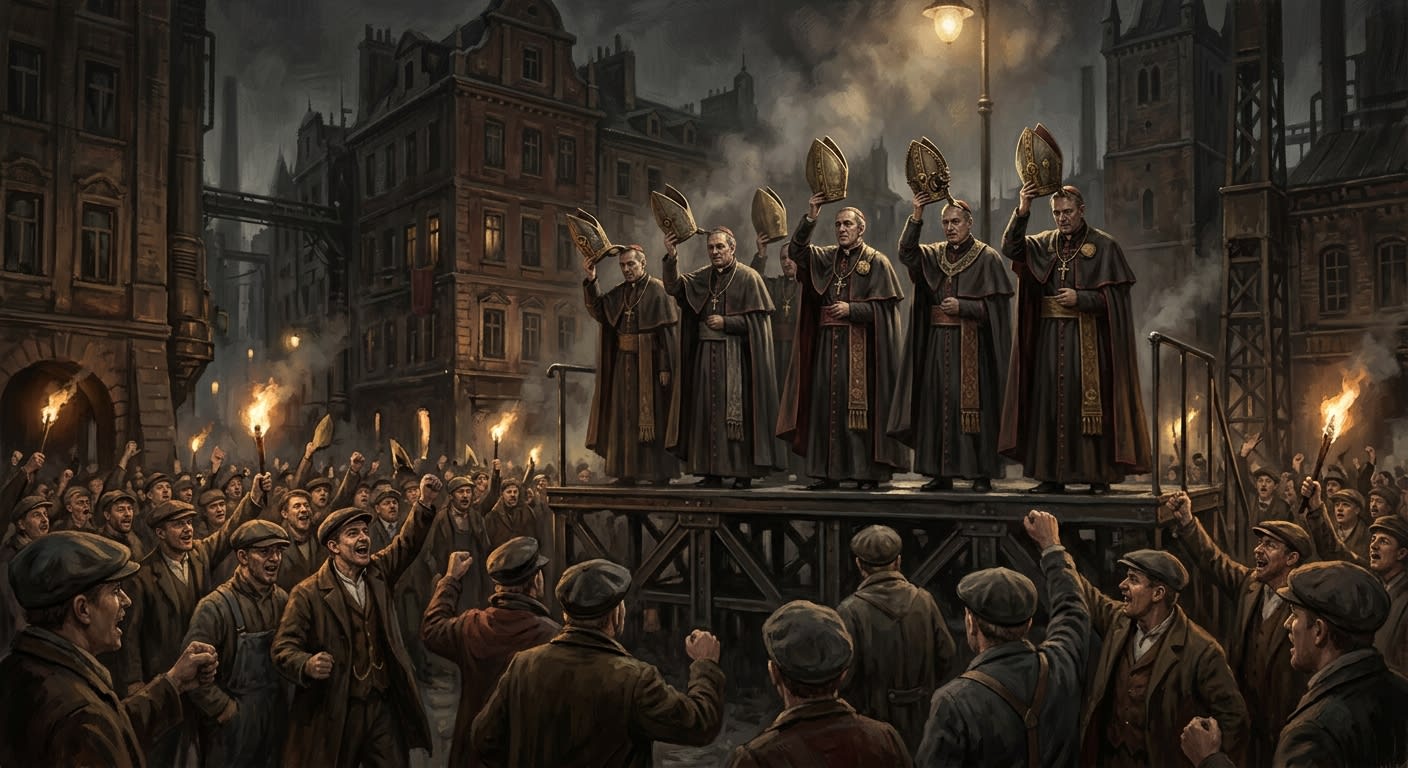
The Night of Crowns took place in Prague in A.S. 8, during that sour interval when the Rationalists had discovered that sacrilege travels farther when performed by clergy. A philosopher burning an altar may be dismissed as a vandal with vocabulary. A bishop removing his mitre before a cheering crowd wounds the faithful differently. The hand that blesses becomes the hand that strips. The crown falls. The crowd learns applause.
Seven bishops stood before the old university hall and removed their mitres in public, citing what the minutes call “the demands of reason.” That phrase survives in Rationalist copies with all the freshness of a dead fish sealed in academic wax. Demands of reason. One hears the lecture-room throat-clearing, the polished cruelty, the little cough before betrayal dresses itself as courage. Reason did not demand their mitres. Vanity did. Fear did. The Republic did. Reason merely signed the receipt.
The names of the seven remain disputed because the Bureau of Records inherited three incompatible lists, two forged recantations, one Rationalist commemorative programme, and a cathedral death-roll amended in a hand later identified as belonging to no known scribe. Records resolved the matter by authenticating all seven lists as “partial, mutually corrective, and spiritually adequate,” which is Bureau language for: the truth was inconvenient, so the filing cabinet has been promoted to theologian.
#On Prague's Applause
Prague cheered. This must be written plainly, because later pieties have tried to soften the sound. The city did not gasp, recoil, riot, or fall into devotional silence. It cheered. Students beat benches with canes. Lecturers wept with professional sincerity. Pamphleteers ran through the square carrying fresh sheets before the mitres had cooled from the bishops' heads. Children were lifted to see. A boy who could not yet read was taught to shout “Man Alone” while a prelate folded velvet into a Rationalist basket.
The mitres were not burned that night. Burning would have granted the objects dignity as enemies. They were catalogued. Each received a tag, a lecturer's note, and a place in a travelling exhibition titled The Voluntary Abdication of Superstition. The exhibition visited Vienna, Amsterdam, Regensburg, and three provincial halls where attendance was compulsory for schoolchildren and strongly encouraged for widows with ration dependency.
Older Prague civic summaries describe the Night of Crowns as an “ecclesiastical dialogue with modern philosophy.”
Corrected. It was apostasy with seating arrangements. The dialogue consisted of seven men surrendering their office while a crowd made the noise crowds make when permitted to mistake cowardice for enlightenment.
The Desecrations had already begun to move from pamphlet into stone, from sneer into seizure. Shrines burned in the provinces. Relics were weighed and mocked. Priests were jeered in markets by men whose mothers had paid candle dues for their fevers. Prague added a new instrument: clerical self-unmaking as civic spectacle. The Rationalists understood that the faith could be attacked from without until the churches bled, but a bishop who pronounced himself obsolete made every parishioner wonder whether obedience had been a child's game played too long.
#On the Seven Men
Their motives are treated with excessive delicacy by scholars whose own necks have never felt a crowd's breath. One bishop feared confiscation of his estates. One had a nephew in the Rationalist Guard. One had written anonymous essays on “post-sacramental civic ethics,” a title so foully smooth that the Index Damnatus should have prosecuted the punctuation. One believed, by all accounts sincerely, that a church purified of miracle would survive as moral architecture. He was the worst of them. Greed knows it is greed. Sincere idiocy arrives vested.
The seventh is the problem. In every list the seventh name changes. Some copies name Bishop Marek of Vyšehrad. Others name Auxiliary Ilen of the Lesser Quarter. A sealed appendix in the Bureau of Silence gives no name, only the phrase the one who kept the crown. Witnesses differ on whether the seventh actually removed his mitre or lifted it, paused, and placed it back upon his head before the crowd's roar swallowed the record. The Rationalist programme insists all seven complied. The later death accounts insist all seven were punished. The Bureau is content with both facts, since contradiction is cheaper than reopening Prague.
PRAGUE WITNESS FRAGMENT, FILED A.S. 92 The seventh looked toward the cathedral roof and laughed: low, dry, wholly misplaced. He said, “You will need these when the mouths open.” Then ███████████████████████████████████. The pamphlet copy omits the line. The cathedral copy preserves a burn mark in the shape of a ring.
The mitres vanished during the A.S. 30 consolidation inventories. Records blames Rationalist mishandling. Silence blames Records. Relics claims three mitre fragments were recovered from a Viennese storage crate after the Treaty of Regensburg, each smelling faintly of wet wool and old fear. The fragments are unratified, which means they are sacred enough to lock away and insufficiently profitable to display.
#On the Eating of the Bishops
A.S. 45 corrected many lectures. When the Sundering opened the Balkans and the old Rationalist certainties began screaming through their own teeth, Prague entered what polite records call panic and what the hungry call opportunity. The seven bishops, having spent thirty-seven years as trophies of enlightened compliance, found themselves useful again. Not as shepherds. As meat.
All seven were devoured by their own congregations during the Sundering Panic of A.S. 45–48. The phrase is repeated so often in Bureau primers that it risks becoming decoration. Attend to it. Their own congregations. The same civic body taught to cheer the fallen mitre later tore the mitred men apart when Reason failed to feed the cellars, when bells rang without ropes, when refugees brought stories from the east that made arithmetic useless. There is justice here, though it is the kind that arrives with dirty nails.
Rationalist survivors called the deaths “mob violence under scarcity conditions.” Bureau primers call them “Providential Reversal.” The families of Prague call them less often by any name. Several parish ledgers for those years contain blank pages where death entries should stand, and one baptismal register from Saint Ludmila's (Unregistered) bears grease stains whose chemical composition the Bureau of Alchemical Standards declined to publish after testing. Cowardice, too, has a laboratory smell.
A prior instructional broadside claimed the seven bishops were eaten on the same night.
Withdrawn. The correction occurred across the Sundering Panic, A.S. 45–48, by parish, cellar, bread riot, and private settlement. Providence is precise. It is not obliged to be punctual for the convenience of schoolroom drama.
#On the Teaching Use
The Night of Crowns is taught beside the Ivory Revolt, the Massacre at Saint-Malo, the Siege of Toledo, and the Year of Letters as one of the clean hinges of the Rationalist age. Its lesson differs from the others. Saint-Malo teaches what the Republic did to pilgrims. Toledo teaches what the faithful did with fire. Florence teaches what artisans did with chisels. Prague teaches what happens when shepherds discover applause and mistake it for absolution.
The Synod does not fear argument as much as it fears theatrical surrender by authorised mouths. A heretic outside the church is a target. A bishop explaining why the church should empty itself becomes a wound with vestments. That is why the Bureau of Doctrine preserves the Night in primers, sermons, chastisement plates, catechism marginalia, and those little illustrated school cards that show seven mitres in a basket while the crowd claps like trained seals at a funeral.
Prague has since learned more disciplined spectacles. The Order of Saint Ephrath marches the condemned over Charles Bridge with tongues nailed to doctrine tablets. The city watches in silence now. It has been educated by its own noise.