
#On the Learned Men Who Preferred Ash
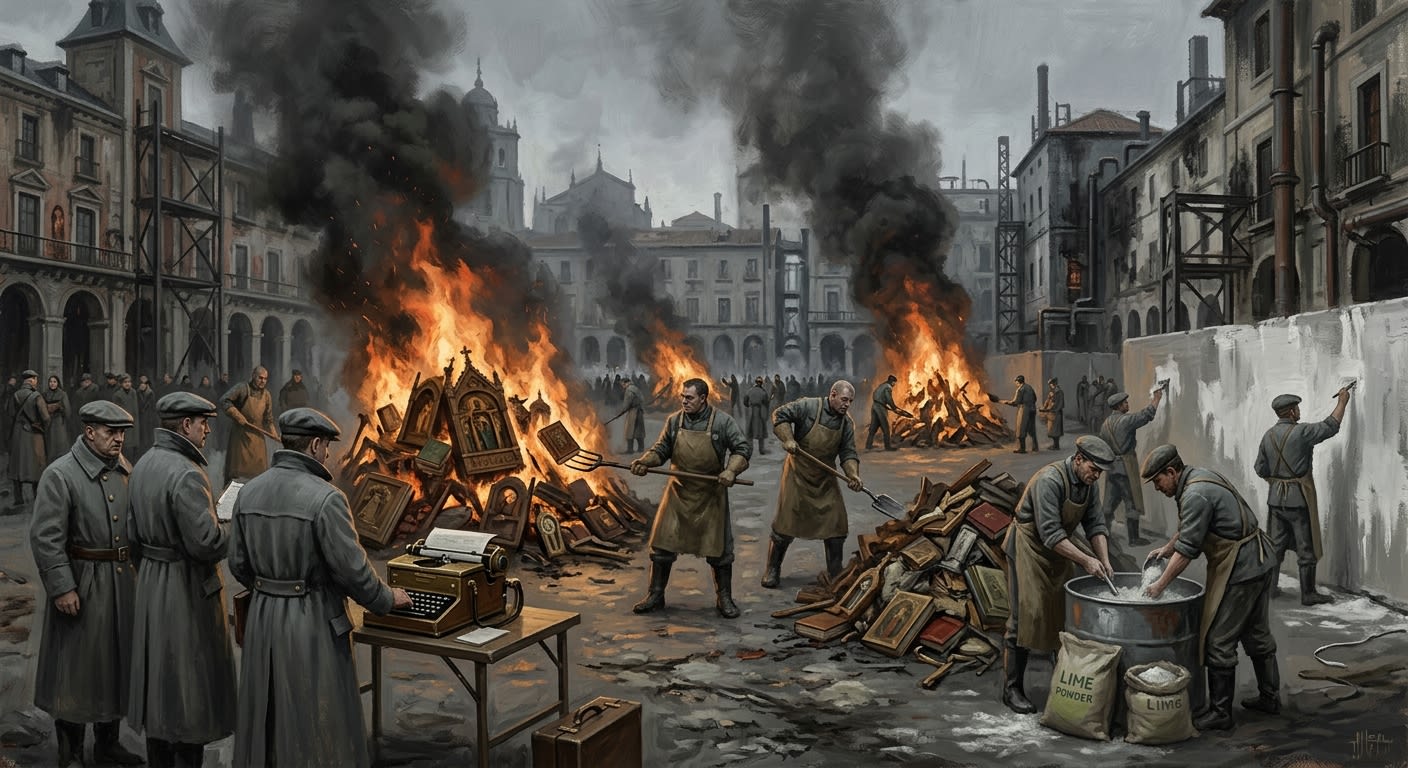
The Bonfires of Purification began in Iberia in –18 A.S. (1692 CE, before the Bureau's calendar), which the old universities called 1692 with that special confidence peculiar to calendars composed before judgment. Rationalist committees entered convents, chapter houses, parish treasuries, roadside chapels, shrines of women with better memories than bishops, and small hill monasteries whose names now survive only because their ashes were itemized by the men who burned them. Relics were carried into plazas. Reliquaries were broken open. Bones were stacked with missals, veils, altar linens, votive crutches, saints' teeth, pilgrims' tokens, and the small domestic crucifixes that grand historians misplace because grand historians rarely know where old women hide the Creator.
The lecturers came in gowns.
That detail must be fixed like a nail through vellum. The Bonfires were not drunken sackings, militia tantrums, or street mobs discovering appetite beneath ideology. They were ceremonies. Programmes were printed. Benches were arranged by subscription rank. Municipal notaries stood at tables beneath grey awnings, writing catalogue numbers while students carried baskets of bone. Prefects of Civic Clarification delivered addresses on superstition, fraud, priestcraft, anatomical error, mineral residue, social hygiene, and the liberation of public instruction from the odour of incense. Then they lit the piles.
The fires were called purification because the Rationalists possessed the decayed instinct of religion without the mercy of doctrine. They understood that a public act requires a name, that flame requires witnesses, that a crowd should be instructed in what it is seeing before its own heart supplies a more dangerous meaning. Purification, in their mouth, meant removal from ritual custody into educational utility. A saint's bone ceased being a saint's bone and became organic matter. A chalice ceased being a vessel and became alloy. A veil ceased being cloth touched by vows and became textile evidence. Every old sanctity was translated into a classroom noun, then destroyed to prove the translation correct.
The first bonfires were recorded at Córdoba, Salamanca, Seville, and Toledo's outer convent houses, though the sequence has been quarrelled over by archives whose survival owes more to rats than to scholarship. Córdoba supplied the model: inventory in the morning, lecture at noon, burning at Vespers, ash collection before midnight. Salamanca added compulsory attendance for apprentices and schoolboys. Seville added lime mixing. Toledo added tower-bell silence so that no local bell could answer the fire.
The Bonfires were not isolated bonfires in the way a plague is not isolated pustules. They formed a system of spectacle, instruction, seizure, fire, and architectural reuse that moved from Iberia outward by imitation. Prefects elsewhere studied the Iberian packets with envy. In Provence, municipal lecturers tried smaller devotional burns and discovered peasants would tolerate the burning of confiscated pamphlets before they would tolerate the burning of a grandmother's rosary. In the Low Countries, academy men proposed ash-lime in public classrooms and were told, by merchants who understood damp walls better than ideology, that saint-dust was a poor solution to canal moisture. In Paris, the scheme was praised, revised, and delayed until other atrocities overtook it. Iberia remained the cleanest case because Iberia had convents enough to feed a programme and plazas wide enough to make grief visible.
The dates require discipline, because the old lore has been copied by men who confuse moral sequence with arithmetic. The Iberian Bonfires belong to –18 A.S. (1692 CE, before the Bureau's calendar), before the formal Year Zero and long before the Treaty of Regensburg hardened Reason's victory into continental law. This makes them more obscene, not less. The Republic had not yet been crowned by treaty. The Council of Nine had not yet possessed all Europe under a single instrument. Still the method was already present: inventory the sacred, convert grief into instruction, call theft hygiene, and let students applaud before they understand what their hands will inherit. A regime reveals itself earliest in rehearsal. The Bonfires were rehearsal with real bones, real smoke, real widows, real boys taking notes while their mothers stared at the ground and learned the shape of lawful shame.
The violence also hardened the enemy's habits. The Rationalists learned that sacred objects could be converted into public pedagogy. The Republican Guards learned that old women will fight harder for a box of ash than young men will fight for a tariff. The faithful learned that public sanctity had become a beacon for seizure. Every side improved. This is why history is mostly the record of men becoming more efficient at sin.
The Bonfire administrators left beautiful paperwork. I say beautiful as an executioner might admire a clean blade. Each convent inventory bore object number, material, alleged saint, local cult risk, crowd sentiment, flame response, ash yield, lime ratio, and recommended educational destination. A chalice might become metal stock. A veil might become ash-lime. A reliquary hinge might be retained for demonstration. A bone might be burned, tested, mocked, and still entered under “uncertain animal origin,” because even Rationalist arrogance occasionally met a tibia and blinked.
One packet from Seville includes seating charts. First rows for academy fellows, second for magistrates, third for guild officers, rear standing area for common witnesses, side cordon for clergy under guard. Children were placed near the front so their first lesson in civic maturity would be the smell of burning reliquary wood. The Republic understood education. It merely chose Hell's curriculum.
#On the Emptying of Convents
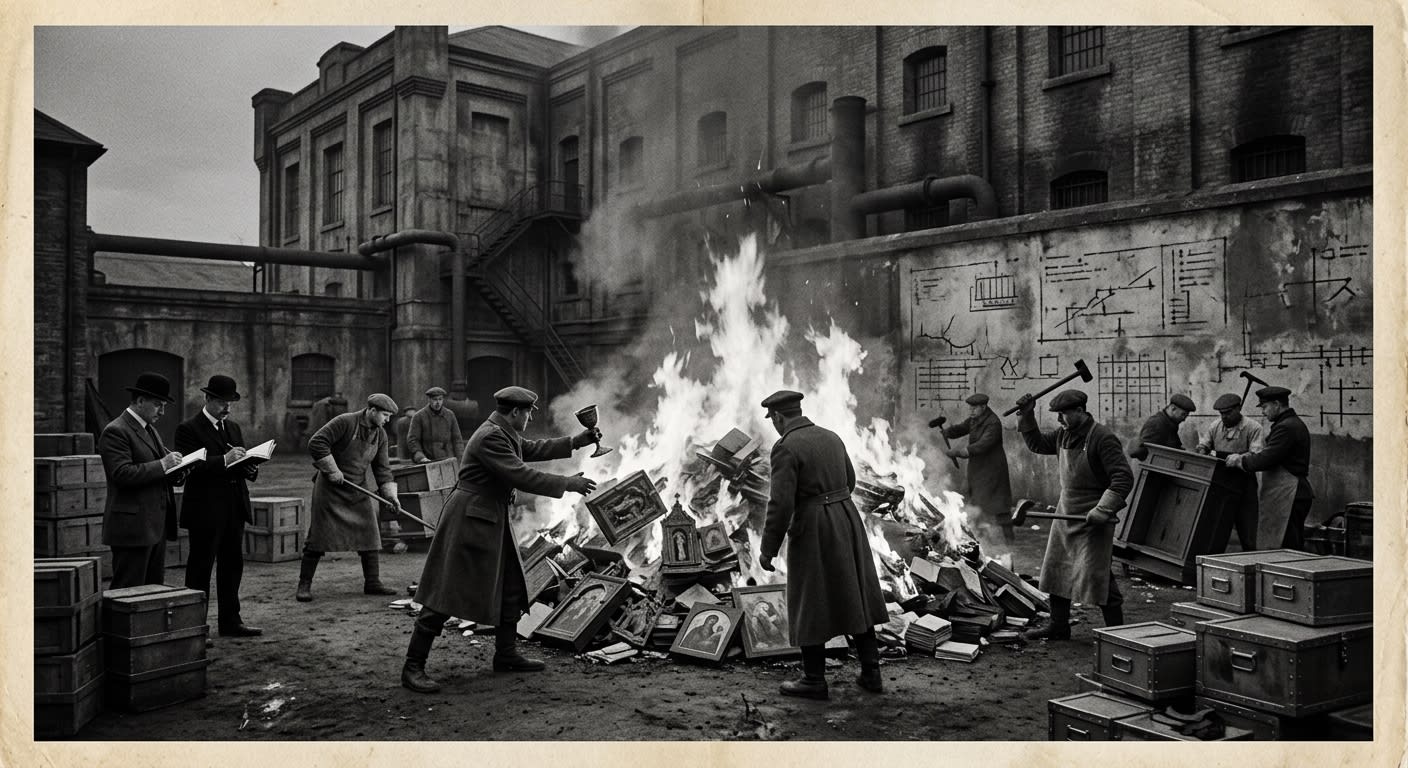
A convent empties differently from an armoury. An armoury surrenders weight. A convent surrenders habits, keys, names, oil lamps, worn steps, herb cupboards, infant socks, altar flowers, account books, death registers, little cupboards where illegitimate children were hidden during raids, and the cupboard beneath the cupboard where the true thing was hidden after the first hiding place became famous. Rationalist schedules did not account for this. They assumed, as men with clean boots so often assume, that a house contains what its public rooms confess.
The convents taught them otherwise.
At Santa Brígida outside Salamanca, the inspectors found three reliquaries in the treasury and declared the search complete. A novice sneezed during the inventory. The cough echoed behind the refectory wall. The wall was opened, and behind it lay forty-two small boxes, each wrapped in linen and labelled in a hand so old that even the abbess could not read it without tears. Finger bones, hair, scraps of burned veil, a child's shoe attributed to Saint Marta of the Narrow Stair, two nails from an unauthenticated martyr-crate, and one small jaw fragment later rejected as bovine by Rationalist anatomists, which proves only that the Rationalist anatomists had opinions.
At the Convent of the Seven Mercies near Córdoba, the sisters refused to identify the relics by name. The prefect ordered each box opened and its contents read into the municipal record. The scribe wrote unknown bone thirty-seven times. On the thirty-eighth, his hand cramped shut and remained closed until death. Rationalist physicians described the condition as nervous seizure. The sisters described it as courtesy from a saint tired of being introduced by an enemy.
The faithful resisted where resistance could take the shape available to them. Bells were rung out of sequence to warn neighbouring houses. Laundry carts vanished into olive groves with reliquaries under wet sheets. Cellar doors were bricked up from the inside. One prioress at Écija swallowed the key to a crypt and sat very upright while Republican Guards shouted at her for six hours. The crypt was eventually opened with hammers. She died two days later. The key was recovered. The report notes this with triumph, as though digestion had been a negotiated surrender.
The Bonfires did not strip every relic from Iberia. No persecution manages what it advertises. A fragment of Saint Iago's jaw survived the auctions, survived the fires, survived service as a Córdoba prefect's paperweight, and was later taken by sanctified requisition to Toledo, where it answered artillery in A.S. 15. The Rationalists never forgave survivals. A burned relic proved their thesis. A surviving relic accused it.
Rationalist circulars from the Córdoba Prefecture claimed “all superstitious bone articles in the district were removed from harmful circulation.”
Corrected by subsequent fire. Relic 14-T(Provisional), the Relic of Saint Iago, remained in circulation long enough to burn three ammunition caissons and forty-seven artillerists. Harm, it appears, depends upon where one stands.
#On the Lectures Over Flame
The plaza lecture was the Bonfires' true altar. Without the lecture, a crowd might see theft, desecration, fear, or a state burning what it could not understand. With the lecture, the crowd was instructed to see progress. Rationalism was never content to wound. It required the wounded to applaud the instrument.
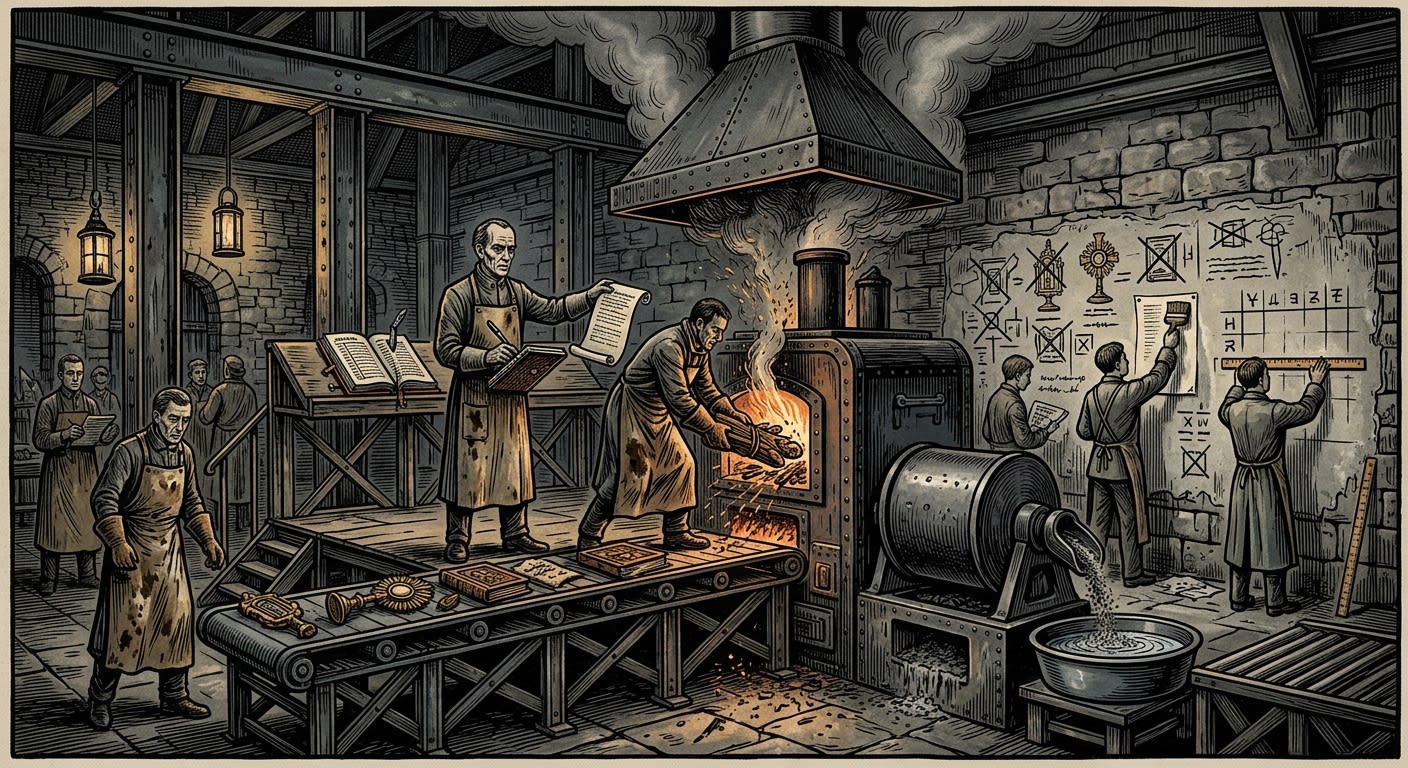
The standard address contained seven movements. First: historical correction, in which local saints were demoted to folklore. Second: anatomical instruction, in which bones were named by species when convenient and by uncertainty when not. Third: economic accusation, in which reliquaries were described as hoarded public wealth. Fourth: moral hygiene, in which prayer was compared to mildew, fever, or infantile dependency. Fifth: civic gratitude, in which the crowd was invited to thank the Prefecture for freeing it from fraud. Sixth: ignition. Seventh: questions, though questions from clergy were not received.
The lecturers made jokes. This too must be recorded. At Seville, Dr. Amador Rusk held up a finger bone and asked whether the saint would object to being useful for once. At Salamanca, a woman from the crowd spat at him and was removed by two Guards while his students laughed. At Córdoba, a lecturer placed a reliquary label against his own jaw and pretended to speak as Saint Iago. The transcript records laughter from the front benches. It does not record the old man in the back row who began keening until his grandson covered his mouth.
A surviving model address from the Prefectural Instruction Packet opens with gratitude to Reason, orders the lecturer to name the object before burning while denying the name's sacred force, places children close enough to observe without kneeling, warns against prolonged handling of teeth, jawbones, blood-cloths, or items reported warm, and ends with the finest sentence in the whole rotten packet: If flame changes colour, continue lecture.
That last rule is important. Several flames changed colour. Blue at Córdoba. Green at Seville. White at Salamanca, where witnesses say the heat bent away from the sisters under guard and licked toward the lecture dais. Rationalist reports attribute the colours to mineral treatment, resin contamination, copper salts, lamp oil adulteration, dye residues, and clerical fraud. Each explanation may be true. None exhausts the matter. Creation enjoys humiliating men who confuse chemical description with final authority.
The Guards stood around the square with bayonets fixed. Their work was crowd theology. If the faithful tried to kneel, they were struck upright. If they crossed themselves, their hands were seized. If a child cried at the wrong moment, the mother was warned. If a priest spoke a name as the object entered the fire, his mouth was covered with the flat of a musket until blood made speech academic. The Republican Guards did not need to understand the lecture. They were punctuation.
#On Ash-Lime and the Lecture Halls
The most perfect obscenity came after the fires cooled. Ash was gathered. Not all ash; the Rationalists were too practical for pure symbolism when useful plaster could be made. Bone ash, linen ash, vellum ash, char from reliquary wood, powdered silver residue, hinge fragments, casket nails, saint-dust, altar-dust, and the grey end of old petitions were sifted into barrels and mixed with lime. The mixture was carted to lecture halls, academies, municipal instruction rooms, and newly secularised convent schools. Walls were plastered with it. Students wrote equations against it. Professors hung diagrams over it. The Republic taught from rooms whose walls still smelled faintly of incense when rain pressed damp through the stone.
At Salamanca's Hall of Civic Optics, the west wall received ash-lime from three convent pyres. Within a month, chalk refused to hold on the lower panels. Students complained that formulae blurred after being written. A janitor swore that the word miserere appeared beneath a geometry diagram and returned after scraping. The Academy dismissed him for superstitious maintenance. The wall was replastered twice. The third layer cracked in a pattern resembling a rosary. The official file reads: settling.
At Seville's Instruction Room for Domestic Rationality, girls were taught household arithmetic beside a wall made partly from the ash of their own convent school. The first cohort learned quickly, according to the prefectural report. They also began counting in liturgical groupings: three, seven, twelve, forty. The instructor corrected them. The corrections persisted in the copybooks. One page survives in the Forbidden Stacks. It shows a column of sums. Every answer is wrong by one. Every wrong answer, when read as a psalm number, forms a penitential sequence.
SALAMANCA ACADEMY MAINTENANCE NOTE — –17 A.S. (1693 CE, before the Bureau's calendar) West wall scraped to base layer after recurrence of Marian text beneath optics diagram. Work crew reported smell of wet roses and extinguished tallow. Foreman ordered continued scraping. Foreman's final entry: “The wall has begun correcting us.” Remaining lines sealed under Doctrine custody; ash sample stored separately after jar cracked from inside.
The Rationalists loved the ash-lime because it made a doctrine touchable. Faith had been burned, mixed, spread, flattened, and made to support instruction in its own absence. A student leaning against such a wall leaned, according to the programme, against conquered superstition. The Bureau later recovered fragments of those walls and found them troublesome. Some crumble when handled by unbelievers. Some harden when exposed to hymn. One panel from Córdoba sweats black moisture every year on the anniversary of its plastering. The moisture contains calcium, lamp soot, human phosphate, and no apology.
The Synod did not destroy every ash-lime hall after the Concordat. We are not sentimental vandals; we are administrative heirs with better theology. Several halls were sealed, several reconsecrated, several converted into cautionary classrooms where children now learn what men did when they thought measurement could absolve them of reverence. A few remain in use by the Bureau of Doctrine because walls made from enemy blasphemy possess an instructional flavour no fresh plaster can supply.
#On Those Who Carried Embers Away
Every bonfire breeds thieves. The Rationalists called them relic smugglers, superstitious scavengers, ash parasites, domestic saboteurs, shrine remnants, and, in one Seville file, women with aprons. The final phrase is the most accurate and the most frightened. Women with aprons carried more from the Bonfires than several mounted escorts carried into them.
They came after midnight. Widows, market girls, failed novices, laundresses, sacristans' sons, mule drivers, two anatomy students with sudden consciences, one Republican Guard whose mother had been buried under a convent floor, and children too small to be stopped by dignity. They sifted ash with spoons. They hid fragments in bread, fish-guts, candle stubs, rosary knots, dress hems, mule harness, baby's swaddling, and once in the hollow tooth of a living man who later complained less than one might expect. They did not always know what they carried. They knew only that the state had wanted it burned, which was authentication enough.
These ember-carriers became the western cousins of what would later be called the Cellar Saints. They fed hidden chapels, family shrines, road crypts, monastery remnants, and the stubborn little devotional economies that kept faith alive under the Rationalist boot. An ash pinch from Salamanca reached Lyon by –9 A.S. (1701 CE, before the Bureau's calendar). A Seville casket nail appears in a Marseille dockside reliquary by A.S. 4. Córdoba silver residue is mentioned in a Toledo repair receipt before the Siege of Toledo. The networks were ragged, familial, bribed, fearful, holy, and badly spelled. They were also faster than the Prefecture's corrections.
The Order of Saint Iago drew from such remnants. Its A.S. 12 sanctified requisition in Córdoba did not arise from abstract zeal. Someone knew the jawbone had survived. Someone had watched the prefect use a saint as a paperweight. Someone carried that knowledge through three searches, one household betrayal, and an interrogation that left wax burns on the wrists. The Bonfires taught the faithful that custody could no longer be public without being suicidal. They learned sleeve custody, cellar custody, apron custody, tooth custody. Providence has always enjoyed bad tutors when good ones grow scarce.
The ember-carriers also made the later Ivory Revolt inevitable. By A.S. 44, Florence's artisans had spent decades absorbing the lesson of Iberia: if the state comes for the small cross, it comes with a cart already measured for your dead. When the guards reached for ivory, the chisels rose. One can trace that motion back through workshop prayers, apron ash, hidden casket nails, convent walls, plaza fires, and the first lecture at Córdoba where a man in a gown explained that bones are only bones.
#On the Bureau's Recovery and Reclassification
After the Sundering and the slow making of the Synod, the Bonfires became evidence. Evidence is holier than memory because it can be stamped. The Bureau of Doctrine classified the event under Coordinated Spiritual Aggression, Category Alpha-1. The Bureau of Relics opened ash provenance inquiries. The Bureau of Records indexed surviving Rationalist programmes, municipal orders, cart schedules, requisition sheets, lecture notes, ash-lime invoices, and fourteen pages of student attendance lists from Seville that still smell of smoke despite three washings and one attempted exorcism by a clerk who lacked rank but possessed initiative.
The recovery work was foul. Reconsecrated lecture halls had to be scraped, but scraping a wall made from saint-ash is not demolition. It is excavation with guilt. Each panel was cut, numbered, wrapped, argued over, sampled, doubted, and sometimes kissed by workmen who should have known better and often did. Doctrine wanted instructional custody. Relics wanted sacred custody. Records wanted clean catalogues. Purity wanted names of descendants. Tithes inquired whether reclaimed ash counted as taxable devotional matter once redistributed. The inquiry was not well received, though it was, disgustingly, reasonable.
A.S. 92 recovery summaries describe the ash-lime removals as “orderly and uncontested.”
It has always been the case that three Bureaus shouting over one bucket while local women threaten them with broom handles constitutes orderly action when compared with war.
Classification produced its own scandal. If the Bonfire ash was relic matter, every lecture hall became a desecrated reliquary. If it was mere residue, the Bonfires lost prosecutorial force in catechism. Doctrine chose magnificently: the ash was classified as violated sanctified remains with continuing instructional agency. The phrase is ugly enough to be true. It allowed seizure, sermon, tariff, pilgrimage restriction, and children pointing at wall fragments while instructors said, “This is what Reason did when no one stopped it.”
Some fragments entered shrines. Some entered evidence cabinets. Some were ground into black teaching ink used for Atheist Wars primers until the practice was stopped in A.S. 117 after three students in Mainz wrote essays in another hand. The essays were doctrinally sound, which made them alarming. One fragment from Seville was installed beneath the threshold of the Bureau of Purity's Iberian annex so that every accused Rationalist sympathizer crossed over the ash of what his intellectual ancestors had burned. The annex reports improved confession rates. The Bureau will call this psychology if forced. I will call it manners.
#On the Present Ash
As of A.S. 201, the Bonfires of Purification occupy a privileged place in the Synod's hatred because they are small enough to teach and large enough to condemn a civilization. The Massacre at Saint-Malo gives us blood. The Night of Knives gives us wire. The Treaty of Regensburg gives us law in its most perfumed corruption. The Bonfires give us the Rationalist soul in a plaza: catalogue the holy, mock the grieving, burn the evidence, make a wall from the ash, charge admission to the lecture.
In Toledo, pilgrims pass through chapel rooms where the empty jaw-setting of Saint Iago rests behind glass. Guides mention the Bonfires before the Siege because the relic's survival makes no sense without the earlier thefts, escapes, and humiliations. In Seville, a sealed wall panel sweats black during Ashmonth. In Salamanca, the west-wall fragment is kept under oilcloth and opened for senior catechists who have earned sufficient disgust. In Córdoba, the former prefectural lecture room has been reconsecrated as the Chapel of the Unburned Name, though the old benches remain. Kneelers were added later. The benches look embarrassed.
Schoolchildren learn the approved sequence. First Relic Auctions. Bonfires. Ghent. Saint-Malo. Toledo. Regensburg. Republic. Sundering. The line is drawn so even a stupid child can follow it, which means several adult sympathizers still fail. The lesson is not that every Rationalist personally threw a saint into fire. Bureau pedagogy is severe, not lazy. The lesson is that a civilization which permits lecturers to burn relics in plazas has already decided what it will do to living bodies once bone no longer satisfies.
There are surviving ash pinches in private hands. The Bureau knows. The Bureau has always known. Total recovery would require searching grandmother boxes, grave hems, doll stuffing, kitchen shrines, mule collars, dowry seams, and the little clay jars hidden behind stove bricks in Iberian houses whose occupants can appear illiterate before a warrant and quote three generations of hiding places after supper. Purity recommends periodic amnesty. Relics recommends registration. Doctrine recommends letting some ash remain in the people, because a lesson held too tightly by the Bureau becomes Bureau property, and Bureau property seldom weeps.
At Vespers on the anniversary of the Córdoba burning, certain Iberian parishes still extinguish every lamp, scatter a pinch of clean lime on the threshold, and speak the names of houses emptied before the Synod existed to avenge them. The ritual is tolerated. It is technically irregular. It is also better theology than several licensed feast offices, which I say here because the responsible Archons cannot strike a sentence they do not wish to admit they read.
The Bonfires burned. The walls remembered. The ash entered lungs, plaster, bread, hems, ledgers, sermons, and the little cracks beneath official history where the useful dead wait for clerks to become honest.