
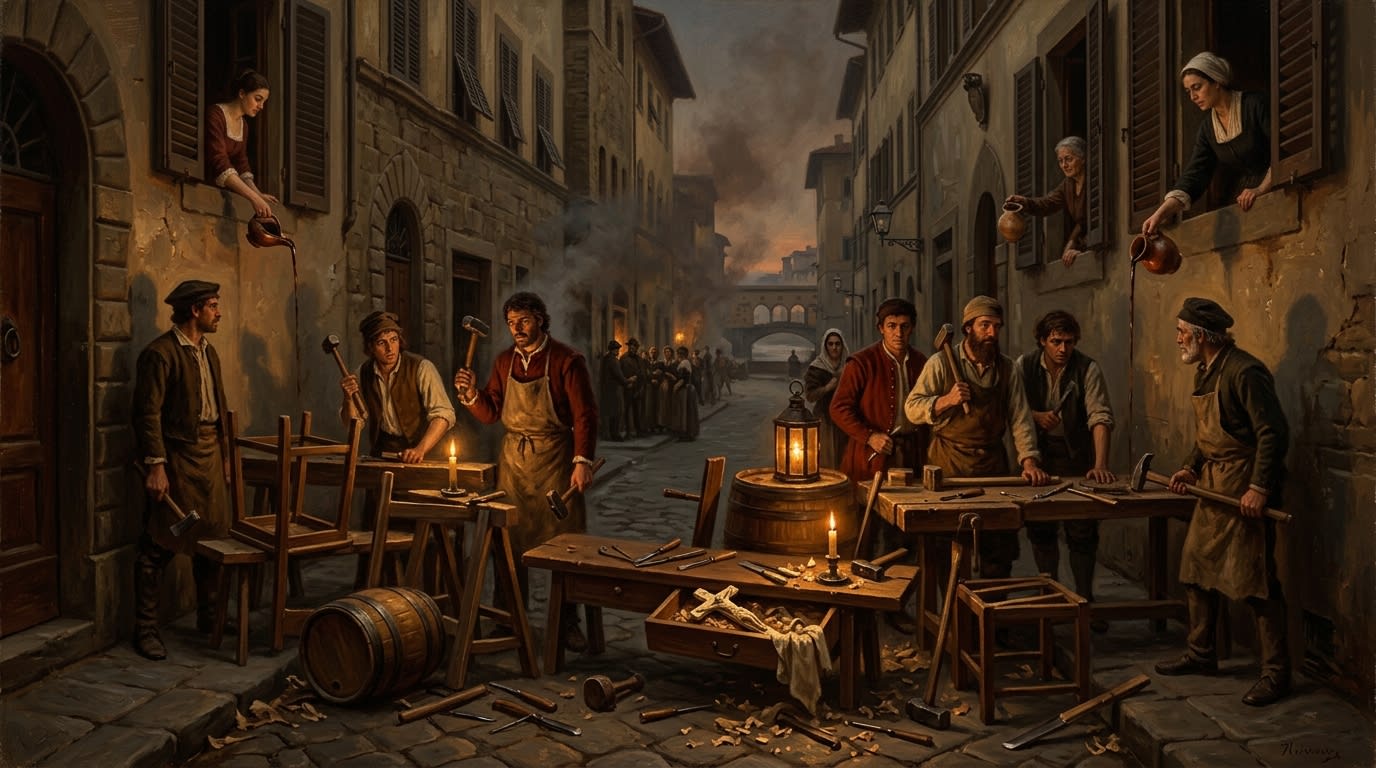
#On the City of Small Crucifixes
Florence is a Zone 2 Italian heartland city under ordinary Synod custody, famous for carved ivory, polished conscience, murdered artisans, and the peculiar civic ability to make beauty look like evidence.
The city lies south of the Alpine obedience routes and north of the older Roman embarrassments, far from the Sagittal Line in distance and uncomfortably close to it in memory. A Sin-General has never laid siege to Florence; no bastion has been cut from its hill; no demon-bridge darkens the Arno (Unregistered). Florence’s wound is older, cleaner, and more insulting: it bled before Hell opened, when men in clean coats proved that sanctuaries could be stripped by reason, weighed by committees, and burned with lecture notes.
Its streets still remember hands. Carvers’ lanes in the Oltrarno keep their benches narrow and their drawers deeper than law requires. Gold-beaters work under icons whose backs are inspected yearly by Purity. Cabinet-makers cut devotional compartments into secular furniture and call them joinery traditions. Lace-tool makers maintain awl racks arranged, by pure accident, in the proportions of a kneeling figure. The city’s piety learned concealment before it learned safety.
The Bureau teaches Florence through the Ivory Revolt because official pedagogy loves a city once it has been reduced to a single lesson. This is useful and false in the way most useful statements are false. Florence is more than that night. It is the room in which the night became possible: craft, secrecy, family drawers, workshop shrines, secular patrons sitting on chair legs that contained hidden saints, apprentices learning to shave ivory thin enough to pass beneath a Prefect’s fingernail and thick enough to hold a cross.
#On the Rationalist City Before Dawn
During the Age of Reason, Florence had every quality the Rationalists found intolerable: skilled hands, private devotion, portable sacred objects, guild memory, money that did not always announce itself, and widows who could hide a relic more competently than a bishop could defend a cathedral. Grandeur is easy to seize. Intimacy must be betrayed.
The Edict of Rational Allocation reached Florence late and arrived hungry. After the Treaty of Regensburg in A.S. 30, the Republic had given theft a cleaner collar. Altar gold became civic material. Bells became cannon. Monastic lands became prefectural acreage. Pocket saints, household plaques, ivory crucifixes, reliquary splinters, and marriage-chest icons became miniature superstition objects of private persistence, which is Rationalist diction for a thing too small to confiscate without looking afraid of it.
Florence made the Republic look afraid.
The Prefecture of Civic Clarification (Unregistered) established itself in a confiscated guild hall and began the usual rites of unbelief: lectures on material progress, school attendance at burned shrines, catalogues of devotional waste, public weighing of silver lamps, and smiling visits from men whose gloves were whiter than their records. Its notices spoke of cataloguing, de-ritualisation, educational display, and civic instruction. No notice said plunder. Rationalism hated accurate words unless it had invented them.
By A.S. 44, the city’s patience had become combustible. The Republic had already shown its programme elsewhere: the Bonfires of Purification in Iberia, the Night of Crowns in Prague, the stripping of shrines, the melting of bells, the little theatre of enlightened contempt repeated until even cowards could recite it. Florence watched, measured, concealed, and sharpened.
A later Tuscan civic primer described pre-revolt Florence as “politically unsettled by economic pressure.”
Corrected. Economic pressure sells furniture. Sacred confiscation teaches furniture to contain knives.
#On the Night of the Ivory Revolt
The A.S. 44 confiscation writ targeted the workshop districts. Rationalist Guards entered at dusk with grey-lined boxes, printed schedules, lecturers, a notary, and the condescension of men who had never seen a chisel used outside demonstration. They expected muttering, tears, signatures, and the ordinary defeated shuffling by which officials convince themselves that obedience has consent hidden somewhere inside it.
At Matteo Bellandi’s bench, a guard touched a crucifix and lost fingers.
The revolt passed through Florence by craft rather than bell. Bells had become suspect. Hammers did better. Gold-beaters struck warning on plates. Joiners barred lanes with trestles and unfinished chair frames. Ivory carvers cut latch-straps. Apprentices dragged varnish barrels into alleys. Women poured lamp oil from upper windows with domestic calm, which is the most frightening calm on earth. Awls flew from balconies. Glue pots burst on Guard boots. A Rationalist cart intended for devotional objects became a stone box with wheels.
FLORENCE NIGHT RETURN — REPUBLICAN COPY, A.S. 44 District: Oltrarno / craft lanes Action: devotional-object recovery Resistance: █████████████████ Children present: classified household noise Objects recovered: ███████ Bodies: entered by trade, not name Dawn recommendation: square burning; lecture after smoke clearance
The barricades held until dawn. That is the number Florence preserves: duration, not victory. The city did not defeat the Republic. It made the Republic work through the night for each drawer, bench, shrine-hole, tool rack, and hidden saint-carving. Every street became an argument conducted in iron and bone. Every shop became a chapel with splinters.
By first light the Rationalist Guards had killed the armed artisans or made them quiet enough for reports. Crucifixes were piled in the square. Some burned. Some cracked. Some resisted fire long enough to be broken under rifle stocks while lecturers spoke on material density to citizens whose grief had passed beyond listening.
The Republic filed the event as urban disorder. Florence filed it under martyrdom. The Bureau, arriving later with its natural genius for naming other people’s courage, filed it as Spontaneous Witness under confiscation pressure.
All three filings remain instructive. Only one is holy.
#On Relics, Workshops, and the Uffizi (Unregistered) Custody
After the Concordat settlement and the slow bureaucratic swallowing of Tuscany (Unregistered), the Bureau of Relics recovered forty-three tools associated with the revolt: chisels, awls, gouges, burnishers, ivory knives, and one hammer with a handle worn by decades of pressure from the same hand. They were classified as Instruments of Spontaneous Witness, Category Two. The phrase has the stiff gait of a clerk trying not to run from grace.
The tools glow faintly under devout handling. Relics examiners hate this fact because faintness is a poor servant of doctrine. A blaze can be authenticated, painted, taxed, sung over, and placed in a procession. A faint edge-warmth near the haft of a chisel requires witnesses to lean close. Florence prefers leaning close. It has always kept its holiest matters at drawer-depth.
The Uffizi reliquary rooms, in their present corrected form, hold the authorised display. I say “Uffizi” as one says Rome or “innocence”: a word that has survived enough revisions to become ceremonial. Fire, seizure, Rationalist rearrangement, Synod committees, relic custody, municipal vanity, and three disputes over corridor rights have made the site a penitential compromise with windows, museum functions attached for public convenience.
Pilgrims leave shavings. Carpenters leave plane curls. Ivory-workers leave nothing, because their trade learned silence under the Republic and never entirely forgot. Children press their palms to the glass until wardens rap the floor. Artisans bring new tools to be passed beneath the reliquary lamps before apprenticeship oaths. The Bureau permits this in regulated hours, having learned that suppressing craft devotion in Florence is like taxing smoke by the handful: possible, profitable for one day, and then very bad for windows.
A Records catalogue once listed forty-seven Florence implements.
Corrected to forty-three. Four items were later judged ordinary debris inserted by local zeal. The zeal was commendable. The arithmetic was Tuscan.
#On Synod Custody After the Concordat
Florence entered mature Synod custody after the A.S. 90 Concordat order settled into the Italian heartlands. Its obedience came with polish, resentment, and invoices. The city kneels correctly. It pays late only with excellent paperwork. Its guilds file clean rosters, then maintain private apprenticeship customs whose origins vanish into family cupboards whenever Purity asks. Its churches display ratified relics while grandmothers keep smaller ones wrapped in linen behind flour jars. Its civic officers speak Strasbourg doctrine with Tuscan vowels sharp enough to cut sealing wax.
The Bureaus distrust Florence in different dialects. Purity distrusts its drawers. Records distrusts its family names, which change shape under marriage, trade, patronage, and what local notaries call elegance. Tithes distrusts its artisans because beauty increases price while hiding material cost. Doctrine distrusts its memory, which is too accurate for comfort. Relics adores and fears it, the way a man adores and fears a saint whose bones keep correcting the inventory.
The city’s workshops supply sanctioned reliquary casings, miniature devotional seals, catechism plates, processional fittings, ivory substitutes, bone-inlay rosary counters, and the little brass hinges used in portable shrine-boxes throughout the western heartlands. No article of Florentine sacred craft travels without inspection. Inspection catches enough for the forms and too little for comfort. Call that local character preserved under supervision, which is the Bureau’s preferred name for failure when removal would cost too much.
The Ivory Revolt remains the city’s central authorised wound, but the older Desecrations give it a wider scar. Florence understands the path from ridicule to seizure. It knows that a lecture can be a scouting party, a catalogue can be a warrant, a display case can be a grave. That knowledge has made the city loyal to the Synod with a loyalty compounded from gratitude, fear, habit, and the obvious calculation that Strasbourg may be monstrous but Strasbourg does not laugh at a widow’s crucifix before burning it.
#On the Present Condition
As of A.S. 201, Florence is loyal, watched, wealthy, and sharp. Its population remains easier to tax than to simplify. Pilgrims arrive for the tool relics. Apprentices arrive for guild training. Bureau auditors arrive with lists and depart with fewer certainties than they carried in. The Arno moves below bridges crowded with petitioners, craftsmen, relic-brokers, wives of officers, permitted foreign buyers, and the small boys who sell unofficial prayer-cards showing Matteo Bellandi’s chisel larger than a sword.
The prayer-cards are illegal. They are everywhere.
The annual Ivory Vigil begins at dusk in the workshop lanes. Officially it commemorates Spontaneous Witness with silence, authorised candles, approved litanies, and no tool-carrying beyond ceremonial implements registered by Relics. Unofficially every bench in the Oltrarno has something sharp within reach. The Wardens pretend not to see. Purity sees and counts. Doctrine sees and smiles, because a faithful city with hidden chisels is a problem for tomorrow, while a faithless city with clean hands is a problem forever.
Florence has made a sacrament of smallness. A cross no longer than a finger. A drawer behind a drawer. A hinge that hides a saint. A tool whose edge remembers the hand that refused. The city learned under Rationalist pressure that faith surviving in miniature may cut deeper than faith proclaimed by trumpet. Strasbourg has ratified this lesson, surrounded it with forms, placed it under glass, assessed its crowds, and, with magnificent humility, taken credit for preserving what Florence bled to keep.