
#On the Name
"Joy leaves a trace."
Watch the thumb. Put a veteran Receipt-Procession Pageant Captain anywhere people are applauding and his thumb starts pressing against his forefinger in time with the clapping. He never told his hand to do it. Through a thousand evenings of drums and ribbon-punches the hand learned to keep tally, and it no longer waits for his permission.
The profession calls what follows joy rot. The Bureau of Mercy files it as Occupational Malady 17-F and defines it as the progressive inability to experience celebration except as data. The Bureau of Festivals employs every sufferer and does not acknowledge the condition at all. So the one injury has three names: a slang word, a registry number and a silence. Of the three, I find the silence the most informative.
"Rot" is guild language, coarse and accurate. The profession's own ranking of its hazards puts it among the spiritual ones, filed beside crush surges and ink fumes. Nobody's flesh turns green. A Captain's skin stays a Captain's skin, with ink under the nails, a stamp-callus on the thumb and glitter in the hair for weeks. The thing that spoils sits behind the eyes, and it keeps excellent books.
#On Celebration Made Countable
"Receipt is remembrance."
The injury cannot be separated from the labour that causes it. After the Gray Week Famine, when open grain audits were answered with cobblestones, Caldrin of Essen gave the Bureau its method: a citizenry that would not submit to the census clerk might still follow a drummer. Under Synod Directive 88-F, the Receipt Reform of A.S. 138 made his wrist-ribbon law. The next year the Lantern Accord put the Lantern Brotherhood on the parade route as escorts. The machine has run ever since.
Follow a Captain through a single feast. Weeks beforehand he walks the route and marks where it must narrow, because a crowd pressed together at a bend can be counted and a crowd spread along a boulevard cannot. On the day itself he hears the drums as orders, since the drum-codes are his: advance, tighten, inspectors present, smile harder. He watches who claps and who stands silent, who wears the ribbon and who has torn it off, who sings the sanctioned refrain and who has found other words. At nightfall he reconciles the manifest against the parish roll and the anomalies against the ribbons. Then the ledger goes by courier to the Bureau of Tithes.
Nowhere in that cycle is the Captain rewarded for enjoying anything. He is rewarded for an accurate count delivered by a smiling face. Year after year the face learns the smile and the mind learns the count. Whatever lies between them goes unpaid and starves.
#On the Signs
"Saint Caldrin, keep the smile on the count."
The published entry on the profession describes the decline in three scenes. I give them as the profession tells them: an illustrative ladder rather than a graded scale from Mercy. Nobody has told me how long a man stays on each rung, and I will not guess.
In the early rot, a Captain counts the claps at his own daughter's nameday. The aunts applaud the child, and without meaning to her father arrives at a figure.
In the middle rot, music becomes measurement. A choir is a volume of voices. The volume implies a density, the density implies a headcount, and the headcount implies a column. He hears the hymn and estimates the size of the nave.
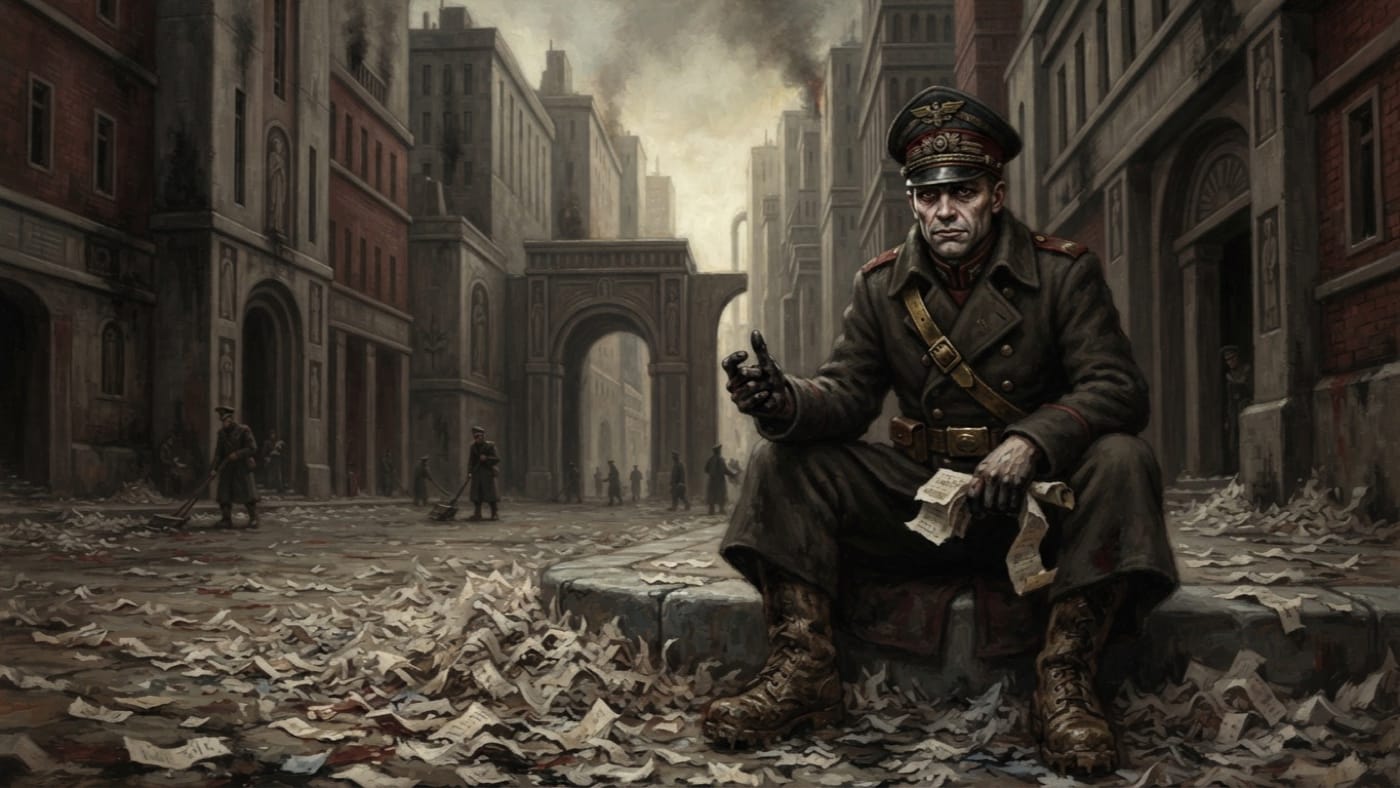
In the late rot, the procession has passed, the drums have faded into the brick and the confetti has settled around his boots. The Captain sits in the emptied plaza and feels nothing except the certainty that the count was clean, the anomaly list was filed and the reconciliation will balance.
The profession's field-lore adds two signs to the ladder. The first is a flinch at unscripted laughter. Laughter that comes off cue has not been routed, timed or planned for. On a parade route it has sometimes been the first sound of a crowd realising it is being counted, and the Captain's body remembers this at supper tables where nobody is counting anything. The second sign comes at night, when he sees crowd flow in his dreams: bodies thickening at a bend, a choke point, a stall in the current that wants a drum.
Then there is the curbstone. After the Feast of the Cracked Bell in Strasbourg, I met a Captain sitting on one, his sash dusty and his manifest closed on his knee. I asked whether the procession had succeeded, and he told me the count was accurate to within three. When I asked whether he had enjoyed it, he looked at me as if I had asked whether he enjoyed breathing. Enjoyment, he informed me, is a civilian metric.
The ladder is the profession's parable. The curbstone is the only rung I can swear to.
#On Mercy and Festivals
"All gifts require witness."
The two offices look at the same officer and disagree about what they see.
Mercy recognises 17-F. Its ward-sisters and ward-brothers keep records as every Bureau does, and their registry admits that a man can perform his office flawlessly while the office eats him. That recognition is a classification and nothing more. I have found no treatment attached to it, no protocol and no recovered Captain held up as proof of a cure. I will not invent one to make the tract tidier.
Festivals answers with Memorandum 440-F, repeated at every annual review: the profession "is a privilege, a sacrament, and a service to the Ledger, and any officer who cannot perform his duties with the prescribed minimum of visible enthusiasm is invited to seek reassignment." Read it twice. Festivals measures enthusiasm, and it measures it by sight. By that standard a Captain in the late rot is fully compliant, so long as the smile stays in place and the reconciliation balances. The memorandum cannot see the injury because it was written to inspect the one surface the injury leaves untouched.
Mercy files an injury and Festivals files a performance. The Bureau of Records, which files everything, files both. The two offices have quarrelled over this profession before, and that quarrel shows where each one draws its borders.
An earlier edition of the Pageant Captain entry described the "lost child" tent as a humanitarian provision of the Bureau of Mercy.
At Mercy's request, that entry now classifies the tent as a Bureau of Festivals operational asset. Mercy protested the misrepresentation of its charitable purpose. Festivals rebutted by citing "the charity of accurate records." Mercy refuses to own the tent where anomalies are questioned. It is prepared to record what that work does to the men who staff the route.
#On Caldrin's Kiss
"Saint Caldrin, smile where I cannot."
In barracks and float-yards, once the wine has gone round twice, Captains call the condition Caldrin's Kiss. Their patron hangs above the barracks door in the approved manner: smiling, ribbon-punch in his right fist, receipt-scroll in his left, hands black with ink to the wrist. Every Captain wears his badge on the sash. In the profession's view, the kiss came with the badge.
The epithet is a soldiers' joke, and it makes no medical charge against the saint. No vita, broadside or chapel copy I have consulted says Caldrin himself had the rot, and I will not diagnose a canonised clerk on the strength of a barracks pun. The pun runs along a different route. Caldrin built the machine that counts the living, so the men inside it name its damage after him.
His hands hold the whole quarrel in small. Festivals reads the ink as diligence. The Captains read it as a stain that will not wash out, the permanent mark of a man who turned the city's festivals into columns. The saint's smile is compulsory, which makes him the one member of the profession whose enthusiasm Memorandum 440-F has never had reason to question.
#On Reassignment
"The confetti room is always accepting applicants."
This is where the matter turns awkward for Festivals, because joy rot leaves the officer competent. A Captain deep in it still designs a serpentine route, still reads the set of a crowd's shoulders, still drowns an unlicensed refrain in drums and still delivers a count accurate to within three. The Bureau of Bells gets its curfew compliance and Tithes gets its households. On paper the afflicted Captain may be the best officer in the division, since nothing distracts him from the paper.
What fails him is the minimum of visible enthusiasm. A face can hold a smile on drill for decades. It can also slip, once, in front of a Judge's agent or at an annual review. At that point the invitation in Memorandum 440-F becomes an instruction, and the Captain goes where Festivals sends Captains it no longer wants on a route. That place is the confetti room, the basement where audit forms are shredded into next season's festivities. He breathes paper dust there, and by the profession's account he dreams in tallies. The Bureau calls this reassignment. The profession calls it burial.
Others resign. Some become Ledger clerks, which means they keep counting and stop smiling, an arrangement with a certain honesty to it. According to the profession's field-lore, what a Captain secretly wants is a real festival, with no ribbons and no count. I have found no record that any Captain was ever given one, and no record of any Captain, reassigned or resigned, who got his joy back. The sources stop at the door of the confetti room, and so does this survey.