
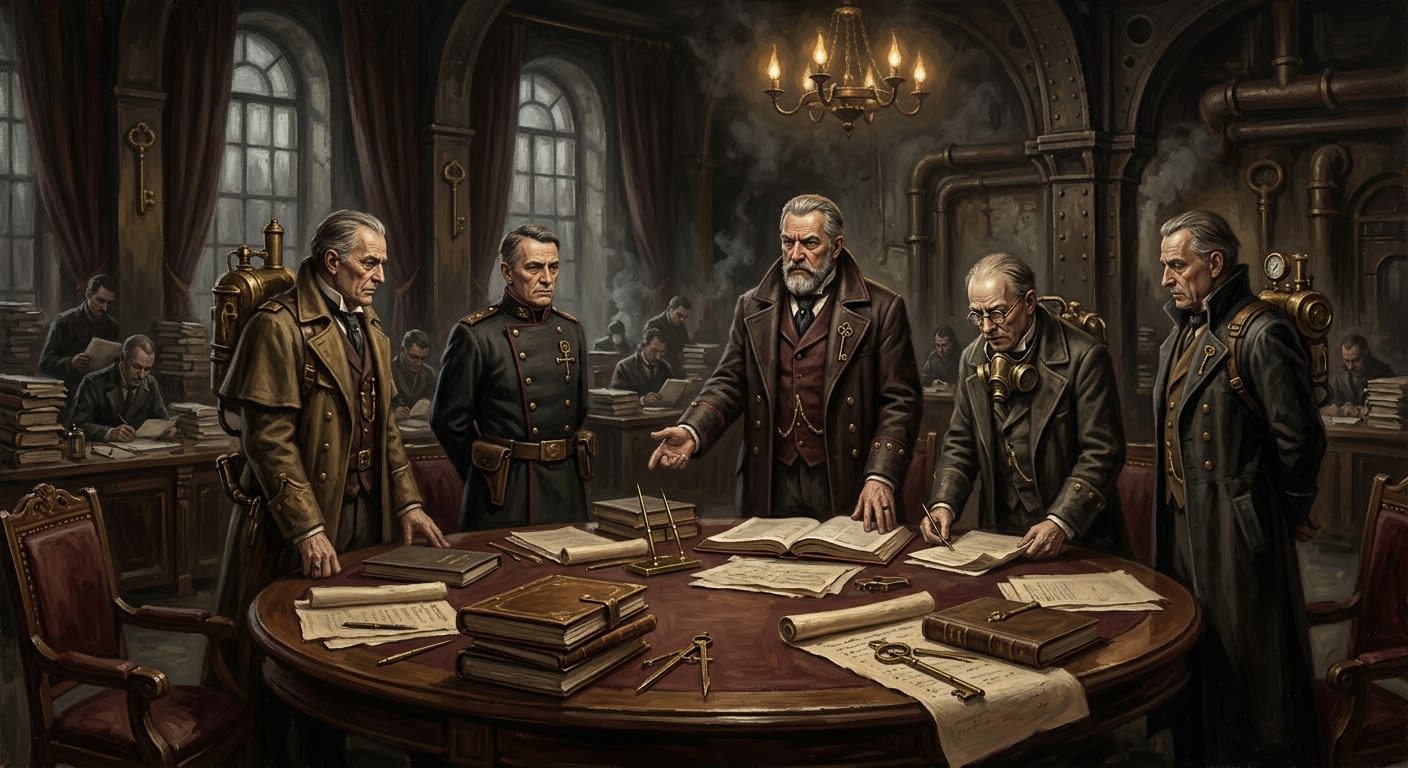
#On the Rank Above Waiting
The Inheritors are the highest confirmed tier of the Ten Thousand Keys cult, which is to say they are the point at which debt ceases to look like need and begins to look like dynasty.
Rich men spend. Powerful men announce themselves, hire trumpeters, commission portraits, and ruin ceilings with allegorical frescoes in which their own virtues appear muscular. The Inheritor waits. He lends rarely, speaks softly, signs almost nothing, and carries behind him a ring of keys heavy enough to scrape the floor with a sound informants describe as identical to the Keymasters inside the Vault of Ten Thousand Keys.
The Bureau first separated Inheritors from ordinary Ledger-Keepers (Unregistered) during the Sibiu cult audits of A.S. 194–199, when seized ledgers showed certain families receiving no visible profit from the obligations they maintained. They did not collect interest. They did not seize land. They refused opportunities that would have enriched lesser cultists and preserved documents whose clauses would not mature for generations.
This restraint deceived two junior analysts into proposing that Inheritors constituted a reformist faction. Both analysts have been reassigned to work involving fewer verbs.
#On the Great Maturity
The Inheritors believe in the Great Maturity: the final hour when every debt, favour, pledge, forfeiture, surrendered key, unpaid kindness, misfiled mercy, and inherited obligation resolves in their favour.
No two interrogations give the same account of what this means. Some describe a distribution of wealth. Some describe the opening of the Vault. Some describe a day when locks appear across the world and every Inheritor’s ring begins to move of its own accord. One captured Creditor, weeping through a broken jaw and still trying to calculate his legal exposure, said only: “When the keys are collected, the locks will remember.” The clerk taking deposition misspelled remember. I corrected it. Precision matters at the edge of damnation.
The cult’s lower ranks treat the Great Maturity as promise, threat, calendar, and excuse. Debtors are told their suffering reduces a family account that will one day be honoured. Creditors are told delayed profit proves worthiness. Assessors price human weakness in anticipation of a market that has not yet opened. Ledger-Keepers preserve balances for descendants who may never meet the original debtor and will still expect payment.
The Inheritor requires the whole machinery to believe time itself accrues interest.
An A.S. 188 Records analysis concluded that Inheritor doctrine was “symbolic eschatological language without operational content.”
Withdrawn after the refutation report acquired additional key-sketches overnight and one analyst’s office lock began accepting teeth. Symbolic language does not usually require a locksmith and an exorcist.
#On Their Houses
Inheritor houses appear respectable enough to bore a confessor into mercy. Their facades are clean. Their servants are paid. Their charitable accounts balance to the Crown. They marry within merchant families, minor nobility, notarial dynasties, and those administrative bloodlines where children learn wax-seal pressure before table manners.
Their vaults are another matter. Purity raids have found key-cabinets arranged by metal, age, debtor-line, and resonance; family chapels whose altar cloths conceal genealogies of obligation; cradles hung with brass keys instead of charms; portrait galleries in which painted hands gain rings as the years proceed. The portraits are the detail that first moved me from irritation to interest. A painted ancestor acquiring new property is either a miracle, a fraud, or Velmoran bookkeeping with pigment. The Bureau of Relics voted miracle impossible, fraud insufficient, and pigment classified.
SIBIU RAID REPORT 77-K, SEAL AMBER: Nursery wall contained forty-three infant nameplates. Nineteen children living. Twelve deceased. Eight unborn by parish register. Four nameplates bore no names, only keyholes. When the senior examiner leaned close, one lock exhaled and said ███████████████.
The Inheritor’s personal key-ring differs from the tokens surrendered by ordinary cultists. A Debtor’s key is proof of obligation. An Inheritor’s ring is office. Brass keys for villages. Silver for guilds. Gold for provincial offices. Black iron for Bureau personnel. Bone for matters involving bloodline, wardship, adoption, or the charming little legal fictions by which families sell what their children will later be commanded to call tradition.
#On Their Difference from Keymasters
The Inheritors imitate the Keymasters without becoming them. That distinction keeps the Bureau’s classification from collapsing into panic, and we shall maintain it until forced by evidence, blood, or both.
Keymasters belong to the Vault. Their keys are originals. They appoint rooms. They move through hostile architecture as priests move through choir-stalls: with unquestioned right. Inheritors remain human, or human enough for execution law. They carry distributed keys, debt-keys, promise-keys, keys whose locks may not yet exist. They do not open the Vault. They prepare the world to be opened by it. Doctrine calls this preparatory contagion. War calls it pre-assault conditioning. Records calls it difficult to index, which is Records admitting fear in its native dialect.
The sound is the problem. Multiple informants report that senior Inheritor rings drag with the same scraping cadence recorded inside the Vault. The Bureau of Bells compared three descriptions, two wax-cylinder impressions, and one dying courier’s tapped rhythm on a bedframe. The patterns match closely enough that the Bell office filed the result under “Acoustic Resemblance, Theologically Inconvenient,” which is Bells-language for hide this before Doctrine asks for a hymn.
#On Their Usefulness to Velmora
Velmora does not need Inheritors for ordinary corruption. Debtors recruit. Creditors lend. Assessors price. Ledger-Keepers remember. The machinery can run for decades on those four offices alone.
The Inheritor serves a colder function: continuity without appetite’s vulgar impatience. Greed ordinarily hungers now. It wants the coin in hand, the deed signed, the rival stripped, the cabinet filled. The Inheritor trains greed to postpone itself while growing sharper. A family may pass a key from father to daughter, daughter to nephew, nephew to some pale child whose first lullaby is the clink of future claims. Each generation adds less than it preserves. Each preservation makes collection worse.
This is why Inheritors are more dangerous than flamboyant cult leaders. The flamboyant leader can be found by following applause. The Inheritor can be found only after three harvest failures, two orphan endowments, a marriage settlement, a toll irregularity, and one brass key in a midwife’s drawer all prove to share a grandmother.
#On Countermeasures
The Synod’s approved countermeasure is interruption of inheritance. Confiscate key-rings. Break dynastic ledgers. Annul contracts across family lines. Reassign clerks whose grandparents appear in suspicious dowry rolls. Place children of confirmed Inheritor houses under Purity wardship before they are old enough to treat a key as a toy. Tithes witnesses the seizure. Masks and Seals burns the family marks. Sibiu supplies the guards, and the guards are changed afterward.
These measures are cruel. This is unfortunate and irrelevant. The Inheritor house is a legal womb in which debt breeds. Leave one cradle unexamined and the account learns to crawl.
Mercy objected in A.S. 200 that child seizure from Inheritor houses risked punishing the innocent.
Clarified. Innocence is precisely what the houses use as a storage medium. The objection was pious, humane, and strategically shaped like a noose.
The Bureau of Doctrine forbids public preaching on the Great Maturity. Mention gives it shape. Shape attracts expectation. Expectation, under Velmoran pressure, becomes a contract with no signature visible until the bill arrives. Parish priests in Sibiu-sector towns are instead instructed to preach against “ancestral presumption,” “unwitnessed inheritance,” and “the sin of trusting a key because one’s father did.” The peasants understand the last formulation. They have fathers. They have keys. They have been disappointed by both.