
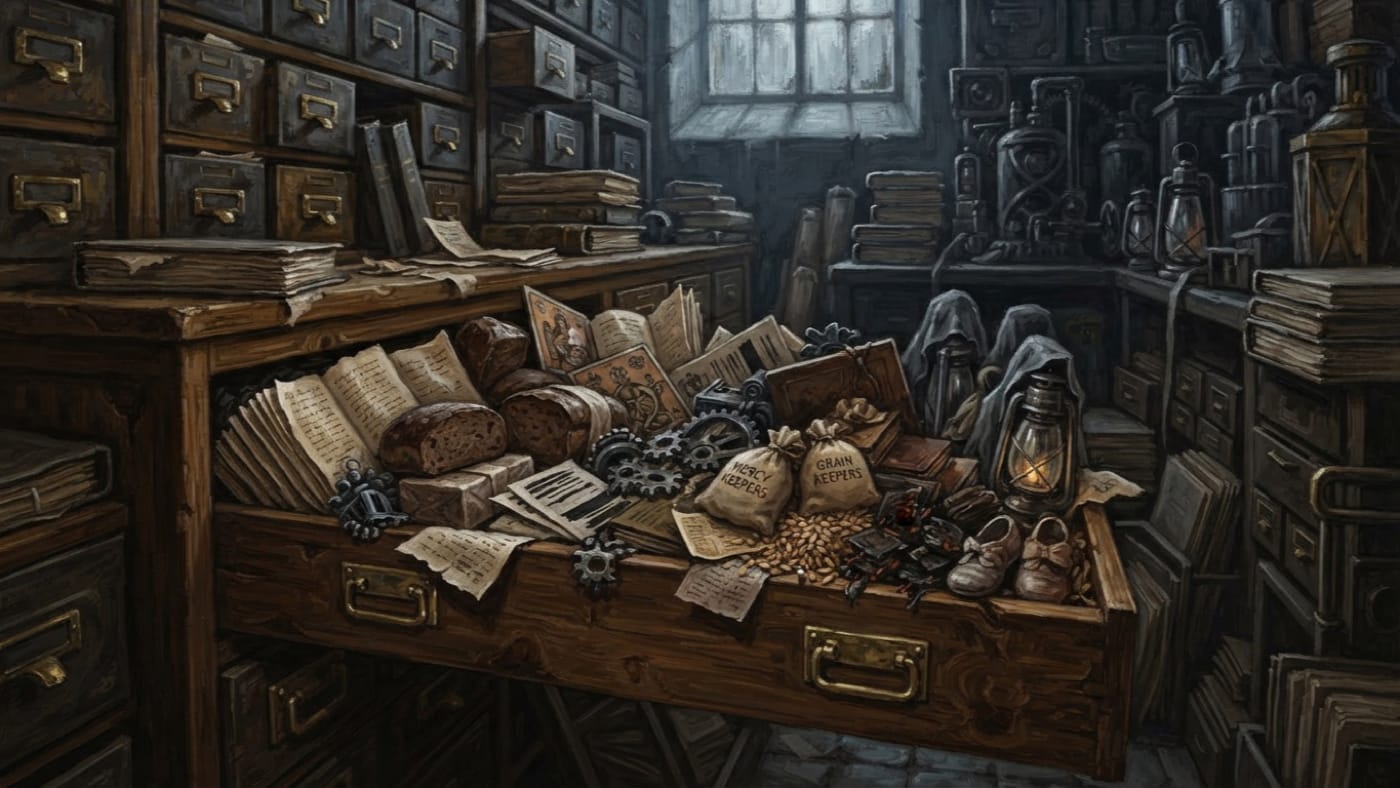
#On the Catalogue
"What they call freedom, we name damnation." — preface to the list, as copied into every edition I have handled
The list of Known Heresies has eight names on it. In A.S. 201 it hangs above every desk in the Bureau of Doctrine. I have been told to account for it because the entry on the Crimson Concord mentions the list without explaining it. A codex that mentions what it will not explain invites its readers to explain it for themselves. That is how the Ashen Circle got started.
A man who reads scripture without the authorized gloss answers to the same authority that condemns treating with demons. So does a miller with three sacks under his loft floor. So do a mother who never registered a birth and a street-chaplain who tells a flogged boy he is forgiven. Doctrine defines what each act means, and Purity decides whether it can be proven. Between those two offices, the whole working life of a parish fits inside the word heresy, which is how the Church likes it.
The eight share a page and nothing more. They have no common council, creed or captain, and no common infernal patron. Anyone who tells you otherwise is selling a conspiracy or angling for a promotion.
#On the Eight Movements
#The True Gospel
The oldest quarrel on the list is about who holds the pen. Adherents of the True Gospel keep scraps of the old scripture, such as water-stained quires or a psalm sewn into a coat lining. They insist the scraps be read bare, without the Synod's gloss. They believe in the Creator, and that is exactly the difficulty. A believer who answers the Bureau's gloss with the bare text has set up a rival court of appeal.
The official charge is book-worship. I have preached the phrase myself. It is a curious charge from an institution that keeps its own parchment under seven locks and revises it weekly.
#The Black Ledger
The Black Ledger is a cabal of thieves, forgers and cutpurses, with assassins in a minority of its crews. It diverts rations, robs caravans and now and then kills a Warden, and it calls the whole business redistribution. The bread is real, and I grant them the bread. Forged chits put loaves into empty hands, and the cabal stages its charity in daylight so the street knows whom to thank.
Then the cabal writes the gift down. Every rescued household goes into a book of obligations, and the debt is paid in a hidden door, a silence or a night's watch. Someone who eats stolen bread is a debtor, not a member. Purity's habit of hanging both from the same beam has made more sympathizers than any sermon has unmade.
#The Silent Godless
The Silent Godless deny the Creator outright, and they organize their unbelief with a discipline I would admire in a seminary. A cell-organizer screens recruits before telling them anything and keeps contacts separated, so a member who breaks under questioning can name two faces at most. Their pamphlets are set from hidden type and left at dead drops. One that I confiscated myself argued, with diagrams, that its district's weeping reliquary ran on a cistern and a length of reed.
The claim that miracles are staged belongs to them. The counter-claim, that godlessness is a symptom of demonic exposure, belongs to Doctrine. Both are on file, and neither settles every miracle or every unbeliever. The Godless share nothing with the True Gospel, which believes too narrowly, or with the Ashen Circle, which measures things and keeps its prayers to itself.
#The Crimson Concord
The catalogue puts the Concord fourth, and its own entry agrees. Its proposition is simple and ruinous: mankind should make terms with demons instead of destroying them. They call it coexistence. The catalogue calls it supping with monsters, and on this point the catalogue's rhetoric and my theology agree.
The Velvet Choir works through desire, while the Concord works through the personnel file. Its people rise through the command and administrative offices of Bastion-Constantinople and the southern theater by being punctual, devout and tactically sound. In public they serve the Line, and in private they hold the coexistence question. Doctrine and the theater registry both record the Concord's association with Velkara. She holds no sector of the wall; in the south her instrument works from inside the offices.
Here the catalogue endangers its users. Exhaustion proves nothing. Neither do competence, a spotless devotional record or three commendations from southern command. Accommodation is a temptation that is offered and freely accepted. No finding of possession I have read has survived examination. The talk of officers being exchanged in the escarpment passes remains suspicion, attributed and unproven.
#The Grain Keepers
The Grain Keepers are farmers, millers and granary clerks who keep food the ledger does not know about. Their methods are dull. They split caches across a dozen cellars, inflate spoilage reports by a sack or two and swap ration chits between wards. They hand out bread as parish alms, so the grain loses its provenance on the way to the mouth.
Their offence concerns reserves and allocation. The Black Ledger steals and forges its stock, while the Keepers sit on grain that has already passed through their hands. Neither is a charitable society. Some Keepers feed children and ask for nothing. Some keep the official distribution running and skim as they go. Others use a sack of rye to buy a vote, a silence or a daughter's labour. The street calls them Mercy Keepers, Quota Men and Hunger Brokers, but the catalogue names none of them.
"Farmers and millers who defy ration decrees, keeping secret stores of grain for themselves and their kin."
That is how the catalogue entry reads. The Church's own glossary says the Keepers hide their stores to feed kin and neighbours. The catalogue's wording remains the public text, and this erratum stands beside it.
#The Ashen Circle
The Ashen Circle preserves banned histories and sciences. Its members buy diaries out of burn-pits and copy diagrams into the bindings of approved devotionals. They write formulas in cipher, and when a source must be cited, they cite some safely dead and sanctioned authority. The Church bans only the scholarship it has not authorized.
The Circle's offence is inquiry without a licence. Its product is often useful: a bridge calculation, a fever remedy. Useful forbidden work has patrons, who keep their appearances spotless while the schematic sits in a locked drawer. Some Circle scholars pray before opening a cipher. Many recovered fragments are simply wrong, because ash keeps an error as carefully as a fact.
#The Pale Kin
The Pale Kin are families who keep their children out of the registries. Infants go unrecorded and youths vanish ahead of the levy. Birth entries move to another ward or turn into stillbirths. The households are the movement, and a grandmother who lies to a census-taker belongs to it as surely as any courier. Behind the households work the Pale Kin Runners. They alter papers, exchange baptism tags and pass children along in short stages.
Synodal rhetoric calls this theft from Heaven and calls the children stolen soldiers. I have used both phrases. Practice varies. Some families place a child only with blood relatives, others with any household they trust, and some operators care about nothing but the papers. That variety argues against a central command. Purity would rather chase one conspiracy than forty kitchens.
#The Lanterns
The Lanterns are wandering and street-corner preachers who put mercy and forgiveness above authorized discipline. They tell a queue that a sentence was cruel. They tell a Warden's victim that the Creator forgives what the Warden will not. Some hold licences as curfew consolators and fold an address, a route or a warning about tomorrow's levy into permitted prayers. A call for medical mercy at the right corner can hold up a patrol for a quarter of an hour, which is long enough to empty a stairwell.
Most licensed consolators are exactly what their licences say they are. The rebel Lanterns are a minority who wear the same grey stole. They are separate from the night patrols of the Lantern Brotherhood, which the Church tolerates, and separate again from the Inquisition's Red Lanterns. Some local Brotherhood circles shelter a preacher or pass a runner along. The organizations remain distinct.
#On Recognition and Enforcement
Every heresy reaches the Bureau as paper or furniture. It might be a confiscated quire or a chit stamped in the wrong ward. It might be a sack that the spoilage report swears rotted in Lent, or a parish register one infant short of the midwife's fee book. Or it might be an officer whose file is spotless.
Doctrine decides what the object means. Its exegetes interpret, and they keep the Index Claritatis, the weekly-revised register of permitted words. Purity must prove the case. Its white-mantled Inquisitors examine wording, confiscate texts and interrogate. The Index Damnatus runners carry each revision of the prohibitions from office to office, so yesterday's tolerated book becomes today's evidence. Neither instrument is a formal Index of Known Heresies, and the list has no tribunal of its own.
Usually another office meets the eight first. A ration auditor finds the Keepers, and a parish registrar finds the Pale Kin. The Bureau of War finds the Concord, or fails to. The movements trade with one another locally, grain for shelter and papers for a route, and argue theology while they do it. That makes them neighbours who deal with each other, not one insurgency. The Church tolerates a Keeper during a famine and a scholar during a fever. Once the stores are full and the fever has passed, it prosecutes both.
#On the Limits of the Record
I cannot tell you who first wrote the list down. I have looked. No decree number, compiler or year of promulgation survives in any file open to my clearance, and I will not invent one to suit the index. The numbering is also unsettled. The catalogue puts the Silent Godless third and the Concord fourth, but at least one office inventory calls the Godless the Fourth Proscribed Heresy. Which clerk got it wrong is a question for whichever clerk is still alive.
What the record does hold is eight names and eight offences. They sit under one jurisdiction, which is wide enough to keep scripture, bread, infants and mercy in the same drawer. The drawer is full. The survey is closed.