
#On the Extra Measure
"Warm soup, cold numbers." — ration-hall saying
Ladle Debt is the smallest contract in the Synod, and the only one written in broth.
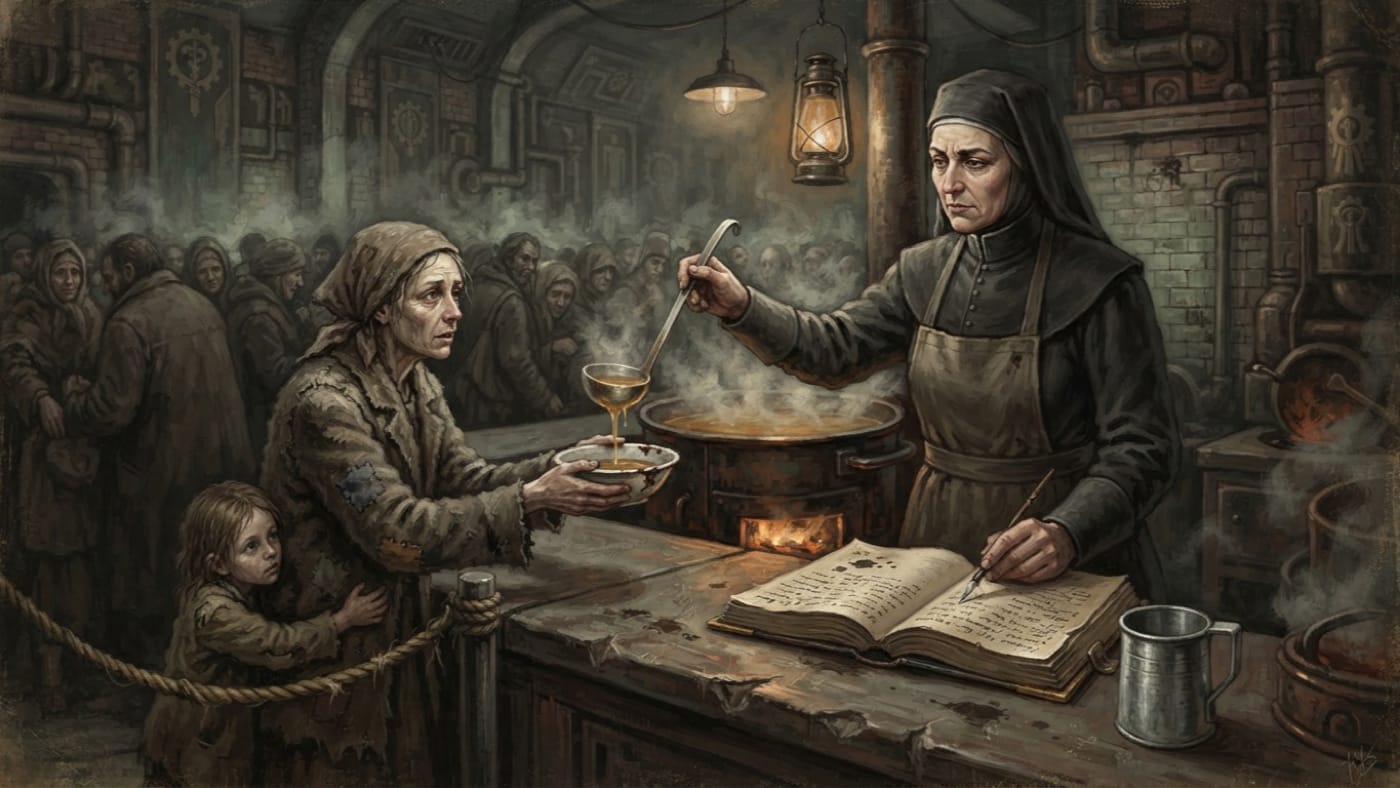
A Matron of Plenty stands at the pot with the measure cup in one hand and the ladle in the other. She has read the recipient's chit, confirmed the household category and poured the ordinary portion. Then her wrist dips again. A second measure falls into the bowl, beyond what the chit allows. Before the bowl leaves the counter, the Matron turns to her book and writes that the household owes a future service. That is the whole of it: extra broth today, and on paper an obligation for some day the paper does not name.
The Mothers of Plenty count it among their backdoor tricks. I admire the phrase for its honesty. A backdoor is a door the architect built on purpose and the householder pretends not to know about. Ladle Debt has no bureau. It has no charter, no saint and no founding year that any archive I have opened will swear to. It lives in the space between the cup and the ledger, which in a ration hall is about the width of a forearm.
The broth matters. I say so plainly because the polemicists forget it. In the deep of winter a second ladle means fat, salt, heat and a few more hours of standing upright. Women have carried infants through a cold month on that margin. Men have finished shifts who would otherwise have been carted off them. Whatever the entry costs, the bowl was full.
#On the Entry
Every portion in a ration hall comes down from a record. The Bureau of Records certifies the household. The household's category fixes its allotment. Registration and compliance adjust the category, and a declared pregnancy adjusts it again. The chit in the recipient's damp hand comes at the end of a long procession of signatures, and the cup measures out exactly what that procession has decided. Nothing in the chain provides for generosity. Generosity is a discrepancy.
Ladle Debt answers that discrepancy with another entry. The extra pour leaves the pot, and the ink follows it. Somewhere in the Matron's keeping a name now stands beside the words future service. It may be a ration book, a household page, or the day's chalk tally copied out at the end of the shift. The pot has been reconciled against a promise.
The evidence does not say what form that promise takes. I have searched for a rate and found none. There is no table converting ladles into hours, no maturity, no rule of interest, no discharge procedure and no seal that closes the account. No source I trust says whether the debt passes to a successor Matron along with the book, dies with the hand that wrote it, or follows the household to another hall. The lore records the transaction and stops there. I report the silence as I found it. A clerk who fills a blank because he finds it untidy is how Tithes acquires half its arrears.
What the entry does accomplish is clear enough. Paper decides who eats, and the paper now says this household took more than its share and agreed to owe for it. The recipient may not be able to read. The recipient almost certainly did not bargain. Hunger does not bargain; it nods.
Take the ordinary case, with no name attached. A widow stands at the rope with a coughing child and a chit for one adult portion. The Matron looks at the child, at the queue behind, at the cup. She pours twice and writes. The widow carries the bowl to the bench and feeds the child first. Neither woman mentions the book.
#On the Uncalled Obligation
Here the practice splits, and it splits according to the woman holding the ladle.
The Mothers have their factions. The Mercy Ladlers feed first and do the sums later. The Quota Sisters do the sums first and feed what the sums permit. Every ration hall also breeds the common types beneath both camps. There are exhausted carers who stopped arguing with hunger years ago. There are true believers who think the cup is holy. And there are predators who discovered that motherly concern is the warmest coat a tyrant can wear.
To a Mercy Ladler the entry is a cover sheet. She pours the second measure because the child is grey at the lips. She writes future service because an unexplained pour is theft, while an explained pour is administration. She has no intention of calling the debt, and the household goes home owing something it will never be asked to pay. My own entry on the Mothers filed this under noble fraud, and in her hands the label fits. The fraud is against the pot, and the nobility is that nobody comes knocking.
The Codex entry on the Mothers of Plenty filed Ladle Debt under "noble fraud," beside Womb-Smoothing and stillbirth substitution.
Corrected: the label "noble fraud" applies only to the merciful use. Called in by a desperate or cruel Matron, the same entry is collection, and the original sentence said so before it finished. The classification has been narrowed. The sentence stands.
Uncalled does not mean cancelled. The book outlives the Matron's mercy. It outlasts her transfer to Records, her retirement into a saint kitchen, or her immurement after some other scandal. The sources do not settle whether the next woman to hold the key may read the old page and decide that it is owed. I would not wish to be the household that finds out.
In other hands, the same entry becomes a hook. Collection is permitted when the Matron is desperate or cruel, and from the far side of the counter the two are hard to tell apart. A desperate Matron facing a short convoy and a hot line needs hands to haul sacks, scrub pots, hold the rope and carry word, and she needs some of them to keep silent. The book tells her who owes. A cruel Matron needs nothing and calls the debt anyway, because a household that can be summoned is a household that can be governed.
The Mothers' wider machinery already turns prenatal allotments into debt, and turns that debt into labour or future levy compliance. In the rear offices, nobody hides the Conscription forecasts drawn from their rooms. Ladle Debt is a smaller and stranger animal. No source says that the second bowl pledges a child, changes a levy category or moves a cradle into custody. It records service, unspecified, owed to whoever holds the book. That is enough to frighten a mother who can read. It is more than enough for one who cannot.
#On the Cup and the Audit
Audits arrive in a fixed order, and every Mother can recite it. The measure cups come first, then the reserve stores. Last come the sample households, visited to confirm that the chits were spent as written.
Each stage meets Ladle Debt differently. The cups are true, because the Mercy Ladler did not shave them; she simply used them twice. The reserve is short by exactly the broth she gave away. An auditor with white cups and a cold manner cannot tell broth that went into a widow's child from broth that went into a flour gang's sack. The household visit is worse. Asked how they fared, a sample family may say gratefully that the Matron was kind and gave them more. Gratitude is the most dangerous testimony in a ration hall.
The entry is the Matron's defence and her confession at once. It shows the pour was recorded. It also shows she knowingly issued beyond the allotment. Giving extra to an unregistered household is one of the profession's open taboos, so if the household she fed was unregistered, the entry becomes a signed admission. The penalties the Mothers fear range from public shame, through reassignment to the plague kitchens, to immurement for bread heresy. None of them is a fixed sentence for Ladle Debt, and I have found no tariff. They are simply the menu from which an auditor orders.
The recipient has her own exposure. A name in a Matron's book is a name an auditor can visit.
The practice should not be confused with its neighbours. Skimming takes from the pot for the Matron's profit and writes nothing down. Womb-Smoothing lowers a pregnancy risk score so that a woman keeps her allotment, which falsifies a record already written. The Grain Keeper feeds people from hidden stores entirely outside the Mothers' halls. The Hunger Brokers among the Keepers have learned the same lesson: food given in secret buys dependency as surely as food given on the books. The Keeper's debt lives in memory. The Mother's lives in ink.
#On the Present Account
In A.S. 201 the halls open at bell-call wherever the Mothers keep a pot. The rope is strung. The cup is tapped three times. The chalk squeaks out the day's quota. Somewhere along the counter a Matron looks at a face, pours twice and reaches for her pen.
I cannot tell the reader how many such entries stand open this winter in the books at Königsberg or Marrowgate. No office counts them, which is itself a finding. Most will never be called. Some already have been. The households carrying them cannot tell which kind they hold, and the Matrons who wrote them are under no obligation to say.
Doctrine has not ruled on the practice and will not, since a ruling would require noticing it. Mercy does not claim it. Purity arrives only when the reserve comes up short. The entry stays where it was written: under a name, beside two words.