
#On the Language and Its Uses
Latin is the tongue the Church uses when it wants eternity to take notes. Bishops carry it as a title, inquisitors have it cut into lintels, and processions in Strasbourg chant condemnations in it while the condemned ride behind in their cages. Before any of this, before the Church came out of hiding, before the Synod had a Bureau or a calendar of its own, friars on the roads of France prayed in it, or are said to have prayed in it. That is a different claim, and this entry treats it as one.
The archive holds no founding instrument for the language. I have looked. No council adopted Latin on a recorded day. No edict makes it compulsory for every prayer, every parish register or every child who mumbles at a font. The language reached the Church already old, and the Church did what it does with everything old that it intends to keep: it stamped it, shelved it and gave it a staff.
That leaves this entry a narrower office than some readers will want. It sets out where Latin is attested and what work it does there. Under the Church it sings, it confers title and it condemns. Each use has its own clerks, and those clerks do not share ink.
#On the Spoken Office
Prayer was the first use, and the plainest. A brother who keeps the hours has his psalms by heart long before he can read them, and he says them in the tongue his house taught him, at the hours his bell names. The cadence lives in the body, in the drop of the voice at the half-verse and the breath before the response. A Rationalist can burn a breviary in an afternoon. He would need a generation to burn that cadence out of a friary.
The Approved History records the expulsion of the mendicants from France, the brothers who walked until the Ardennes took them. The Rationalists called them "disbanded." The peasants of that forest say their chant can still be heard under the moss at dusk, and they say it is Latin. Rationalist scholars say it is wind. I file it as local legend, attributed, with the observation already entered by better men than the scholars: wind is rarely so particular about its declensions.
The legend is useful because it marks a distinction. The mendicants on the road had no Bureau of Rites to correct their pronunciation and no Bell Codex to time them; the Codex was ratified in A.S. 115 / 1825 CE, a century and a half after the roads emptied. Their hours were older than their regulators. What the Church later standardized, it standardized from practice that had already outlived persecution, and the clerks of Rites and Bells are custodians of that practice. They did not invent it, however much their annual reports would like a reader to infer otherwise.
#On the Rhône Testimony
The language also turns up at Lyon, where it is least certain.
In A.S. −39 / 1671 CE, seven years before the Year of Letters, Lyonnais militias killed the friars of a house beside the Rhône and cast their ashes into the river. The Red Slaughter of Lyon has its own entry, and I will not walk its floors again here. For three nights afterward, witnesses on both banks reported psalms rising from the water.
The witnesses do not agree on the language. Some heard Latin. Others heard Burgundian French or Provençal, and one heard Greek, a claim the Bureau of Doctrine has since filed, retrospectively and with a dry pen, as "pious overreach, musically admissible." No Bureau existed in 1671 to make that ruling on the night. The label was attached long after the river had gone quiet.
What the witnesses agree on is when the singing came. It came at Matins before dawn, at Sext in the white middle of the day and at Compline when the lamps were shuttered, which are the hours the friars had kept. Fishwives, dock-porters and at least one magistrate's clerk who later regretted signing his deposition all fixed the same three hours, though they could not fix the language.
I count Latin as one reported identification among four. The Church possesses no transcript of the river, no recovered psalter from the friary that matches the reported verses, and no surviving witness whose ear the Bureau has certified. My own marginal remark on that entry, concerning which psalm the Rhône preferred, was a remark. Several students have since cited it as a source, and every one of those citations has been struck.
Catechism primers once taught that the Slaughter at Lyon opened the Atheist Wars.
Withdrawn. The Atheist Wars opened publicly with the Massacre at Saint-Malo in A.S. 10 / 1720 CE. Lyon was an earlier escalation, smaller and older and in my opinion fouler. The primers have been reprinted. The old ones were pulped, and the pulp, I am told, was used for new primers.
#On Titles, Texts and Permission
The Church uses the language for names as well as prayers, because a title in Latin sounds older than its holder and harder to remove.
The Hierarchs in Strasbourg are styled Vicarii Orbis, Vicars of the World. The Bishops-Praetorial who govern provinces are each styled Custos Animae, Keeper of Souls, a title that must be honoured even at the moment its holder is reconciling a tithe shortfall. The Inquisitors of the Flame keep the motto Ignis Mentem Revelat, Fire reveals the mind, cut over every interrogation-chamber door, so that the accused can study a sentence of Latin while he waits. Few of them find it devotional. Several have been heard to correct its grammar, wrongly, which was recorded.
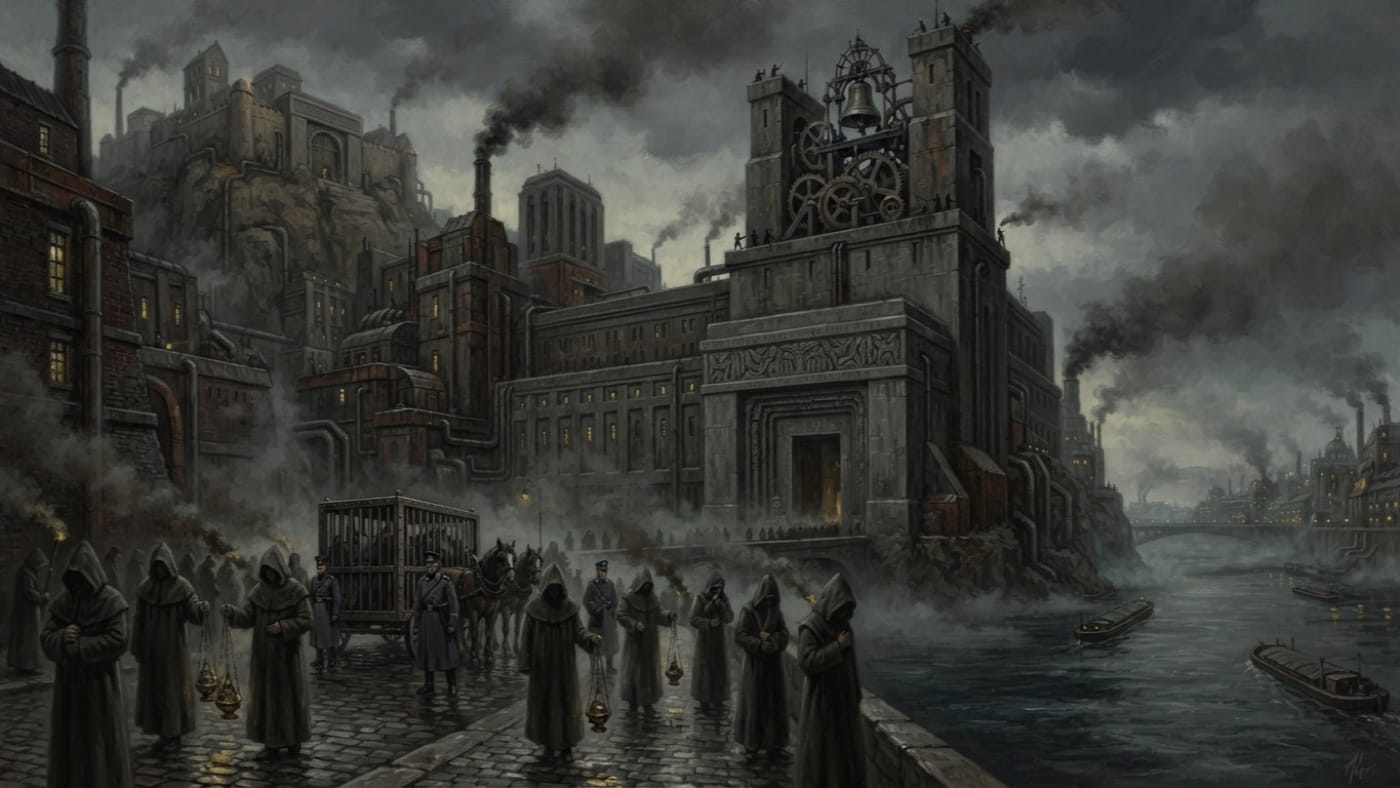
In the processions of Strasbourg the condemnations are chanted in what the Lore Book calls "Latinized tongues." I take the phrase at its word. A hybrid sung from a cart is Latin's dress worn over the vernacular, and the crowd understands the dress well enough.
Behind the titles stands a separate apparatus, which readers persistently mistake for the language itself. The Bureau of Doctrine keeps the Index Claritatis, its compendium of permitted public words. The Bureau of Purity keeps the Index Damnatus and enforces its proscriptions. Under Procurator Maxentius della Torre, Purity suppressed Lombard speech until the children of that province recited only approved catechisms. It also imposed the Triune Alphabet, under which a peasant carving a name on a grave must first submit the spelling for verification.
The Triune Alphabet is a script and a regime of spelling, and it is not Latin. The Lombards' tongue was taken from them, and the record does not say Latin was given back in its place. Those who conflate the two have read the stamp and skipped the document.
The Bureau of Records completes the furniture. Its scribes authenticate, copy, classify and correct. They rule their pages, trim their reeds, and bleed red into the margin where a predecessor erred. A Records Scribe guards the form of words whatever their language, because a seal on a misspelled instrument is a forgery with good manners.
#On Present Use
The language persists where the Church most wants to sound old. It persists in the styling of Hierarchs, in the bishop's title, in the inquisitor's lintel and in the hours, which Bells now times with a pedantry the Ardennes friars would have found either holy or unbearable. It persists in small bureaucratic etymologies as well. The Line takes its name from sagitta, arrow, because it runs north to south like a shaft driven down into the contested East, and every soldier on the Sagittal Line carries a Latin word in his posting without knowing it.
The general faithful are not fluent and are not required to be. They know the responses and the cadence. They know which words the confessor will say before he says them, and they know the motto over the interrogation door, which most of them would rather not translate.
For my own part, I am Hieromnemon, keeper of the Church's memory, and I prefer my memory in Latin. It is harder to misquote and slower to forge, and it keeps the curious out of the archive. When I enter a correction against a lesser clerk's folio, I write it in the old tongue. The clerk then has to find a dictionary, and a clerk with a dictionary has no time to argue with me.