
#On the Binding
Paper is power. The Bureau of Records holds this dogma with a sincerity it extends to nothing else, including the Creed, which it merely files.
This tract is indexed to the A.S. 187 renewal of Standing Order 44-A. That milestone belongs to the sanctioned orders' licensing framework; it dates neither the invention of Ledger-Bindings nor the Siege of Pressburg.
A Ledger-Binding is the sanctioned order of miracle by which a recorded promise becomes a material condition. The Dialectic of Power lists it with the Bell-Litanies, Reliquary Fire, the Choir-Engines and the Saints' Shares. Of the five it puts on the least show, and I think it is the most dangerous. A bell can be heard and reliquary fire can be seen. A binding is simply kept, and nobody notices it until somebody tries to break it.
The Lore Book gives two examples, both plain enough for a quartermaster. A bridge will not collapse if it is bound with the proper notarised contract. An oath will not break if it is signed with iron-gall ink and a tithe of hair. The first example concerns masonry and the second concerns men. I have never found any administrative distinction between them.
Doctrine teaches that a miracle is a sanctioned alteration of Creation, sealed by obedience and ledger. It also teaches that the Creator's permission is all that separates a miracle from the identical alteration made for the Great Deceiver. The binding is that teaching reduced to stationery. Records keeps the entry and the Bureau of Rites licenses the working. Afterwards, the Bureau of Doctrine explains why the result was holy.
#On the Substance of the Instrument
The sources name fewer ingredients than the rumours do. I list them here, attached to the examples they belong to, because provincial chaplains like to stir everything into everything. In the hands of a provincial chaplain a recipe tends to become a stew.
The bridge requires a notarised contract, and the source calls it proper. It does not say who drafts the contract, how long it lasts, or what the masons are paid. The oath requires a signature in iron-gall ink and a tithe of hair. Iron-gall is the ordinary ink of every registry in the Church: oak-gall and vitriol, pale when first laid down, darkening on the page over the following days, and in time eating into the paper it marks. Nothing about it is exotic. It is in the well on every desk in the building. The hair is a tithe in the same way that a portion of a harvest is a tithe. The Lore Book requires it for the oath. Nothing I have read requires it for a bridge, and I will not cut a bridge's hair on a curate's say-so.
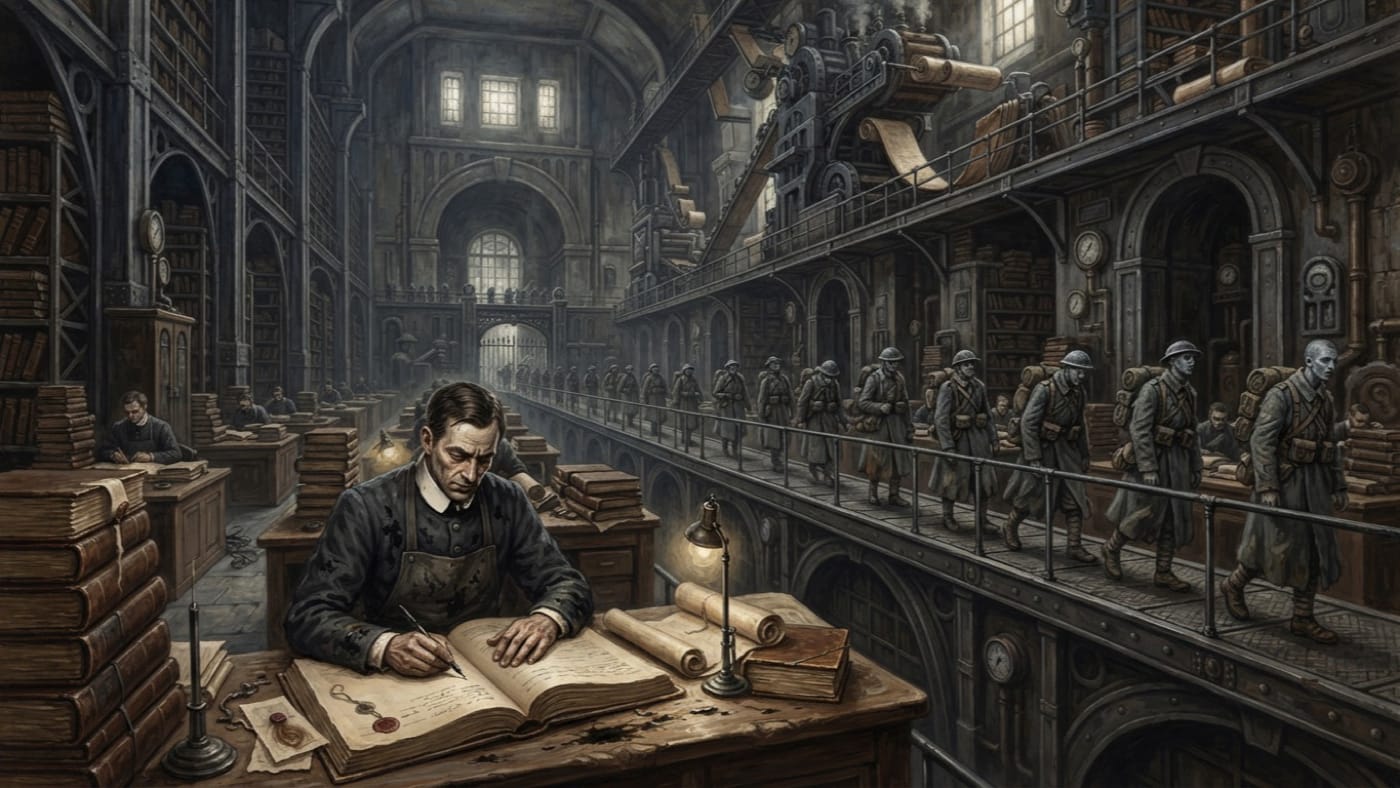
The labour around the instrument is performed by ordinary hands. A Records scribe rules the page, takes down names and conditions, stamps and seals the entry and makes the duplicate. The scribes can be recognised by their ink-stained cuffs, the freckles of wax on their wrists and the paper-dust cough of the registry room. Where the instrument is an oath, the Bureau of Oaths has its own officer for sworn words. An Oaths Witnesser interviews the swearer for signs of coercion, fills in the checklist, witnesses the vow and enters it in the registry.
These offices are related. None of them is the binding itself. An ordinary witnessed vow can still be broken. The Witnessers process breach notices every week, and they have dissolution rites for promises that fail. An oath sealed as a Ledger-Binding, on the Lore Book's account, does not break. If one ever has, I have yet to find the breach notice.
#On Pressburg
Pressburg is Bratislava. Today it is a Danube crossing and a secondary rail junction between the ruins of Vienna and Budapest. It takes the overflow of the Central Corridor's supplies and houses one of the major checkpoints of the Bureau of Passage. The city now deals in grain, troop trains and stamped passes. The Siege of Pressburg belongs to its older record. The sources I am permitted to cite give no year for the siege, and I will not invent one. The Bureau employs other clerks for that.
The archive records what happened, in a single sentence. At the Siege of Pressburg, deserters found themselves walking back into the line against their will, and their own signatures dragged their feet like shackles.
That one sentence is all the archive offers. It gives no names, no company, no number of men and no commanding officer, and it says nothing of what happened to them once they were back in the line. The record does not say how many there were. It says which way they walked.
The order of events is not in dispute. First, at some desk, under some lamp, each man signed. The instrument recorded his assent, and the Bureau authorised the instrument. Later the man refused, and he refused in the only language the front allows a private soldier: he turned around and walked away. His feet carried him back. The binding treated the earlier signature as final and the later refusal as a fault to be corrected.
The Bureau of Doctrine calls this "the triumph of paperwork over chaos." In that sentence, chaos is a frightened man walking away from the line.
I have already called it slavery sealed with the slave's own hand, in the parent entry, and I let that word stand. It is my judgment and has no standing as a legal classification. The Bureau has no column headed slavery. It has enlisted, absent, and returned to duty. At Pressburg the signatures converted refusal into return; the record does not time the journey.
#On Clauses and Counterfeits
The comparison the Bureau dislikes is with Contract Theurgy, the school of Velmora, whose agents write pacts so venomous that the paper itself becomes a parasite.
Inside Synod territory, the dedicated record is firm on one point. Greed's demons cannot override human choice. They tempt, deceive, addict and threaten, and they make the wrong choice feel inevitable. Velmora's Guarantors do not move a debtor's hands. They change what the debtor wants, so that the debtor chooses to deliver and the choice seems reasonable at the time. A man in Velmora's books who hands over what he promised has been ruined, but he chose to hand it over.
The deserters at Pressburg had already made their choice and were carrying it out. The binding walked them back regardless. Velmora has to persuade a man. The Bureau only has to file him.
Against her clauses, the Bureau of Records employs contract readers. These specialists review agreements for unusual wording, buried terms, and words that do not quite mean what they appear to mean. Every document passes through several clerks. A good number of the readers go mad from what they find written between the lines. The rest are promoted. No reader I have met claims to have a test that cannot fail. The procedure catches some clauses, and I would trust it no further than that.
So the sanctioned clause and the demonic clause share the same ink and paper, and both press on a man's conduct. What separates them, as far as any reader has shown me, is the stamp of the Bureau of Rites. I make no claim about where the power comes from. I observe only where the licence comes from, and the Bureau of Doctrine has asked me to stop observing it in print.
Public copies of the Orders of Miracle employed the vulgar word "spell."
Corrected pursuant to the Bureau of Records, Third Revision: replace "spell" with "orison" in all public copies. Internal training documents may retain "spell" for clarity. Friction is fuel.
#On the Account Charged
Every miracle is charged to an account. The Bureau of Rites records devotional expenditure with clinical precision. Its symptoms include hunger and fatigue, impaired memory, shortened lifespans, dulled taste, insomnia hymns and brittle joy. Communities deep in devotional debt walk grey-faced through their rations. The miracle has already spent them.
Nothing in the record says which of these symptoms a Ledger-Binding charges. The hair is a tithe, and a tithe is only a portion. I have found no ledger that states what the rest of the bill came to or who paid it. For the bridge, I can find no column at all. For Pressburg, I can find nothing on what it cost the deserters, the clerk who drew up the instrument, or the district that supplied the ink. Either the cost is too small to tally or it is too awkward to print. The Bureau would prefer that I not speculate on this, and so I have not.
The order's uses at present are obvious enough to anyone who has stood at a railhead. The Central Corridor runs on crossings, the crossings run on bridges, and the Bureau of War would prefer its bridges stayed up. Armies run on oaths, and an army prefers its oaths to hold. The sources do not say whether any particular bridge on the Danube has been bound, or whether every soldier's enlistment is sealed in iron-gall with a lock of his hair beside the signature. Recruiting sergeants find that uncertainty extremely useful. A man who does not know whether his signature can walk him back to the line tends to stay in it.