
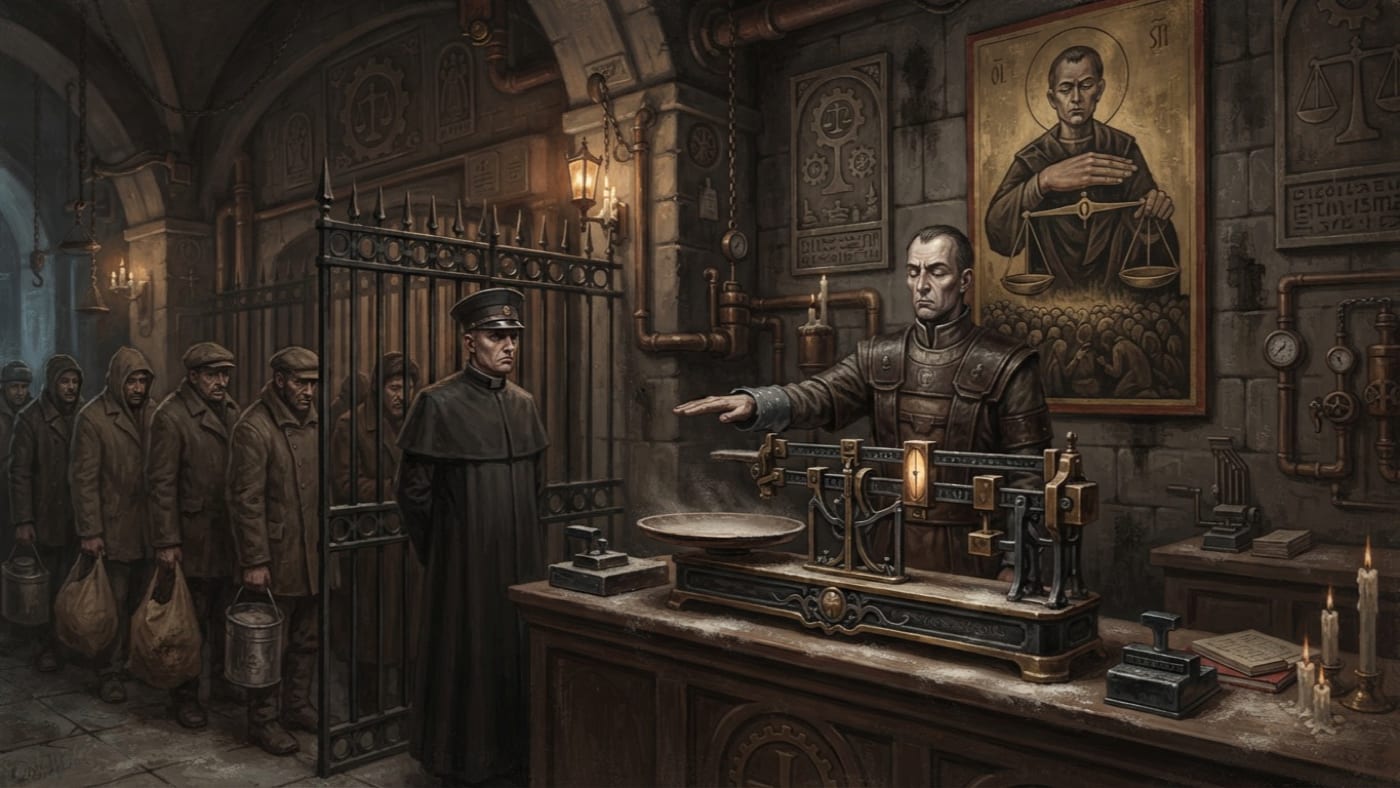
#On the Hand Above the Pan
The Level Prayer is spoken over an empty pan. Every chapel weigher learns this fact first. They learn it on a cold morning, with a witness at their elbow and a queue coughing in the doorway.
The prayer belongs to the Commerce Clerk, the tariff-chapel weigher with ink-stained cuffs and chalk in the creases of the thumb. It also belongs to one day above all others. On the feast of Saint Calibrus, the Level Hand, the clerk stands at the licensed scale and extends the right hand, palm down. The clerk holds it level above the pan and recites. The iron of the scale-arm is cold enough to ache, and wheat dust lies on the brass. Somewhere behind the clerk the saint holds the same posture over a kneeling crowd. He may be painted on board, stamped in brass or printed on paper curling in the candle-damp, and in every version he keeps his mouth shut.
The clerk does not keep quiet. The clerk prays. I do not set the words down here. No approved wording has been furnished to this survey, and I do not compose liturgy for other people to be hanged by.
The hand can be recorded. It hovers above the pan without touching the grain, the weight or the beam. It is the arm of Calibrus copied by a tired employee of the state. Before a single sack is lifted, it declares that the person behind the scale favours no one.
#On the Measure Made Holy
The setting of the prayer is older than any clerk now living and younger than the Church's patience. In A.S. 97 a grain guild rigged its weights and a bastion's gate square burned. After the Bread-Scale Uprising, the Synod seized the scales, outlawed private measurement and declared weighing a sacramental act. The Tariff Chapel was the room this decree required. Calibrus supplied its face.
He had been a local devotion. After the reforms he became official equipment. The Bureau of Tithes wanted him for legitimacy and the Bureau of Doctrine wanted him for sermons. The Bureau of Purity wanted a saint above the scale for its own reason: a tampering clerk should feel the sacrilege long before the felony reaches court.
The archive says nothing about the birth of the Level Prayer itself. No author signs it. I hold no year of composition, no record of a first performance and no promulgating instrument, and I have a very large desk. The institutional history belongs to A.S. 97. The history of the prayer belongs to nobody yet. Readers who require a founding date may petition the same committee that mislaid the saint's grain-town.
The hagiography explains the gesture. In the attributed vita, Calibrus set the town's last consecrated weight on the scale during a famine. He refused to lift it for officer, abbot or widow, and he did not alter the weight. The level hand turns that refusal into a posture, and the tariff-chapels turned the posture into a condition of employment.
#On the Witnessed Zero
The feast is called the Day of Zeroing, and its order is plain. Every licensed scale is cleaned, checked and blessed, then re-zeroed before a witness. At some point in that procedure the clerk raises the right hand over the pan and recites the Level Prayer. The Tariff-Chapel Division records these parts. It has not given me a running order, and I will not invent one for it.
Ordinary days have their own rite, which is smaller and more frequent. At the start of each shift the clerk opens the reliquary calibration casket and touches a fragment to the scale-arm. The clerk then recites the calibration line, chalks a small cross on the pan and sets zero. The surviving material does not say whether the shift's calibration line and the feast's prayer share words, borrow words or merely share a room. The profession treats them as kin. Kin quarrel.
Relic fragments anchor calibration across the licensed system. The doctrine behind them is institutional teaching: saints knew true measure, and demons thrive in ambiguity. The Bureau of Relics keeps its own counsel on which fragments are what they claim to be. No authenticated hand of Calibrus survives, and the competing claimants are classed as devotionally consonant. The prayer does not move the beam. A sliver of bone in a casket does not counterweigh a sack of barley. Anyone who tells a queue otherwise should be referred to the assayers, and then to someone less patient.
Everything depends on the witness. The profession's oldest superstition forbids calibrating alone, because an unwitnessed scale will choose a side and the auditors will choose one too. On the Day of Zeroing the witness watches the instrument and the inspectors watch the clerk. The inspectors come because a fixed feast makes a convenient appointment. They check the seals first and the calibration witnesses second. Then they lay the ledgers beside the bread prices. Anything that fails to match acquires a name.
#On Mercy at the Scale
Apprentices learn the posture by failing at it. They hold the arm out level, as in the icon, and the arm shakes long before the saint's would. I have set out the doctrinal reading in the saint's own dossier. A shaking arm means fatigue. A tilted arm means favour. A lowered arm means mercy has entered the calculation, and in a tariff-chapel mercy must be stamped before use.
Here the profession divides, and both halves claim the same saint.
The True Measure Zealots see the kneeling crowd as a congregation at prayer. For them the level hand is the whole of the commandment. They calibrate hard, report bribes and recite over the pan as though the pan could hear them. The Mercy Weighers see the same crowd as people whose knees have given way from hunger. They shade tariffs for the desperate and recover the difference from someone better fed, so the book balances even when the mercy does not.
The Mercy Weigher leaves the instrument alone. The levy bends and the beam stays true. A clerk who shades a levy has committed a disputed act of charity, accountancy and insubordination. A clerk who greases a pan has committed false weight, and false weight is heresy. The two offences are filed in different rooms, by different men, beside different fires.
The queue confuses three quantities at the scale every day. The first is the mass in the pan, which is what the Level Prayer attends. The second is the tariff assessed on that mass, which the rate tables set by war, season and sector discipline. The third is the grain that actually exists in the depot. No prayer, rate table or clerk has ever enlarged it by an ounce. Accurate weighing catches the thief. It cannot fill the sack.
Early chapel pamphlets claimed Calibrus fed the entire town.
Corrected. He measured and divided grain that already existed. The pamphlets were withdrawn. The grain-town's appetite was not consulted.
The attributed account says thirteen people died in the queue on the night Calibrus kept the weight honest. The Bureau calls this a miracle of measure. The Zealot cites it as proof that honesty holds a town together. The Mercy Weigher cites it as proof of thirteen. The icon settles nothing. The scale has not come to rest and the crowd has not risen. The saint's mouth stays closed, which is the most theologically useful thing a painted mouth can do.
#On Its Present Use
As of A.S. 201, the Level Prayer is recited wherever a licensed scale stands. That means gate tariff-chapels, port weighhouses, alcoves in the market wards and the depot chapels of the trench supply corridors. The gesture is the same everywhere, and the conditions differ.
In the ports, bribes arrive as candle oil and extra chalk. There the hand above the pan is watched for what it might be about to pocket. In the trench depots, discipline is heavy and the queue wears uniform. There the hand is watched for whether it stays steady when shells shake the pans. I have recorded elsewhere that the feast takes one morning in a rich port and three days in a poor depot. The length of the queue accounts for the difference.
Vendors resent the feast because it halts trade at the hour they can least afford. Clerks resent it because it brings in the quiet robes and the white weights. Above them all the Bureau of Heraldry keeps the icon ambiguous, as approved. Under the icon the clerk keeps an arm level and a mouth moving.
On the Day of Zeroing, someone waits outside every chapel with an empty sack and watches a clerk hold a hand over an empty pan. The sack is empty from want. The pan is empty by rubric.