

I've finished the source reading. The scope is cleared and no hold file is present, so I'm writing the article now.
#On the Corps and the Survey
This survey is filed in A.S. 201. The date belongs to the survey and to nothing else. No register I am permitted to read gives the Lime Men a founding year, a founder, a first captain or a muster roll fit for print. I will not supply any of them to satisfy the reader's appetite for origins. Appetite is the subject of this article, and it should be handled with gloves.
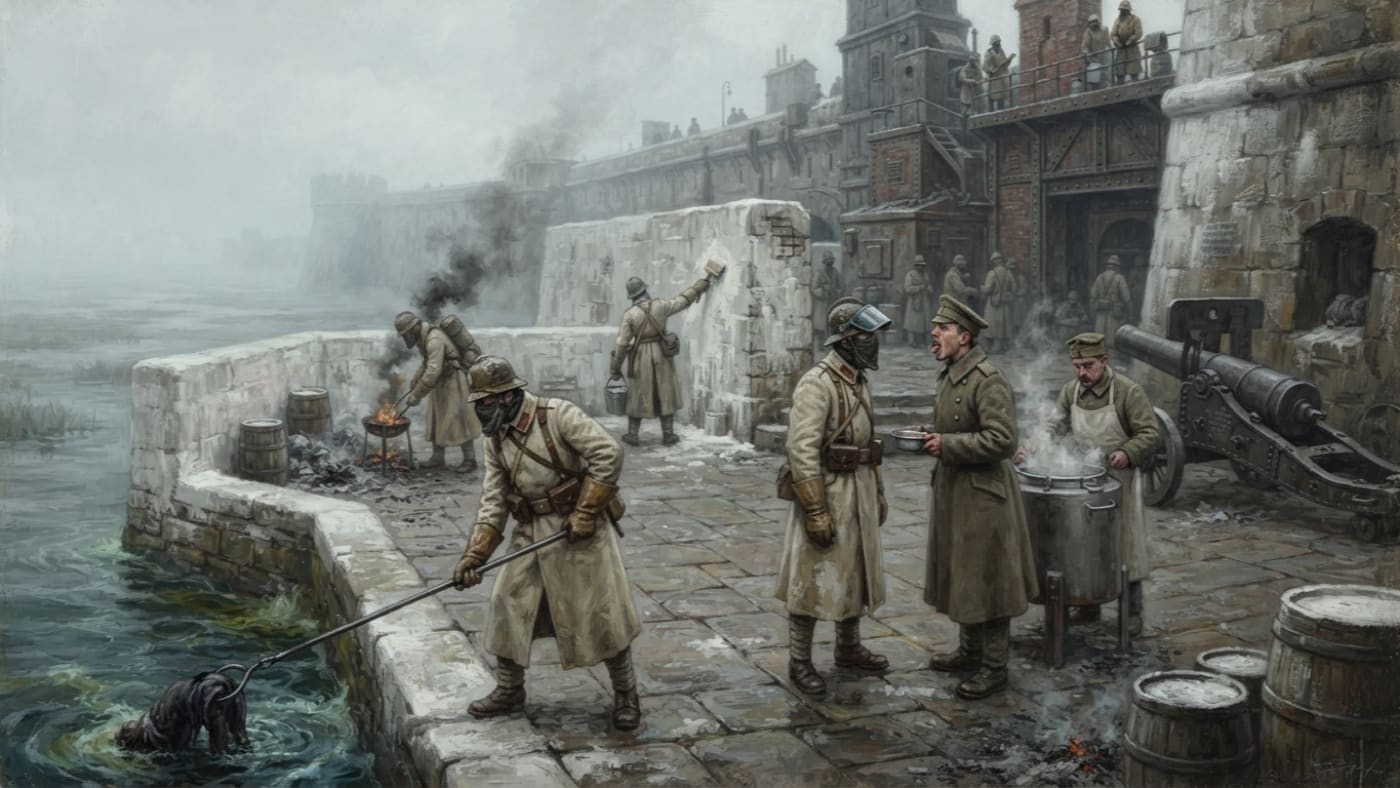
The Lime Men are soldiers detailed to the Ravelin of Purity, the Second Outer Ravelin of Bastion-Constantinople. It sits sunwise between Vigilance and Obedience, at the southern anchor of the Sagittal Line. The ravelin's published account calls them its "peculiar corps." Peculiar is exact. Their work is whitewash, ash, the burning of rations, the hooking of corpses and the inspection of mouths. The Bureaus have spent a century generating Latin for lesser trades.
The wall faces marsh that the same account assigns to Kargath. Its reeds are reported to move without wind, and its water to froth the colour of old bile. Where the marsh stops and the Devourer's dominion starts, no surveyor has fixed. The account itself admits that marshes do not respect survey pins. What Purity faces, every morning, is hunger, and hunger comes by cart with its seals intact.
#On the Substance of the Work
Whitewash comes first, because the walls insist on it. The ravelin's account puts lime on the parapet, on the ration benches, in the drainage mouths and under the fingernails of soldiers who have forgotten clean hands. It records whitening weekly in ordinary season and daily when the marsh exhales. It does not say that the Lime Men alone carry the brush, so I will not say it for them. Their name says plainly enough where the lime ends up.
Ash comes next. In the published account, at dawn the Lime Men scatter ash across the porch stones, the cooks bring test kettles, and the sentries show their tongues. The Ledger holds this as a scene and not as a roster. No shift table survives to tell me whether every dawn is the same. I suspect it is. Suspicion is the ravelin's whole economy, and I see no reason to exempt myself.
Then the carts. The corps drags sacks from suspicious carts, and the ravelin's history explains why a seal settles nothing. Its founding offence, as the account tells it, was a ration cart with proper seals, dry sacks and a driver who could recite the weigh-prayer. At boiling, the first kettle formed teeth. The account says convoys still arrive with their seals intact and something wrong beneath the sacks. A seal certifies the clerk. It has never once certified the grain.
The bread is the obscenity. The account records that the Lime Men burn bread that smells too good. No sentence in the Second Ravelin is more dangerous than a compliment to the loaf. A hungry garrison stands at the porch and watches a ration it was owed go into the fire because it smelled the way bread smelled before the war. The Kargath file says Synodal rationing is partly practical and partly spiritual, says that whether it works spiritually is unclear, and says it certainly creates hunger. The Lime Men feed that hunger daily with the best-smelling food on the wall. How many of the burned loaves were corrupt, no one can say. The evidence has been reduced to ash, and ash has no testimony to give.
Before dawn they hook floating animals out of the water. The account's list of marsh lures includes a dead mule at the edge, still in western harness, and a sack of flour lying dry on black water. The hook keeps a hand away from what the marsh has offered. It is the oldest theology at Purity, and the only kind no Bureau has tried to annotate.
Then the mouths. The sentries show their tongues. The ravelin's hunger drill orders a tongue inspection for any comrade who asks for a second ration before the bell. The Lime Men also hold the bowls while officers vomit, after seeing what a loaf may contain when Kargath has left it shaped like a loaf. The account does not say what the loaf contained. I have read the account. I prefer its silence.
The Lime Men are a lay brotherhood of the lime, bound by a rule of cleanliness and sworn at the porch.
Corrected. No rule, vow, habit, chapter, induction rite or brotherhood is on file. The Lime Men are soldiers on detail. The previous sentence was the surveyor's own and is withdrawn before any Bureau could ratify it, which at the Second Ravelin takes about a fortnight.
#On the Kit
The kit is recorded briefly and smells worse than the record. It is a pale canvas overcoat, a leather mask soaked in vinegar, and gloves that stiffen after a week from lime and old saliva. The account does not say whose saliva. A week of mouth inspection suggests some candidates. I leave the deduction to the reader, who has volunteered for nothing and so can afford it.
The coat is pale so that the lime does not show on it, or so that everything else does. I have heard both explanations from men who were sure of themselves. The register supports neither. The mask's vinegar announces a Lime Man before he comes round the corner, and that is all the record proves about it. The gloves are the most honest part of the kit. They harden into the shape of the work and then refuse any other.
What none of it proves is protection. No register I hold certifies that vinegar keeps off the Devourer, that lime purifies grain, or that ash on porch stones does anything except lie there and be ash. None certifies the opposite either. The masks are worn regardless. Most doctrine survives on the same terms, and I have defended a good deal of it in print.
#On Command: Valenne, Purity, and Gun Two
Purity answers to Gate-Warden Petra Valenne, because every ravelin answers to Valenne. The account still calls the Second the least comfortable of the six under a soldier's hand. Bureau of Purity detachments operate there by writ. They regard the ravelin as theirs by name, by whitewash, and by the old right of men who arrive late to a crisis in cleaner gloves. War regards it as a gun platform with inconvenient chaplains. Doctrine regards it as a sermon. The marsh regards it as the edge of a plate.
When Valenne took the six gates into her hand, she made one rule there: no Ordeal team may countermand a gun captain while the reeds are moving. Purity objected with twelve citations. Valenne returned one sentence: "Lime does not outrank canister." The sentence is now scratched inside Gun Two's loading hood. Purity has asked for it to be removed.
The rule should be read as written, which is a discipline the Bureaus find almost unbearable. It binds Ordeal teams. It protects gun captains. It applies while reeds move and lapses when they stop. It does not make every gunner senior to every writ, and it does not abolish Purity's presence on the wall. It does not say the Lime Men are Ordeal teams either. The account calls them soldiers detailed and does not say whose roll carries them, War's or Purity's. I will not settle a jurisdiction that the Gate-Warden has chosen to leave unsettled.
Gun Two keeps the sentence. The account says the gun "continues to enjoy literature." I have read worse criticism from Doctrine and been paid less for it.
#On Present Application
As of this survey the Ravelin of Purity is active. Its ration porches open before dawn. Its marsh guns fire salt canister twice a week for drill, and more often when the reeds behave like clergy approaching a budget. The Lime Men's recorded work goes on: whitewash on the parapet, ash on the stones, hooks in the water at first grey, bread in the fire, tongues at the porch. The corps has no headcount here because Records has not given me one, and I do not invent soldiers. The Church has enough of those on paper.
Readers who have met lowercase lime men elsewhere should not confuse them with this corps. Practical crews by that name painted the first lines at the Wagon Quays, and the Sanitation Chapter grew out of a gang of the same description. Those crews quarantine wards and queues. The capitalised corps belongs to the Second Ravelin, faces the marsh and burns its own breakfast. Lime is common. The Second Ravelin's corps is not.
Surveyors may treat any lime-handling crew on the southern anchor as a detachment of the Lime Men.
Withdrawn. That guidance would put the Wagon Quays and the Sanitation Chapter under Purity's porch and set off a jurisdictional war over whitewash, a war the Bureaus would enjoy and the city could not afford. This survey covers the Second Ravelin's corps only.
At dawn the ash goes down on the porch stones. A Lime Man in a pale coat holds out a bowl, and the cook holds out a kettle. Somewhere behind them an officer looks at a loaf for too long.
- Sources: The Lime Men facts come from the published Ravelin of Purity article. I checked the continuity reference, the style guides, the Kargath, Valenne and Obedience files, and the Locations file against it.
- Date: A.S. 201 appears only as the date of the survey, never as a founding date.
- What I left out: I gave the corps no founder, headcount, ranks, vows or order, and I made no claim that the lime, ash or masks actually work.
- Gun rule: It binds only Ordeal teams while the reeds are moving. I did not say the Lime Men are Ordeal teams, or whose roll they belong to.
- Wagon Quays and Sanitation Chapter: Both pages mention lowercase "lime men" crews. I said outright that those crews are not this corps.
- Links: I left the Macedon-only Ordeal Teams article unlinked. Every slug I did link exists locally, but none has been checked against the live site yet.