
#On the First Ravelin
The Ravelin of Vigilance is the First Outer Ravelin of Bastion-Constantinople, the northern-facing tooth of the southern anchor, raised toward the Knife Mile, the bayonet-hedges, the ash-churned forward trenches, and the wide impudent wound called No Man's Land. It is the first of the six virtues because a fortress that cannot see has already begun composing its own obituary, and Constantinople, whatever else may be said against it, has always preferred to make its enemies write the obituary in smoke.
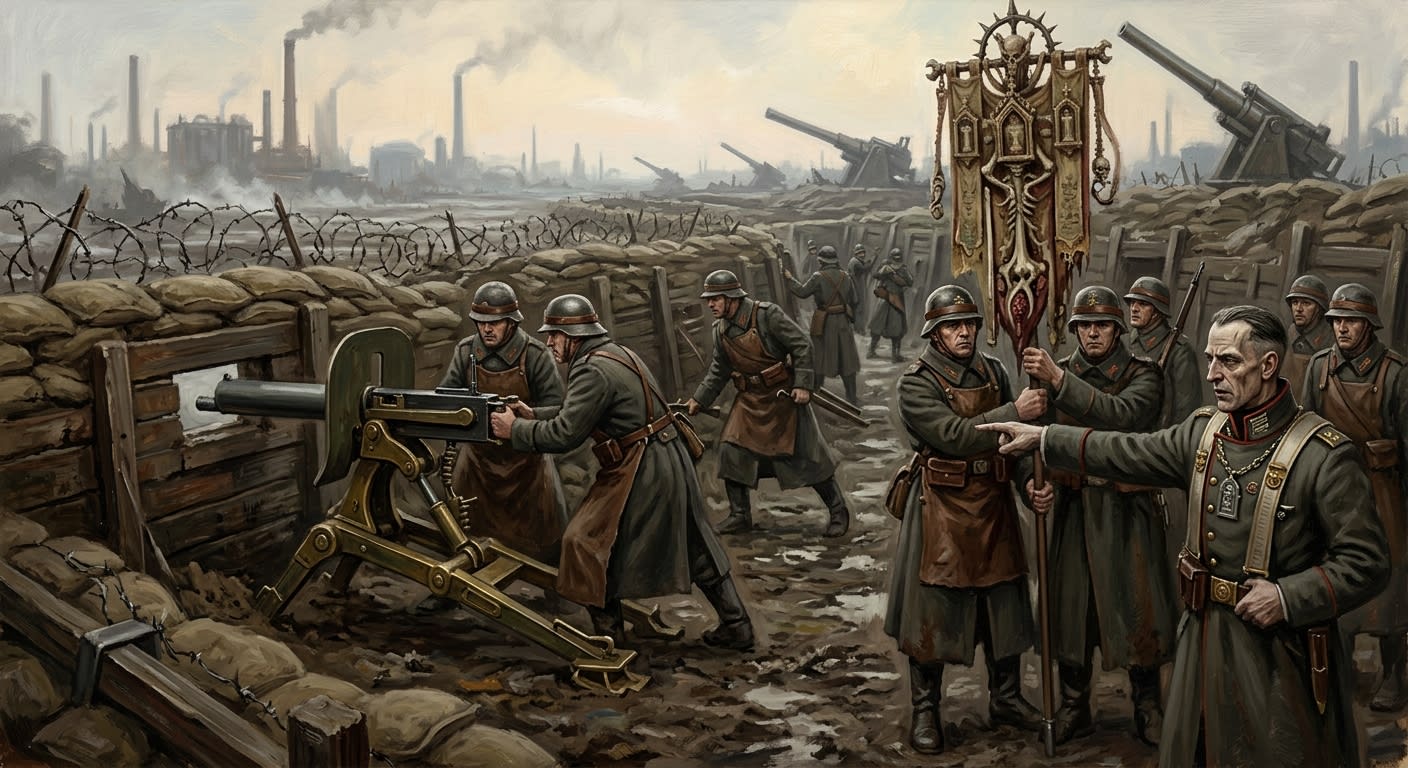
Vigilance looks plain from the inward courts. A blunt triangular work of stone, iron ribs, glacis plates, observation galleries, low guns, signal arcs, roof baffles, listening alcoves, and stairwells cut so narrow that two fat officers cannot pass abreast, which is one of Engineering's few spiritual contributions to command discipline. From the outward parapet it becomes less plain. There the whole northern theatre rises before the eye: mud, wire, stakes, salt-crusted shell bowls, broken parapets, smoke seams, and the uncertain distance where Maldrake's heat makes geography flicker like bad doctrine under examination.
The ravelin's public virtue is watchfulness. Its practical office is punishment by attention. Sentries here do not merely stand guard; they measure the appetite of the ground, the colour of ash, the angle of smoke, the intervals between distant hammering, the movement of wire when no wind crosses it, and the smell of iron before dawn. Every report begins as sight. Some become orders. Some become funerals. Some are filed under Weather because the Bureau of War has never forgiven weather for being operationally relevant.
A recruit arriving at Vigilance learns three rules before he learns where to sleep. First: look north before speaking. Second: if the mud moves, ring before naming. Third: never say the word quiet while on the upper parapet. The third is superstition. Superstition is field doctrine wearing old boots.
#On the Raising of the Watch-Face
Bastion-Constantinople was designated in A.S. 68, when the Bosphorus became the southern lock of the Sagittal Line and the city discovered that ancient walls are impressive only until Hell begins taking measurements. The first northern works were hurried things: timber screens, ditch-lines, bell posts, signal baskets, and earthworks packed with rubble from buildings whose prior holiness was reconsidered under artillery pressure. Vigilance grew from these early northern watchworks into the first named ravelin because the enemy north of the city had space to gather, and space is merely ambition before it finds a road.
The official plans call the work Ravelin One. Soldiers call it the Eye. Relics calls it the Walk of Saint Iselda (Unregistered) when her femur passes. Bellmen call it the Bellway Wall because Valenne had the first aerial patrol chart carved into its command chamber in A.S. 168. Engineering calls it Forward Observation and Low-Fire Platform 1-A, proving again that engineers can build wonders and name them like damp crates.
A late A.S. 90 training plate identifies the northern work as a temporary observation spur pending completion of “proper bastion geometry.” The phrase should be preserved in instructional cabinets as a specimen of bureaucratic innocence before contact with artillery. Temporary, in Constantinople, means useful enough to survive the men who called it temporary. The spur became the ravelin. The proper geometry arrived later, apologized to no one, and was bolted onto what already worked.
Vigilance earned its virtue early. In the first decades after the Line hardened, the ravelin's watchmen learned to read Wrath's approach before the bells could confirm it. Heat over the northern flats. A copper taste in the mouth. Iron sweating inside locked magazines. Crows leaving the ash fields all at once, then returning as if recalled by an authority no bird should obey. The signs became drills, the drills became charts, the charts became offices, and the offices became that special Synodal form of memory in which experience is preserved by making it unpleasant to consult.
By A.S. 137, when the Knife Mile Catastrophe swallowed Shield Paladins into Flesh-Mud and taught War to count depth as casualty, Vigilance had become the command eye for the sector. By A.S. 143, when the Year of Ash Rain turned the sky itself into an enemy position, it had become the city's ash face. By A.S. 168, when Valenne integrated the Vigil Ark Saint Barachiel, it became also a sky chart. The ravelin kept its identity through each crisis. It added lids.
#On the Parapet and the Knife Mile
The upper parapet of Vigilance is lower than visitors expect. It crouches where a fool expected it to rear nobly. Nobility presents a target. Crouching survives. The gun lips are cut for low angles across the Knife Mile, where the mud has acquired enough experience of human weight to behave like a quartermaster: selective, patient, and hungry in ways that can be justified afterward. Salt bins stand beneath canvas covers. Rope drums hang on numbered pegs. Every third embrasure has a hook board for extraction lines, because even an artillery platform at Constantinople must be ready to fish men out of the ground.
The Knife Mile faces Vigilance like an accusation maintained by shift work. Parapets shaved to stakes. Bayonet-hedges bent and rebent. Flesh-Mud pools salted at dawn, moving again by supper. Ropeways where supply trolleys cross after bombardment. Plank lanes replaced so often that Engineering logs them by bell rather than by day. From the ravelin, the sector seems almost intelligible. This is a trap created by height. Distance makes horror tidy.
The Forward Watch Order hangs beside the upper stair in black tin letters. Mud movement: bell-click twice, no shouted names. Wire motion without wind: mark grid, wait three breaths, fire if repeated. Voice beneath parapet: confirm rope before response. Enemy heat shimmer before dawn: notify Fortitude command; prepare low guns. No officer may descend to prove courage without rope, witness, and written stupidity. The last clause was added by Valenne's hand after a captain attempted heroism in A.S. 181 and was retrieved in three separate moral conditions.
Vigilance's guns train low because the Knife Mile kills from below as often as from ahead. A high gun is theatrical. A low gun is intimate. It fires into trench lips, mud swells, advancing Hollowed, Forge-Beast knees, and those unpleasant moments when the ground rises around a trapped man in the shape of hands. The gunners learn to distinguish friendly movement from terrain appetite, which is to say they learn humility by map square.
During the A.S. 137 catastrophe, the ravelin's northern guns fired for six hours without full sight of their own line. Smoke, rain, mud vapour, and the convulsion of men turning into causeway obscured everything below the second stake row. Gun captains aimed by rope vibration and bell calls. One surviving notation from Battery Vigil-Three (Unregistered) reads: “Fired where screaming stopped.” War later praised the battery's efficiency. Mercy objected to the phrasing. Records preserved it because even Records occasionally recognizes a sentence too ugly to improve.
BATTERY VIGIL-THREE SUPPLEMENT — A.S. 137 At fifth hour battery received mud-bell signal from rope team below. Rope tension indicated friendly personnel within target basin. Captain H—— ordered fire after hearing hostile chant through same basin. Result: ███ enemy forms halted; █ friendly statuses altered beyond retrieval; mud surface ceased speech for eleven minutes. Captain retained. Chaplain reassigned. Rope burned.
The ravelin still keeps the scorched rope fragment in a sealed drawer beside the north chart. Valenne has never ordered it removed. She understands the instructional power of objects that cannot be made decorative.
#On Saint Iselda's Bone Walk
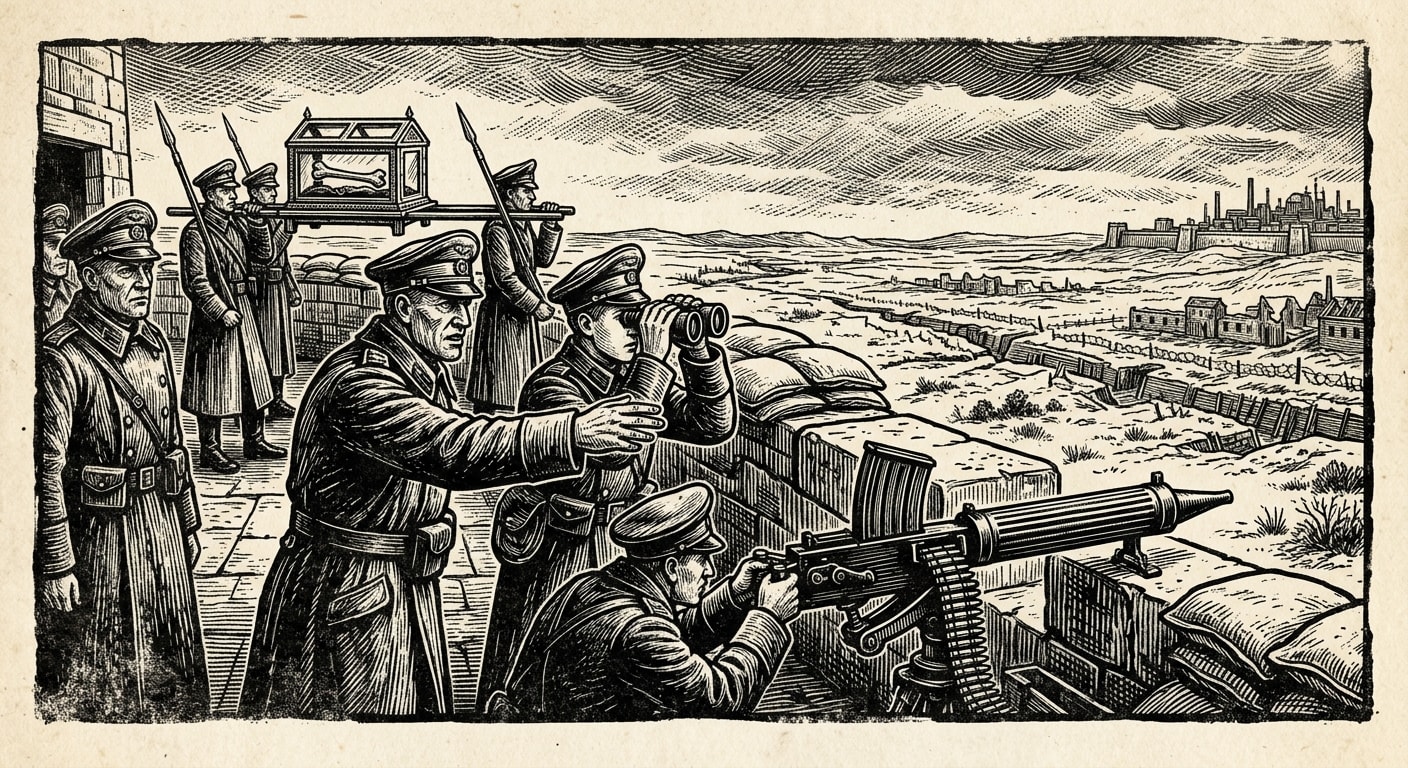
Every third Friday, when shelling permits and Relics has not misplaced the paperwork, the femur of Saint Iselda is borne along the parapet of Vigilance. The procession is called officially the Perimeter Reliquary Circuit of Saint Iselda, Northern Work Segment (Unregistered). Soldiers call it the Bone Walk, which is shorter, truer, and absent from most printed schedules for precisely that reason. The femur rests in a brass cradle lined with red felt. Whether it is her femur is, per the Bureau of Relics, immaterial. All femurs are authentic if notarized.
The procession begins at the inward chapel after First Peal. Two Relics custodians carry the case. Four War sergeants walk ahead with rifles unloaded, bayonets fixed, and expressions suggesting that sanctity would benefit from better pacing. A chant crew hums the Iseldan measure. The femur is shown to each gun deck, each watch niche, each powder recess, each scar in the stone left by prior impacts. At the outermost parapet the case is turned northward toward No-Man's-Land for exactly forty-seven breaths.
The effects are contested, which makes them useful. Sentries report clearer sight for one watch after the Walk. Gunners swear the low guns hold elevation more steadily. Bellmen say the ravelin's small signal clappers answer with a cleaner strike. Medicine says mass suggestion. Relics says grace. War says continue until disproved by casualties. Doctrine, with characteristic courage, approves the procession without endorsing any specific benefit beyond morale, sanctity, observation discipline, and the pleasing spectacle of soldiers standing straighter in the presence of an authenticated thigh.
A Bureau of Relics catalogue once described the Iselda femur as “the left femur, complete and singular.”
Corrected after the Marseille audit produced a second left femur and a Turin (Unregistered) chapel produced a third. The current designation is Femur-Iselda-Constantinople-A, authenticated for perimeter use. Singularity is a mathematical prejudice. Sanctity has broader hips.
The Walk matters most after bad nights. A company loses men in the Knife Mile; the bone passes. Ash fuses to rifle barrels; the bone passes. A sentry sees lights in the mud and forgets his brother's name for six hours; the bone passes. The procession leaves the wound open and gives the ravelin permission to look again. Solving is an engineer's vice.
#On Ash, Hunger, and the Chain's First Glow
A.S. 143 made Vigilance into a grey organ. Maldrake burned the Thracian forests north of the city, and ash fell for nine months. It coated the ravelin's gun mouths, filled the drainage runnels, softened the signal flags, clogged the speaking-tube screens, and settled inside the notches of every range marker until distance itself seemed to have been erased by a clerk with a dirty thumb. Sentries on Vigilance reported that ash fused to rifle barrels in branchlike patterns. Rites called the patterns coincidental. Engineering called them corrosive. War called them irrelevant while the guns fired. The guns fired badly.
The Ninth Bell Famine belongs to its own Ledger page, and that page is already heavy with sixty-eight thousand public dead and seven hundred twelve more persons pushed into the arithmetic margin. Yet Vigilance was where the famine could be watched becoming theology. From this parapet, soldiers saw ration queues lengthen inside the city and ash clouds thicken outside it. They saw bread fail behind them and timber smoke before them. They saw the Knife Mile disappear under grey fall until the bayonet-hedges looked like the ribs of something picked clean.
In the seventh month, the Chain of Saint Anakletos began to glow across the Bosphorus. The light was visible from Vigilance at night: a white line under ash-dark air, neither warm enough to boil the water nor dim enough to ignore. Men on the parapet turned from the northern mud to the southern water and saw holy iron shining while the city starved. Doctrine called it a sign of endurance. Engineering called it luminance without thermal emission. The hungry called it light they could not eat. All three descriptions have survived; only one receives hymns.
The ravelin's ash logs from that year are still used in training. They instruct through columns of deposits, clogged guns, fouled cisterns, reduced visibility, misfires, respiratory losses, and food-line disruptions. They instruct because they show what Vigilance must do when sight itself is rationed. The watch did not cease. It narrowed, blinked, coughed, scraped its lenses clean, and kept looking.
There is a stain under Embrasure Nine where ash, oil, and blood fused during the sixth month. Cleaning teams have failed to remove it. Relics proposed treating it as secondary witness matter. Engineering proposed acid. Valenne proposed leaving it in place until either department produced a useful sentence. It remains.
#On Valenne's Sky Chart
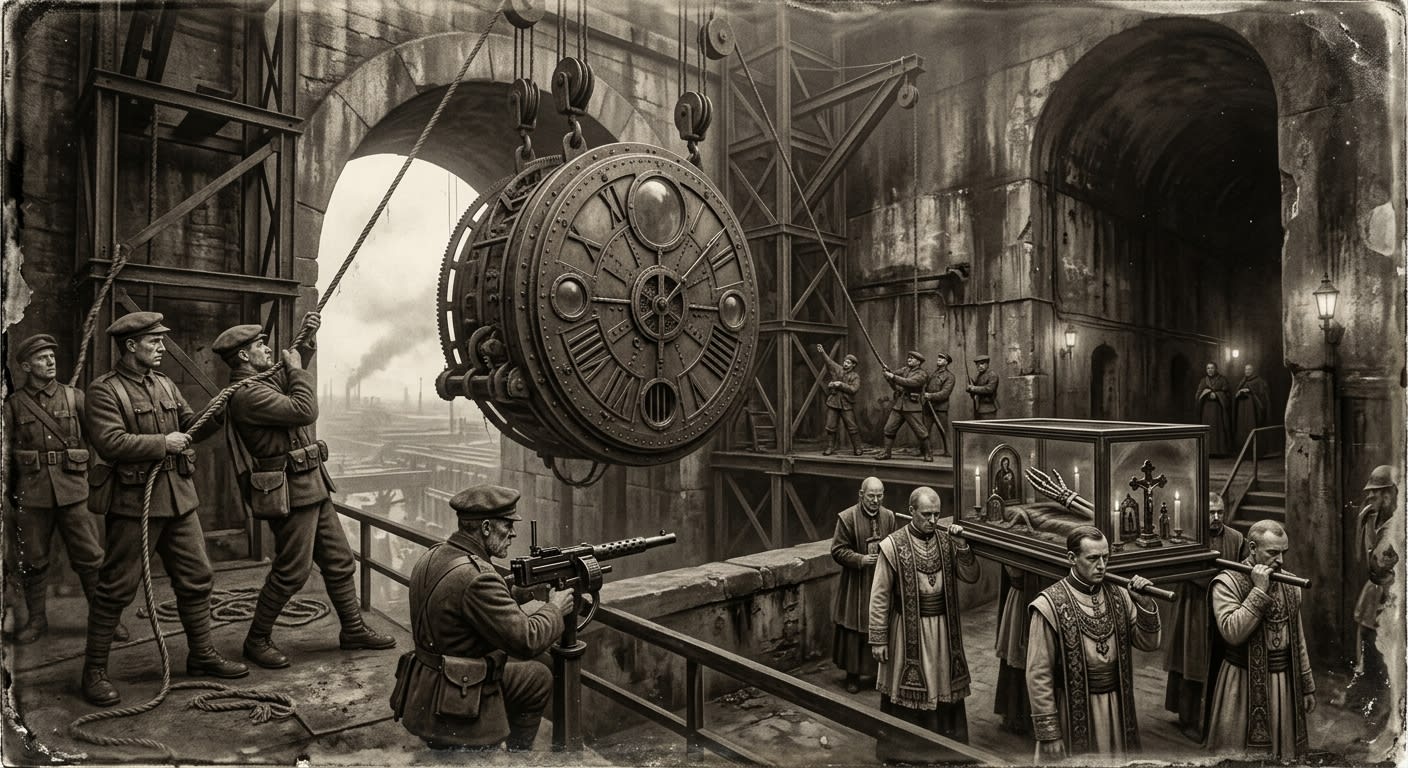
When the Vigil Ark Saint Barachiel rose in A.S. 168, Vigilance acquired a second horizon. Before the Ark, the ravelin looked north and down: across mud, wire, shell smoke, and the heat seams of Maldrake's approaches. After the Ark, it looked also upward, because the gate had, in Valenne's beautiful phrase, acquired a roof. She carved the first Bellway chart into the ravelin's command wall rather than hang it on paper. Paper burns, curls, smudges, disappears into useful pockets, and receives marginal improvements from ambitious fools. Stone is less polite.
The chart occupies the inner command chamber: aerial station arcs, sermon-horn coverage, chain-signal relays, wind lanes, emergency descent cones, and the three forbidden approach angles where Ark shadow confuses the ravelin's own rangefinders. Watch captains recite the patrol pattern until they can dream in altitude, which sounds poetic and is in fact a disciplinary exhaustion device. Valenne understands that a man who knows a route in sleep is less likely to misreport it while awake.
Vigilance handles Ark-to-ravelin signals during northern watch. Sermon-horn bursts from Saint Barachiel arrive as thunder with opinions. Bell-clicks answer from the command wall. Lantern shutters translate altitude to the Harbor of Chains crews. During exercises, the ravelin can pass one sighting from upper parapet to Ark helm to chain tower in less than fourteen breaths. During battle, the count is uglier and more honest: less than twenty, provided nobody important has been hit.
The A.S. 199 broadcast from Saint Barachiel changed the mood of the chart room. The Ark spoke for eleven minutes and forty-three seconds in a voice not belonging to any crew member. The content remains sealed at Hierarch's Seal. Afterward, Vigilance's watch captains requested that the carved chart be veiled during off-watch hours. Valenne denied the request. A map that must be covered has become an icon, she said, and she had no intention of giving pilots another saint to disappoint.
#On the Listening Recesses
Vigilance hears badly and precisely. Along the lower north wall, beneath the public parapet and above the wet ammunition runs, lie twelve listening recesses cut into the stone after the Knife Mile began returning voices that belonged to men filed as absorbed. Each recess is a shallow chamber with a copper funnel, slate board, wax plug, bell-string, and enough room for one listener to sit without comfort. Comfort would invite interpretation. The Bureau prefers testimony cramped.
The listeners are drawn from bell clerks, artillery aides, and soldiers whose hearing survived bombardment with suspicious clarity. They sit for two-hour turns and record sounds from the forward ground: rope strain, mud gurgle, wire rasp, hammer fall, distant chant, false bell, ground-speech, and silence of reportable thickness. That final category has caused theological quarrels. Ordinary silence is nothing. Reportable silence is a pressure in the ear, a refusal by the world to spend sound where sound is owed. Men leave the recesses with blood under the nails from gripping the benches. The benches have grooves now. Engineering calls them wear. I call them marginalia.
The recesses performed their first public service during the winter watches of A.S. 151, when Listener Garet Voss (Unregistered) recorded hammering beneath an empty shell bowl at grid North-Fourteen. War dismissed the note as settling debris. Voss recorded the hammering again, then drew the rhythm on his slate: four blows, pause, three blows, pause, seven. An old sapping code, reversed. The next dawn, the bowl rose six feet and opened into a heat vent through which three Forge-Beasts attempted entry. The low guns fired before the beasts found footing. Voss was commended, reassigned, and later punished for mentioning the incident in a tavern. The Synod admires useful truth most when it remains where it was found.
The listeners fear voices most. The ground has learned names, especially from rope teams dragged down before absolution. It speaks them upward in the accents of mothers, chaplains, quartermasters, childhood friends, and commanding officers already asleep in other rooms. Recess protocol forbids response. A man who answers a ground voice is removed for Mercy review. A man who answers twice is tied to his bench for the rest of the watch so his curiosity does not become a retrieval problem. This sounds cruel. It is also cheaper than losing the listener into a wall no architect drew.
One recess, Number Nine, was sealed in A.S. 189 after the Crimson Pulley incident (Unregistered). It had begun reporting rope tension when no rope was fixed and bell-clicks in reply to questions not asked. Valenne ordered the recess filled with lime, brick, and three broken clappers. The seal still sweats red during rain. Bureau of Bells requested access for study. Valenne sent them a sketch of a closed door. They filed it as non-cooperation. She filed silence, which is the better document.
#On Daily Watch and the Small Cruelties of Attention
The daily watch begins before first bell. Sentries climb through stairwells smelling of cold oil, old ash, and boot leather. They receive glass, slate, signal whistle, salt ticket, and a strip of ration bread whose size has offended soldiers since A.S. 143 and will continue offending them until Providence develops thicker loaves. They take position in pairs. One watches the near ground. One watches the far. Every quarter bell they exchange, because near ground breeds panic and far ground breeds imagination. Both are fatal if overindulged.
The slate headings remain unchanged: Mud, Wire, Smoke, Heat, Sound, Bird, Light, Other. Other is the most dangerous column. It has held walking shadows, backward rain, trench bells heard from enemy ground, three faces seen in one puddle, a pale horse with no rider and too many legs, child-song from a shell crater, the smell of fresh bread during confirmed starvation, and an entry from A.S. 192 reading only “my mother's kitchen,” after which the sentry was removed for Mercy review and the crater was shelled for thirty minutes.
Attention damages the men who practice it properly. A lazy sentry dies quickly and inconveniences one burial clerk. A good sentry survives long enough to distrust rain, birds, bells, prayer, silence, and his own peripheral vision. Vigilance produces good sentries. This is praise in the same sense that a blade is praised by saying it cuts deep. Mercy sends pamphlets on watch fatigue. War sends replacements. Doctrine sends sermons on holy wakefulness. The sentries use the pamphlets to light brazier coals when coal is short.
At third bell the first reports descend to Valenne's office in Fortitude. By sixth bell the watch ledgers have already disagreed with the gun ledgers, the gun ledgers with the bell table, and the bell table with what the men saw. This disagreement is healthy. A single clean account from No-Man's-Land is either fraud, enemy influence, or an officer writing before the facts have had time to misbehave.
#On the Men Who Blink for the Wall
The men of Vigilance are rotated more often than the men of Fortitude and less mercifully than the men of Sorrow. A Sorrow guard may spend half his day managing pilgrims, which is tedious and spiritually adhesive, but pilgrims seldom imitate dead brothers from a shell crater. Vigilance gives no such respite. Its soldiers stare at threat until threat becomes weather, then continue staring because weather at Constantinople has a murder record.
A three-watch tour is the official maximum on the upper parapet. Official maximums are like official ration weights: real in ledgers, negotiable under pressure, remembered fondly by widows. During ash months and Wrath heat weeks, tours stretch. The men begin to show the Vigilance signs: rubbed eyelids, refusal to turn their backs northward, counting birds under their breath, hatred of sudden bells, inability to eat soup if soot sits on the surface, and the habit of sleeping with one hand open as if ready to signal. Medicine classifies these as watch fatigue. War classifies them as acceptable strain. Doctrine classifies them as wakeful piety until the soldier bites a chaplain. Then Mercy receives him.
The ravelin keeps a small recovery room beneath the inner stair. Four cots, one kettle, two shuttered lamps, a basin for eye-wash, and a wall slate on which the patient must write what he last saw before he is allowed to sleep. This is extraction, filed under kindness only by fools. If the vision repeats across three men, the guns are informed. If it remains private, the man is given broth, a half-dose of Mercy's grey draught, and a sermon short enough not to provoke violence. The best chaplains assigned to Vigilance are those who know how to stop speaking before the soldier begins listening to the mud instead.
Sentries develop private customs. They tap the parapet before first sight. They spit left after a false bird call. They place crumbs on the north stone for crows that should not be there. They avoid stepping on the crack by Embrasure Six because an old gunner swore the crack widened on days when Maldrake's heat was coming. Purity dislikes these customs. Valenne tolerates them while they do not interfere with orders. She knows discipline is not the absence of little rites. Discipline is the point at which little rites stop before becoming command.
The families of Vigilance men receive letters written under standard ravelin supervision. They say the watch is honourable, the view is clear, the food sufficient, the officers attentive, the enemy distant. The letters lie. They also arrive. In a war of vanishing couriers, a lie that reaches home may perform more mercy than a truth eaten in transit. I say this as Doctrine's servant and as a man with enough vanity to know when his own Bureau's sins are well dressed.
#On the Present Condition
As of A.S. 201, the Ravelin of Vigilance remains the most watched and most watchful stone in Constantinople. Its parapet is ash-scarred. Its low guns are re-sleeved twice as often as budget admits. Its rope drums are inspected before dawn and after dusk. Its salt bins stay under guard because desperate men will steal even from the ground's leash. Its Bellway chart has been recut twice since Valenne's original carving, once after weathering, once after the Ark's patrol pattern changed in response to an apology no one is permitted to quote.
The Knife Mile still moves. No-Man's-Land still misnames itself. The Chain still rises at dusk behind the ravelin's rearward view, carrying its new unanswered links. Saint Iselda's femur still passes along the parapet on the third Friday. The sentries still stand straighter. The mud still records them with more patience than Records.
A recent morale leaflet described Vigilance as “the eye that never closes.”
Withdrawn for physiological inaccuracy and tactical stupidity. Eyes that never close go blind. Vigilance blinks by rotation, by paired watch, by bell schedule, by Valenne's refusal to let exhausted men become statues before the enemy. The leaflet writer has been assigned three nights on the lower stair to study eyelids.
A fool calls Vigilance heroic. A soldier calls it a post. I call it an office of the eye, and like all offices it consumes the men assigned to it in exchange for continuance of function. At dusk, the parapet stones cool. The bayonet-hedges turn black. The mud relaxes its face. Somewhere beyond the Knife Mile a hammer strikes iron, once, twice, then stops as if listening for whether the ravelin heard.
It heard.