

#On the Work Under Survey
Third in the register. Readers may not take this as third in rank.
This is a survey of the Ravelin of Obedience as it stands in A.S. 201. It is one of the six outer ravelins of Bastion-Constantinople, southern anchor of the Sagittal Line. It is also the third work named when the register lists those ravelins in order of construction, sunwise from the north: Vigilance, Purity, Obedience, Fortitude, Sorrow, Correction. The list is public. I did not arrange it, and so I am spared the blame for its cadence.
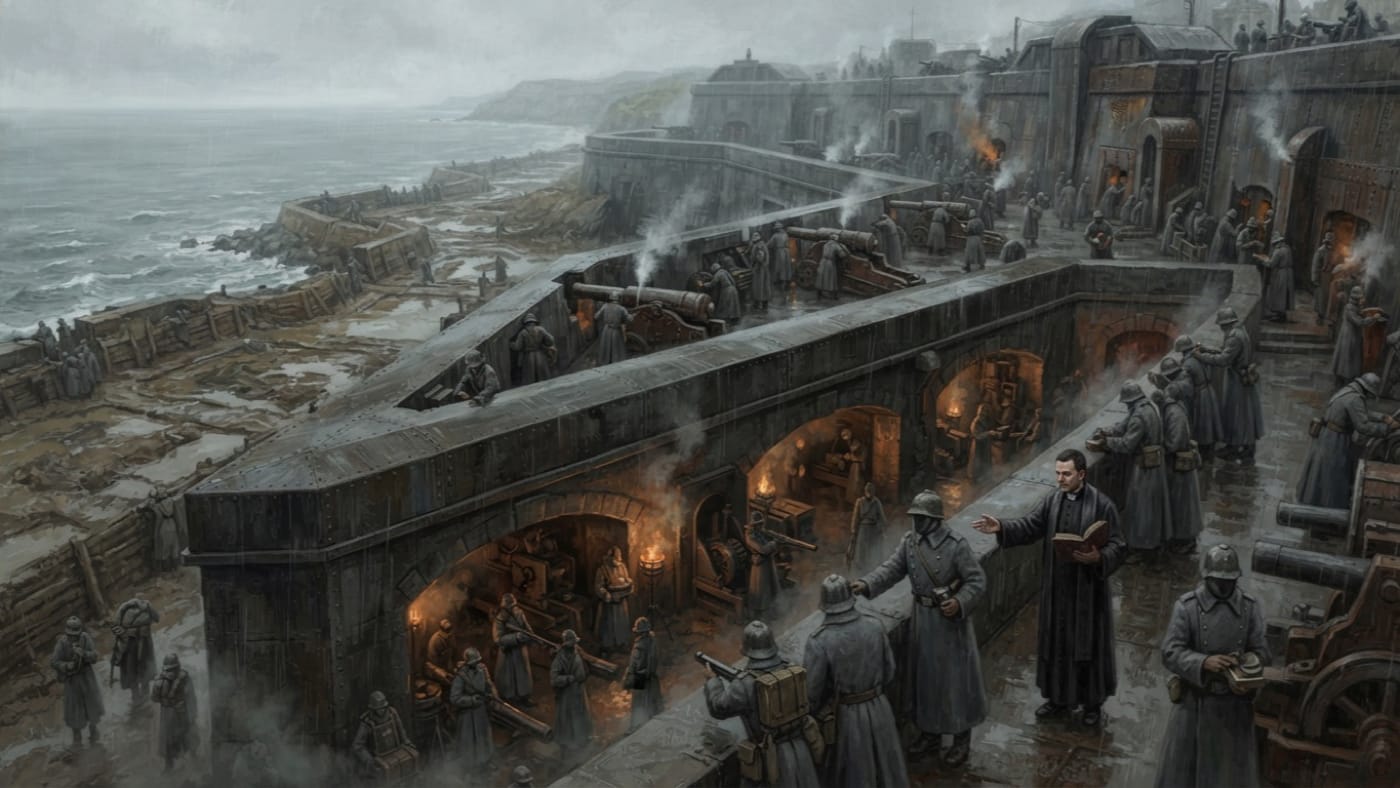
Obedience faces the Sister Trenches. It carries guns, under-vaults and chaplains. With its five siblings it answers to Gate-Warden Petra Valenne. By her account, it smells of wet wool.
That is the dossier. Anyone expecting a founding legend, a martyred commandant or a wall that weeps on feast days has come to the wrong ravelin. Two of its neighbours supply such goods in quantity, and the Bureau of Records does not lend miracles between works.
#On Its Facing
The parent register says that Obedience faces the Sister Trenches. The dossier of the Sixth Ravelin agrees, and it adds the one functional fact an engineer would want: Obedience holds that facing and speaks in order-words.
The Sister Trenches are twin forward works on the Aegean littoral. Sea-wall alternates with sandbag there, and both are raised by day and pulled down by the tide. Then they are raised again before the next tide can make a fool of the last repair. Salt eats rifles there faster than the armourers can issue them. The garrison polishes in unison and calls the exercise the Hymn of Rust. Engineering calls it wasted labour and Doctrine calls it discipline. Both are describing the same men holding the same rags.
The register does not say in miles what a ravelin at the Bosphorus owes to trenches on the Aegean, and neither shall I. In Synodal usage a facing is an assignment of attention. Purity is set against the marshes of Kargath, and Vigilance against the Knife-Mile. In my judgment Obedience is set against a front whose chief adversary, after the enemy, is repetition: the wall that must be rebuilt because it was rebuilt yesterday, and the rifle that must be cleaned because cleaning is what keeps it a rifle.
On the order-words I will say only what has been published, which is that Obedience uses them. How they are composed, carried or answered is the business of the Bureau of War and of the men who must know them by heart. A Codex that printed them would be fit for the enemy's lectern.
Opinions require no clearance, though, and I hold one. An order-word is obedience cut down to the smallest unit that can still be carried. A sermon can be misheard, and a requisition can die between two desks. A single word either arrives or it does not. The man who returns it has confessed in one breath that he is where he was told to be. I can think of no fitter vocabulary for a work whose facing is a trench rebuilt by the tide.
#On Guns and Under-Vaults
Valenne's dossier gives each of the six ravelins its guns, its under-vaults and its chaplains, so Obedience has all three. This survey prints no counts, calibres or chamber plans, for the plain reason that I have seen none attested. I refuse to invent artillery to flatter a wall.
The guns are the visible argument. The under-vaults are the hidden one: the stone beneath the gun-line, where a ravelin keeps whatever must stay out of the weather and out of view. Beneath anything in Constantinople there is more city than the maps admit. I do not stretch that remark to any particular door at Obedience. I record only that the vaults stand in the Gate-Warden's inventory.
The chaplains are the third provision. Valenne's file records that she dismissed three chaplains for preaching under bombardment. She reinstated two of them once they learned to carry ammunition. She promoted the third after he knocked a powder acolyte senseless for dropping a shell-fuse near an open brazier. The file does not say which ravelins those men served, and I decline to assign them to this one. A chaplain at Obedience serves under the same Gate-Warden as the rest, and that is warning enough.
Then there is the wool.
Valenne knows her ravelins by smell. To her, Vigilance smells of oiled brass, Purity of lime and men lying about hunger, and Fortitude of sealed powder. Obedience smells of wet wool.
She gives no reason, and readers will supply their own, as readers always do. This survey supplies none. The record holds a woman who has learned six works well enough to tell them apart without a lamp, and who knows the third by damp cloth. That is a garrison smell, the smell of men in wool standing where they were put.
#On Command and Compliance
The sources name no commandant for this ravelin alone. I will not manufacture one just to give the reader a face to look at.
Valenne commands all six works from a windowless chamber behind the Ravelin of Fortitude. She does so under the seal of the Governor-Praelate and within the command apparatus of the Bureau of War. Her office is not at Obedience. Anyone picturing Mother Six-Gates asleep on its parapet should know that she keeps a chair she never uses, and she keeps it somewhere else.
Next comes the matter of the name. Each of the six works is dedicated to a virtue. The parent register says Obedience was named for a virtue "too often disputed and therefore relocated here for safekeeping." That line went out under my seal, and I stand by its malice. A virtue kept in a ravelin comes with a garrison, guns and a ration schedule. It is the only kind of virtue the Synod has ever trusted.
The Catechism of Obedience shares the word, and nothing else of record, with this ravelin. The Catechism is an instrument of the Bureau of Doctrine, with articles, revisions, retroactive guilt and copies by the million. The ravelin is masonry with a facing. Readers who have followed the Catechism's consequences to Constantinople know where they landed. That was on the southern curtain of Correction, and I have already sealed that dossier. Nothing from that night is to be carried three works north and filed here for convenience.
The discipline of a ravelin is plainer. A man is at the gun when the bell says so. He returns the word when it is put to him. He relieves the man whose watch has ended, and he does it on time, because the man he relieves is wet. A fortress depends on this more than on courage. Courage comes and goes. Compliance can be put on a schedule.
Valenne's own dossier says she is obeyed rather than loved, and that obedience is colder and lasts longer. I have no quarrel with the sentence. The only addition I would make is that a fortress built on that principle eventually names a wall after it and posts sentries there to keep the name dry.
Older Line literature and route guides filed the bastion's outer works under the name "Bastion-Lorraine" and placed that fortress on a western anchor.
Corrected. Bastion-Lorraine is a retired name for the same fortress. The works surveyed here belong to Bastion-Constantinople, southern anchor of the Sagittal Line. The ravelin did not move, only the paperwork did.
#On the Present Register
As of A.S. 201 the Ravelin of Obedience stands within Constantinople's six-ravelin system. It is third in order of construction, it faces the Sister Trenches, and it answers through Valenne's office. This survey counts to six and no further. Proposals for additional works have passed through Engineering before, and none is ratified. One ravelin is not authorised to be the subject of another's ambitions.
The parent register places the Ash Gardens outside "the third ravelin." By that register's own count, that is Obedience. I note the numbering and draw nothing further from it: no gate, no passage, and no duty of this garrison to the roses.
The disposition is short. Obedience is maintained. Its guns, its vaults and its chaplains are kept, the last as far as the Gate-Warden permits. It holds its facing and speaks in order-words. It smells of wet wool. Nothing in this survey requires it to be more interesting, and I advise the Bureau not to ask.