

Sources are read; drafting the article now.
#On the Present Compilation
This survey of the Link-Runners is compiled in A.S. 201, at Strasbourg, from papers that were never meant to describe them. The year belongs to the compilation and to nothing else. It is not when the Runners began, which no file I hold records. It is not the date of an inspection, because I have inspected nobody for this entry. Nor is it the date of the observations, which are spread across three roads and several decades and come here already dry.
The subject is narrow, and the Bureau will not thank me for keeping it so. A Link-Runner, as far as the surviving record goes, is a person attached to a pilgrim chain who works under the direction of a licensed Pilgrim-Chain Handler. Four published accounts mention them. None of the four was written about them. They turn up in the margins of rivers, columns, roads and one personnel folio, much as the Runners themselves turn up at the side of a column: present, useful and unindexed.
The Bureau of Pilgrimage would like a fuller article than this one. It would like a ladder, a pay scale, a feast day and a list of punishments fit for engraving. It has these things for its Handlers. For the Runners it has a handful of verbs.
#On the Iron That Came Before Them
Two dates frame the subject without belonging to it. The chain entered Jubilee use in A.S. 109 / 1819 CE, after Strasbourg had watched pilgrims dissolve into sympathetic towns over several seasons. Handler licensing followed in A.S. 112 / 1822 CE. Both dates are recorded in my survey of the Rhône. Neither is a Link-Runner date. The chain has a year and the Handler's licence has a year. The person walking beside the chain has no year at all.
The same Rhône survey gives the Runners their earliest surviving sentence: Link-Runners learned the ferry schedules. In that passage Chain Keepers learn which chapels have strong rings set into the paving, and Handlers learn how a column behaves on a damp quay. The three offices are named separately, each with its own lesson, so the passage at least tells us they were not the same office.
What the sentence does not give matters more to a careful reader. It names no ferry, no crossing and no timetable. It does not say every Runner worked a river, or that a Runner on the Rhône road worked every crossing on it. It says that ferry schedules were something Runners learned. On a river where the Bureau of Passage issues ferry recognitions and a chain must not be unlinked on board without a Handler's order and countersign, knowing when the boat leaves is no small piece of knowledge. A column that reaches the bank an hour late does not wait politely. It stands in the wet, under the eyes of the bank, attracting mothers.
#On Column 7-North and the Voice That Arrived First
The fullest sight of Link-Runners at work is my own, and it is brief. In A.S. 188 / 1898 CE I walked as doctrinal observer with Column 7-North out of Strasbourg toward Bastion-Przemyśl, under Handler Third Class Maren Kessler. The column left with four hundred and twelve souls, three volunteers among them. Three hundred and seventy-nine were counted living at the first checkpoint. Three hundred and seventy-nine were filed at the second. Delivery was declared perfect.
I give those figures as the ground the Runners walked on, and for no other purpose. I cannot say what happened to each of the thirty-three missing from the first living count. Nor can I say whether any Runner hastened or delayed a single one of those subtractions. A survey that pinned the thirty-three on the people carrying water would be cheaper than the ledger, and the ledger is already cheap enough.
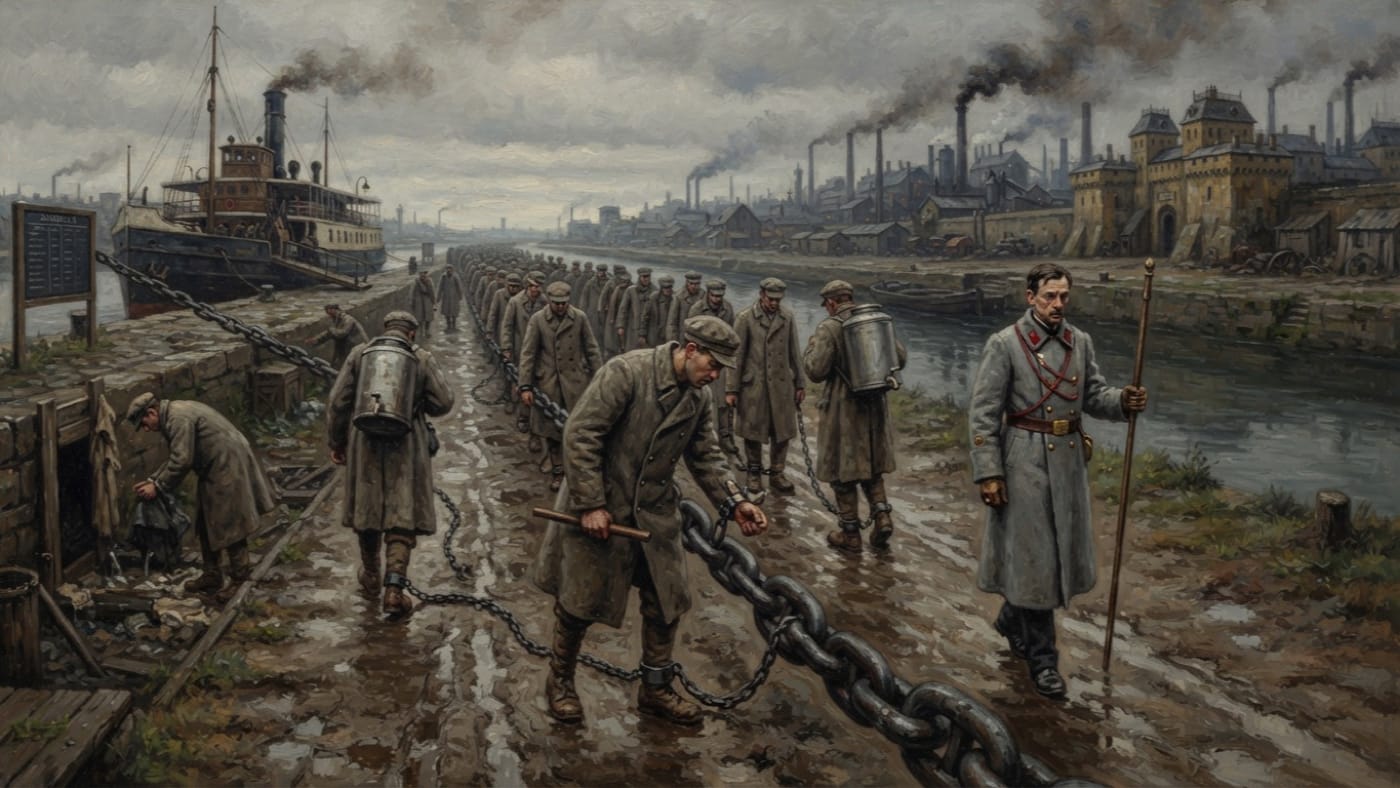
Here is what I saw. Kessler's Link-Runners carried short rods. They seldom needed them, because her voice reached the trouble first. On empty road she walked the flank listening to the chain: link-spacing, foot-drag, the rattle of a cuff on a thinning wrist. Then she spoke, and the Runners moved.
"Shorten." "Loose left." "Lift the wrist." "Breathe on four."
I recorded the words and I record them again. They were her orders, given on her column, as I heard them. I will not promote them into a drill for every chain in the Church, because I have never seen them written in any manual, and a theologian who invents a manual has a short and well-deserved career. I also will not claim the rods were never raised. Seldom is the word I wrote, and I meant it.
As for why each order was given, I can offer only what an observer may infer from standing close. A shortened segment drags less. A wrist lifted is a wrist not yet torn. A count of four for breathing is a cadence, and on that road cadence was the only thing that could be handed out without being entered against a quota. Those are my inferences. The commands were hers. The hands that carried them out down the line belonged to the Runners, and the record never names one of them.
#On Water and the Latrine Lane
The third account comes from a different road. My survey of the Munich–Sibiu Jubilee Road, between the Munich depots and Bastion-Sibiu, gives the Runners one sentence: Link-Runners haul the water and walk the latrine lane.
That is the Munich–Sibiu account, and it belongs to that corridor. I did not see Kessler's Runners haul water on the Przemyśl road, though somebody must have filled her gourd. I did not see them walk a latrine lane, though every column produces one. Whatever my nose may suspect, I decline to carry duties from one road to another. Readers who want a single job description for every Runner on every route may write to the Bureau, which will reply with a form.
The same passage lists in detail what the Handler wears and carries: the ash-grey coat, the red cord of authority, ranked keys, a tally slate sealed in wax, a ration gourd and a brass mercy ring notched for each issue of relief. All of it is the Handler's. The passage gives none of it to the Runner. The Runner hauls water that the Handler issues, and the mercy ring counts the issue on the Handler's finger. Relief on that road has been pre-allocated since the A.S. 141 formula. Water carried by a Runner remains, for accounting purposes, the Handler's water, and its lawfulness depends on the Handler's interval.
The published Pilgrim-Chain Handler survey states that a Link-Runner carries the lowest-rank keys, sufficient to adjust a cuff's tightness.
Restricted for this compilation: the river, column and road accounts surveyed here enter no key on any Runner. On the Munich–Sibiu road the ranked keys appear in the Handler's equipment. The profession survey's statement stands in that survey and is not certified here. I sealed both documents, and I am perfectly capable of disagreeing with myself in writing.
On every road where they appear, the Runners work at the Handler's word, beside a chain they do not command and within an allotment they do not set. Nothing in these accounts describes a Runner chapter, a Runner seal or a Runner grievance. If they ever had meetings, nobody took minutes.
#On One Folio
There is a single career on file. Maren Kessler's personnel folio records an initial assignment as Link-Runner on the western pilgrimage roads. Later entries record her as a licensed Handler, then Handler Third Class, and her retirement in A.S. 196 / 1906 CE to a village outside Mainz. The folio gives no date for the first assignment and no account of what she did in it.
Junior clerks love this line. They read it as a staircase: Runner below, Handler above, and the step between them earned by obedience. It is one woman's folio. It shows that one Handler began as a Runner on one set of roads. It does not show that every Handler began there, or that every Runner rose, or that rising followed any fixed order of steps. The folio records her first post and nothing about how she climbed from it.
A clerk's gloss on the Kessler folio, appended to a draft of this survey, describes Link-Runner as "the established entry rank from which Handlers are drawn."
Struck. The folio supports one assignment in one career. The clerk has been asked to show me a second folio before he writes about a ladder.
I find myself wondering whether she learned to listen to a chain while walking beside one at somebody else's command, with water in her arms and an order in her ears. The folio does not say. I asked her a number of questions on the road to Przemyśl. That was not one of them.
#On What Remains Unentered
The register is short. It is the whole register.