
#On the Attribution
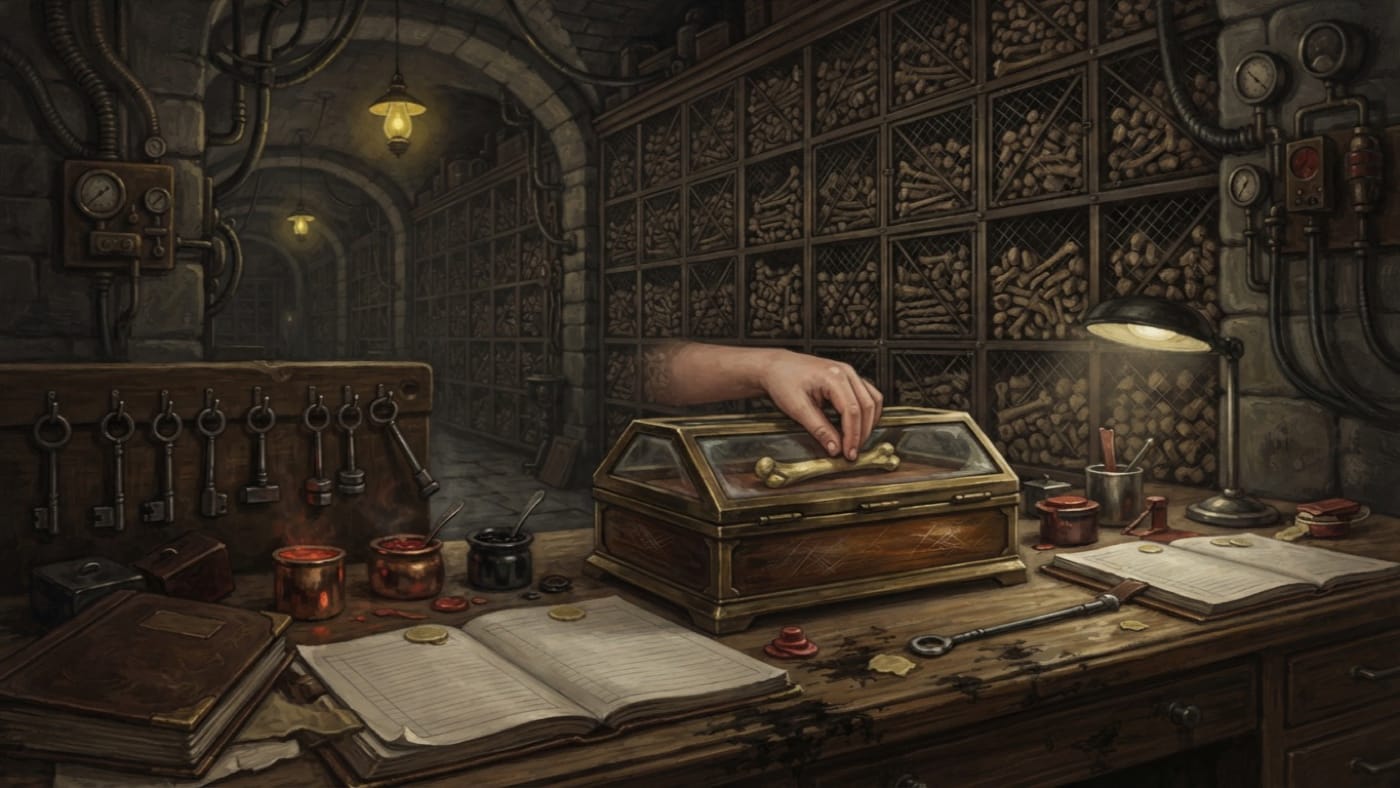
The Little Finger Bone of No Parish is a fragment that devotion attributes to Saint Vellum-of-the-Quiet-Hand and that nobody has authenticated. The Bureau of Relics has issued no Sanctity Writ for any object in her name. This one gets no exemption for being small.
The title makes three claims in four words. The thing is a bone. It came from a finger. The finger was the little one. This entry records all three as claims made by the name, because no measurement, colour, age, species or place in the hand has reached this office in a form I would sign. A pilgrim who wants to know whether it came from the left hand or the right may ask the Creator, Who has told me just as much.
No Parish comes with the object, and nobody has supplied where it came from. Nothing in the file says who first used it, in what register, or with what intent. A name this suggestive invites invention. In an afternoon one could produce a vanished village, a burned register or a corpse no family claimed. The record supports none of them, and suggestion is not provenance. I keep the designation exactly as written and say nothing more about it.
What the record does hold is short and in order. The bone appeared, was venerated, was tested, was doubted, and was returned to custody. The parent dossier gives that sequence without a single year attached, and I have no warrant to add one.
#On the Hand the Workers Invoke
Ritual Bone-Stampers go below after curfew carrying tap-rods, district-coded stamp-heads, warmed wax wafers and ledger slates that must balance by morning. They listen to a bone for drift, wipe it, set it on its proper axis, press the seal at the prescribed force, cut the notch, write the count and return it to the stack in the official pattern, or in whatever pattern keeps it still. The work runs on conviction. Conviction runs out faster than wax, and no quartermaster issues more.
Vellum is the saint they pray to as it runs out. The Bureau of Records keeps her feast in the ossuary calendar. The Bureau of Rites has never confirmed her canonisation. Her patronage entered institutional use with the Records directive of A.S. 92 (1802 CE), which made bone-stamping a licensed trade. Her vita sits in the convenient fog before that year: a copyist in the underworks of Bastion-Brest on the Bug, with no given name, no parentage and no parish. Nobody has placed the bone at Brest, and neither does this entry.
A saint with no parish and a bone called No Parish make the kind of rhyme devotion adores and Records cannot file. A rhyme is not a chain of custody. I note the coincidence, and a coincidence is all it is.
The hunger is easy to understand. A saint is a story. A bone is a story that can sit on a shelf in the same cold room as the worker. When a young Seal-Warden's hand will not stop shaking over warm stone, a story told in daylight comforts her less than the thought of an object in the building. That thought does not need a Writ to work, and it never asked for one.
Her icon shows a bare hand over an unnamed skull. That is iconography. Painters do not supply phalanges on request, and an artist's choice to leave the hand ungloved proves nothing about the bones inside it. Her prayer, Quiet the hand. Bite the wax. Hold the dead., belongs to her whole cult. No record assigns it to this fragment or gives the fragment a rite of its own.
The worker who thinks of Vellum's finger in a bad corridor is asking for a hand steadier than her own.
"The worker who thinks of Vellum's finger in a bad corridor…"
Corrected. The possessive belongs to the devout, and this office let it into its own sentence. Read instead: the little finger bone attributed to Vellum. The Ledger does not grant ownership to a saint whose canonisation is pending, on behalf of a bone whose authentication never happened, because a clerk liked the sound of the shorter phrase.
#On Authentication
Three different questions bear on the object. The ignorant confuse them, and so, regularly, do people who ought to know better.
The first belongs to the bone-stamper. Is this bone counted, sealed, placed and quiet? A containment mark answers that and nothing else. It records that a skilled worker has stopped a fragment of the dead from being a problem tonight. It says nothing about whose fragment it was. Stampers seal anonymous remains every night of the year, and an anonymous bone is exactly the kind they seal best.
The second belongs to the Relic Authenticator. Whose was it, and is it holy? The profession's general practice is intake and quarantine, reconstruction of the custody chain, physical examination for tool marks and residue, a test of fit with authorised doctrine, response testing under lamp and bell-hum, then a drafted verdict, notarisation and disposition. I give these as the standard practices of the trade. The file supplied for this bone holds no examination report, so I do not say which steps were taken, by whom, or with what result. The parent says only that it was tested and doubted. I will not dress that up as a hearing.
The third belongs to Rites. Was the supposed owner a saint at all? Here every object in Vellum's name is stuck. A flawless provenance, traced link by link with no missing page, would still end at a woman whom Rites has not confirmed. Relics cannot authenticate a relic of a saint who does not yet officially exist. Rites will not let her exist on the strength of an object Relics has refused. Each Bureau can blame the other for ever. Both have given every sign of enjoying it.
#On Examination and Return
The bone belongs to a group of six. The others are the Quiet Wafer of Ulm, the Brest Palm-Cloth, the Mainz Stamp-Head, the Strasbourg Apron Strip and the Ashen Thumbnail of Cologne. All six appeared, were venerated, were tested, were doubted and were returned. The bone shares that fate with the rest. Nothing else connecting them is documented, and that fate is not evidence of a common origin. Six objects attached to one saint make a cult. They do not make a workshop.
Only one of the six has its finding published with a date. Relics examined the Palm-Cloth in A.S. 140 (1850 CE) and found ordinary linen, ordinary soot, ordinary wax and no demonic contamination, and concluded against authenticity. That verdict was delivered on linen. It cannot be carried across the shelf and applied to a bone, any more than a coroner's report on one corpse can be stapled to the next body in the cart. Whatever the bone's examiners looked for, and whatever they found, was their own business. None of it is the Palm-Cloth's.
Doubt names no culprit. Calling the bone unauthenticated identifies no forger, proves no deliberate manufacture and says nothing about whose finger, if any finger, it once was. The Great Deceiver is credited with enough already without being handed every object that fails a Relics hearing. A failed attribution is a gap in the evidence. A crime needs someone who committed it.
Custody is a different gate. In Relics vocabulary, "returned to custody" means placed where revenue may continue under supervision. The Bureaus keep Vellum's objects for what the review dossier calls pastoral-operational utility. That review hides its quantities and outcomes behind black bars. I can confirm that the bone was retained. I cannot name its keeper, its shelf, the terms of its keeping or any miracle, tariff or quieted corridor credited to it, and I will not make any of these up to get a better paragraph.
#On the Unsettled Entry
As of A.S. 201 the Bureau of Doctrine has ratified Vellum for operational devotion. That ratification covers her cult: the feast after last bell, the wafers laid in rows, the prayer said three times in the warming alcove. It does not cover her body. Doctrine accepting that stampers may pray to her authenticates no fragment of her, and no clerk should read the ratification as a Writ issued sideways. The Bureau of Relics has issued nothing new. The bone stands where the parent left it: attributed, venerated, tested, doubted and kept.
Records keeps her feast. Rites keeps its doubt. Relics keeps the bone. Doctrine keeps the peace among the three by describing the matter as settled, and it is settled in the way a sealed corridor is settled, until someone has to go back in.
The name remains unexplained, the hand unassigned and the owner unconfirmed. The bone stays in custody and remains on the books. Should any office produce a provenance chain, it may submit it through the proper slot. Until then, this entry is closed.