
#On the Nineteen Miles
"A road that vanishes in spring is a road that has opinions." — Cantor-Toll Sevra of the Third Causeway, deposition before the Bureau of Engineering, A.S. 187
This file surveys the Long Salt as it is crossed in A.S. 201: its route, its tolls, its winter, and the conditions under which a traveller may expect to reach the far side. It does not record when the road was first laid. The Bureau of Records holds no such date, and I have declined to invent one for the comfort of the index.
The Long Salt is the Third Causeway of the Salt-Vigil Causeways: nineteen miles of raised winter road across frozen marsh and the Frisian shallows. Nineteen miles is the top of the network's recorded range, and the Bureau of Engineering calls the Third the jewel of the seven. The Engineers have never been asked to walk it in a wind.
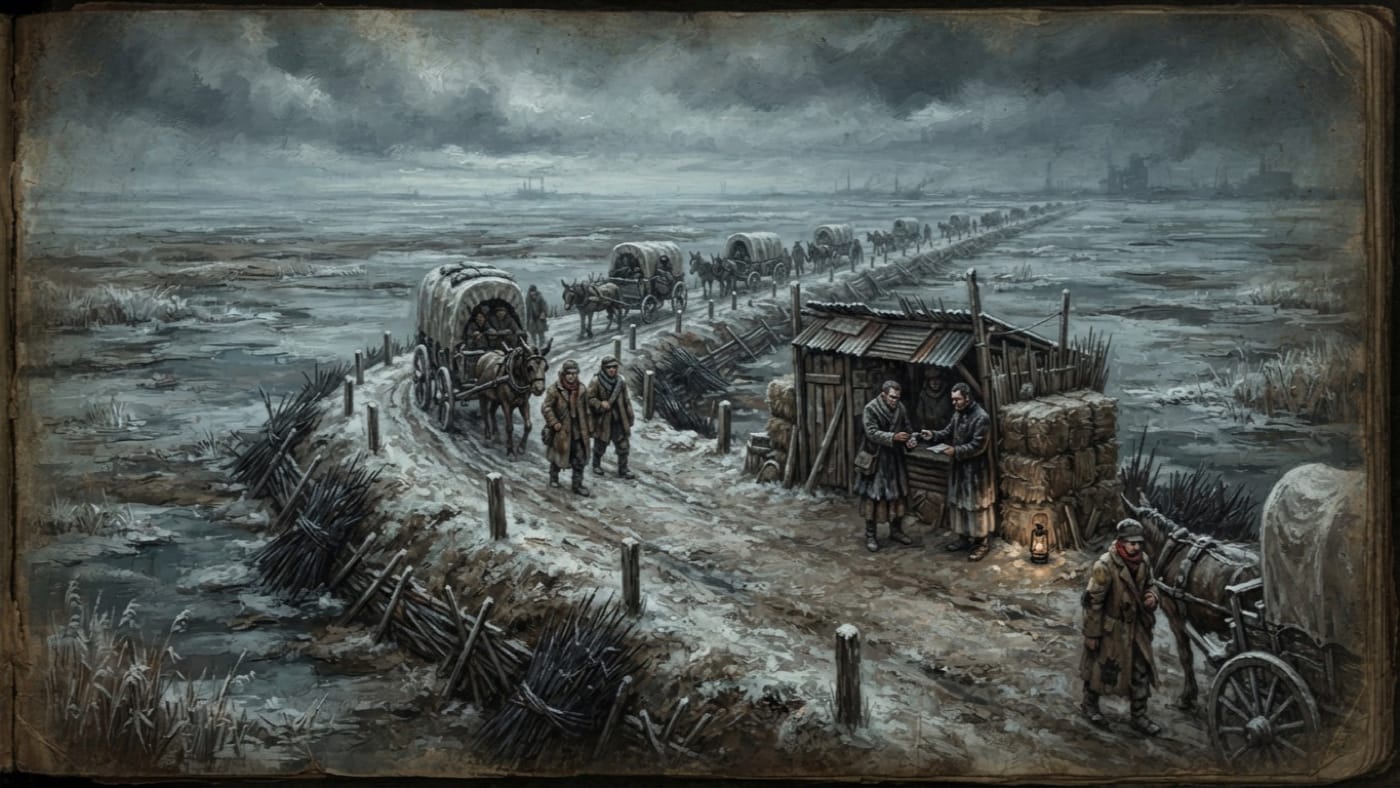
In summer the Long Salt is marsh, and the Engineering maps colour it the same green they keep for "terrain of no administrative consequence." In winter the mud sets and the shallows harden under a crust of salt. A line of reed stakes then marks out a road that the order builds and the north depends on. Records files it as Seasonal Arterial Infrastructure, alongside six siblings. The wagoners call it the Long Salt, and they say the name the way men name a debt.
#On the Fork and the Northern Road
The Long Salt begins at Brine Fork, the marsh island where the order's roads converge and where Prior Idris of the Sixth Tide administers the Salt-Vigil road chapter. The Candlewick Spur comes up to the Fork from the Palatinate's canal-gates. A southern road goes off toward the western gatehouse of the Queue Road. Shorter seasonal branches run to fishing villages and salt-panning stations, among them the Brielle spur, which is a separate road with its own troubles. The Long Salt runs northeast toward Hamburg's overland approaches.
Observe the preposition. The road runs toward Hamburg. The survey records its length and its bearing from the Fork and names no terminal gatehouse at mile nineteen, so I will not build one in ink. Cartographers who need a grander ending may petition the frost.
The Long Salt connects the northern ports to the Heartland supply network at the season when the alternatives fail. The Rhine barges ice in and the coastal lanes go storm-wracked. The Rope-Ferry Chain halves its crossings once the rivers freeze. On paper the Long Salt is cheaper than the ferries and quicker than the barges. Nobody on it would call it kinder.
Engineering reports that the road crosses the shallows in a line so straight it suspects divine intervention. The Salt-Vigil credit "good surveying and a total disregard for comfort." I record both as impressions taken by eye across flat country. No bearing has been certified, and no miracle has been filed.
#On Winter Passage
The road exists only while the frost holds. The network keeps its ordinary season from November to March, subject to conditions the Bureau can record and cannot order. Each autumn the order raises the causeway again out of what the marsh supplies: stakes, reed, packed earth and salt. Each spring the thaw takes it back. Nothing on the Long Salt is permanent except the requirement to rebuild it.
Nothing on the flats stops the wind. It comes off the shallows at the height of a man's face and keeps coming for nineteen miles. Wagons crust white along their windward boards. Mules learn to walk with their heads down. Travellers give up talking within the first hour, which the toll-confessors count as a mercy.
The Salt-Vigil stand in it by vow. Under the Vow of Exposure, every brother and sister spends at least six hours of each winter day at their assigned toll-post. They work bare-handed, with salt-cloth wrapped on their feet, and their only shelter is a waist-high windbreak of stacked reed bundles. The Bureau of Mercy has lodged nine formal objections. The order has filed nine replies, and each reply is the single word Endure. I have read all eighteen documents. The replies are better drafted.
The certificate covers that one season, from its opening to its closing. Nineteen people died of cold. Seven drowned when the ice gave way at mile fourteen, and that is all the certificate says about mile fourteen. The three disputed deaths are referred to an incident file that has not been placed before this survey, and I will not write its contents for it. Every one of the twenty-six undisputed dead is accounted for by weather and water, which are the oldest clerks on the road.
#On Salt and Sealed Payment
A traveller on the Long Salt pays two collectors, and neither one recognises the other's receipt.
The first is the Bureau of Tithes, which takes its crossing fee in Synod scrip, salt tokens, or the Palatinate's wax-sealed trade chits. The second is the order, which takes salt. The salt is stored at Brine Fork and spread on the causeways the following autumn, so the road is resurfaced with what it collected the winter before. The Tithes clerks call the arrangement efficient. The traveller calls it something else, and the toll-confessor writes it down.
Those who can carry neither fee nor salt go into the Weeping Chamber. A brother or sister of the Vigil sits as witness with a glass phial of the standard issued by the Bureau of Alchemical Standards. The traveller confesses whatever grief, sin or exhaustion brought them onto a frozen marsh in winter. When the tears come, they are collected. The phial is sealed, stamped with the date and the toll-station, and sent to Brine Fork. The traveller crosses, and the debt is entered as paid.
Earlier editions of this Codex, compiled under Hieromnemon Octav, described the Salt-Vigil tithe of tears as "ceremonial in nature and of no practical consequence."
Corrected. The tear-tithe is a material levy. It is collected in standardized phials, sealed, stamped, forwarded and kept. Octav's ceremony has a filing system, a cellar and a liaison assessor.
The phials go to the Brine Fork cellar, which held eleven thousand four hundred and six at its A.S. 199 inventory. That figure covers every station and every winter on record. The documents before me do not say how many of those phials came from the Long Salt, and I will not cut the Third a share by guesswork.
The Third Causeway's phials have one distinction on record. In the A.S. 200–201 season, Assessor Maren Gault weighed the Fourth Post's tears against matched samples from the other toll-houses, and the Third's phials were among those samples. They were her ordinary.
Prior Idris says that the road drinks, that all roads drink, and that his drinks what it is given. I record this as the Prior's belief. No Bureau has turned it into a finding.
#On the Refused Transfer
After the Fourth Causeway failed in A.S. 199, Brother Erasmus of the Fourth Post asked to be moved to the Third. Prior Idris refused, as he refuses transfers on principle, and kept Erasmus at the Fourth Post. Erasmus serves there still. His station, his contact with the open water and the closure all belong to the Fourth Causeway Anomaly and to his own file. He was never posted to the Long Salt, never inspected it and never kept a toll on it.
His dossier describes the Long Salt as "nineteen miles of honest misery with nothing at its eel bends but eels." That is a comparison made by a man asking to leave a worse post, and it should be read as one. It is not an inspection. The Long Salt's bends are covered by the Long Salt's certificate, which lists seven drowned at mile fourteen. A road can be honest and still drown people.
During the Fourth's closure in the A.S. 199–200 season, convoys went round by the Third Causeway and by the Queue Road's western gatehouse. No diversion totals have reached this survey. The Long Salt carried part of the Fourth's traffic that winter. The Fourth's open water, its covered lamps and its Amber procedures remain filed against the Fourth, and nothing in this survey moves them nineteen miles north.
#On the Present Condition
In A.S. 201 the Salt-Vigil network is classified Operational (Seasonally). Every causeway is graded Green (Standard) except the Fourth, which is Amber (Monitored). The Long Salt is therefore Green, and that is a seasonal grade only. It does not promise that the road is open on any particular day, and the frost has never signed it.
The survey records what it could verify: the road's designation, its length, its junction, its bearing, the dates of its last season, its dead and its methods of payment. It does not record a founding year, a count of bridges, a named terminal post or any load figures the Engineers have certified. Those gaps belong to the archive. I prefer an honest blank to a confident lie.
The road will freeze again or it will not. Prior Idris will be standing at the Fork either way.