

#On the Compilation and Its Limits
A survey of houses that declines to count the houses.
This entry is compiled in A.S. 201, the year 1911 of the common reckoning, from my own inspection notes, the published accounts and the testimony filed with them. The year belongs to the compilation. Nothing in the Longhouse Rows was founded, built, inspected or quarrelled over in A.S. 201 on the evidence of this page, and the Bureau of Records is asked not to infer otherwise from the date on the cover.
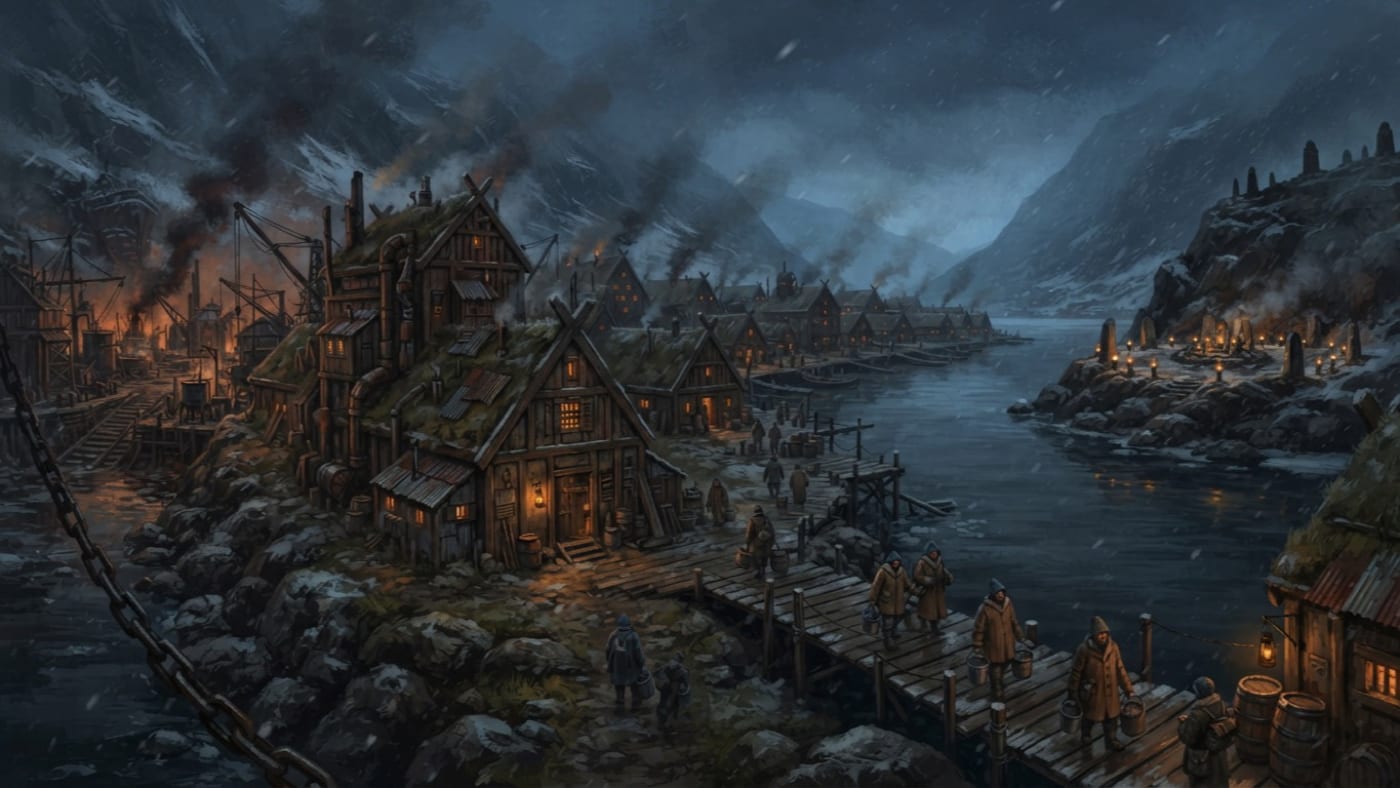
The Longhouse Rows are the clan housing of Hrafnvik, one quarter of a settlement strung in hamlets along a single fjord of the Norwegian coast in the Fractured North. They are not Hrafnvik entire, and they are no separate village. The Rows are where the longhouse families sleep, eat and wait out the dark, and they are the reason every count elsewhere on the fjord matters. A barrel notched in the Render Yards ends up as hours of light behind a door in the Rows, or fails to.
I can't give the Bureau a plan of the quarter. I have no measured boundary for it, no founding year, no builder and no house count. I spent nine days at Hrafnvik during the compliance inspection of A.S. 197, and in that time nobody offered me any of these things. I did not think to demand them until I was back in Strasbourg, where such omissions are considered a moral failing. The census figures for A.S. 195 and A.S. 197 are figures for Hrafnvik. Neither of them counts the Rows, and the difference between them counts nobody's dead.
#On the Western Bank
The houses face the water. The water does not return the courtesy.
The published survey puts the Rows along the western bank of the fjord. The Render Yards lie at the south end, where the carcasses are boiled. The Slipways lie at the narrows, and so does the chain the Clan Moot keeps across them. The Shrine Rings stand on the eastern cliff and the Watch Cairns along the ridge above. These are the relations as they were reported. They do not make a site plan, and I have not drawn one. Anyone who prints a map of Hrafnvik over my name has taken up cartography without a licence.
What I can certify is the smell. The Rows smell of smoke and wet wool, with the steady fat of the stewpot underneath, so that a southerner learns the quarter through his nose before his eyes have finished watering. In midwinter the dark runs twenty hours. Coal from the south fails when the strait freezes. The published accounts list smoke-poisoning in sealed longhouses as a hazard that kills more reliably than demons, and the Rows are where a family must choose between a shut door and a cold one.
Routes matter more than distances here. Oil comes up from the yards, papers come over from the Chapter, and the Winter Watch decides which paths are walked and by whom when the whiteout falls. A house in the Rows is joined to all three by its obligations. I have no measurement of how far it lies from any of them.
#On the Household and Its Obligations
Every door in the Rows owes something to the yards, the shrine and the ridge.
A household in the Rows owes the Moot its oil-tithes, its watch-hours on the cliffs, its fast days and its wick dues. In return it receives communal lamp-aid, the allowance of oil and lamp-time drawn from common stores that carries a longhouse through the dark. The two columns are kept by different hands, and the household lives in the gap between them.
The work arrives by schedule. Elder Sigrun Half-Wick sets the render schedule at dawn and alters it as the catch requires. Under it one household skins, another boils, another tends the vats through the night, another carries oil to the Shrine Rings and another stores barrels in the Frost Pits. Each assignment is both wages and sentence. First rendering brings the earliest heat and the worst scalds. Night-cooling brings the first accusation when a barrel comes up short.
The count is cut into wood, because paper rots in the damp. Barrel staves carry notch-codes. Oil-chits and bone tokens settle smaller debts between neighbours. Lamp-time can be owed, traded and withdrawn, and when it is withdrawn the consequence is felt in one particular house.
The south confuses two things here, and a careful clerk should keep them apart. Communal oil belongs to the Moot's allocation, and the household holds it only on the terms of the schedule. A household's own wicks, lamp and stores are its own to ration. Conservation happens inside a single house when a family burns what it has more slowly. Withdrawal is a judgement passed on that house from outside, by people who still have oil. The shears make the same motion either way. Only the ledger records the difference.
The jurisdictions are separate as well, and I set them down plainly because the Northern Office has blurred them before. The Moot allocates. The Shrine Chapter of the Blessed Wick, under Prior Malthus, keeps the fast calendar, the exemption papers and the confession record, and reports south. The Watch, under Rauk One-Eye, keeps the routes and the escorts, and makes the rescue choices. A household's claim to warmth may need all three to agree.
#On the Split Barrel
The Chapter keeps the form. The Moot keeps the weight.
The best account I hold of a claim from the Rows crossing every one of these jurisdictions has no date, and I will not give it one. It followed a thin-seal week. Prior Malthus moved to deny fast exemptions to three households. The published account names none of them, and neither will I.
The ground was a quota. Malthus held that the households had failed it. Sigrun came out to meet him in a blizzard, halfway between the Longhouse Rows and the narrows chain, carrying a lantern and bringing two witnesses and a barrel tally. That is the account's own description of the place. It tells you where the argument stood between two landmarks. It is not a surveyed distance, and I refuse to turn it into a route, a doorway or a reconstruction for the edification of people who were indoors at the time.
The tally showed that the households had met quota by weight, though not by notch. One barrel had split and been rebound, and the notch-count on the rebound staves no longer agreed with the oil they held. Under the Chapter's form the shortfall was real. On the scale it did not exist.
Malthus objected to the form. Sigrun asked whether he wished to lick the oil from the snow and count it personally. The exemption issued.
Nothing in the record says whether the three households fasted afterward, kept their lamp-aid, or remember the night with any gratitude. The record shows that a claim made by houses in the Rows was decided in the snow outside them, and that the decision turned on a cooper's repair.
#On the Half-Wick House and the Dark Doors
One longhouse lived. The fjord has quoted it ever since.
Sigrun's standing in the Rows rests on one household's survival. The testimony on the Seal-Death Winter of A.S. 188 says she had oil for three weeks and cut every wick in her household in half. The oil lasted seven weeks. She lost two fingers to frostbite, and every member of her longhouse lived. I have seen the hand.
The account goes no further than that. It does not explain how three weeks became seven, and I will not explain it for the testimony. It does not count the other houses in the Rows that winter, and it does not say who lived or died behind their doors. It does not prove that this winter was the undated seal die-off that local tradition says brought the mandatory fasts and the first dark-houses. Malthus arrived in A.S. 192, four years after the thaw. He kept no calendar that winter and denied no one anything.
Her authority over the doors of the Rows now comes from that winter, from her reputation and from the Moot's assent. No Synodal charter grants it. A household that fails quota, breaks a fast without sanction, sells tainted oil or puts out a shrine lamp in spite may lose its lamp-aid and become a dark-house. The Chapter's Doctrine of the Lamp calls this purification. The Moot calls it discipline. The household notices only that the house is cold. Sigrun has ordered doors left unlit for three nights. She has also sent wicks to dark-houses by routes that no Watch report records.
The published accounts describe the Dark-House Circle as well: hidden oil, stolen wicks, and unlit paths between excluded houses and their caches. I record that such help exists. I do not record who gives it, who receives it, or which door in the Rows it reaches. The Circle keeps no minutes, and the Bureau will not get them from this compilation.
#On the Present Condition
Compiled A.S. 201. Nothing here was revisited to compile it.
As this compilation closes in A.S. 201, Hrafnvik's conditional compliance stands renewed pending review. Seal returns have thinned. The south asks for tighter quotas, because Bastion-Königsberg burns northern oil and the Northern Office takes the barrels as its measure of faith. The longhouses ask for fewer fast days, and in a lean year every fast is felt first in the Rows. Warm Paper Brokers multiply at the Slipways and sell exemptions for oil that a household in the Rows must render again next season. Sigrun remains active. So do Malthus and Rauk.
I have not returned to Hrafnvik. This page is a compilation from the desk, made in a warm room by a lamp nobody counted, and I mention that only so the Bureau knows which of the two of us has the easier winter.