

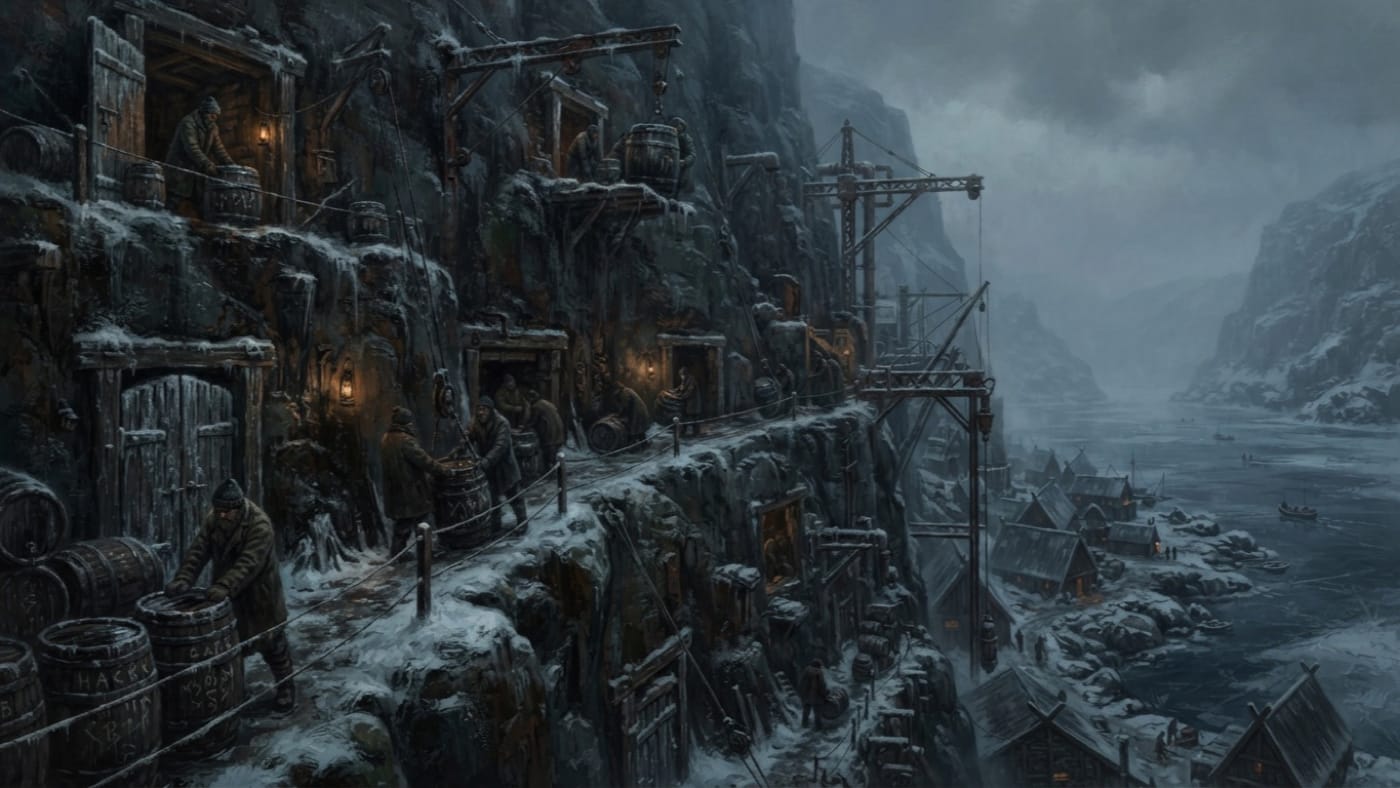
#On the Pits and the Present Compilation
The south asks what the pits contain. The north asks who is owed it.
The Frost Pits are storage chambers cut into the cliff face at Hrafnvik, a village cluster strung along one Norwegian fjord in Zone 8 of the Fractured North. Barrels of seal-oil are kept in them. The published testimony says the cold keeps fat from turning, and since it says nothing more about the cold, neither will I. I can give you no temperature, no season in which the stone warms, and no engineer. Nobody has shown me a builder's name, a year of cutting, a chamber count, a measured depth or a plan. I decline to draw one for the Bureau of Records merely because its forms contain a box shaped like a floor.
The record supplies only a few physical facts: cold stone, damp, wooden barrels, the smell of oil, and the numb hands of the people who handle them.
This survey was compiled in A.S. 201 / 1911 CE. It draws on my nine-day compliance inspection of A.S. 197 / 1907 CE and on accounts already published in this Codex. I made no fresh visit to compile it. The year at its head is the year of the compiling and nothing else.
#On Storage and the Render Schedule
The seals keep a season. The lamps keep none.
At Hrafnvik, storage is a household duty, and Elder Sigrun Half-Wick assigns it. She sets the render schedule for the Clan Moot and adjusts it as the catch requires. It fixes which households skin, which boil, which tend the vats, which carry oil to the Shrine Rings, which store barrels in the Frost Pits, and which load the shipments bound south. These are six assignments within one economy. I found nothing that sends every barrel past every one of them in a fixed order. The Bureau prefers a single flowing diagram, and the fjord is under no obligation to supply one.
The pits solve a problem of timing. Seal carcasses come over the shingle when the seals come. The shrines want oil every night of the year. The south wants it when the ice lets a hull through, and every longhouse wants it most in the twenty-hour dark, when the catch is thinnest. Oil rendered in a good week has to wait somewhere for all of those demands, and in Hrafnvik it waits in the stone.
The storing household pays for that with its labour. The barrels are heavy, the stone is wet, and fat soaks into wool. The Moot's published account says the carriers smell of fat for a week and that everyone suspects the storers. Whoever handles the reserve is questioned first when the reserve comes up short. In a fjord where a shortfall can be entered as theft rather than a thin season, that suspicion has a price.
The Shrine Chapter of the Blessed Wick blesses the batches. Accounts differ on where in the work the blessing falls. I will not merge them into a liturgy the Chapter never wrote.
What happens without stores is recorded elsewhere. In the Seal-Death Winter of A.S. 188, Sigrun stretched three weeks of household oil across seven and lost two fingers doing it. That winter dates her name. It does not date the pits. I mention it only because no one who has read of it will need telling why a fjord cuts storage into a cliff.
#On the Count Kept in Wood
Paper rots in the damp. A notch survives the winter.
Every barrel in the pits carries notch-codes cut along its staves, because ink runs in the first sleet and paper goes soft in the Hrafnvik damp. The barrels carry tags as well. Both are attested, and I will not invent a theory of why a fjord keeps two kinds of mark when the south keeps eleven. Nobody explained the notch-code to me, and this survey does not explain it to you.
The notch links the stored barrel to everything else Hrafnvik owes. Oil-chits and bone tokens settle debts between households. Lamp-time, the hours of light a household draws from communal oil, can be owed, traded and withdrawn, and under the Doctrine of the Lamp the Chapter reckons lamp-debt as sin. At the lamp audit the elders check the notches on the barrels against the wicks burned and the oil remembered. When notch and memory disagree, the elders settle it.
Three powers handle the count, each at a different point. The Moot allocates communal oil and lamp-aid. Prior Malthus and the Shrine Chapter keep the fast calendar, the confession ledger, the exemptions, the passage papers and the reports sent south to the Bureau of Doctrine. Rauk One-Eye and the Winter Watch decide routes, escorts, closures, and who is fetched back from the ice. No account names a keeper of the Frost Pits, a guard at their mouths, or a deed to their stone. Sigrun assigns the households that store. That is authority over labour, and the file claims nothing larger.
So holding oil and having a right to it can separate. A barrel can sit in the pit, notched and counted, while the household that stored it has been struck from communal lamp-aid and made a dark-house. The oil is there. The household's right to draw on it is gone, and the notch records only the first fact.
A Northern Office abstract of A.S. 195 described Hrafnvik's oil allocation as "managed jointly by Shrine Chapter and Clan Moot under Synodal advisory order."
Corrected after the A.S. 197 inspection, as already entered in the published Hrafnvik accounts. The Chapter blesses, documents and exempts. The Moot allocates. The Watch decides passage. This survey reproduces the existing correction and extends it no further. The Frost Pits appear in neither the error nor its correction.
#On Oil Under Other Names
A tag is a statement. In Hrafnvik, statements are cut to fit the winter.
The Dark-House Circle hides oil in the Frost Pits under false inventory tags. The published examples are good oil tagged as tainted render, oil tagged as tithe already delivered, and oil tagged as the stores of a household that died. Those are examples. I do not know the full list, and I distrust any clerk who says he does.
From the caches the oil leaves by routes that appear on no Watch roster. They are walked without a lamp, because a lamp on a cliff path at night is visible to every cairn on the ridge. Certain paths are also walked in silence. The Bureau of Rites classifies Hrafnvik's fog as responsive, and a name spoken aloud there may come back to the wrong ears. The oil reaches excluded households in small amounts: enough for a short wick, a pot kept from freezing, an infant kept warm. The carriers come back with numb hands. The longhouses speak of a dark-house midwife who carries oil under her coat. As far as my notes go she is a type. I have no woman's name for her, and I would not enter one if I had.
I knew of the Circle during the A.S. 197 inspection and left it out of my report to the Northern Office. I later acknowledged its existence in this Codex and withheld its people and its paths. This survey keeps that practice. The Circle's leaders, members and beginning remain unknown to the Bureau, and the routes out of the pits are not drawn here.
Sigrun's published dossier records that she hid unlogged warmth in Frost Pit Seven for births, fevers, and the old who had earned enough anger to be saved discreetly. The same dossier records that she withholds lamp-aid from households that miss quota or break the fast, and that she has ordered doors left unlit for three nights. I enter both. The hidden oil does not make her the Circle's commander, and nothing in the file proves she belongs to it. The sanctions do not make the hidden oil a lie. She keeps oil out of the same count she enforces. Hrafnvik does not seem to have expected anything else of her.
The Circle's published account says that some people are kept alive in the Frost Pits with oil under a false name. I read that as people kept alive by the oil. I would not read it as a population living in the stone. I have no count of persons and no evidence that anyone lives there.
#On the Present Account
The barrels did not wait for the compiling.
As of A.S. 201 / 1911 CE, seal returns at Hrafnvik have thinned. The south wants tighter quotas, because Königsberg burns northern oil and the Northern Office measures northern faith in barrels. A barrel shipped south is a barrel that never went into the pits against the next dark season. A barrel kept back is entered somewhere as a missed quota. The Moot, the Chapter and the Watch argue over the difference, each in its own office. Whatever the argument leaves goes into the stone.
Hrafnvik's conditional compliance was renewed this year, pending review. The renewal is a judgement on the settlement. It ratifies no local doctrine, approves no storage practice, and certifies no count of the Frost Pits.
This compilation adds no inspection, finding or order. It records cold storage cut into a cliff, assigned by household, counted in notches, checked against memory, and partly hidden under false names. The construction, founding, builders, chamber count, capacity, dimensions, temperatures, preservation times and means of access are unknown. The names and routes of those who carry the hidden oil are not furnished. A reader who requires more must go north. He should bring gloves only if he is prepared to lose them.