

#On the Winter and the Surviving Account
Hrafnvik keeps its calendar in barrel notches. One winter is cut deeper than the rest.
The Seal-Death Winter fell upon Hrafnvik in A.S. 188, the year 1898 of the common reckoning. The fjord-villages of the Fractured North do not keep it with a feast, a vigil or a fixed day. Nobody I questioned could name the month it began or the week it ended. The Shrine Chapter's ledgers record oil to the spoonful, and they record nothing of its opening or its close. What survives is one household's account and a name.
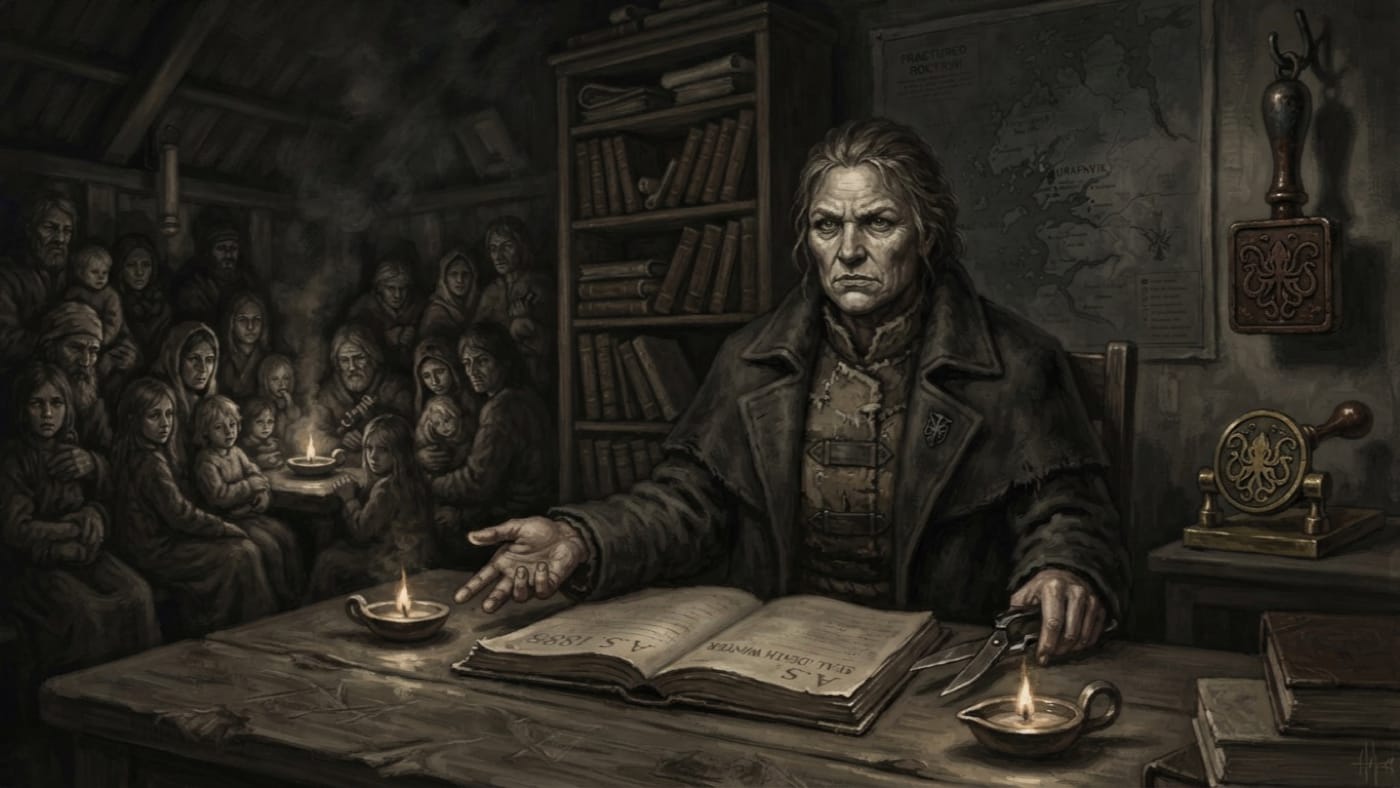
The account runs as follows. A woman of the longhouse rows had oil enough for three weeks, and she cut every wick in her household in half. The oil lasted seven weeks. She lost two fingers to frostbite. Every member of her longhouse lived. The fjord gave her the name Half-Wick, and the name has now outlived the winter by thirteen years.
That is all of it. The Bureau of Doctrine has never promulgated a teaching under this title, and I have found no instrument by which any Hrafnvik authority adopted one. The winter is cited all the same, the way a canonist cites a precedent he has never read in full: as settled, as sufficient, and as the end of the argument.
#On the Half-Wick
Half a wick gives half a flame. The arithmetic stops there.
A seal-oil lamp in a Hrafnvik longhouse is a shallow dish of rendered fat with a twist of fibre in it, and on a good night the flame stands as high as a thumbnail. Halve the wick and the flame drops to the height of a nail paring. The heat drops with it. Smoke gathers under the bone bracing, wet wool stops drying, and the household draws in around the dish until their knees touch. Anyone who has spent one winter evening in those rows knows that cutting the wick was more than a gesture. It meant being colder every hour, for every hour that remained, with no promise that the hours would run out before the oil did.
Sigrun made that decision and held to it. The published account says three weeks of oil became seven. I have done the division several times, in Strasbourg, by a lamp I did not have to ration, and halving a wick does not on its own turn three into seven. The account gives no reason for the difference. It mentions no hidden cask, no neighbour's charity and no wonder, and I will not supply one on its behalf. The Bureau of Records would call the gap an irregularity. I call it a gap, and I file the testimony as it was given.
The fingers are another matter. Nobody disputes them; I have seen the hand. The account does not say which two fingers, or in which week the frost took them, and I did not ask. One does not question a woman about her missing fingers while she is counting barrels.
The winter bought her standing. In Hrafnvik, a name earned in the cold is the nearest thing to ordination the clans recognise. A woman who had brought her whole longhouse through seven weeks on half a flame could speak about scarcity with an authority no southern prior could counterfeit. When she came to lead the Moot, nobody asked for her qualifications. She carried them on her hand.
#On Deprivation as Discipline
The wick Sigrun cut was her own. The wicks cut since are entered in a ledger.
Two different acts use the same motion of the shears. The first is conservation: a household with too little oil burns what it has more slowly, so that the oil runs out no sooner than the winter does. The second is withdrawal: an authority that has oil declines to give it to a household it has judged unworthy. Hrafnvik's present teaching treats the two as kin. I enter them in the ledger separately.
The Doctrine of the Lamp, as taught by the Shrine Chapter of the Blessed Wick, holds that light is grace and that giving it out is a sacrament. Lamp-time is taxed, traded and withheld. Lamp-debt counts as a moral failing as well as an arrear. A household denied communal lamp-aid becomes a dark-house. A person who breaks a fast becomes uncounted and loses lamp-aid and passage priority together. The Chapter calls this purification. It is the Chapter, not the Bureau, that says a cold house stands where the Creator has placed it. Strasbourg has neither ratified that claim nor condemned it, and I have no authority to do either in its name in a footnote.
Local tradition keeps a second winter underneath this one: a seal die-off, undated, after which the fasts became mandatory and the first dark-houses were declared. It would be convenient to call that winter and Sigrun's the same. Nothing I hold proves it, and the Chapter's ledgers do not go back far enough to rule it out. I keep them in separate folios. The origin of the fasts belongs to the undated winter. The Half-Wick belongs to A.S. 188. Whoever sews the two together is binding one book from gatherings of different paper.
#On Who Allocates the Oil
Three hands on one barrel, and none of them cold.
Hrafnvik today divides its warmth among three authorities. The Clan Moot sets the render schedules and controls how communal oil is shared out. The Shrine Chapter holds the fast calendars, the exemptions, the confession ledger and the warm papers. The Winter Watch, under Rauk One-Eye, chooses the routes and the escorts, and decides which house the rescue reaches first when a whiteout comes down. In midwinter the dark lasts twenty hours. Coal from the south fails when the strait freezes, and the narrows close. Under those conditions oil means survival, and whoever controls its allocation controls the households.
The account does not say who held which office in A.S. 188, and I will not fill that winter with officers borrowed from my own inspection. Prior Malthus arrived in A.S. 192, four years after the thaw. He imposed no fast that winter, negotiated no exemption and witnessed nothing. His predecessor goes unnamed in every document I was shown.
Sigrun leads the Moot now. The render schedules are hers, and she enforces them by withholding communal lamp-aid from any household that misses its quota. The woman who stretched three weeks into seven at the cost of two fingers can now, every winter, shorten another household's weeks with a notch on a barrel. I record both facts. I have no account of what she thinks when she makes the second kind of cut, and I will not invent one to flatter her or my reader.
#On Those Outside the Count
Every member of her longhouse lived. The sentence ends at the longhouse door.
The Half-Wick account is about one household. It stops at the walls of one longhouse, and the praise it earns is earned inside them. It says nothing about the other longhouses, the outlying hamlets, the refugees or those already uncounted. I found no register of the winter's dead. I found no record of how much oil reached the houses beyond Sigrun's, or failed to. Anyone who quotes the Seal-Death Winter as proof that Hrafnvik brought its people through has taken one household and multiplied it by the fjord.
The Bureau of Records offers no firmer ground with its own totals.
ERRATUM — BUREAU OF RECORDS, NORTHERN DESK The A.S. 195 census figure for Hrafnvik (6,200) is superseded by the revised A.S. 197 figure (7,400). The difference of 1,200 persons is a correction between two censuses. It may not be used to estimate losses in the Seal-Death Winter of A.S. 188, or the membership of any unregistered society.
Entered: Bureau of Records — Northern Desk — A.S. 199
Households struck from the ledger today are not always left to the ledger's arithmetic. The Dark-House Circle moves hidden oil and stolen wicks along unregistered routes to houses the Chapter has struck through. Nobody has told me whether such help existed in A.S. 188, who began it or when, and the Circle keeps no minutes. Its existence shows that a struck name does not always become a corpse within the week. It tells us nothing about the winter.
#On the Present Use of the Winter
A precedent needs no seal when everyone already obeys it.
In Hrafnvik the winter is now spoken of the way the clans speak of an oath, as something already decided. In my reading the winter has become a credential. It is my reading alone, since no instrument of adoption survives in anything I consulted. Whoever has endured scarcity is presumed fit to administer it, and whoever administers it can point to that endurance when a household complains of the cold. The household complaining has seldom lost any fingers. The Moot finds this persuasive. The Chapter finds it convenient: a deprivation the clans already honour costs less to enforce than one sent up from the south.
As proof that she was competent, the winter will serve. As a warrant to cut other people's wicks, it has never been tested before any tribunal I know of. The Bureau prefers it that way. So, I suspect, does the Moot.