
#On a City Kept to Time
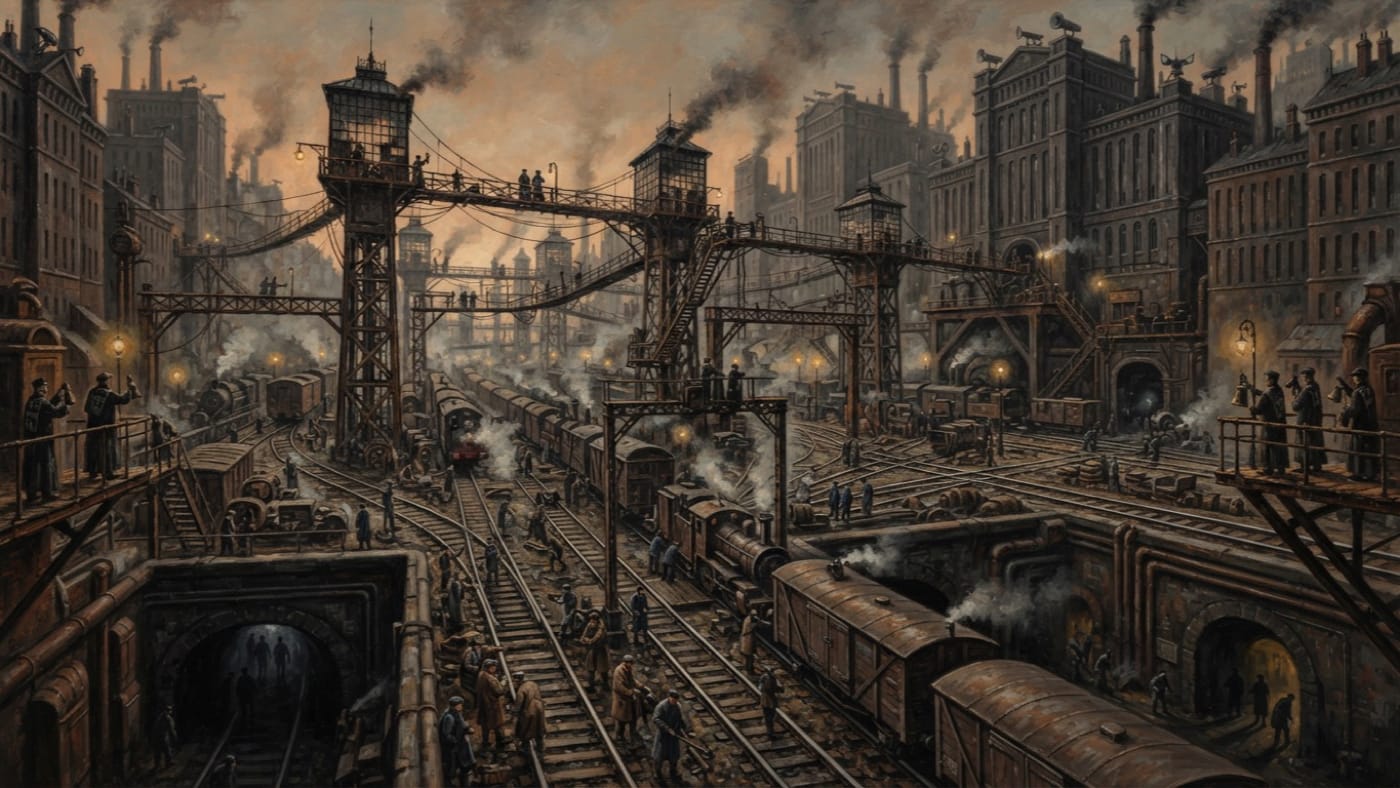
Lorn is a timetable that people happen to live in. Twelve rail lines converge on the Heartlands fringe where three supply corridors meet, in the Zone 2/3 belt behind the Sagittal Line (Unregistered). By Records' rounded reckoning some two hundred and ten thousand souls live around the junction, and more arrive whenever shift-workers, conscripts and pilgrim freight riders swell the count. The formal name is Lorn Palatine Logistics City. The street says the Switch. Those who have worked a winter there say Hymn-Grind, and the provosts fine them for accuracy.
The Palatine Switchyard is the reason the city exists, and the city is not permitted to forget it. A resident of Lorn eats when the schedule opens a meal line and marries when two route windows agree. Burial waits until the death receipt clears. Movement is licensed and licence is priced. The local saying reduces the civic constitution to six words: Sing it true or die on schedule.
#On the Town Beneath the Yard
A market town stood here first. No register the Bureau will lend records its founding year, and I will not certify any surviving form of its former name. Its cellar lanes remain. So, in a manner, does its chapel.
The recorded local sequence says that in A.S. 104 (1814 CE) Synodal war authorities requisitioned the town for rail and turned the chapel into dispatch premises. Prayer and departure have always been neighbours in the Church. At Lorn they were made to share a desk. Slag came afterward, berm upon berm, until the old streets lay under the new ones.
By A.S. 110 (1820 CE) the First Continental Levy had driven the yard into headlong expansion. Traffic was already moving through under-yard passages that appeared on no plan. Lorn grew as war requires, first quickly and then with a blessing.
Then came A.S. 112 (1822 CE). The Silent Derailment killed forty-one men of a night crew. In its aftermath every thrown switch required a voiced measure, and the cantor procedure that governs Lorn today took its present shape. The yard had sung before. Bell practice there was lawful under an Office of Bells constituted in A.S. 52, and the current Bell Codex would follow in A.S. 115. The change in 112 was obligation. From then on a crew sang or was fined, and the Bureau of Bells took a chair it has never vacated.
#On Wards, Catwalks and the Air Itself
The city rings the yard. Above the switch fields hang administrative catwalks, the iron-and-glass cages of the Switch-Towers, crane decks, and roofline horns that send dispatch hymns into every kitchen whether the kitchen wants them or not. Below them lie rail-cut gullies, soot flats and slag berms that settle without notice. Under those run the service passages and the cellar lanes of the town nobody names.
Rank in Lorn is measured in height. The Palatine Office looks down from the catwalks. Licensed cantors keep to Cantor Walk in ash stoles. The Cinderrow Wards house the shift masses in soot-brick terraces, and their canteens serve coal-oven bread, thin stew and salt tea in queues timed to the midday bell. A guest in Cinderrow is offered warmth and soap before anything else. Both are scarce, so the offer is a real one.
Dawn brings bell fog, steam and coal haze mixed so thick that the far towers vanish and the dispatch hymn is heard before it can be understood. Crews call their measures blind. The city's illnesses are its trade's illnesses: coal-dust lung, crush injuries from rushed coupling, grease fires, scalding vents, rails frost-locked in winter, and slag that gives way under a careless boot.
All of this tempo must pass through the Needle, the single-track pinch and inspection gate. Every delay in Lorn eventually has an address, and the address is usually the Needle.
#On the Three Chairs of Palatine Command
The Bureau of Records and the Bureau of Bells govern Lorn jointly through Palatine Yard Command. Three officers sit at its head, and each holds a different key to a resident's life.
Yard Palatine Odrin Kessel controls track priority. He can grant a window and he can withhold one. His god is throughput, because the Bureau of War consumes everything Lorn routes, and the front does not take apologies by the ton. He is known for immaculate gloves and, by report, for never stepping on gravel.
Prefect Halden Wry controls manifests and documentary identity from the Manifest Basilica. A worker whose name clears Records can be employed, fed and housed. A worker whose name does not clear is a problem waiting for its form. In Wry's Safety Booths, confessions are attached to employment licences: a man signs for the accident so he can keep the job that caused it.
Bell Marshal Sister-Calder controls procedure certification. Without her stamp no switchman throws, no tower calls, and no cantor sings for pay. She keeps a book of missed measures.
Their demands do not agree. Kessel wants speed, Wry wants inspection and Calder wants audible obedience. The worker stands between them and pays route-tolls, bell-fees, stamp fees, compulsory labour hours "for safety" and confession penalties for procedure neglect. The Yard Tribunal, the red-sashed provosts and the safety inquisitors collect. Lorn is a cheap city until you price obedience.
Wealth follows the same arithmetic. Coin circulates beside ration chits, stamped papers, route tokens and union oath-notes. A rich man in Lorn holds a priority window, a quiet inspector or a name that Records will accept. Grain arrives from Wexel, a day away by rail, and goes home as tools.
Yard notices affirm that no accident occurs where procedure is followed.
Corrected. The forty-one dead of A.S. 112 died on a siding the manifest denied, which means the paper was in perfect order and the crew was not. Procedure decides who is blamed. Safety is a separate matter and does not presently appear on the schedule.
#On the City Outside the Schedule
The Switchmen's Union, called the Thrown Hand, is lawful, chalk-banded and furious. It shields its members from cantor overreach and payroll cuts. Its bargaining power rests on the one asset Lorn cannot replace in an afternoon: knowing what each junction does. That power works in both directions. A union that can protect a crew can also slow a city, and its solidarity fines land on the disloyal as hard as any Tribunal penalty. The Thrown Hand and the Cantor Corps quarrel without end over fees, safety and who must answer when a train goes wrong.
The Scrap Basilica breaks rolling stock for parts, and some of those parts leave through a tunnel mouth behind its furnace wall. Below everything lie the Hush Tunnels, where the Hush Tunnel Runners keep their under-schedule.
At curfew the towers lock and the under-yards wake. Runners move freight riders, contraband and documents beneath the official timetable. A route-skin is a borrowed identity worn for one passage. Lamp-talk is the towers' blink-code, read through grates and turned into warnings. The paper-dead are people Records has struck off, transferred or misclassified. They go on breathing in Cinderrow anyway, and they must eat, work and move without a name that clears.
Ordinary Lorn depends on these services. That does not make the Runners a charity. They charge salt, stories, true names and debt. A family can buy an erased daughter a route below ground, then find her chalked name on a blacklist the next season. The Bureau of Shadows, which also denies its own existence, finds the arrangement convenient. Above ground, silence is a crime against the measure. Below ground, it is what you pay to arrive.
#On the Failures of Certified Song
Lorn has an anomaly, and Lorn has named it, which is the first step toward fining it. Crews and tower callers report the Hymn-Phase Slip. Switches throw clean and set wrong. Echoes come back a measure late. Manifests smear as if wet. Men who have worked the yard for twenty years find it briefly unfamiliar. Switch-Tower Nine draws the most reports, and its lamps are said to answer certain hymns with a delayed blink. Hence the shibboleth: Which tower answers? The answer is Nine, late. A pre-Synod clock tower lies sealed in its foundation. It remains sealed, and I recommend it stay so.
Calder's cantors blame the Slip on unsung traffic below ground. The Runners report tunnel marks that reverse overnight. Cinderrow prescribes two voices on every call, wax on the switch housings, salt on the tower steps and a quiet minute before the Needle. No explanation has been certified. Several of the remedies are practised by the very officials who deny the problem.
#On the Present Condition
Since A.S. 199 the Payroll Spur Vaults have been losing relic-payroll. Crates logged through the Needle arrive empty with their seals intact. Kessel produces audits proving the absence. Wry produces stamps proving the transit. Calder produces tonal records proving the measures were sung. Every office is innocent, and the crates are still empty. The Tribunal's notices call it ordinary smuggling. Yet the routing, the unbroken seals and manifests that agree too neatly with one another point to someone with better paper than any smuggler can buy. This survey does not certify whose.
So far the consequences arrive as plans. The Thrown Hand is preparing a slowdown. In Basilica corridors a purge is discussed under the name of safety recalibration. Yard Command proposes more towers and a second Needle gate, as though one pinch had not taught the city enough. From Strasbourg, Inquisitor-Regent Veyl Hark has been dispatched to audit Tower Nine's bell codes and open the Payroll Spur logs. She has not yet arrived. Lorn has begun singing more correctly regardless.