
#On the City and Its Name
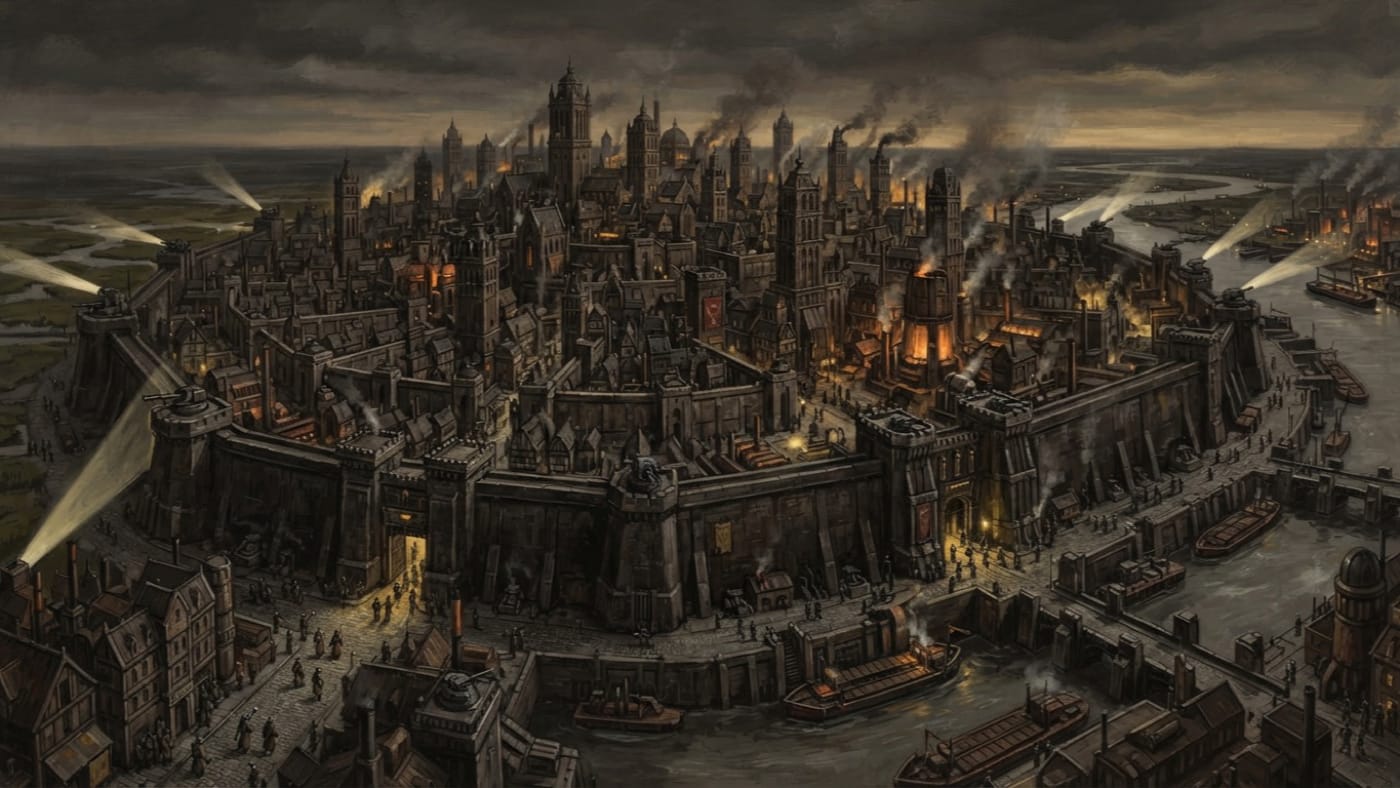
London survives. The continent tends to forget this, much as a clerk forgets a drawer he has been forbidden to open, so I record it at the head of the entry. The old city on the Thames stands. It is inhabited and armed, and it answers to the British Crown and to no office in Strasbourg. The British call it Lunden-Kirk.
The standing assessment puts its population at approximately four hundred thousand souls. It lies in England, inside the independent territory the Bureau of War files as Zone 0, a designation which means, in plain speech, that the Synod's maps include the city and the Synod's writ does not. Lunden-Kirk is not the seat of the Crown. That dignity belongs to Canterbury, where King-Warden Aldric III holds the throne and the cathedral keeps its relics. Any reader who calls Lunden-Kirk the British capital in my hearing will be corrected before the sentence is finished.
I have written elsewhere that the British refuse any name that lacks a reference to the Creator or to stone. I wrote it in a temper. The philologists of the Bureau of Records would ask for evidence, and all I can offer is the name itself, half city and half church, which the British pronounce as though the question had been settled before anyone thought to ask it.
#On the Parish Walls
A Synod city is drawn in rings: the outer wall, then the gate-wards, the market and the cathedral close. Each ring belongs to a different Bureau, and each provokes a different quarrel over who pays for the mortar. By every account in the Bureau's possession, Lunden-Kirk is drawn in cells.
Every district is a parish, and every parish keeps a bell tower, a garrison house and a wall of its own. That makes the parish a unit of worship and a unit of defence at once. The tower calls the faithful to prayer and watches the street below. The garrison house quarters the men who answer the tower. The wall closes the parish off from its neighbour as firmly as the city's outer wall closes the whole from the country beyond.
The military consequence is simple. An enemy who forces one gate has taken one parish. Behind the first wall stands a second, behind the second a tower already ringing, and behind that tower a garrison house already emptying into the lanes.
Those lanes are narrow, and narrow on purpose. A broad avenue is a gift to artillery, to cavalry and to any procession the Crown has not licensed. A narrow lane is a gift to whoever holds the corner. The city does not sprawl. Strasbourg spills past its walls into hospices, pilgrim boroughs and the encampments of the unregistered, but Lunden-Kirk keeps itself inside its stone and crouches there.
I cannot give you the number of parishes. I cannot give you their names, their boundaries or the order in which their walls were raised. The Bureau's file lists none of these things, the British have volunteered none of them, and I decline to draw a map merely because a reader expects one. Cartography by conjecture is a sin I leave to novelists and to the Bureau of War's younger draughtsmen. What the Sundering's tidal surges did to the Thames is likewise absent from every report I hold. The surges reached Britain, the walls stand now, and between those two facts the record is silent.
#On the Abbot-Commander
The Abbot-Commander of the Thames governs the city and reports to the Warden of the Southeastern Shore. The Warden reports to the Crown.
That is the entire chain.
The title tells the Synod everything it needs to know and nothing it wishes to hear. An abbot answers for souls. A commander answers for walls. The British have placed both answers in a single mouth, and it speaks under a Crown charter that predates every Bureau in Strasbourg. Across the Crown's territories this joining of the martial and the ecclesiastical is ordinary practice. The Wardens, whose national institution is the Table of Nine, command garrisons and ordain chaplains with the same hand. The Abbot-Commander does the same within the walls of one city, and so presumably consecrates bells and posts sentries in a single morning without consulting anyone below the Warden.
Neither the present Abbot-Commander nor the present Warden is named in any document I possess. I mention this so that no reader thinks the omission an oversight. The British give the Bureau their titles readily enough. The men who hold them stay on the island.
#On the Hours and the Streets
By every report, the bells of Lunden-Kirk keep the city's time. They ring the hours, they ring the alarm, and they toll for the dead. Across Britain these duties belong to the Lantern-Ringers, ordained warrior-monks who carry functional maces cast from the bronze of the bells they serve. Whether every parish tower in Lunden-Kirk has its own Ringer, or how the towers answer one another across the parish walls, I cannot certify. The Bureau of Bells would like to know as well, and its curiosity has fared no better than mine. In a city where every district keeps a tower, I will say only that silence must be rare and noticed when it comes.
The streets are clean, and on this point the reports agree with a unanimity I find personally distasteful. Every seventh day the British wash their streets with lye and with prayer. The Bureau of Mercy calls this obsessive. The British call it godly. I call it embarrassing, because I have walked the lanes behind Strasbourg Cathedral after a feast day, and the comparison is not one a loyal servant of the Synod enjoys making.
The reader should not mistake a clean street for a kind one. The lye is applied by the parish, under the eye of the tower, on a day fixed for everyone. A street washed in common is a street on which everyone is visible, every door accounted for and every absence obvious by the evening bell. The British have made hygiene and vigilance into the same chore. I admire the economy of this. I do not envy the man who misses his turn with the bucket.
#On Penance and the Wall
The national practice is well attested. British penances last for months. British fast days outnumber the Synod's. British dissenters are bricked alive into monastery walls, and this is a judicial sentence carried out by the Crown's authority, with nothing of rumour or allegory about it. The Bureau of Purity condemns it in public as theologically irregular and admires it in private. Those private remarks I have read and will not quote.
What I cannot give you is Lunden-Kirk's own account. I hold no sentencing register for the city, no list of the walled, no annual total and no indication of where within the parishes such sentences are carried out. I will not supply a victim to satisfy a reader's appetite. The Bureau keeps enough invented martyrs already.
I can reason from the architecture. A city built of walled parishes is a city in which every man lives within sight of his own tower, within reach of his own garrison and within earshot of his neighbours, and in which those neighbours helped build the wall that hems him in. The Lantern Way makes no distinction between devotion, military service and private discipline. A parish that worships together, drills together and washes its street together will know very quickly when one of its members has stopped doing any of the three.
Some of the island's own people are said to whisper that the fortress has become a prison. Within the city I can neither confirm nor deny it. I can say only that if a prison were designed by a committee of abbots, it would look very like what the reports describe.
#On the Present Condition
Lunden-Kirk remains in the Crown's allegiance, as it has been for as long as the Bureau has kept a file on it. The Crown remains an independent co-belligerent and a non-signatory to the Concordat of Strasbourg, and the city lies wholly outside the jurisdiction of the Synod. The Synod has no tithe-office on the Thames, no Purity station and no inspector of bells. Its authority there extends exactly as far as the courtesy of British harbour officials, which in my experience is a short distance, carefully measured.
The Bureau of Doctrine calls the Crown "Schismatic by Omission." I have filed my objection to that phrase elsewhere, and it remains unratified. The faith practised in the parish towers of Lunden-Kirk carries its own separate classification, and the Bureau, in its wisdom, has since altered it.
Erratum — Filed by the Author, A.S. 201: Readers who consult older Bureau assessments will find the faith of the British parishes, Lunden-Kirk's among them, recorded as "Schismatic Heresy, Category Two." That classification was revised by the Bureau of Doctrine in A.S. 199 to "Non-Standard Observance, Diplomatically Accommodated." The revision concerns Synod terminology alone. It records no British conversion, submission or request, and the British are not known to have noticed it. Amend your copies. Filed.