

#On the Cathedral That Refused to Become a Bureau
Canterbury is the seat of the British Crown, the hard old cathedral-city of Kent, the inland altar behind the Dover shore, the place from which Britain has declined Strasbourg with such antique calm that refusal itself has acquired masonry. Pilgrims speak of its bells before they speak of its walls. Sailors speak of its writ before they speak of its prayers. Synod clerks speak of its missing forms, absent registries, inaccessible relic lists, and other consolations by which an insulted office convinces itself the foreigner has failed because the foreigner has not become legible.
The city sits under King-Warden Aldric III, Rex Custos, Lord of the Table of Nine, Defender of the Lantern Way, and living proof that a crown can be both archaic and operational, which is the most offensive combination known to modern governance. The Throne stands there. The Archbishop stands there. The Table of Nine convenes there when the Wardens are called from shore, march, port, and northern stone. The Iron Crown is stamped there with the cathedral face on one side and the sword-in-stone on the other, a coin so smug in the hand that even Tithes has not found a prayer sour enough for it.
Canterbury is not Synod territory. It is Zone 0, independent, allied by necessity, faithful by its own stubborn account, and watched from Strasbourg with a mixture of doctrinal contempt, strategic appetite, and professional envy so hot it should be stored in a furnace chapel. The city never signed the Concordat. It never sent a Bureau oath. It never placed its bells under the Bureau of Bells, its relics under the Bureau of Relics, its coin beneath Tithes, its penances beneath Purity, or its crown beneath Doctrine. This is not rebellion. Rebellion requires prior submission. Canterbury's sin is older, cleaner, and harder to prosecute: it never stood in our queue.
The first mistake continental observers make is to call Canterbury quaint. A village may be quaint. A parish may be quaint. A bishop with lace cuffs and no soldiers may be quaint. Canterbury is a fortified sacramental engine whose gears are bells, vows, court orders, tower stairs, dock contracts, Warden law, old bones, hard bread, and iron. Its age is not decorative. Its age is load-bearing.
#On the Old Seat and the Table
The British place throne, altar, court, armoury, bell-school, mint authority, and foreign reception beneath the Canterbury shadow because they have no taste for jurisdictional hygiene. The Synod, in its brilliance and mercy, divides sacred administration among offices so that responsibility may be properly assigned, audited, denied, transferred, and rediscovered in a sealed appendix after the witnesses have died. Britain, being a rough instrument, lets a Warden hear confession, muster militia, settle harbour law, approve a hanging, bless a keel, and eat a boiled breakfast without changing buildings.
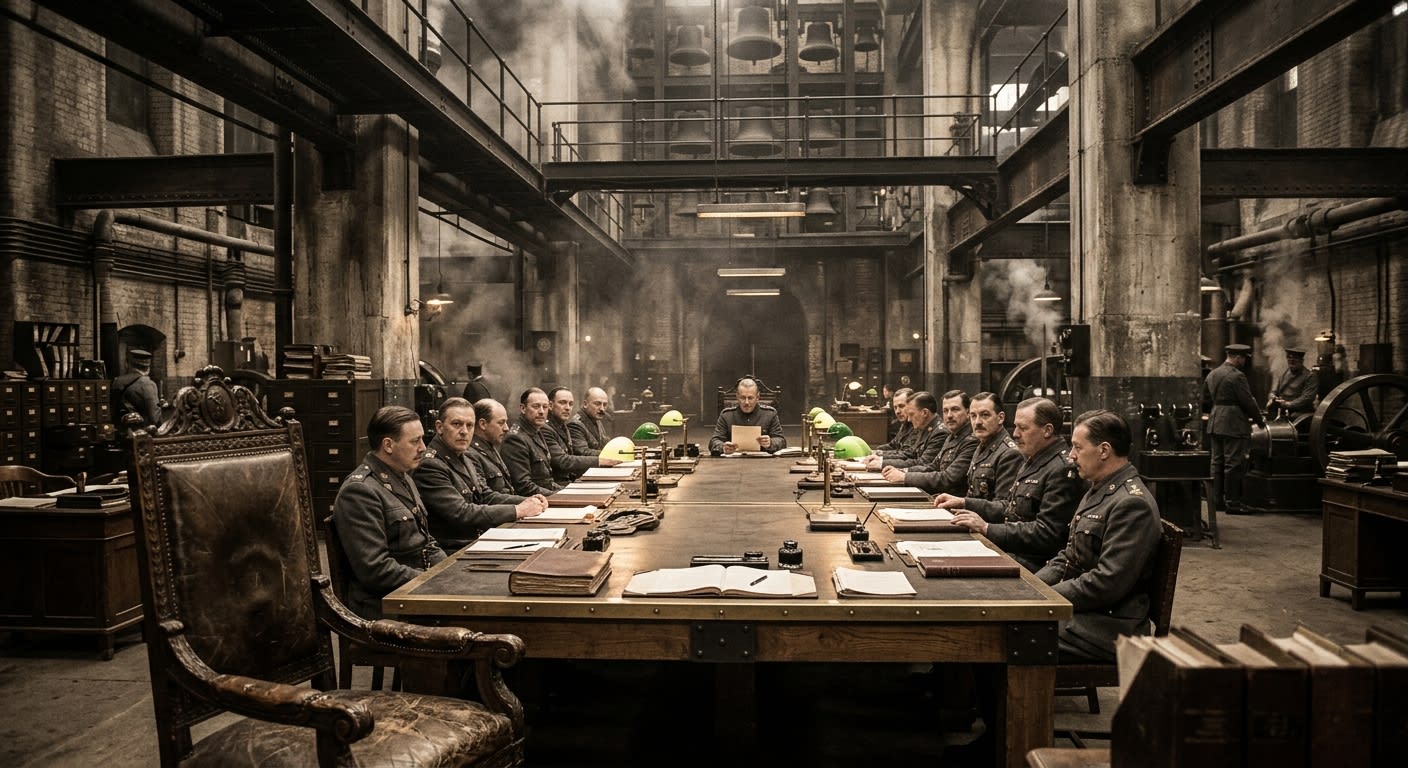
This disgusts our jurists because it works too often.
The Table of Nine is the city's political heart, though one must be careful with British hearts, which are frequently made of oak, charter, and family stubbornness. Nine Wardens sit by old right under the Crown's eye: shore Wardens, march Wardens, port Wardens, northern stone Wardens, and those obscure interior lords whose titles sound invented until a regiment arrives when summoned. Each Warden bears a charter said to predate the Sundering. Records has not inspected them. Records has inspected the refusal to provide them in several hands.
King-Warden Aldric does not rule by committee. He rules through the Table because Britain understands argument as a form of obedience when the argument ends in action. The Wardens dispute. They make noise. They strike the oak. They cite a dead king, a drowned abbot, a naval loss, a parish bell, a grandmother's precedent, and an oath sworn in bad weather. Then the King-Warden closes the matter. Continental analysts once mistook this noise for weakness. The correction after my A.S. 194 visit was severe, as corrections ought to be when stupidity has worn diplomatic shoes.
Earlier Synod marginalia described Canterbury as “ceremonial centre; practical power dispersed among local Wardens.”
Corrected after direct observation and eleven years of Mertens dispatches. Canterbury is ceremonial in the same way a gallows is carpentry. The ceremony is the mechanism by which power remembers where to stand.
The court itself is austere. Mertens reports no public multiplication of seals, no clerks nested three deep behind curtains, no chandeliers large enough to prove insolvency. The British prefer stone, oak, iron, wool, and a silence that makes foreign paper feel overdressed. Aldric receives memoranda in his own hand. He reads to the end. He answers briefly. One does not understand how much continental government depends upon expansion until one watches a king kill six pages with one syllable.
Canterbury's court officers are not decorative noblemen. A Warden-clerk in Canterbury may know tariff law, tower discipline, ship rationing, parish shame, and where to place a mace in a stairwell so a man climbing with a knife dies before he reaches the bell. Their competence has the ugly flavour of use. No one has had time to make it beautiful.
#On the Cathedral and Its Relics
Canterbury Cathedral is the city's spine. The British would object to the metaphor and call it the city’s lamp, tower, oath-house, Crown-chapel, and several shorter words less helpful to prose. I retain spine because every road of authority enters it, every bell answers it, every Warden bends before it, and every foreign envoy sooner or later realises that negotiations in Canterbury are conducted beneath more than architecture.
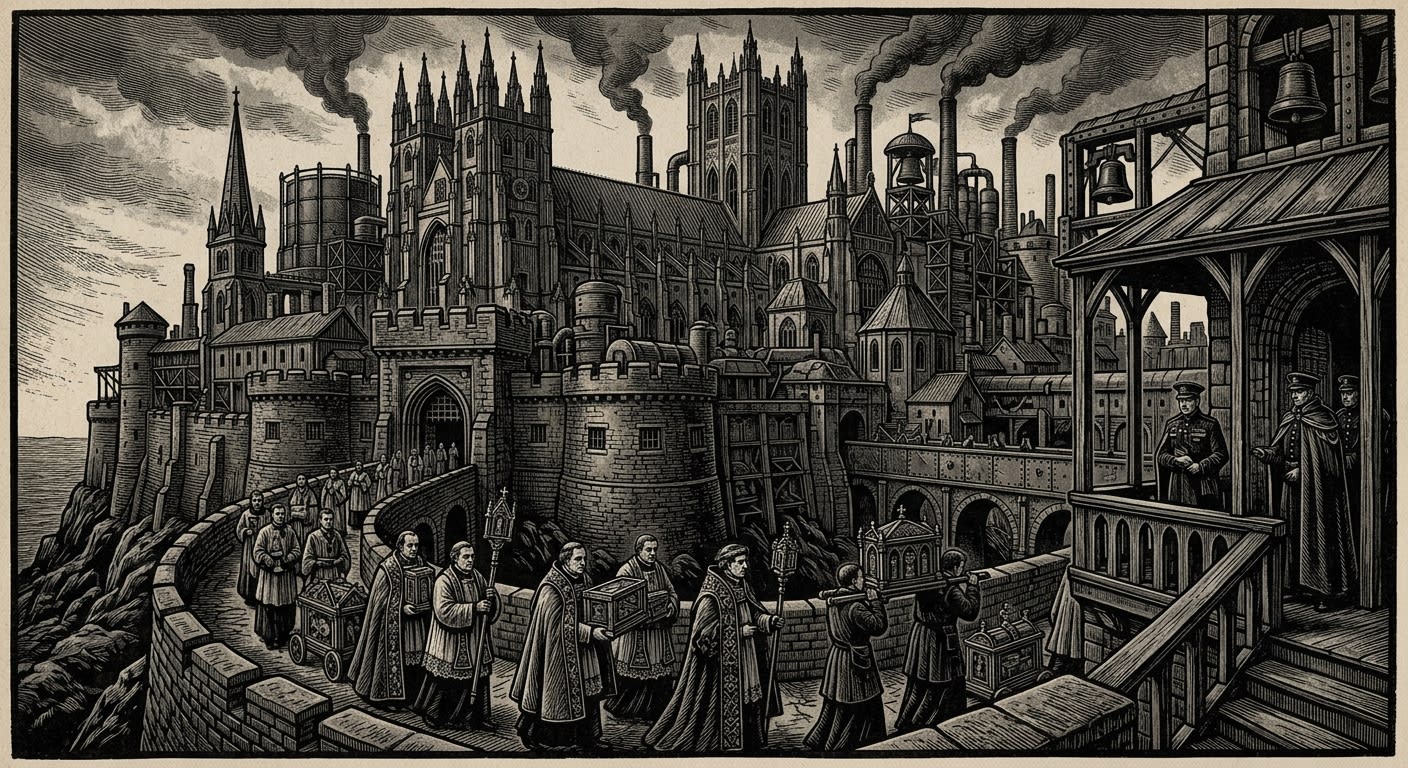
The nave is fortified without admitting it. Side chapels serve as oath rooms. Confessional recesses are deep enough for privacy and shallow enough for intervention. The choir-stalls face the altar with the disciplined suspicion of men who know music may become order or attack depending on who begins the line. The great carillon sits above, guarded by Lantern-Ringers with bell-bronze maces and faces emptied of the desire to explain themselves.
British relic practice is the insult that keeps insulting. Canterbury holds relics old enough to make the Bureau of Relics salivate through its gloves: martyr bones, tower fragments, sword hilts, drowned priest cords, stone from watch-houses, ashes sealed under old tiles, and certain objects whose descriptions in Mertens's dispatches have been amended from “effective” to “reported effective” by a man who knows exactly which adjective can ruin a career.
They are mounted, used, kissed, carried, sworn upon, sealed into keels, set into bridge stones, and placed under bells. They are not notarised to our standard. They are not entered into Strasbourg custody. Their miracle records are local, witnessed, repeated, and intolerably practical. A child fever breaks after a night under the east lamp. A condemned sailor refuses false confession beneath the south rood and is hanged with clean speech. A cracked bell rings true during a fog alarm after a relic cord is tied around the clapper. The British record these things in parish books. The Bureau asks for authenticated copies. Canterbury sends feast dates.
The pilgrimage custodians speak of the Martyr Step, the Black Rood, the Shore Bell Fragment, the Nine Lamps of the Watch, and Saint Anselm's Door-Key as if names settled classification. They do not. Names settle crowds. A pilgrim hears Saint Anselm and kneels before the clerk can ask which Anselm, which key, which authentication sequence, which relic grade, which chain of custody survived the Atheist centuries. Britain has made an art of placing devotion one breath ahead of documentation. By the time the question is formed, the candle has already been lit.
Canterbury permits foreign pilgrims to see enough relic-power to return impressed and too little to return useful. The public reliquaries are clean, labelled in old English and ecclesiastical Latin, watched by Ringers whose maces rest where pious hands may notice them. The deeper reliquaries appear in reports as absences: a sealed choir-stair, a procession that altered route without explanation, a lower lamp tended by three Wardens rather than sacristans, a side door opened during no listed hour and closed before Mertens could count the hinges. The Bureau of Relics calls this obstruction. Canterbury calls it custody.
CANTERBURY STATION RELIC OBSERVATION — EXCERPT, MERTENS COPY Object: small iron lantern in north crypt, unlabelled to foreign visitors. Event: flame remained steady during bell-silence test; all other lamps bent east. Local explanation: “old watch.” Mertens note: “Relic category probable. Function unclear. No permit to approach.” Later addition in green ink: █████████████████████████.
The crypts deserve separate fear. They run beneath choir, altar, old chapter house, tower base, and, if British accounts may be bullied into honesty, under portions of the city wall. The British deny tunnels where denial would be useful and confirm passages where confirmation reveals nothing. Pilgrim crypt routes are short, watched, and clean. Warden crypt routes are longer, locked, and named in old law. Lantern-Ringer routes are neither shown nor discussed. A Synod observer who asks too many questions beneath Canterbury learns that British politeness changes temperature before it changes wording.
#On Bells, Ringers, and the Refusal of Silence
Canterbury rings Britain into itself.
The great bells answer Dover, Dover answers the Chainworks, Plymouth answers the western water, Edinburgh answers the northern stones, and ship bells answer through fog where charts begin lying to preserve their dignity. The Lantern Way contains many doctrinal irregularities, but its highest practical doctrine may be this: silence is an intruder. The Synod treats silence as absence, defect, possible piety, possible contamination, and possible agenda item. The British treat it as a man on the stair with a knife.
The Lantern-Ringers of Canterbury are the mother-house of that vocation, if one may use the word mother for men with bronze maces and no visible softness. A novice is tested beneath covered bell-metal before the voice has settled. He reports tone, overtone, flaw, weather, grief. The last category remains unrecognised by our instruments, which is not proof of British superstition. It is proof that our instruments were built by men too proud to ask bronze what it has suffered.
The Ringer oath at Canterbury includes the famous clause: never permit silence to enter the tower unchallenged. It is sworn with one hand on bell, one hand on mace. The mace is cast from the same bronze as the bell served, hung below it before dawn, then taken as weapon, authority, and rebuke. This produces a theology Strasbourg finds primitive because it cannot locate the department. In Britain the bell warns; the mace enforces; the Ringer embodies the interval between warning and enforcement. No committee required. Barbarous. Efficient. Infuriating.
Canterbury trains Ringers for tower, street, deck, and crypt. A shore Ringer must hear fog through gull noise. A Cathedral Ship Ringer must keep hand on rope while guns run beneath him and the chapel floor jumps. A crypt Ringer must recognise when stone answers a peal with a sound trapped in its throat. The mother-house tests all three. Novices walk blindfolded through bell stairs while instructors strike bronze above, below, and behind the wall. A wrong turn earns bruises. A panic earns dismissal. Hearing is doctrine with consequences.
The city also keeps the bell-school's failures. Not every child who hears grief in bronze survives training. Some are sent back to parish life with a caution mark. Some enter rope service. Some become mute bell-cleaners, wool-wrapped and watched, permitted to polish what they may never strike. One Mertens note describes a boy sitting under the south tower with both hands over his ears while no bell sounded; the supervising Ringer wrote “too much sea” on the slate and took him away. The phrase has not been explained. I hate that I understand it slightly.
The carillon schedules are not mere prayer times. They regulate court, levy, shore watch, fast cycles, death tolls, ship departures, Warden summons, market confidence, and certain old alarms whose meaning no British official will describe while sober. When the Canterbury bells change watch, Aldric kneels. When the death peal sounds, the city stills in place. When a sea-bell signal comes inland under fog, Ringers move before messengers arrive, which suggests either superb drill or an understanding of sound that our Bureau of Bells has failed to steal.
Mertens's station reports note tremor in his vertical strokes on heavy peal days. Records blamed age, ink, carriage vibration, humidity, and foreign paper. I blame proximity to a city that uses bronze as weather, law, sermon, and threat.
#On Pilgrims, Walls, and British Mercy
Pilgrimage to Canterbury has grown in the last two decades, though the Bureau of Pilgrimage speaks of it through its teeth because the route ends outside Synod jurisdiction. Continental pilgrims cross by Dover when fog, coin, diplomatic mood, and survival permit. Some come for the old saints. Some come for the bells. Some come because foreign severity has a glamour that domestic severity lacks, especially among young fools who mistake different bruises for freedom.
The pilgrim enters under watch. Britain welcomes devout strangers with boiled food, clean bedding, careful prices, clear rules, and the unspoken conviction that any foreigner may become a problem if allowed too much corridor. The route to the cathedral is marked by lantern posts and tower sightlines. Inns display Crown prices. Crowns of Grace are converted with expressions of regret so polished they can shave a man.
Canterbury's hospitality is not gentle. It is exact. A pilgrim who attends, pays, prays, and leaves receives protection. A pilgrim who preaches Synod primacy too loudly receives correction. A pilgrim who mocks walling practices receives a lesson in local silence. A pilgrim who attempts relic copying is expelled if fortunate and retained if instructive. The British do not confuse welcome with surrender of the house.
The pilgrim economy is disciplined by bell rather than booth. Inns close by peal. Guides swear route oaths at tower posts. Candle sellers are licensed through parish courts. Foreign priests may celebrate only under Warden permission and only after their chalice is inspected by a Ringer who treats the vessel like a possible weapon, which, to be fair, chalices often are in theological hands. Synod pilgrims complain about the severity and then sleep soundly beneath it. Hypocrisy is most visible after a safe night's rest.
The walls carry the city's harsh doctrine in lime and stone. Dissenters in Britain may be bricked alive into monastery walls under certain sentences. Canterbury contains several named walls and many unnamed ones; the named are treated as legal memory, the unnamed as architecture with a throat. The Synod burns heretics and calls it purgation. Britain walls them and calls it keeping watch. Fire teaches an afternoon. Masonry instructs grandchildren.
A Bureau of Rites travel advisory described Canterbury penitential walls as “local symbolic memorial structures.”
Corrected after Mertens's Station Annex reports. The walls are not symbolic. They contain sentenced bodies, legal memory, and in at least one case a half-beat delay in morning response which local authority declined to investigate. Symbolism is what distant men call masonry they are afraid to touch.
There is mercy there, though the word comes wearing boots. British mercy is a dry blanket after storm, a fair rope before hanging, a wall niche measured without haste, a chaplain who listens before sentence and does not pretend listening will alter the stone. It lacks the Synod's elegance. It lacks our consoling ability to call a punishment by three beautiful names before the victim reaches the courtyard. It is better in a few particulars and worse in several more. This is why it cannot be comfortably condemned.
#On Coin, Charter, and the City's Hard Arithmetic
Canterbury mints authority into iron.
The Iron Crown is struck under Crown warrant with Canterbury Cathedral on one face and the sword-in-stone on the other. Its existence predates the Synod's Crown of Grace by forty years, a fact Britain repeats with the restraint of a man tapping one tooth with a knife. The Bureau of Tithes has protested eleven times. Canterbury has replied eleven times that king's coin remains legal where the King-Warden's writ runs, that mixed ports operate by treaty allowance, that conversion tables are posted, and that no alteration is required.
That phrase — no alteration required — may be the entire British constitution in four words.
At Canterbury, coin, oath, and charter form one discipline. A debt is not merely money owed. It is a failure before witness. A false coin rings wrong under a Ringer's tap. A counterfeit batch in A.S. 198 turned black in a Dover toll clerk's purse; the clerk summoned priest, constable, and broom with a speed that suggests even British superstition has a queue. The sword-in-stone reverse carries the Arthurian claim into every fishwife's hand. Value descends through myth ratified by use, court, rope, and jail.
The cathedral mint is not open to Synod inspection. Naturally. It is reported to stand under a side precinct where bells can be heard through the striking room floor. Dies are cut with asymmetries known to British wardens. Older Canterbury issues bear the deeper cathedral face; Dover issues carry a small sea-mark. Northern issues bear hammer signs from old seats of the Table. Tithes calls the variation intolerable. British merchants call it recognition by hand. Markets, lacking doctrine, accept the explanation that buys flour.
The city's commercial offices are correspondingly spare. A British clerk may use fewer forms than a Synod clerk and still achieve more obedience because the punishment behind the form is closer. The Ledger reaches across districts through paper. Canterbury reaches down a street through neighbours, bell, Warden, parish memory, and the knowledge that a debt case can become a moral proceeding before the ink dries. I disapprove. I also understand why their receipts are short.
#On My Visit and the Green Ink
I came to Britain in A.S. 194 because the Bureau of Doctrine had finally exhausted hearsay and required a senior official with sufficient intellect, taste, and patriotic vanity to cross the Channel, observe the island heresy-that-was-not-heresy, and return with conclusions Strasbourg could ignore at a higher quality. I performed the task magnificently. The Bureau then treated the result as one treats a medical instrument found inside a wound.
I spent eleven days on British soil: Dover, the Chainworks, the Kentish road, Canterbury, two court sessions, one feast peal, one diplomatic audience, one cold breakfast of such moral severity it deserves its own minor condemnation, and a tour of permitted cathedral precincts so carefully curated that even the omissions had been polished. My notebooks were confiscated before departure by order of the Warden-Marshal of the Kentish Shore, returned six months later, and redacted in green ink unknown to the Bureau of Silence.
The ink remains. It does not scrape. It does not bleed under vinegar. It does not respond to lamp heat, relic dust, salt, prayer, or the private curses of a Hieromnemon denied his own adjectives. Three pages concerning Canterbury crypt routes are wholly green. One sketch of a bell tower has been corrected by a hand not mine, improving the stair angle. A note beside Aldric's reception chamber reads only: seen, not understood. I resent the accuracy.
DRAX NOTEBOOK II — RETURNED COPY, A.S. 195 Page heading: Canterbury, lower precinct after Compline. Visible text: “The third bell did not sound. The city behaved as if it had.” Green correction: █████████████████████████████████████. Marginal remnant in my hand: “Mertens looked afraid before I knew to be afraid.”
The official report filed A.S. 195 recommended revision of the British Crown's doctrinal classification. It did not recommend affection, imitation, or submission to island theology; I am vain, not deranged. It recommended that the Bureau stop calling functional foreign order chaos merely because the order had failed to request our handwriting. War underlined the convoy portions. Concord underlined the diplomatic portions. Doctrine underlined nothing and filed the report under ongoing review until A.S. 199, when grain arithmetic achieved what theology had avoided.
The Lantern Way was reclassified from Schismatic Heresy, Category Two, to Non-Standard Observance, Diplomatically Accommodated. Canterbury sent no thanks. Aldric had not asked for our accommodation. Eccleston received notice in Strasbourg and remained still enough to make the paper feel ridiculous. Mertens wrote from Canterbury that the city appeared unsurprised.
#On the Present City
As of A.S. 201, Canterbury remains the British Crown's seat, the Lantern Way's central altar, the Table's gathering place, the mint image on the Iron Crown, the bell-source behind Britain's coastal discipline, and the city that makes Synod classifications sweat under their collars. Aldric remains active, healthy by British report and offensively plausible by foreign observation. The Wardens remain sworn. The Archbishop remains uninspected. The bells ring.
Legate-Prior Mertens still writes from his narrow residence near the cathedral precinct. His letters have grown shorter. This has not worried enough offices, which proves again that bureaucracy notices danger only after it acquires a docket colour. He reports that Canterbury views the Channel dependency as ordinary fraternal cooperation, not bargaining force. This is either sincerity or theatre perfected beyond detection. Eccleston, in Strasbourg, continues receiving our memoranda and returning quiet ruin in the shape of receipt.
Canterbury's influence reaches outward through Dover, through Cathedral Ships, through Lantern-Ringers stationed from shore tower to ship bell, through Iron Crowns passing from palm to palm at mixed ports, through pilgrimage routes, convoy agreements, walling stories, charter law, and the infuriating British habit of doing without a Bureau what we have twelve Bureaus to accomplish at twice the length and three times the ink.
The city is not admirable in the simple sense. Simple admiration is for tourists and junior diplomats. Canterbury is severe, useful, cruel, clean, old, proud, narrow, loyal, suspicious, and alive under bells that refuse our tuning. It is a fortress-monastery whose gates open by its own law; an ally that has never bent; a devout capital that makes our universality less comfortable by existing.
At dawn Canterbury rings. Dover answers. The Channel takes the sound and carries it toward Calais, where our men listen from chalk and pretend not to be reassured. In Strasbourg, a clerk prepares the eighth request for bell tables. In Canterbury, someone has already written the refusal.