
#On the Order and Its Bells
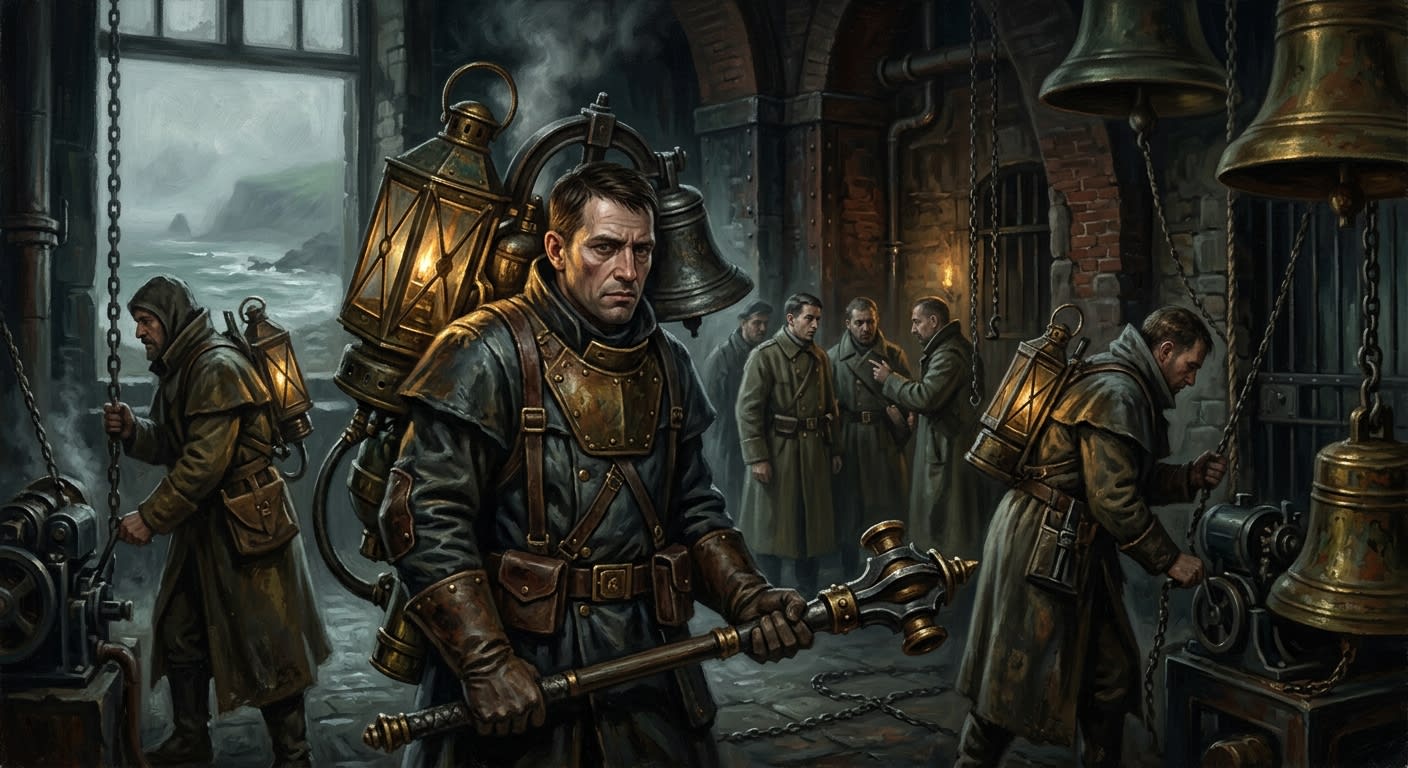
The Lantern-Ringers are Britain’s ordained bell-warriors: monk, watchman, executioner, chorister, and alarm in one wool-cloaked body. They serve the great bells of the British Crown from Canterbury to Dover, from Plymouth (Unregistered) to the Welsh marches (Unregistered), from Edinburgh’s wet stone towers to the small shore-chapels whose bells face the sea and never turn their backs on it.
Each Ringer is attached to a bell. This is not poetic language. The attachment is sworn, registered, scarred into the palm, and renewed at every major feast of the Lantern Way. A Ringer may be moved between towers by order of a Warden, but the bell remains the centre of his vocation, the bronze mother, the iron parish, the hanging judge. He serves it. He polishes it. He rings it. If required, he dies beneath it, though the British, being practical in their savagery, prefer that he kill someone else first.
The Bureau of Bells has requested access to British tuning specifications seven times. Seven refusals have arrived, each written with courtesy sufficient to make the denial more insulting than anger would have been. The British position is that the bells belong to their towers, the towers to their parishes, the parishes to their Wardens, the Wardens to the Table (Unregistered), and the Table to the Crown. Strasbourg’s position is that sound of military value ought to be subject to technical exchange. The sea has not been asked. It would side with Britain, the treacherous bastard.
#On Formation
The making of a Lantern-Ringer begins with hearing.
British children are tested at parish towers before the voice fully settles. The test is simple in form and barbarous in implication: the child stands under a covered bell while a Ringer taps the bronze with a padded hammer. The child reports what is heard. Tone, over-tone, flaw, weather, grief. The last category is the one no Synod instrument records and every British tower takes seriously. A child who hears grief in bronze is marked for further testing. A child who hears nothing is sent home and grows up happier.
Training lasts seven years for the ordinary tower service, nine for cathedral carillons, twelve for sea-bell posts and chapel ships. The novice learns rope, stance, silence, chant, weather, bell-metal, wound binding, night watch, and mace work. The order’s rule is short by Synod standards, which is to say it is readable. Its punishments are immediate. Missed hour: fast. False alarm: lash. Failure to ring for the dead: confinement beneath the bell through one full tide-cycle, which at Dover means the chalk sweats and the sea speaks through cracks in the tower stones.
Ordination is performed by a Warden-priest or, in Canterbury, beneath the eye of the Archbishop himself. The novice places one hand on the bell, one on the mace, and swears to ring the hours, ring the alarms, ring the dead into the sea, and never permit silence to enter the tower unchallenged. This final clause has no Synod equivalent. We treat silence as absence, defect, failure of sound. The British treat it as an intruder with a knife.
Earlier Bureau summaries described Lantern-Ringers as “bell attendants with militia duties.”
Corrected after A.S. 194 observation and Canterbury station reports. A bell attendant dusts bronze. A Lantern-Ringer has legal authority to kill a man in the tower stair if the man interferes with the appointed peal. The distinction is the sort one prefers to learn before climbing.
#On the Maces
Every Lantern-Ringer carries a mace forged from the same bronze as the bell he serves. When a bell is cast, a measured portion of its bronze is withheld before consecration and set aside for the weapon. The mace is then cast, tempered, inscribed, blessed, and hung under the bell for one night while the tower remains awake. At dawn, the Ringer takes it from the hook. The bell and the weapon have heard the same first silence.
The mace is functional. I record this because the Bureau of Doctrine has a tiresome habit of assuming foreign devotional objects are symbolic until someone breaks a clerk’s jaw with one. The head is heavy, usually flanged, often fitted with iron through the core for durability, though purists in Canterbury prefer unalloyed bell-bronze and tolerate denting as a form of sworn evidence. Ringers train to fight in tower stairs, nave aisles, wet decks, pier gates, and crowd press. The weapon is short because bell towers are narrow. Theology follows architecture more often than theologians admit.
A Ringer struck with his own mace is considered under judgment. A Ringer whose mace is stolen is confined until the weapon is recovered or recast. Recasting requires melting the old bell’s repair scrap, if any remains. If no scrap remains, the Ringer may be transferred to rope service without arms, a humiliation the British rank beneath excommunication and above drowning. The Synod’s personnel offices would call this excessive. The Synod’s personnel offices have never met a tower at midnight.
#On Their Liturgical Function
The Lantern-Ringers keep British time.
That sentence sounds administrative until one remembers that Britain places no trust in continental clock-law, no faith in Bureau minute tables, and no tolerance in communities that cannot hear the hour. The bells tell prayer, labour, watch-change, fast-beginning, execution, storm closure, ship departure, parish death, royal summons, Warden decree, and enemy alarm. A British village without a bell is not a village. A ship without a bell is suspect. A court without a bell is, by British instinct, already lying.
The Ringers ring the dead into the sea. On the coast, when a parishioner dies, the tower tolls while the body is washed, named, wrapped, and brought to the tide-stone. The bell continues until the water touches the shroud. The British say this prevents the dead from hearing the wrong summons. The Bureau of Rites classifies the practice as non-standard mortuary acoustics. The Bureau of Rites has never improved a phrase by touching it.
Canterbury Station Annex, A.S. 197: During the funeral toll for a drowned child at Dover, all gulls in the harbour settled simultaneously on the chainworks roof. The toll continued for forty-seven strokes. At the forty-eighth, three bells answered from offshore where no vessel was visible. Lantern-Ringers formed mace line on the quay. Legate-Prior Mertens notes: “No civilian panic. They had drilled this.” Further acoustic description sealed under ███████████.
At sea, the Ringers serve aboard Cathedral Ships, where chapel bells, alarm bells, and bell-masts are treated as weapons with souls or souls with weapons; British categories are intimate and untidy. Their bells sound through fog that confuses compasses, through spray that curdles on deck, through nights when the Channel presents ships with lights from harbours that sank before the Sundering. Convoy captains report that a Cathedral Ship’s bell-mast clears bad water before the hull cuts it. The Bureau of Engineering has measured the retreating fog. The British have measured the rope wear.
#On Their Discipline and Cruelty
The Lantern-Ringers are loved and feared by their parishes. This is the honest combination, and honesty in matters of public affection is so rare that I mark it with grudging respect.
A Ringer wakes the village and buries it. He watches the tower at storm, stands beside the Warden at judgment, escorts dissenters to the wall niche when brickwork is ordered, pulls the fast-bell when food is denied, and strikes the alarm when the sea behaves like a document with forged seals. Children are taught to bow to him. Drunk men are taught to avoid his stair. Widows bring him oil for the ropes. Smugglers bring him coin and are beaten for misjudging the office.
The order’s harshness protects its authority from sentiment. A Ringer who fails at an alarm may be stripped of mace and bell-name. A Ringer who rings falsely for private advantage is immured in the tower base for one night per false stroke; if the false stroke caused deaths at sea, the count is adjusted by the Warden without appeal. A Ringer who refuses the death toll is exiled inland, where no sea-bell can hear him. The British regard this as mercy. They have unusual ideas about mercy, several of which work.
A Bureau of Rites paper proposed that Lantern-Ringer discipline could be “harmonised” with Synod bellwarden standards through exchange visits.
Withdrawn after review by the Bureau of War. The War annotation reads: “Do not send our bellwardens to learn British discipline unless prepared to receive them back armed, silent, and contemptuous.” Sensible, for once.
#On the Synod’s Interest
Strasbourg wants the bells.
Spare me the diplomatic lace. The Bureau of Bells wants the tuning schedules, War wants the alarm protocols, Engineering wants the bell-masts, Rites wants the ordination formula, Purity wants the parish enforcement model, and Doctrine wants proof that all of it is derivative, licensed in Heaven only through mechanisms we can retroactively claim. Britain has supplied demonstrations, hospitality, and nothing that matters. The Ringers stand in their towers with bronze at their belts and make the same answer in metal every hour.
The difficulty lies in the British fusion of rite and use. In the Synod, a bell is registered by Bells, consecrated through Rites, explained by Doctrine, requisitioned by War, audited by Tithes, and occasionally stolen by Shadows. In Britain, a bell rings. Around that ringing, law gathers like parishioners around a bier.