
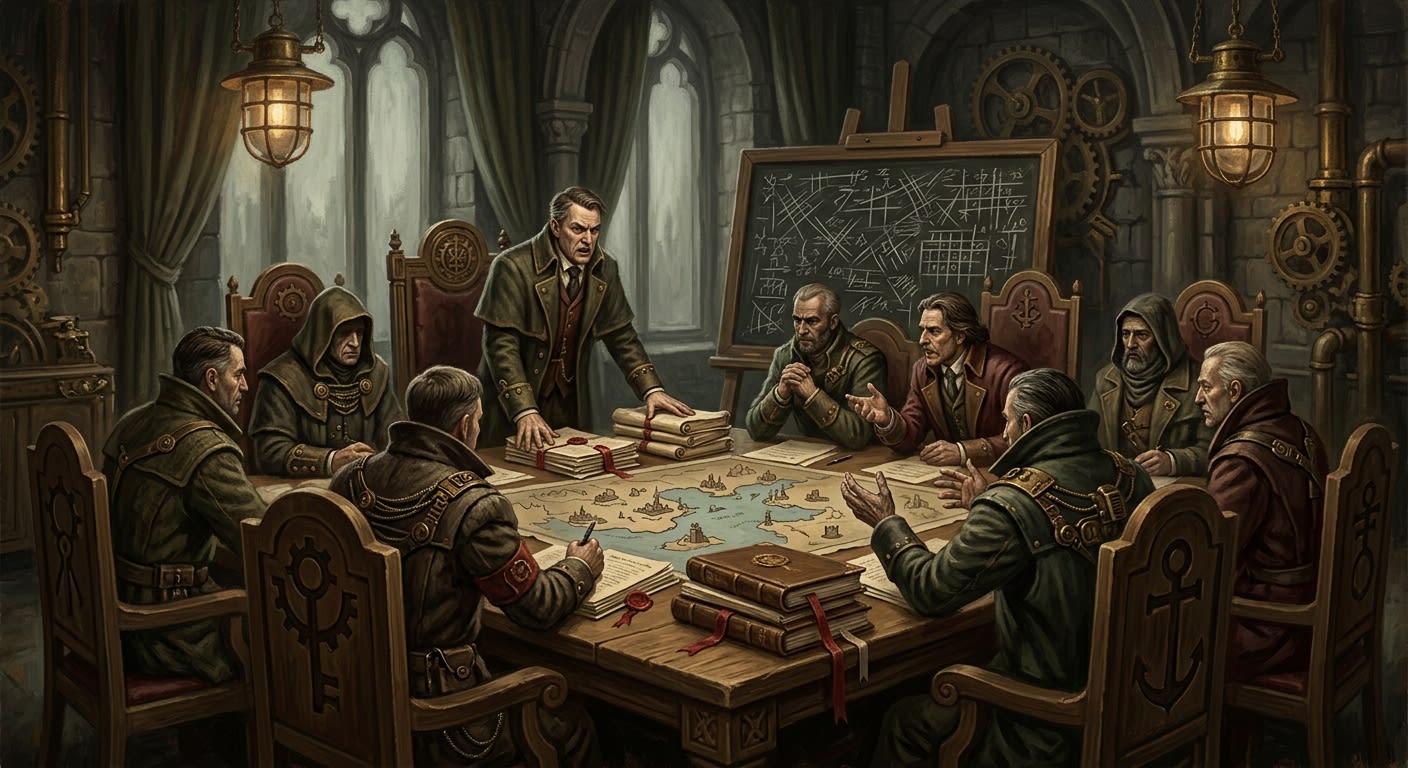
#On the Institution That May or May Not Be Furniture
The Table of Nine is the governing council of the British Crown, seated in Canterbury, answerable to King-Warden Aldric III, and inaccessible to the Synod in the precise manner that makes bureaucrats chew their own lips in private. It is called a table. It may possess a table. In the useful sense, it is a council wearing furniture as camouflage. Britain enjoys these jokes because it mistakes opacity for manners.
Nine Wardens sit by old right under the Crown’s eye: shore Wardens, march Wardens, port Wardens, northern stone Wardens, interior Wardens whose titles sound invented until militia arrives under their banners, and certain holders of chartered authority whose family trees appear to have been pruned with axes rather than pens. Each Warden bears a charter (Unregistered) said to predate the Sundering. The Bureau of Records has requested copies seventeen times. Britain has confirmed that copies exist.
Continental analysts first described the Table as a feudal relic. The phrase survived three editions because nothing comforts the modern clerk like declaring the older thing obsolete while depending on its ships. Direct observation, Mertens’s eleven years of dispatches, and my own A.S. 194 irritation have corrected the matter. The Table is old, yes. So are knives, bells, graves, and certain taxes. Age is no argument against use.
#On the Nine Seats
The nine seats divide Britain by function as much as land. This distinction frustrates Records, which prefers borders to obligations, because borders may be coloured and obligations have a vulgar habit of walking about in boots.
A shore Warden governs cliff, harbour, watchtower, pilot, customs throat, and sea-bell. A port Warden holds chainworks, drydock, ropewalk, victualling yard, naval levy, and the little courts where sailors learn that British mercy has calluses. A march Warden keeps interior road, parish militia, old Roman stone, hill beacon, and the awkward households who regard central command as a polite rumour. The northern stone Wardens answer for fortresses, cold passes, hard sheep-country, and whatever survives in the weather above ordinary jurisdiction. The remaining seats gather interior bread, law, bell discipline, penitential routing, bridge rights, and the ancient quarrels by which an island remembers it is a kingdom rather than a sack of counties tied with wet string.
The names of all nine current Wardens are not available in full Synod copy. The British claim privacy, security, and custom. The Bureau claims obstruction. Both claims fit. Lord-Warden Eccleston is one of them, or speaks with authority proper to one of them, or carries a Warden’s rank abroad as an embassy weapon. The British wording varies according to who asks. Eccleston smiles with the patience of a man watching a dog investigate a locked chapel.
Earlier Bureau abstracts classified the Table as “ceremonial advisory nobility attached to the Canterbury Crown.”
Corrected after A.S. 194 observation and Canterbury station dispatch review. The Wardens advise by striking oak, citing charters, producing soldiers, closing ports, opening arsenals, consecrating bells, and compelling the King-Warden to answer. Ceremony is present. Decoration is absent.
The Table’s authority is military and ecclesiastical in one hand. A Warden may sentence a smuggler, bless a keel, hear local penance, call militia, order harbour chains raised, discipline a chaplain, and commission repairs before a Synod subcommittee could determine which stamp dislikes the ink. Strasbourg calls this jurisdictional contamination. Britain calls it Tuesday.
#On the Charter the Bureau Has Not Seen
Every British explanation of the Table eventually reaches the charter. The charter predates the Sundering, the Concordat, the Synod in its present majesty, and most clerks currently alive to resent it. It may descend from Arthurian law, from old ecclesiastical settlement, from coastal war compact, from coronation myth, from a set of documents tied with hide in a Canterbury vault, or from all of these layered together until origin becomes masonry.
The British invoke Arthur (Unregistered) in every high oath: king, warlord, saint, ancestor, warning, furniture of legitimacy. His Table structures theirs. Nine seats, nine Wardens, each answerable to the Crown, each old enough to make Records itch. The number is sacred to Britain in a manner the Bureau of Doctrine has not found profitable to denounce. Nine shore lamps. Nine bell answers in certain crypt reports. Nine witnesses required for some Warden appeals. Nine signatures on naval emergency writs. Nine swords laid flat during Crown confirmation, if Mertens’s shaken handwriting is to be trusted, and it is trusted by everyone except the offices wounded by it.
The refusal matters. The Synod governs by producing instruments of authority, displaying them, copying them, sealing them, teaching them, misfiling them, rediscovering them, and executing someone for having read the wrong version. Britain governs here by withholding the instrument and acting as if the action itself proves it. A Warden summons a regiment; the regiment comes. A Warden closes a port; the chain rises. A Warden sends a letter to Canterbury; Aldric reads it. The charter’s absence from our vaults has not impaired its force in British hands.
This is what makes the Table intolerable. It violates our catechism of legibility and then functions in public.
#On Argument as Obedience
The Table is noisy. This misled the first analysts, a class of men who believe a quiet room contains agreement because they have never attended a successful assassination.
When summoned, the Wardens argue before Aldric. They cite drowned abbots, dead kings, ship losses, bridge oaths, harvest failures, tower bells, ancestral insult, coastal weather, grandmothers’ precedents, and the kind of parish memory that enters a room wearing mud and leaves carrying policy. They strike the oak. They interrupt. They swear by lamps, stones, graves, and ships. They make the sort of sound that causes Bureau undersecretaries to reach for procedural sedatives.
Then the King-Warden closes the matter.
The obedience that follows is real. Aldric does not rule by committee. He rules through the Table, which is a sharper thing. The Wardens contest the shape of action before the Crown’s face; once settled, they carry it into shire, port, march, and sea-lane. Synod hierarchy fails to name it. Republican disorder fails worse. It is a Crown using old rights as muscles rather than ornaments.
Legate-Prior Mertens describes this as “argument terminated by oath.” The Bureau of Concord marked the phrase as interpretive drift. I marked it as useful and watched three clerks become unwell. Mertens has lived under Canterbury bells long enough to understand that the British do not regard disagreement as disobedience until the Crown has answered. Before the answer, noise is service. After the answer, noise is treason, and Britain has walls.
CANTERBURY STATION OBSERVATION — GREEN-INK ADDENDUM During closed Table session, ninth bell sounded below floor rather than above tower. Wardens placed right hands flat on oak. Aldric did not speak for █████ breaths. Mertens note: “No one moved. Even the foreign pen stopped.” Later line excised by British review: █████████████████████████.
#On the Table and the Sea
The Royal Fleet answers through the Crown, and the Table supplies much of the practical body by which that answer reaches water: port authority, repair rights, harbour discipline, local levy, chainworks custody, victualling schedules, pilot obligations, chapel staffing, bell service, and the old rules under which a captain at sea becomes Crown hand without waiting for an office to bless his urgency.
This is where the Table injures Synod pride most profitably. A Cathedral Ship is a scandal of compression: chapel, guns, bells, reliquary-keel, court, execution authority, parish discipline, and naval command in one hull. The Table is the shoreward version of the same offence. The British put related powers close enough to strike one another until they move. The Synod separates related powers into offices arranged by metaphysical cleanliness, then wonders why its requisitions limp.
The Wardens do not own the Fleet; Aldric does. The Wardens make the Fleet possible. A port does not produce a warship by royal poetry. It produces one by timber, iron, rope, dock hands, stores, men, bells, chaplains, chain, pitch, gun crews, punishment, and the local certainty that a Warden’s command will be obeyed before lunch. The Table keeps that certainty attached to place. Aldric supplies the crown-seal. The sea supplies the examination.
Convoy dependence gives the Table diplomatic weight. British ports guard the Channel crossing, the western approaches, and the grain lanes on which several continental stomachs depend with undignified honesty. The Chalk Redoubt of Calais may glare across the water with guns, Script Walls, Undertide Pens, and continental self-respect. The open passage belongs to British hulls, British bell-masts, British pilots, and Warden writ.
Doctrine may dislike the Table. Tithes may resent the Iron Crown. Bells may covet the Canterbury schedules. War counts ships and counsels accommodation.
War wins that argument because famine is a theologian with no patience.
#On Eccleston and Mertens as Table Instruments
Eccleston abroad and Mertens within Canterbury form the two visible edges of the Table’s diplomatic blade.
Eccleston sits in Strasbourg as Lord-Warden, embassy lock, receipt-machine, and living proof that courtesy may be sharpened past cruelty. He receives memoranda, transmits them, and permits them to die in Canterbury with all rites observed. His power comes from the Table because another man’s ink would make him an envoy. Eccleston carries one of Britain’s old seats, its habits, its refusal, its naval arithmetic, and the dispatch clasp that ends conversations more neatly than a censor’s knife.
Mertens sits at the counter-altar, a Synod man under British bells, sending back reports too accurate for comfort. He writes that the Table is primitive only if age is mistaken for inadequacy. He writes that British penance is cruel but socially legible. He writes that the Crown never rebelled because it never submitted. These sentences are wounds in good grammar.
Concord training material once described the Strasbourg and Canterbury embassies as “balanced diplomatic presences.”
Corrected. Eccleston is a locked gate with tea service. Mertens is a lantern carried into a cellar where the Bureau had preferred to call the furniture invisible. Balance has nothing to do with it.
The Table uses Eccleston to make sovereignty polite. The Synod uses Mertens to make ignorance informed. Neither side is grateful enough to the instrument it holds.
#On the Present Condition
As of A.S. 201, the Table of Nine remains intact, unaudited, old, armed, devout, irregular, and operational. No Warden has broken table oath. No charter has been surrendered. No port has accepted Synod jurisdiction. No Cathedral Ship specification has been provided. The Iron Crown still circulates where British law says it circulates. Canterbury bells still ring beyond our tuning tables. Aldric still reads foreign objections to the end, which is either courtesy or cruelty wearing a crown.
The Bureau’s current position is a compromise written in the ink of necessity: recognise the British Crown as Category Zero (Unregistered) independent allied sovereignty; accommodate the Lantern Way under A.S. 199 language; request records without expecting them; protest coinage without interrupting convoy; condemn irregularity in sealed annex; praise cooperation in public; depend on the ships always.