
#On the Faith That Rings Instead of Files
The Lantern Way is the Creator-serving faith of Britain, recognisable to any honest theologian and intolerable to any administrator trained in Strasbourg, which proves that recognition and toleration are separate sacraments.
Its articles are familiar enough: the Creator, the Adversary, the wound of the Sundering, the obligation of the faithful to resist corruption, endure chastisement, bury the dead properly, and keep watch until the last bell. Its practice is the offence. Britain binds chapel, armoury, hearth, court, ship, parish, and scaffold under one local vow. The Synod divides these matters among Bureaus because the soul, like an empire, should be audited by specialists. Britain hands a man a sword, seats him under a bell, and expects him to confess before supper.
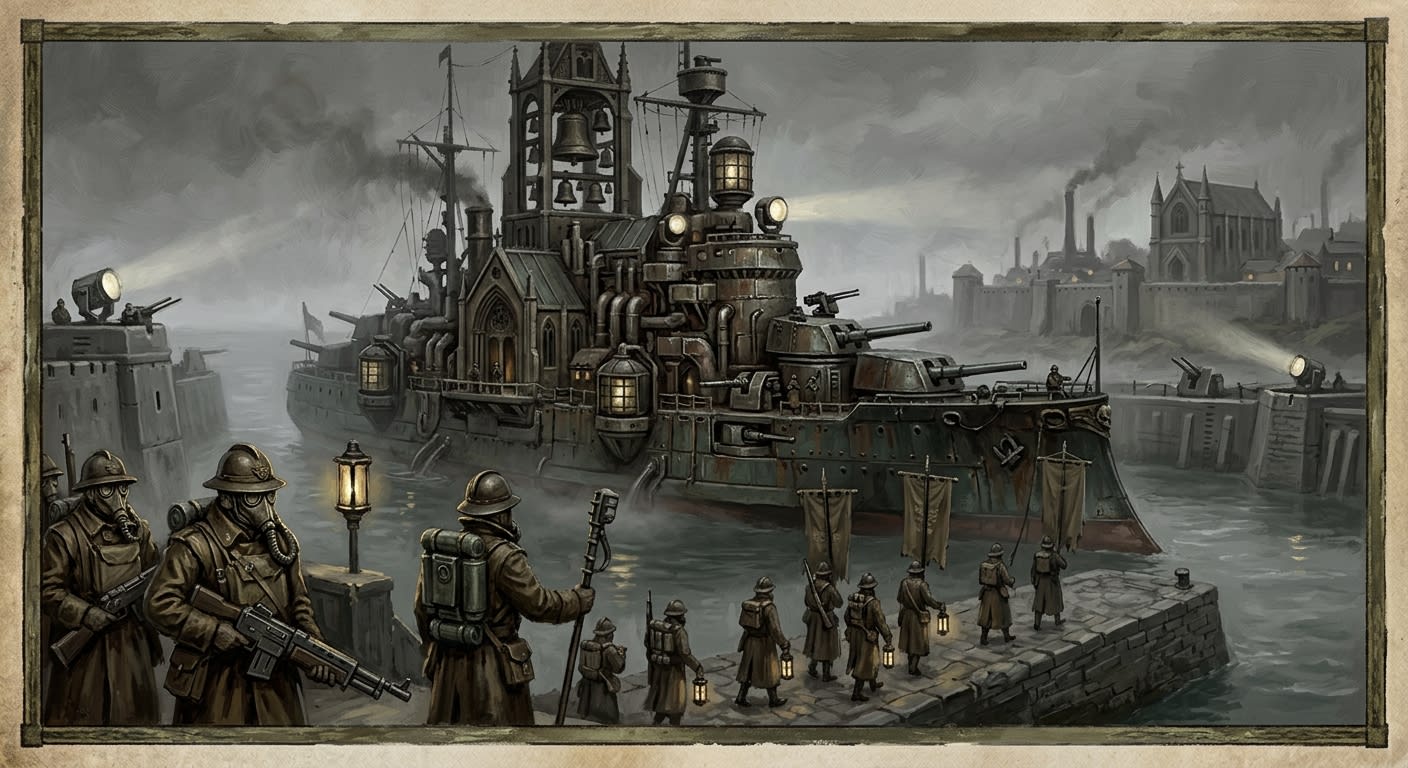
The British call it the Lantern Way because faith is, in their own phrase, “a light carried in the fist.” The phrase is vulgar, practical, and popular with sailors, which explains why it has survived theologians. The lantern refuses gentle illumination. It is the watch-lamp on a tower stair, the ship-lamp in fog, the corpse-lamp beside the quay, the carried flame by which a Ringer sees whether the man below him is parishioner, pirate, or something wearing a parishioner’s coat.
#On Its Offices Without Offices
The Lantern Way has no Bureau of Rites, no Bureau of Purity, no Bureau of Bells, no Bureau of Doctrine, and yet rites are kept, sinners are punished, bells are rung, and doctrine persists. This is deeply offensive. It is also data.
British authority runs through Wardens, parish halls, ship chapels, tower crews, and the old court at Canterbury. A Warden may hear a petition, pronounce a penance, muster a militia, bless a keel, condemn a thief, and join a marriage in the same day without once requesting an inter-office routing slip. The British consider this unity. The Synod considers it a jurisdictional swamp with hymns. Both judgements are accurate; only one has better ships.
A Bureau of Rites memorandum described Lantern Way practice as “liturgical disorder sustained by habit.”
The priest is often a Warden. The bellman is often armed. The confessor may have powder on his sleeves. The court oath is sworn before relic, sword, and ledger — yes, they have ledgers, though they use them as records rather than altars, a barbarism I note for the prosecution. A child learns the hours by bell before letters by slate. A sailor learns the burial peal before the articles of pay. A widow knows which tower answers her loss and which wall received the man who caused it.
#On Penance, Walls, and Public Severity
The harshness of the Lantern Way is not rumour. It is mortar.
Dissenters in Britain are bricked alive into monastery walls under certain sentences. The Synod’s public position condemns the practice as theologically irregular. The Synod’s private memoranda admire its efficiency in terms so warm they should be washed before handling. Months-long fasts are imposed. Public shame is local, immediate, and remembered by name. Parish discipline presses inward from neighbours, kin, crew, bell-stair, market stall, and supper table until the sinner has no private corner in which to become abstract.
Canterbury Station Annex, A.S. ███: A condemned dissenter was sealed into the north wall of Saint Bartholomew’s Watch-House (Unregistered). Third course of bricks completed at Vespers. Subject continued reciting counter-doctrine until midnight. At dawn the wall answered the morning bell one half-beat late. Local Warden ordered no investigation. Legate-Prior Mertens notes: “No one crossed themselves. They had expected worse.”
The Synod burns. Britain walls. Fire makes spectacle; masonry makes memory. A pyre teaches the crowd for an hour. A wall teaches children for generations, particularly when their mothers lower their voices near it.
#On Bells and the Armed Sacred
The Lantern Way’s purest servants are the Lantern-Ringers, ordained bell-warriors attached to tower, ship, parish, and coast. They ring the hours, ring the alarms, ring the dead into the sea, and carry maces forged from bell-bronze because Britain has never found a distinction between warning and enforcement worth preserving.
Their vow contains the clause “never permit silence to enter the tower unchallenged.” The Synod has no equivalent. We classify silence as absence, acoustic failure, devotional opportunity, or sign requiring committee review. The British classify silence as an intruder. This explains much about their island and several injuries suffered by overcurious Bureau observers.
The bells hold the faith together. Canterbury answers Dover, Dover answers the Chainworks, Plymouth (Unregistered) answers the western water, Edinburgh answers the northern stones, and ship bells answer through fog where no chart keeps its dignity. A British parish without a bell is a wound. A British ship without a bell is cargo.
#On the A.S. 199 Accommodation
Until A.S. 199, the Synod classified the Lantern Way as Schismatic Heresy, Category Two. The classification was bold, tidy, satisfying, and strategically stupid. It had the special beauty of a doctrine written by men whose breakfast arrives by land.
The revision came after War reminded Doctrine that British Cathedral Ships protect western grain convoys, Channel crossings, chain shipments, pilgrim passages, medical stores, and diplomatic dignity. To call Britain heretic while asking Britain to escort flour is possible in theory and hungry in practice. Doctrine revised the file to Non-Standard Observance, Diplomatically Accommodated. Aldric did not thank us. Eccleston received the notice with professional stillness. Mertens wrote that Canterbury “appears unsurprised.”
The A.S. 199 revision states that new theological evidence clarified the Lantern Way’s position.
Clarification: the evidence floated, carried guns, rang bells, and guarded grain. Theology followed in a smaller boat.
#On the Present Rite
As of A.S. 201, the Lantern Way remains Britain’s living religion: personal, martial, parochial, naval, severe, and free of Strasbourg’s permission. Pilgrims still cross to Canterbury. Wardens still bind sword and confession in one hand. Ringers still bruise the air. Walls still receive the condemned. The British still insist this is normal, which is the privilege of any people whose customs have not yet been conquered by forms.
The Synod’s position remains unchanged because the Synod’s positions always remain unchanged, especially when revised. The Lantern Way is accommodated. It is watched. It is envied. It is useful. It is wrong in ways that keep men alive, which is the most irritating kind of wrongness.