
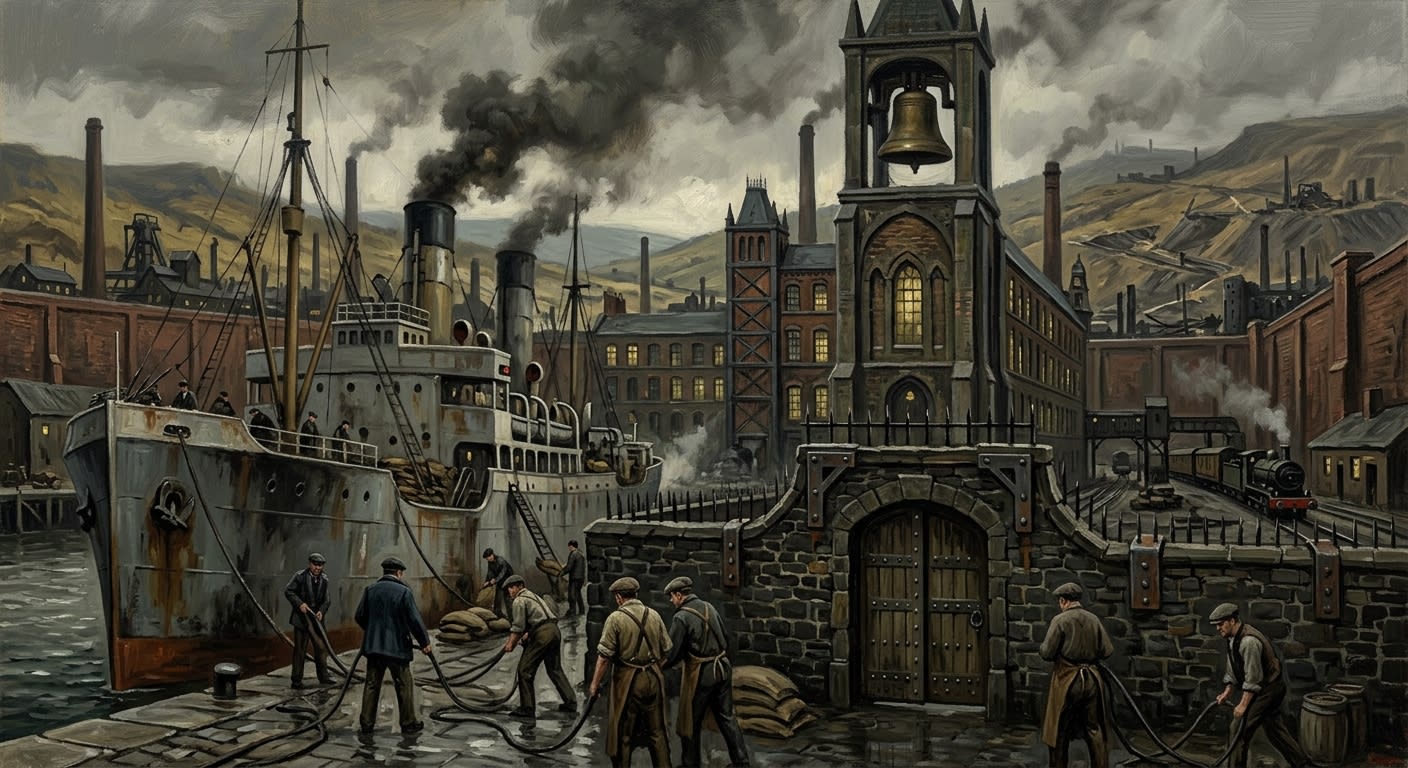
#On the Island That Declined to Become a Province
England is the old southern fist of the British Crown: chalk, bell, harbour, rain, pasture, wall, court, chapel, gallows, shipyard, and refusal compressed into a kingdom that has made geography do the work of theology. The Synod calls it Zone 0, Independent Territory. The British call it England. The brevity is not provincial innocence. It is contempt sharpened down to one word.
The Bureau of Doctrine’s older files state that England “fell to chaos across the Channel” before the Concordat of Strasbourg sealed the Triune Hearth in A.S. 90. This sentence has survived because it was useful, not because it was true. England did not fall. England withdrew behind water, bells, Crown writ, parish wall, naval timber, and the sour discipline of a people who watched the continent turn councils into governments and decided, with island arrogance of a very high order, that they already possessed enough government for the number of souls at hand.
England is not the whole of Britain, though continental mouths often use the terms with the barbarous ease of men who think maps are napkins. Canterbury rules from Kent; Dover bites the sea; Lunden-Kirk crouches on the Thames; northern seats answer through the Table of Nine; Wales (Unregistered) and Scotland (Unregistered) preserve their own hard stones under the Crown’s wider oath. England, in strict usage, is the Crown’s southern engine and oldest diplomatic irritant: the shore nearest Calais, the road to Canterbury, the mint of many Iron Crowns, the harbour-throat through which our convoys must pass while pretending not to need passage.
England’s offence is not hostility. Hostility would be cleaner. We could condemn it, blockade it, print woodcuts of it with horns, and instruct schoolchildren to spit westward at Matins. England cooperates. England sells rope. England escorts grain. England permits pilgrims under rules that make our own clerks sweat. England sends ambassadors who say little and mean all of it. England keeps the faith without asking Strasbourg to define the faith first.
There. The wound is visible.
#On Canterbury, Dover, and the English Mechanism
The English mechanism has two public throats: Canterbury inland and Dover at the sea.
Canterbury is the cathedral-seat, Crown altar, court city, mint image, relic centre, Warden gathering place, Lantern-Ringer mother-house, diplomatic stone in Strasbourg’s shoe, and old devout capital whose bells have refused every request to submit their cadence tables to the Bureau of Bells. Aldric III sits there under the style Rex Custos, King-Warden and Defender of the Lantern Faith. The Archbishop stands beside him. The Table of Nine gathers under Crown summons. Throne, altar, armoury, court, chapel, and war office breathe the same air, which is precisely the sort of jurisdictional intimacy that gives Strasbourg a rash.
The Synod divides authority so guilt may be located, transferred, corrected, archived, and denied. England places authority close enough to be struck with a mace if it lies too loudly. A Warden may approve a hanging, bless a keel, settle a harbour dispute, hear a confession, muster a militia, and instruct a baker to repair his weights before Compline. This is primitive. It is also fast. I record both facts because accuracy, unlike diplomacy, sometimes has manners.
Dover is Canterbury’s seaward hand. It faces Calais and the Chalk Redoubt across the Channel’s sullen strip, answering our chalk, fog, pass-seals, salt tribunals, and anxious artillery with bell-lanes, chapel-quays, chain-yards, port Wardens, toll clerks, Lantern-Ringers, and the immaculate British habit of making refusal sound like a receipt. Its Chainworks forge chain, net-cord, blessed rope, naval fittings, fog gear, and every small object by which our western shipping continues to behave like shipping rather than memorial debris.
The road between Dover and Canterbury is England in miniature. A pilgrim enters through salt, fee, bell-question, inspection, coin exchange, parish warning, and Warden record. He learns quickly that British plainness is not softness. At Dover the questions are asked without incense. At Canterbury the bells ask them again. Between the two, the traveller discovers that an island may lack Bureaus and still possess paperwork enough to bleed him politely.
A Concord digest once described England as “under-administered by continental standards.”
Corrected after Dover, Canterbury, and Mertens dispatch review. England is not under-administered. It is administered near the bone. The lack of decorative paperwork should not be mistaken for absence of teeth.
#On the Lantern Way in English Soil
The English faith is the Lantern Way, recognised by necessity, accommodated by A.S. 199 revision, envied in secret, deplored in public, and effective in precisely those places where our own forms would prefer to be called indispensable. It is faithful. I write the word without apology. It confesses the Creator, resists the Adversary, remembers the Sundering, keeps fasts, rings the dead, punishes heresy, honours relics, and expects the faithful to become useful before becoming eloquent.
It does not have a Bureau of Doctrine. It does not have a Bureau of Rites. It does not have a Bureau of Purity. It has Wardens, parish halls, bell towers, ship chapels, Lantern-Ringers, local courts, old law, and neighbours with long memories. This should not work. It works often enough to be embarrassing.
The Lantern Way’s English character is harsher than continental pilgrims expect. The British do not keep severity in special offices. They let it live in the street. A parish fast becomes everyone’s business. A false oath stains a family table. A condemned dissenter may be bricked into monastery wall, where silence becomes sentence and sentence becomes architecture. The Bureau of Purity publicly condemns this as irregular. Privately, it has taken notes with the vigorous discretion of a butcher watching another butcher sharpen a different knife.
The bells are the central English instrument. Canterbury answers Dover; Dover answers the sea; Lunden-Kirk answers the Thames; parish towers answer the roads; ship bells answer through fog. Silence is treated as intruder, not absence. A Lantern-Ringer carries a mace cast from bell-bronze because warning and enforcement occupy the same hand. Our Bureau of Bells has requested specifications. England has supplied courtesy.
English relic practice compounds the insult. Relics are mounted, sworn upon, sealed into keels, set into bridge stones, tied to clappers, carried through weather, and used. They are not authenticated to Strasbourg’s satisfaction. They produce effects anyway, which is the most impolite thing an unaudited relic can do. The Bureau of Relics asks for copies. Canterbury sends feast dates. Dover sends rope invoices. Lunden-Kirk sends nothing unless the request concerns ship repair.
#On Lunden-Kirk and the Interior Watch
Lunden-Kirk, the old London (Unregistered) stripped, walled, washed, and made obedient to church-stone, is England’s river citadel rather than its capital. Continental memories imagine a metropolis swollen with trade, theatre, parliamentary noise, and rationalist coffee-room vanity. Those memories belong to a dead calendar. Modern Lunden-Kirk crouches beside the Thames (Unregistered) as a fortress-monastery of roughly four hundred thousand souls, governed under Warden authority and Abbot-Commander (Unregistered) discipline, with every district tied to parish bell, street watch, and wall gate.
Its streets are clean in a manner that irritates me personally. Lye and prayer every seventh day. Drainage inspected by men who do not require seventeen signatures to notice a smell. Market lanes narrow enough to stop a rush, broad enough for a cart under watch, angled enough that no mob may forget the nearest tower. The city’s order lacks Strasbourg’s magnificence. It also lacks Strasbourg’s odour, which I mention only because truth is a sacrament when directed at other offices and an inconvenience when directed at one’s own.
The English interior is less empty than foreign reports pretend. Parish-farms, bell hamlets, Warden roads, monastic barns, militia greens, toll bridges, rain-black fields, and timber yards feed the Crown’s coast and fleet. England’s strength is not sheer population, nor continental industry, nor Bureau scale. It is coherence. A parish knows the tower. The tower knows the Warden. The Warden knows Canterbury. Canterbury knows the sea because Dover makes forgetting impossible.
This coherence has cost them. No English village is innocent of watchfulness. No road is free of oath. No wall is merely wall if a sentence has ever been mortared inside it. Children learn fog peals before they learn foreign geography. Widows keep accounts sharp enough to shame Tithes. Sailors cross themselves at bells and check knots with the same motion. The whole country seems built around a single proposition: the sea spared us the continent’s madness, so we shall manufacture a smaller madness fit for island use.
CANTERBURY STATION EXTRACT — MERTENS, SEAL GREEN Subject: English interior walling practice. Observation: “The condemned do not always die before the wall accepts them.” Continuation: ███████████████████████████████████████ Marginal note in British hand: seen, not understood.
#On England and the Synod’s Hunger for Universality
England embarrasses the Triune Hearth because it remained outside the hearth and did not freeze. The Procession of the Triune Hearth displays England as “providential quarantine” on Float LXXXIV, The Nations Yet to Kneel, under seals thick enough to make denial look upholstered. The float is correct only as theatre. England is quarantined from Synod jurisdiction, not from faith, order, violence, usefulness, or prosperity.
At the Concordat, England’s absence allowed Doctrine to perform a tidy simplification. France, Iberia, Rhineland: three seals in one wax. Italy in anticipated compliance. England in chaos. The category made the page neat. The island spent the next century making the page look foolish. It built ships, rang bells, minted iron, kept Canterbury, patrolled the Channel, escorted our convoys, refused our auditors, accommodated our pilgrims, sheltered our irritants when useful, and occasionally returned them in improved condition, which is to say more difficult to prosecute.
Official schoolroom plates describe England as “chaotic during the Concordat settlement.”
Clarified for advanced instruction. England was chaotic to Strasbourg because Strasbourg could not read its order. A locked cabinet does not become empty because the clerk lacks a key.
The British do not argue Synod primacy with sufficient passion. This is their cruellest tactic. A passionate refusal can be condemned as rebellion, pride, ignorance, provincial zeal, or foreign infection. England’s refusal is older, calmer, and tied to ships we need. Aldric receives letters. Eccleston absorbs memoranda in Strasbourg. Mertens writes from Canterbury with the dangerous accuracy of a man beneath bells. The conversation continues because grain must move, rope must hold, pilgrims must cross, and War has learned to count calories before adjectives.
England’s present relation to the Synod is a ledger of mutual necessity dressed as pious courtesy. We require the Channel kept passable. England requires continental trade, certain materials, pilgrim revenue, and the political advantage of letting Strasbourg remember the island is useful before it is irritating. The arrangement is stable because both parties dislike it in profitable proportions.
Do not call England quaint. Quaint things do not keep three hundred warships fed, crewed, blessed, armed, and rude. Do not call it free. Freedom is too soft a word for a country that walls dissent and rings every absence into public memory. Do not call it ours. The Channel would laugh first, and then Dover would send the invoice.