
#On the Provenance
Lust-court debris is a quartermaster's phrase. It names no order, no guild and no conspiracy, whatever the Purity sermons say on slow weeks. It names a source: the broken glass of Lust's palaces, pried loose and carried west. The cinder-bitten pieces scraped out of Wrath's slag-plains are a separate stream. Both end in the same ledger column under demon glass. The Polishers insist they do not end on the same bench.
The principal association is with the Shattered Courts of Belgrade, where palaces of glass multiply like a fever and every princeling sees himself enthroned in a corridor of mirrors. "Shattered" describes the architecture, not the occupancy. The Courts remain hostile and active. Perfume-fogs still cross their avenues. Memory still slips there: a man kneels to kiss his mother's hand and later recalls it as something else entirely. Velkara holds the Courts as a nominal seat while she works through every port, bathhouse and infirmary behind the Line, so a fragment's departure proves only that the fragment left. The Courts stayed.
Most court rubble is not demon glass. It is masonry, gilt, rot and cheap mirror. The trade concerns itself with the rest.
#On the Fragments
Polished, the material gleams like a stained window. Behind the shine, faint shadows move and whispers run in tongues that the Bureau of Doctrine attributes to the Great Deceiver and declines to transcribe on grounds of hygiene. Raw, it cuts, and the cuts sting with something the Polishers call language.
The recovery ground belongs to the Scavengers. In the court zones it belongs to the Palace-Crawler, who works the mirrored crawlspaces while a partner watches the mirrors. The air is perfume-fog, and the fog rewrites what a man remembers of his own route. Mirror-Stalkers hunt the corridors. Reflections move half a beat late. Crews carry perfume-cloth against the fog and refuse to say their own names aloud. "Lust fog in the skull" is their phrase for a man who has come back from a pull and can no longer be trusted to know where he has been.
Polishers say court glass and slag glass differ in temper. They say it at the market edge while haggling, which is where most provenance in this Church is established. No master has produced a test that settles origin, and I decline to invent one for them.
Pilgrims buy fragments for glimpses of "possible salvations." Most see their own deaths, performed in lurid reflection. These are reported visions and sales talk. The Ledger records that people saw something. It does not record that what they saw was true. The vendor who promises otherwise is selling the promise, at a better margin than the glass.
#On Recovery and Quieting
The sequence is the same on every bench, so I set it down as practice, attached to no particular crate.
The Crawler prises the fragment free with tongs and a dull hammer. No bare hand touches it; the trade calls bare contact being shard-bit. At the ruin's edge the piece goes into an ash-salt rinse, which dulls the whispers and costs some of the vision value. Quieter crews pay that cost gladly. Seers resent it. The fragment is graded vision-grade or furnace-grade, wrapped in waxed cloth and never unwrapped in the field. Wrap fast; unwrap never.
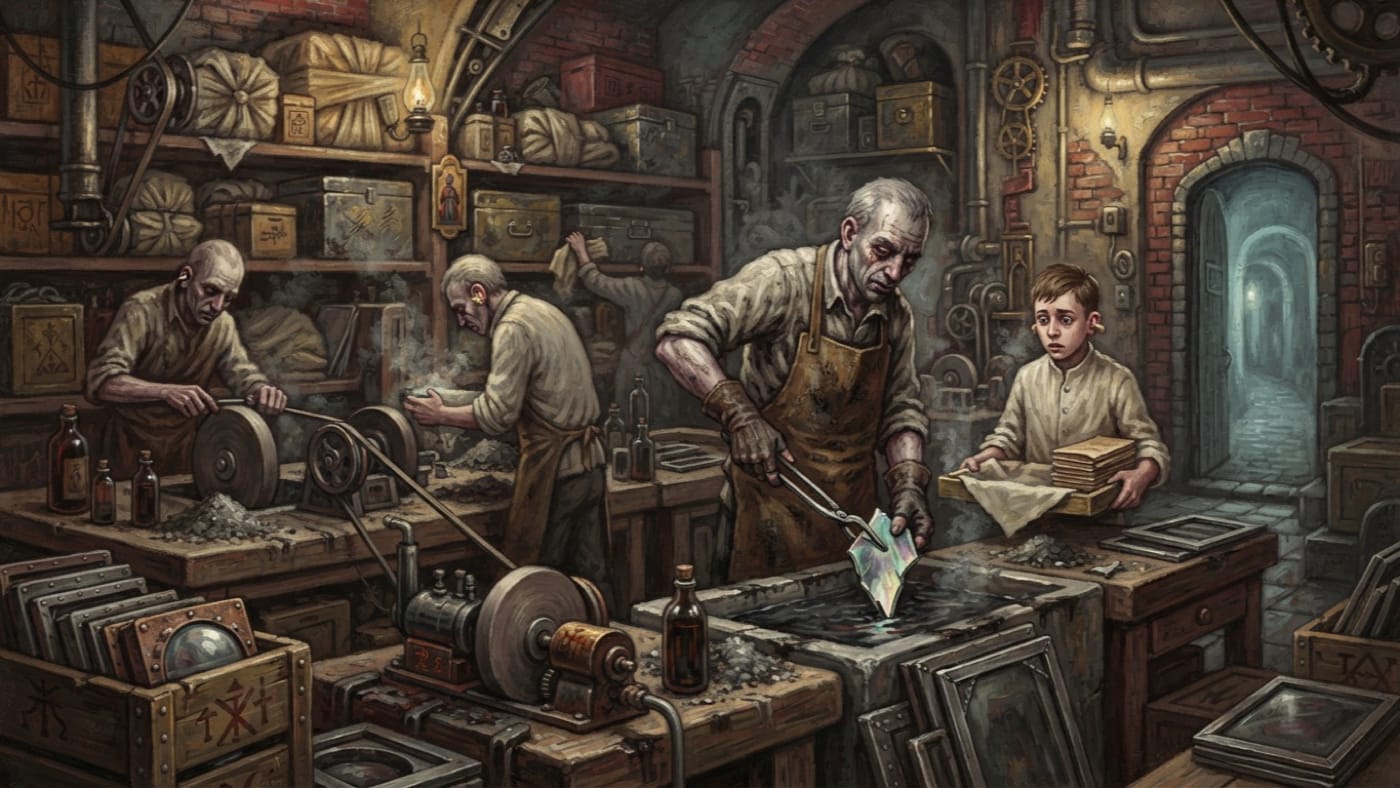
At the Polisher's bench the fragment spends a day in a quiet-box while someone listens for activity. Then comes the cold wash in salt and ash. Grinding takes down the edges where voices catch, and lapping with oil and fine ash-grit gives the surface the church-window gleam that buyers pay for.
The silence test follows: candle reflections, breath fog, and a list of names read aloud. They are always other people's names. A worker who reads his own name into a pane has made the elementary mistake, and the trade keeps no record of what the pane does with it. Wax plugs stay in the ears throughout and the lamps stay dim. Noon work is forbidden. The benches hold that bright sun lets the glass learn your face, and nobody in the Lanes has volunteered to disprove it.
A pane that passes is mounted in lead came, an iron mask socket or a reliquary frame. A pane that whispers through its testing may be filmed with black diesel, which mutes it until the film peels.
The workers pay for all of it: glass-dust lung, scarred eyes, lead in the fingertips. Memory goes too, small words first and larger ones after. The Grit-Runners who mix the grit and empty the quiet-boxes are children. They are forbidden to touch active shards because they work nearest the boxes.
#On the Hands That Pay
From the ruin's edge the fragment travels as holy freight. Bosporus smuggler-sailors seal shards into double-walled icon boxes and saint-bone sleeves, replace the seals with warmed wax and cross under the bell-tolls. The reliquary crate is the oldest joke in the trade and still its best camouflage. That is one route. The under-quay tunnels of Thessaloniki are another, worked through Pilot-King Nenos's water and Ledger-Ghost Tamsin's paperwork. I do not certify that every fragment follows either.
Brokers sort the buyers. Pilgrims want a vision before departure. Private collectors want something to look at that looks back. The Maskwright Lanes want lenses, because the southern regiments want to see through fog and glamour. Some of the men who sell those masks claim they show the enemy's soul. The claim belongs to the sellers. This office cannot certify soul-reading and does not intend to learn.
The Polishers quarrel over the goods. The Quietists thicken the lead and accept that a silent pane sells for less. The Revelators keep the visions and charge for them. The Bureau-Friends keep a decoy crate for every real one and arrange for Purity to find it.
Doctrine requires that every fragment be seized and shattered. The Bureau of Purity raids the benches. The Bureau of War buys the finished lenses as Optical Supplies, Standard. The same tithe funds both offices.
#On the Lanes' Present Supply
Since Varna in A.S. 151, when Purity smashed raw glass in public and the shards showed the crowd its own skeletons, every port has known that raw fragments are never broken before witnesses. The Lanes built their discipline on that lesson. Court debris tests it hardest.
In A.S. 198, three Grit-Runners in the Lanes touched active Lust-palace shards. Pelas, a Stainwright, broke their fingers before the precinct runner could arrive. The record says the act contained the contact. It does not say what the contact would otherwise have done, and I will not supply the sermon Purity has written in its place. Glassman Dimo is named as the gentler master. He prefers temperature and delay to fracture, and he certifies silence under the closed eye of Varda. Apprentices learn both methods.
Supply has grown since then. Maldrake's pressure on the southern coast in A.S. 198 raised demand for lenses just as a glut of shards reached the ports from the Wound-sites, the Wrath-slag and the Courts. The Lanes do not separate these sources in their stock books, because they keep no stock books that would survive a raid. The demand and the glut arrived together. Nothing on file shows that one caused the other.
Purity notice, A.S. 200: "The Maskwright Lanes have been cleared of contraband optics."
Corrected. What was cleared was decoy stock, packed by Bureau-Friends to be found. The court fragments it was meant to account for had already left beneath the quay before Captain Mavra turned the corner.
No census of court fragments exists. Purity counts the crates it breaks. War counts the lenses it receives. The Lanes count fingers.