
#On the Existence of a Profession That Does Not Exist
"All glass confesses." — attributed to Saint Varda of the Lead Hands, whose canonisation the Bureau has neither confirmed nor troubled itself to deny
The Synod maintains, in formal doctrine and in the voice of every Bureau of Purity inspector who has ever stood at a port-side market pretending to be surprised, that demon glass is seized upon discovery and shattered. The fragments are interred in lime. The lime is blessed. The blessing is stamped. The stamp is filed. The file is sealed. And the matter, insofar as the Bureau is concerned, ceases to exist in precisely the manner that a man ceases to exist when the Great Ledger crosses out his name.
Except that it doesn't.
The shards keep returning. Through every bastion, every port, every pilgrim checkpoint from Marseille to the Harbor of Chains, demon glass circulates with a persistence that defies the word "smuggling" and earns the word "contagion." Scavenged from the slag-plains where Maldrake's fire melted the earth to glass, or from the ruin-palaces where Velkara's courts shattered in whatever catastrophe the Bureau of Silence has classified so thoroughly that even the classification's existence is classified — the raw shards arrive in reliquary crates, sewn into pilgrim hems, packed between salt-fish in barrels that no customs clerk opens twice because the stench has been consecrated by something worse than rot.
And when they arrive, someone must polish them.
#On the Craft
"Polish is a prayer with grit." — Stainwright's saying, origin unknown, repetition punishable
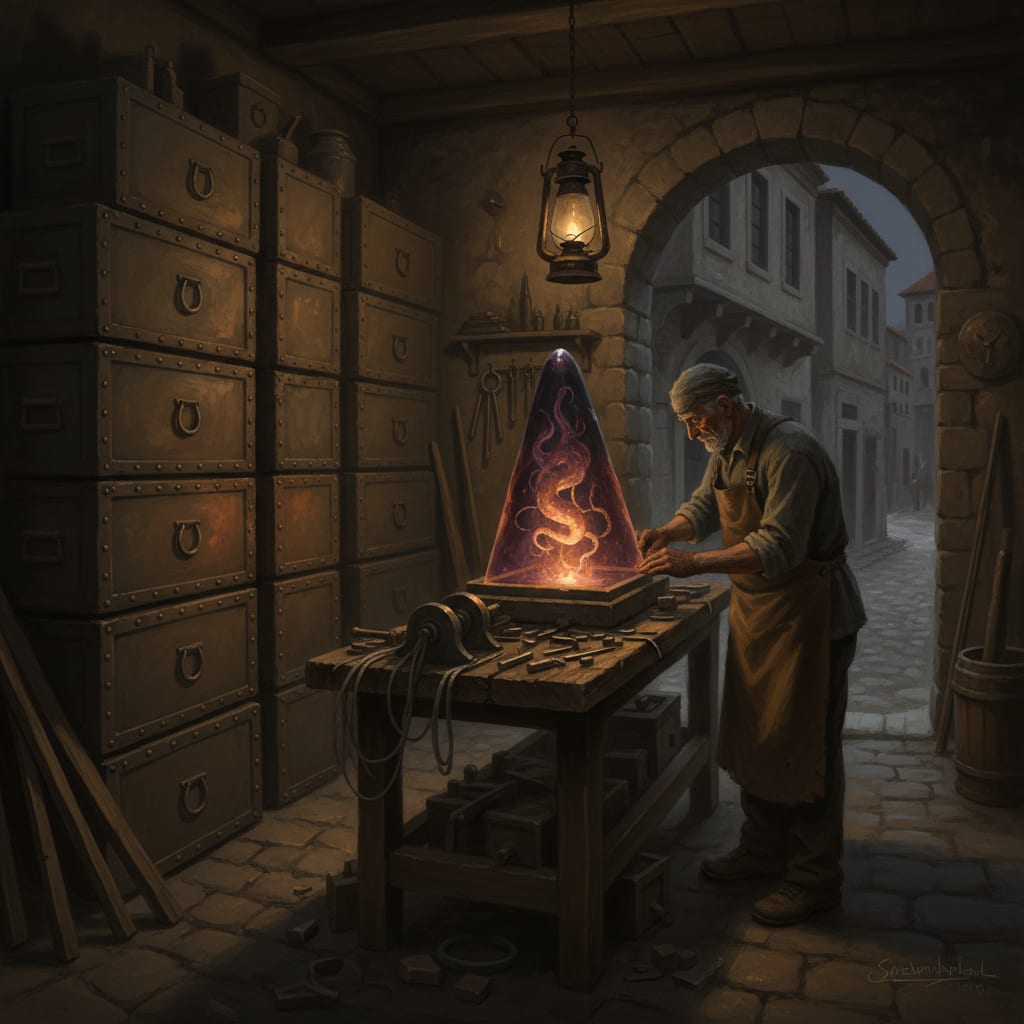
The Bosphorus smugglers bring the material. The Polisher makes it usable. Between the raw shard — a jagged thing that cuts the hand and cuts the mind and mutters in a register that sits just below hearing — and the finished pane that gleams in a captain's mask or a widow's reliquary shrine, there stands a craftsman whose profession the Bureau insists does not exist and whose services the Bureau has never, to anyone's knowledge, declined to tax.
The work proceeds in stages, and the stages have names that no guild charter records because no guild exists.
First: quarantine. The fresh shard is sealed in a lead-lined box — the Polishers call it a "quiet-box" — for twenty-four hours. If the lid hums, the shard is active. Active shards require a higher bribe to the precinct runner, a second pair of wax ear-plugs, and a willingness to work in dim light for the duration. Bright light wakes the glass. This is literal. Noon-sun through an unpolished Wrath-slag piece has been documented — by witnesses whose testimonies are sealed under Martial Code 22-A, Spiritual Contamination, Involuntary — to produce reflections of events that have not occurred, persons who have not been born, and one instance, at a glazier's stall in Thessaloniki in A.S. 184, of a face that was subsequently identified as belonging to a soldier who would die at Bastion-Shipka twelve years later. The identification was confirmed retroactively. The file was marked "Coincidence, Category Two," which in the Bureau's taxonomy sits between "Inexplicable" and "Do Not Discuss."
Second: cold wash. Salt and ash, scrubbed with rags soaked in black-diesel film — for no doctrinal reason; the oily residue mutes the whispering by approximately forty percent, which is enough to keep the craftsman sane through a full shift. The Polishers discovered this empirically. The Bureau of Engineering would find the methodology interesting if it acknowledged the profession's existence, which it does not, though two of its junior assessors have been observed purchasing finished panes for what they described as "personal optical research."
Third: the grind. This is where the craft earns its name. With ash-grit stones and hand-planes — tools inherited, stolen, or fabricated from scrap iron in port-side forges — the Polisher shapes the raw edge, removes the fracture-lines where whispers catch and amplify, and brings the surface to a smoothness that the profession's internal argot calls "church-window brilliance." The phrase is offensive to the Bureau of Rites, the Bureau of Relics, and the Bureau of Doctrine simultaneously, which is an economy of blasphemy one must respect.
Fourth: the silence test. A candle is placed before the finished pane. A list of names — never the Polisher's own, never a family member's, never a name belonging to anyone the Polisher has met — is read aloud. If the glass remains dark, it is quiet. If the glass shows the candle flame bending toward a name, that name belongs to someone the glass has an opinion about, and the pane must be ground further or boxed for a buyer with a specific appetite for prophecy, which is to say a buyer who has already committed one heresy and sees no profit in stopping at one.
Fifth: mounting. Lead came for window-panes. Iron sockets for trench-masks. Reliquary frames for the shrine-pieces that pilgrims purchase at exorbitant prices to glimpse what the Bureau calls "damnation" and the buyers call "possible salvations." The mounting is where the Polisher's art meets the Polisher's commerce, and the commerce is considerable.
#On the Polisher's Hierarchy and the Problem of Saint Varda
The profession that does not exist has, with characteristic defiance of nonexistence, developed a hierarchy.
At the bottom: the Grit-Runner. A child, usually. Port-born, ration-poor, possessed of steady hands and the particular moral flexibility that comes from growing up in a city where the queue is longer than the street. The Grit-Runner mixes ash-grit, cleans tools, empties the quiet-boxes, and never — under any circumstance — touches an active shard. The prohibition is enforced with a ferocity that the Bureau of Purity might envy if it admitted the hierarchy existed. Three Grit-Runners in Thessaloniki were found in A.S. 198 to have been handling active Lust-palace shards. Their master — a Stainwright known by the working name Pelas — broke their fingers himself before the precinct could be notified. The Bureau of Purity later arrested Pelas for an unrelated offense and found nothing, because by that time the workshop had been disassembled, the shards moved, and the Grit-Runners reassigned to a salt-fish operation where they presumably remain, fingerless and obedient.
Above the Grit-Runner: the Lapper, who grinds, and the Mounter, who frames. These are the journeymen. Skilled, expendable, and numerous enough that a Purity raid can sacrifice three without materially affecting production. They work eight-hour shifts, at night, by lamp-light — never candle, because candle flame does something the Polishers will not explain and the Bureau has not asked about because asking would constitute acknowledgment.
Above them: the Stainwright. The master. The title is their own invention and the Bureau of Heraldry would prosecute its use if the Bureau of Heraldry were not, at this precise moment, engaged in a jurisdictional dispute with the Bureau of Masks and Seals over the definition of "title" that has consumed eleven memoranda, four barrels of ink, and the patience of every clerk in Strasbourg. The Stainwright certifies silence. When a pane passes the candle test, the Stainwright stamps — with no Bureau seal: a lead impression bearing a closed eye, which is either a reference to Saint Varda or an insult to the Bureau of Purity or both.
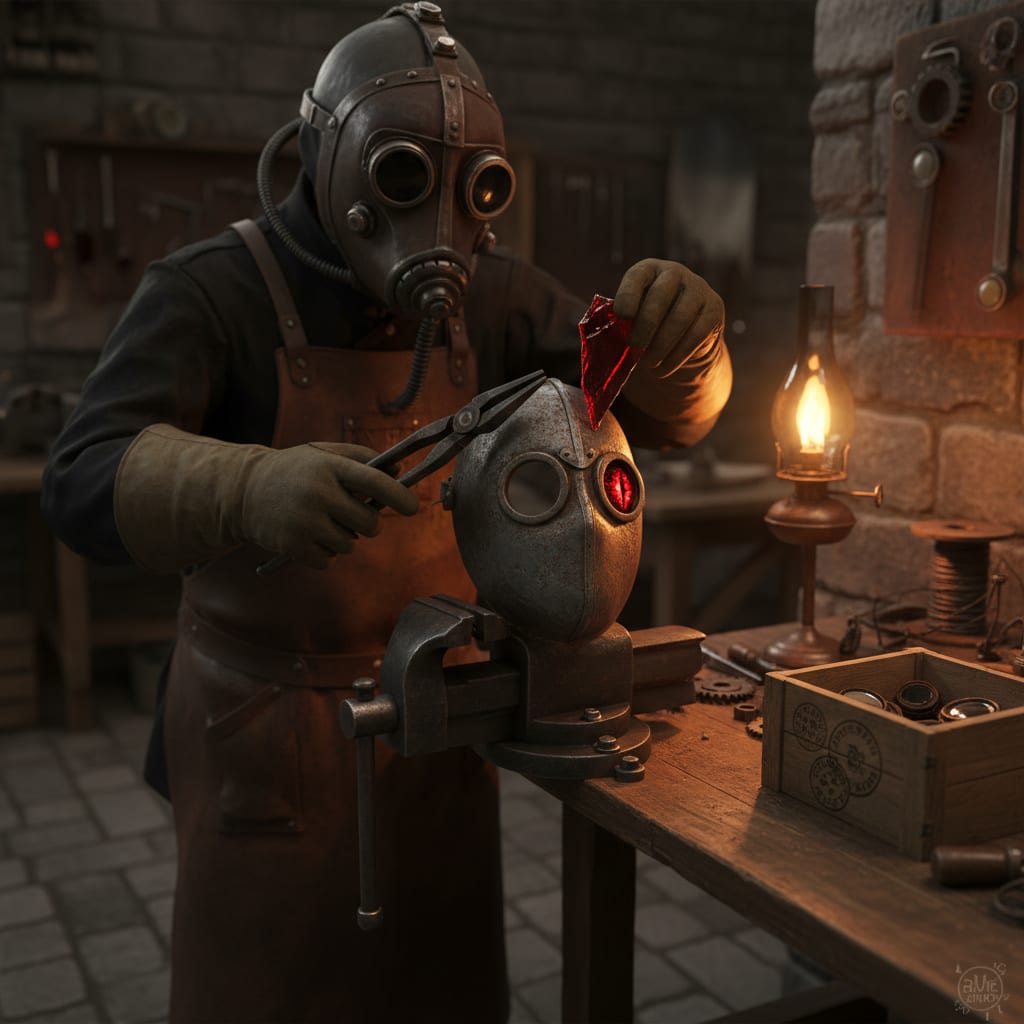
At the summit — rare, itinerant, and spoken of in the argot with a reverence the profession otherwise reserves for no one — is the Mask-Lens Surgeon. Combat-grade work. Embedding demon-glass shards into trench-mask eye-pieces so that soldiers along the Sagittal Line can, as Glassman Dimo phrases it, "see the enemy's soul." The Bureau of War orders these masks under the filing designation "Optical Supplies, Standard." The Bureau of Purity raids the workshops that produce them. Both Bureaus are aware of the other's activities. Neither has filed a formal complaint, because a formal complaint would require each Bureau to describe, in writing and under oath, what demon glass is, what it does, and why one Bureau wants it destroyed while the other wants it mounted in iron sockets and issued to front-line regiments.
The matter remains, as all intractable contradictions remain, filed under "Ongoing Review."
Saint Varda of the Lead Hands is the profession's patron. Her canonisation exists in no Bureau record. Her hagiography circulates in pencil on folded paper passed between port-side workshops. She is said to have sealed a whisper behind solder — a single shard, the story goes, that spoke in a dead saint's voice, and Varda mounted it in lead and glass so perfectly that the whisper could be heard only by the faithful and only on the Feast of Silenced Tongues, which is no true feast and which the Bureau of Rites would condemn if the Bureau of Rites had heard of it, which it has, and which it has filed under a classification I am not permitted to reproduce.
#On the Factions and the Mirror Riot's Long Shadow
Three tendencies divide the craft, and the tendencies have names the Polishers use among themselves with the casual savagery of professionals who understand that their colleagues are also their competition and that the precinct runner can be bribed to raid a rival's workshop as easily as a stranger's.
The Quietists polish for containment. Minimize the vision. Maximize the silence. A good pane, in the Quietist doctrine, shows nothing but church-window brilliance — color, light, a sense of depth, and no whispering whatsoever. The Quietists are the profession's conservatives, and their clientele is the profession's safest: captains who want lenses that resist fog, nobles who want reliquary windows that impress without disturbing, and the occasional Bureau of Shadows operative whose purposes the Quietists do not ask about and whose coin the Quietists do not refuse.
The Revelators sell prophecy. They push the polish to the edge of silence without crossing it — or cross it deliberately, calibrating the whisper to match the buyer's appetite. A widow who wants to see her dead son. A pilgrim who wants confirmation of salvation. A soldier who wants to know which trench will kill him so he can request transfer to a different one. The Revelators charge more, risk more, and account for the majority of the incidents that give Purity its quarterly arrest quotas.
The Bureau-Friends occupy the middle ground that all middle grounds in the Synod's territories eventually occupy: complicity dressed as cooperation. They stage raids. They supply decoy crates — one "active" shard packed among lead blanks and wrapped in enough reliquary cloth to look impressive when Purity smashes it in the public square. They pay their tithe. They keep their real stock in locations the precinct runner knows about and the precinct captain does not, or knows about and has been compensated to forget, which in the Bureau's filing system amounts to the same thing.
ERRATUM — BUREAU OF PURITY, CONTRABAND OPTICS DIVISION The Bureau's official assessment that demon-glass polishing represents "an isolated artisanal deviation confined to two or three port cities" has been revised. The revised assessment reads: "an isolated artisanal deviation confined to two or three port cities." The revision is identical to the original. The Bureau thanks the reader for not noticing.
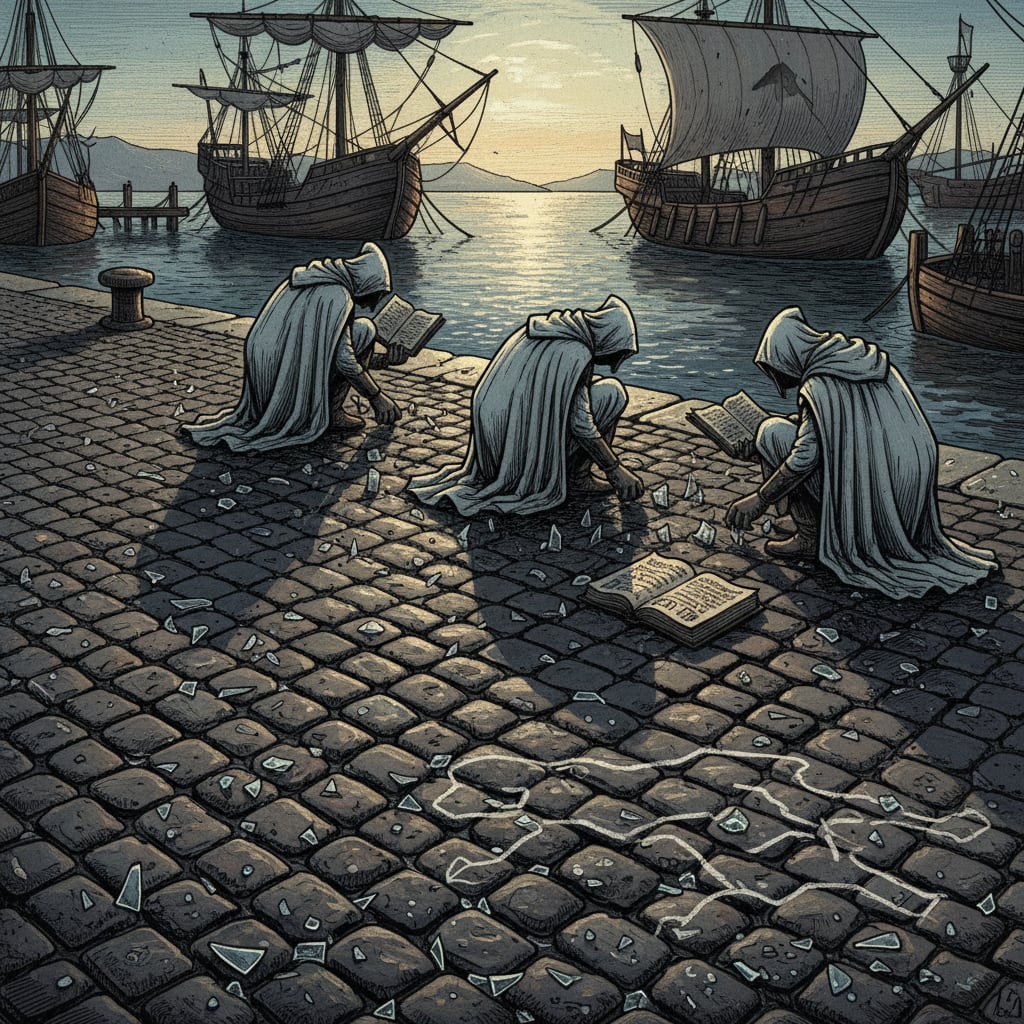
The Mirror Riot of Varna casts its shadow over all three factions. In the spring of A.S. 151, sailors sold raw demon glass in the harbor — unpolished, uncontained, sold by weight to buyers who did not know what they held and sellers who did not care. When Purity patrols arrived and smashed the shards on the cobblestones, the fragments reflected the crowd's skeletons — moving independently of the bodies that housed them, gesturing in directions the living had not chosen, walking toward the harbor. Hundreds drowned. The official report attributes the drownings to "mass hysteria aggravated by heretical optics." The unofficial account, which circulates in every port from Thessaloniki to Calais, is simpler: the skeletons wanted the water, and the bodies followed.
Varna is why the Polishers exist. Raw glass kills. Polished glass — contained, ground, silence-tested, mounted in lead — merely corrupts, and corruption, unlike death, can be taxed.
#On the Present Condition
The trade is expanding. This is the Bureau's assessment, filed in a memorandum I am not authorised to quote and am quoting regardless: "Demon-glass distribution networks have increased operational capacity by an estimated thirty percent across Zones 5 through 7 in the period A.S. 198–201, correlating with increased demonic activity along the Thracian front (Unregistered) and consequent increase in raw-material availability." The memorandum's author — a junior analyst in the Bureau of Shadows whose name I will protect because her career depends on her superiors not reading this article, which they will — recommends "enhanced interdiction." Her superior has written, in the margin, "Noted."
"Noted" is the Bureau's way of saying "filed and forgotten." The glass will keep coming. The Polishers will keep grinding. Purity will keep raiding the workshops it knows about and ignoring the ones it profits from. And the shards will keep whispering — in the quiet-boxes, in the lead-camed panes, in the mask-lenses of soldiers who look through Glassman Dimo's eye-pieces and see, for one bright and terrible instant, the thing that waits behind the enemy's face.
The Polishers have a saying for this. They murmur it over the grit-stones, over the cold-wash basins, over the candle-lit silence tests where the names of strangers are read aloud to glass that listens with an attention no cleric has ever matched: All glass confesses.
The Bureau has not yet determined what the glass is confessing to. The Bureau suspects it would prefer not to know. The Bureau is, for once, correct.