
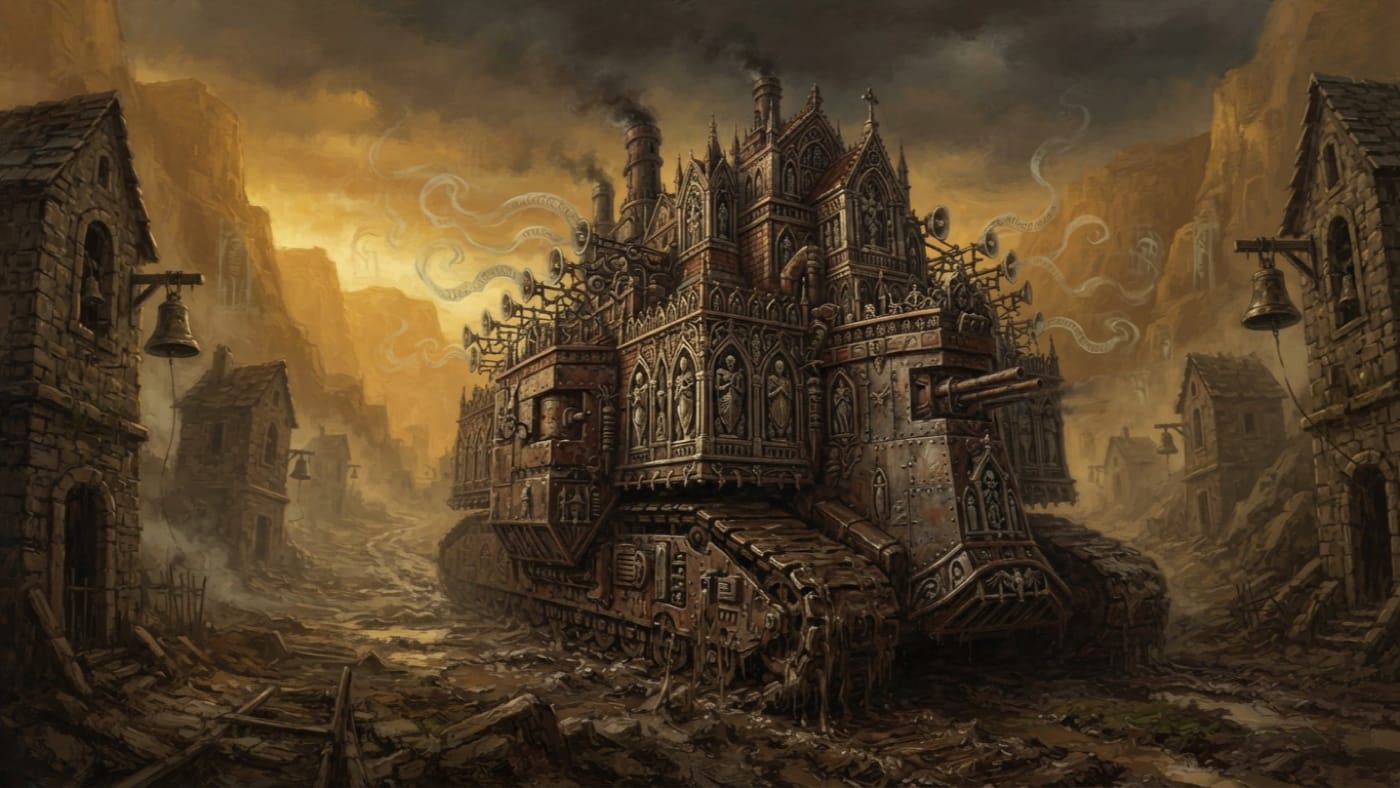
#On the Recorded Service
In A.S. 188, 1898 by the old calendar, the Catacomb-Carrier Threnody served in the Macedonian corridor defence. That sentence is the whole of the certain record. Everything after it is testimony, or classification, or the narrow aisle between the two where an archivist spends his working life. I know where the furniture stands in that aisle.
The operation is named in Bastion-Constantinople's account of its carriers, and that account supplies the year. It is listed among the honours in Threnody's service file, beside Belgrade. It appears again in the War service abstract kept under her registry entry, and once more in the field accounts gathered along the Macedon Escarpments. These are overlapping entries copied by overlapping clerks. A reader who counts them as five witnesses has mistaken a choir for a crowd.
None of them gives a calendar day, a season, a duration or a count of the engagements inside the operation. The thirty-seven engagements in Threnody's file cover her whole career. One day some clerk will divide that figure by her honours and file the result as history. He will be wrong, and he will be promoted.
#The Northwest Approach
The Escarpments rise northwest of the Bastion in broken limestone terraces. Fault ravines cut through them, and the gold veined through the rock turns the light amber until distance becomes a matter of opinion. The Bureau of Engineering has confirmed in writing that the glare defeats the eye. It is one of the few points on which Engineering and the muleteers agree, and both parties found the agreement humiliating.
The corridor matters because Constantinople eats through it. The southern anchor of the Line cannot live on the Bosphorus alone. Grain, rivets, relic-cases and sealed coffers come up the escarpment roads, and a road that feeds a fortress has to be held by whatever the fortress can spare. In A.S. 188, part of what it could spare was sixty tons of ossuary on treads.
The record does not say which pass she held, which stretch of road or which ravine. No map comes with the service note, and no convoy is named as the thing defended. The surviving accounts give mud, ravines, and tollhouses standing abandoned along the route, of the kind the old highlands kept before the Sundering taught their gold a worse arithmetic. Beyond that, the accounts describe the corridor the way a confessor describes a parish: by its sins, with no street plan.
#The Carrier and the Restraint Verse
A Catacomb-Carrier is a land-fortress on iron treads, hulled in layered iron, reliquary plate and ossuary brick, assembled in the Carrier Yard of the Foundry Quarter. Bone-resonance speakers along her upper flanks broadcast licensed hymns. Her casemates carry blessed artillery, and her middle deck carries shield-saints in sealed frames. Beneath them sits a housing kept by the Order of the Shackled Flame, whose contents the official account describes in nouns I am not paid enough to believe.
Threnody is the first famous carrier of her pattern. She was commissioned in A.S. 145 and is older than the A.S. 179 reconstruction pattern, with twelve speakers to a flank. Her survival of the Three-Night Bombard in A.S. 177 and her long maintenance afterwards belong to other files. I name them here only so that no binder sews them into this one.
The hymn rules matter more here than the guns. The Carrier Yard copy is blunt: no engine ignition without the Canticle Primer, and no forward crawl without the Second Restraint Verse. The verse is the condition of movement. A carrier going forward is, by regulation, a carrier being sung to.
So when the service note records that Threnody met the corridor with "continued forward crawl under Second Restraint Verse," it records a rule being kept. It does not say the verse silenced the bells, calmed the mud, broke an attack or brought the defence to an end. A chaplain could preach a miracle from that line. The line offers him no help.
#Reports from the Corridor
Arranged by kind. The record gives no order of occurrence, and the reader will be given none.
The mud. Carrier crews reported that the mud clung to her treads as if it were reading serial numbers. Mark the "as if." The crews did not claim the soil could read. They were describing how it clung: a slow, deliberate grip, like a clerk running a finger down a column. Whatever the ground of the Escarpments was doing, the witnesses chose an accounting image for it. Soldiers do not reach for the ledger when they describe weather.
The bells. Abandoned tollhouses along the route rang their bells whenever a debt was denied. No keeper is recorded and no hand on a rope is named. The accounts set the refusal and the ringing side by side and stop there, and I stop with them. The region's reputation for debt is well filed elsewhere. A reputation does not explain a mechanism, and I will not sell the reader a mechanism.
The echoes. Echoes in the ravines repeated orders in superior voices. The service note calls this "hostile echo discipline," a phrase so composed it deserves a frame. For a carrier crew this is a hazard of the plainest kind. A crawl under hymn requires the driver to obey one voice, and the ravines offered several, each with better credentials than the last.
The names below. Crews reported hearing their own names spoken beneath the deck by men not yet assigned aboard. I give this exactly as it was given. The account does not identify the speakers, and no later posting list has been put before me as proof of prophecy. Clerical habit tempts me to check the roster. So far my instinct for survival has won.
#The Service Note and the Three Appendices
The Bureau of War filed the whole affair under adverse terrain behaviour. I admire the phrase the way one admires a well-made reliquary built over something one would rather not see. Terrain behaves adversely when it floods. When it rings for unpaid debts and borrows a colonel's voice, War still calls it terrain, because terrain needs no inquiry. It needs no chaplain's report, and no letter to the Bureau of Purity asking whether ground can commit heresy.
Read the last line twice. It is an instruction. It tells us that a voice claiming rank spoke from below, and that someone feared it would be answered. Whether every crewman obeyed is not recorded. Instructions are written by men who expect disobedience. An obedient crew needs no paper.
As for the casualties, the note gives no total. Three appendices tell the reader that the casualties filled more than one folder. They tell the reader nothing else, and the note does not open them. I have never seen a figure honestly drawn from those appendices, and I will not make one up to please a reader who likes his dead counted.
The cited accounts establish no outcome. Threnody's file lists the defence among her honours, which proves she was there and that War thought her service worth an honour. Honours lists are drawn up afterwards, at desks, by men with dry boots. They tell you who was decorated, and they tell you nothing about how the road fared.