
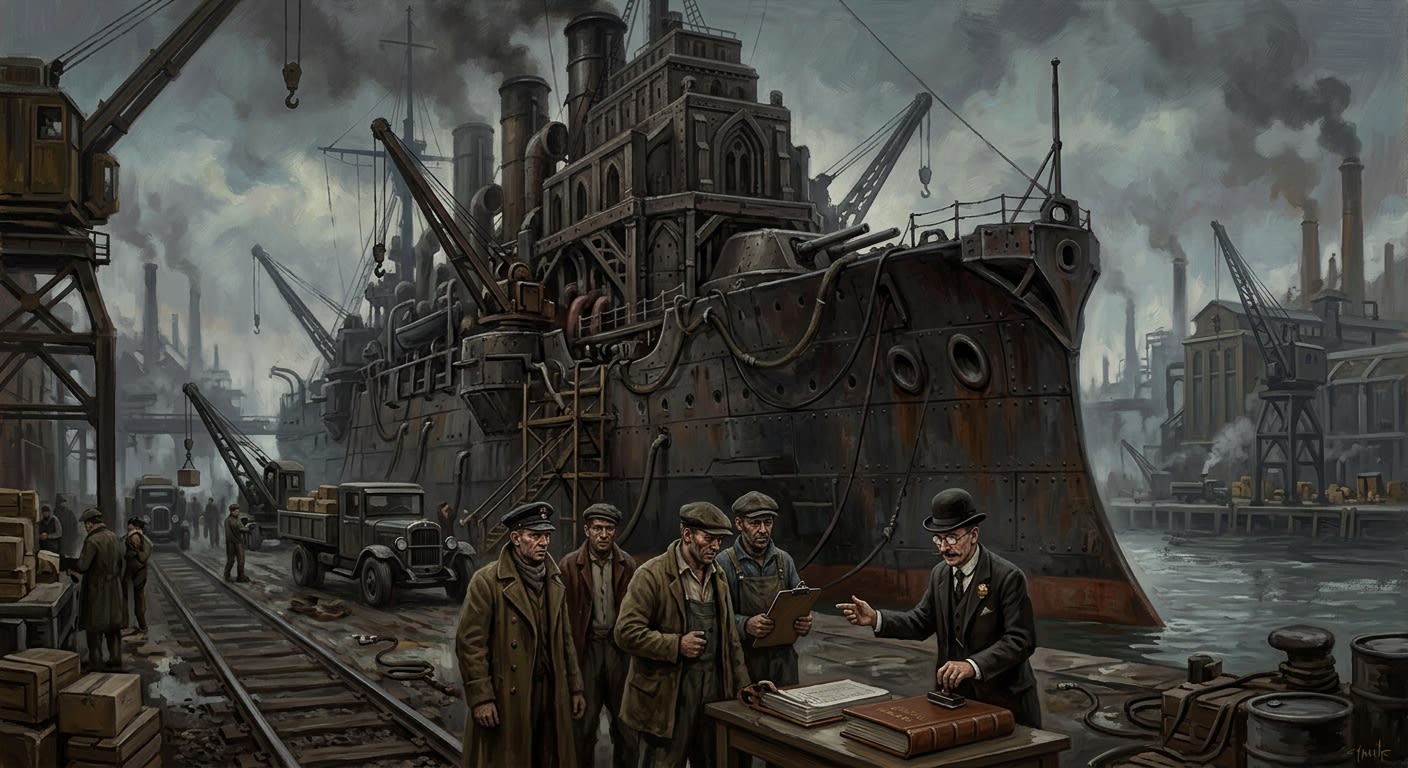
#On the Carrier at Pier Seven
The Threnody occupies Pier Seven of the Harbor of Chains and has done so for eleven years, which is a long maintenance interval for a land engine and an excellent prison sentence for a theological mistake. She is a Catacomb-Carrier of the first famous pattern: sixty tons in the War ledger, nearer seventy when fed, ossuary-bricked along the flanks, iron-treaded, hymn-speakered, saint-mortared, and possessed of the particular stillness that makes dockworkers lower their voices while pretending not to.
Pier Seven was not built for silence. It was built for loading, winching, swearing, repair, smoke, hoist-bells, and the brassy violence of War materiel arriving late. Around Threnody the pier behaves like a chapel after a bad funeral. Men walk around her shadow. Rats avoid her tread housings unless driven by floodwater. The harbor clerks process her mooring fees with faces scraped clean of curiosity.
#On Commission and Service
Threnody was commissioned in A.S. 145 from the Foundry Quarter Carrier Yard, when the Order of the Shackled Flame still used cleaner euphemisms and the Bureau of War still believed a bound housing could be made obedient by naming it after grief. She became the earliest named Carrier whose record survived every later audit, fire, transfer, and mercy of redaction.
Her service file lists thirty-seven engagements. Belgrade service. Macedonian corridor defence. Southern breach work in mud so corrupted that boots had to be burned before entering prayer. Three emergency extractions of shield-saint frames. Six confirmed returns under partial tread failure. One retreat classified as “advance in reverse,” because War hates the plain verb when the plain verb has teeth.
The men who marched beside her called her the Rolling Dirge. The men who served inside did not call her anything where officers could hear. The old crews learned to sleep between hymn pulses, to count shifts by condensation on reliquary glass, and to ignore the tapping beneath the lower deck unless it matched the Canticle Primer. If the tapping matched the Primer, they sang louder.
#On Her Construction
Threnody is a chapel built as an argument with physics. Her hull is layered iron, reliquary plate, bone-lime, authenticated martyr fragments, and the less discussable material that arrives from the lower galleries in carts covered with damp canvas. Her ribs contain saint-brick from Ulm, martyr-dust from three authorised ossuaries, and several consignments whose provenance sheets were chewed by harbor damp in a way that spared the signatures and destroyed the nouns. Miracles have manners. So does fraud.
The upper deck forms a processional aisle broad enough for chained choirmen to pass in two lines. The middle deck carries shield-saint frames and blessed artillery. The lower deck holds the motive reliquary housing. No visitor is taken to the lower deck. Inspectors who have seen it speak of wax seams, blackened rivets, and an engine casing warm on feast days without external heat.
A prior technical digest described Threnody as “a conventional armoured carrier fitted with devotional apparatus.”
Corrected. The devotional apparatus is not fitted to the machine. The machine is fitted around the devotional apparatus. The distinction has killed enough artificers to deserve grammar.
Her bone-resonance speakers are older than the A.S. 179 reconstruction pattern: twelve to each flank, saint-rib lattice behind brass teeth, prayer-vox ports worn smooth by years of hymn pressure. When intact, they can throw the Second Restraint Verse (Unregistered) across two trenches and make Maldrake’s ash-serfs crawl with blood coming from their ears. When damaged, they sing inward. The maintenance logs call this reverse acoustic pressure. The former crew called it being eaten by music.
#On the Voice in Quotation Marks
The maintenance logs are six hundred and fourteen pages long. The word “voice” appears forty-two times, always in quotation marks, always followed by an explanation supplied by a man whose handwriting worsens before the sentence ends.
“Voice” in aft casing: pressure vent flutter.
“Voice” beneath choir deck: sympathetic pipe vibration.
“Voice” reciting crew tally: clerk error in auditory conditions.
“Voice” using the name of a dead gunner whose file was sealed after Belgrade: under investigation.
The Bureau of Engineering prefers vibration. War prefers morale stress. Purity prefers delayed inspection, a preference so consistent it has become almost doctrinal. The Shackled Flame prefers silence. Doctrine prefers the file remain filed. I prefer truth, provided truth has first been dressed, shaved, notarised, and made to stand where I can see its hands.
CARRIER YARD MAINTENANCE LOG — EXTRACT 412 Event: interior sound during sealed lower-deck inspection. Logged content: “████████████████.” Witnesses: three artificers, one choir mechanic, one Records clerk. Post-event condition: two bleeding from ears; clerk reciting old crew roster; artificer Belan missing from locked compartment. Compartment status: sealed from inside.
#On Pier Seven Accounting
The mooring fees are paid quarterly by a Bureau of War account that predates the current accounting system by two administrative generations. This is literal phrasing. The account number uses a prefix abolished before the present ledgers were born, a seal form retired after the A.S. 158 Sigil Reform (Unregistered), and a debit notation whose last authorised manual copy sits in a locked cabinet in Strasbourg under a label reading obsolete. Obsolete money spends beautifully when War signs it.
Harbor clerks receive the transfer, stamp receipt, and move the folio along. None asks why a land fortress pays harbor fees. None asks why the payer is older than the form. None asks why arrears have never accumulated despite the account lacking visible replenishment since A.S. 170. The clerks are not fools. They are alive.
Harbormaster Joram Clee’s office tolerates Threnody as it tolerates fog, chain groan, undeclared cargo, and the occasional rat carrying a paper scrap in its teeth. The carrier remains moored because the harbor registry says she is moored. Law, in its purest form, is a rope tied to something that should not move.
#On the Crew Supplemental
The crew is listed as “intact — see supplemental.” The supplemental has not been filed.
This is the sort of absence that begins as clerical inconvenience and matures into Doctrine. A Catacomb-Carrier crew is not small: drivers, tread men, artillery crews, choir mechanics, shield-saint bearers, reliquary custodians, chaplain-controller, damage clerk, oil boys, bell counter, corpse registrar. If intact, they should eat. If they eat, stores should move. If stores move, invoices should exist. The invoices exist. They show ration draw for forty-one persons, candles for twelve stations, lamp oil, throat lozenges, boot grease, and burial linen in quantities described as reserve.
No one leaves the carrier.
No one joins it.
The ration crates are delivered to the lower side hatch every third morning. By fourth bell the crates are empty and stacked on the pier, lids aligned, nails pressed back into their holes. Harbor labourers refuse to touch the empties until sunrise. One young fool did otherwise in A.S. 196 and opened a crate while it was still damp. He resigned from harbor work, entered the Bureau of Pilgrimage, and now leads processions in Marseille where the sea cannot see him directly.
A dockmaster’s A.S. 193 note recorded that Threnody had “no active crew aboard.”
Clarified. The note was based on visual deck inspection. Current registry language supersedes it: crew intact. Visual absence is not legal absence. The Synod has survived two centuries by respecting this distinction and abusing it only when necessary.
#On the Barnacles
Barnacles grow on Threnody’s lower tread guards.
I include the fact because it offends classification. A land engine does not acquire marine life unless the sea has touched it, the engine has entered the sea, or the barnacles have grown ambitious. Pier Seven mechanics scraped them twice. They returned in seven days, forming small white knots along the rivet seams, densest near the lower housing where the deck plates pulse during harbour bells. The Bureau of Relics declined to authenticate them. Relics will authenticate a splinter of saintly furniture from a tavern privy if the donation is adequate, but barnacles on a Catacomb-Carrier apparently strain credulity.
At low tide, harbor children throw pebbles at the tread guards and dare one another to listen. The prudent ones hear nothing and claim victory. The less prudent hear surf. One claimed to hear marching. His mother beat him for lying, then moved the family from Blue ledger zone to Ochre terraces within the week.
#On the Present Maintenance
Maintenance, in Threnody’s case, has become a sacrament of avoidance. The artificers inspect outer plates, polish hymn-speaker brass, replace prayer tiles, oil visible hinges, and certify the carrier unready for movement with the serenity of priests confirming that a sealed vault remains sealed. The lower housing is not opened. The primary casing is not removed. The crew supplemental is not filed. Pier Seven remains occupied.
A machine may be broken. A machine may be waiting. A machine may be obeying an order no living officer remembers giving. I offer no preference among these possibilities. Preference is for men with fewer clearances.
At dusk, when the Chain of Saint Anakletos rises across the Bosphorus and the harbor bells mark closure, Threnody’s hymn-speakers sometimes breathe once. Not sing. Breathe. The sound is low enough to make the ropes tremble and the nearest water wrinkle away from the pier.
The harbor log records wind.
Phase 2a correction log: corrected the A.S. 177 survival honour to “survival of A.S. 177 Three-Night Bombard” to match the Foundry Quarter record; no date, bastion, geography, or link-density errors found. Article dateline set to A.S. 145 for Threnody's commission; public seal stamps remain A.S. 201.