
#On the First Famous Carrier
The Catacomb-Carrier Threnody is the earliest named Catacomb-Carrier whose record survived audit, fire, transfer, accident, sabotage, salt damp, theological embarrassment, and the helpful appetite of offices that misplace files exactly when those files acquire teeth. She was commissioned in A.S. 145 from the Carrier Yard of the Foundry Quarter in Bastion-Constantinople, under a War charter old enough to use cleaner lies about the Order of the Shackled Flame.
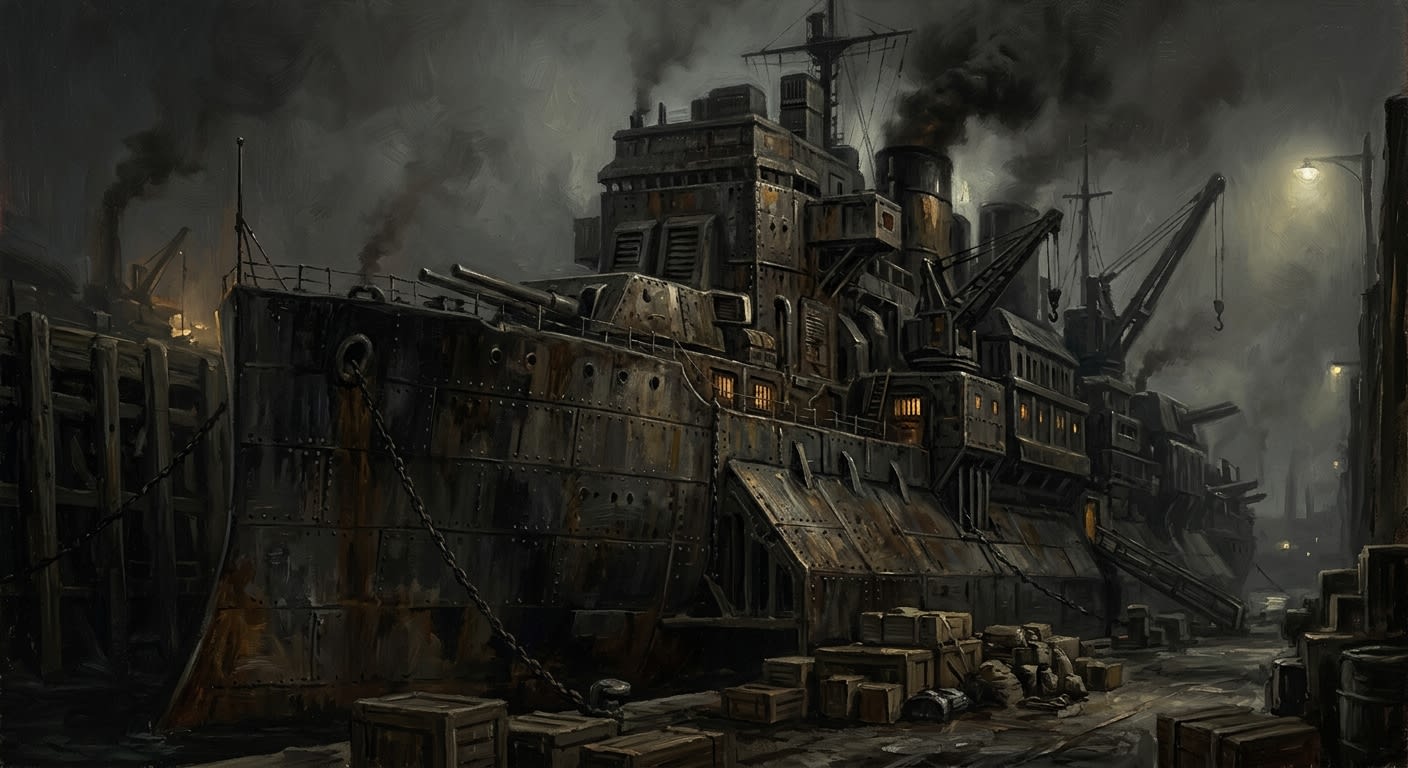
She is a land-fortress on iron treads. She is a moving ossuary. She is a chapel built around an engine casing and then taught, by prayer, pressure, bone, iron, wax, and something colder than doctrine, to crawl toward whatever the southern Line requires dead. The ordinary man calls this a machine because the ordinary man values sleep.
Her War ledger records sixty tons. That number is a courtesy extended to bridge inspectors, budget clerks, and other fragile breeds. Fed, armed, sainted, crewed, packed with shield-frames, and carrying enough shell to make a ravine reconsider its vocation, she weighs nearer seventy. The extra ten tons consist of bone, fear, grease, concealed amendments, and the difference between Engineering arithmetic and battlefield fact.
#On Her Construction and Interior Rite
Threnody was built according to a pattern the Bureau of Engineering insists it designed and the Shackled Flame insists it completed. Both claims are true in the way two executioners may both claim a neck. The hull is layered iron, reliquary plate, ossuary brick, saint-bone mortar, heat-cured wax, prayer tile, and those covered consignments from the lower galleries whose manifests list weight, seal number, and destination while declining the vulgarity of nouns.
Her upper deck is a processional aisle. Choirmen may pass there in two chained files, thuribles swinging, breath counted by hymn pressure and fear. Her middle deck carries shield-saints, blessed artillery, choir mechanics, oil boys, ammunition lockers, reliquary custodians, damage clerks, and the narrow mercy of men who know where to stand when the guns speak. Her lower deck contains the motive reliquary housing. No casual visitor descends there. No careful visitor asks.
A pre-reform technical digest classified Threnody as “a conventional armoured carrier fitted with devotional apparatus.”
Corrected. The carrier is sanctity, containment, artillery, and heresy arranged until motion occurs. Calling the apparatus devotional is like calling a guillotine carpentry.
Her speakers are older than the A.S. 179 reconstruction pattern: twelve saint-rib lattices to each flank, set behind brass teeth and prayer-vox ports worn smooth by years of licensed breath. They broadcast the Canticle Primer, the Second Restraint Verse (Unregistered), pressure hymns for tread alignment, and the emergency litanies men sing when the casing grows too warm in places no fire reaches. When they sing outward, infantry rise. Demons recoil. Ash-serfs bleed. When they sing inward, crewmen bite leather and wait for the chaplain-controller to find the correct page.
The brake housings are packed with bone-ash. The bearings are marked with saint ciphers before rotation. The gun casemates receive incense flush after firing black-capped rounds. The lower casing is bled of oil according to a rite whose rubric uses the word maintenance seventeen times and confession once, in a margin hand no clerk admits recognising.
#On Service, Belgrade, and the Mud That Read Numbers
Thirty-seven engagements sit in the service file. I have read the file. It is too neat, which is always how one knows something ugly has been swept under the chapel rug. It lists Belgrade service, Macedonian corridor defence, southern breach work, three emergency extractions of shield-saint frames, six returns under partial tread failure, and one retreat classified as “advance in reverse,” a phrase I recommend to every coward with literary ambition.
At Belgrade, Threnody broke through a Kargathite body-wall after two lesser engines stalled in meat-mud. The report calls the obstruction “organic fortification.” Soldiers called it the Supper Rampart until Purity fined the joke. Her forward guns fired consecrated canister at such short range that the saint-dust blew back through her own vox ports and coated the choirmen’s tongues white. Three sang for two days afterward without waking. One never stopped, though Records eventually solved the difficulty by marking him dead.
In the Macedonian corridor, the mud clung to her treads as if reading serial numbers. Abandoned tollhouses rang bells whenever a debt was denied. Ravine echoes repeated orders in superior voices. Carrier crews reported hearing their names spoken from under the deck by men not yet assigned aboard. War filed the whole affair under adverse terrain behaviour. War’s genius lies in making terror sound like weather.
#On the Three-Night Bombard and Her Survival
The Three-Night Bombard of A.S. 177 destroyed much of the Foundry Quarter and opened portions of the Yard like a surgical lesson conducted by lunatics. Velmora’s agents purchased failure through official channels, packed powder into the Quarter’s own appetite, and let the southern anchor teach itself combustion. Four Catacomb-Carrier engines died in their barns with ribs open and hymn-speakers pulsing without sound.
Threnody survived because she was at Pier Seven under maintenance. This is the public explanation. It is also the private explanation, which makes it rare enough to deserve preservation. Her berth spared her the first blast, the harbour wall shielded her from the second, and during the third night her speakers breathed once without power, according to two watchmen, one crane boy, and a Records clerk who later amended his testimony to “wind.”
Early Bombard memoranda described Threnody’s survival as “providential absence from the primary blast field.”
Corrected. She was present: moored, sealed, and listening from Pier Seven while her sisters burned. Providence may claim credit after filing salvage forms.
Reconstruction in A.S. 179 created the newer carrier pattern: more speakers, heavier housing lifts, deeper Yard access, additional hymn-locks, and a sharper official reluctance to discuss what survived beneath the old floor. Threnody remained first pattern, older, narrower, meaner, and increasingly difficult to treat as equipment. The old machines remember the old permissions. That is why new manuals are printed so often.
#On Pier Seven and the Unfiled Supplemental
Pier Seven has held Threnody for eleven years. Harbor men will tell you she is motionless. Harbor men are entitled to their small comforts. The registry says she is under continuous maintenance, crew intact, supplemental pending. That pending supplemental is the most powerful document in Constantinople by virtue of not existing where anyone can safely read it.
A carrier crew is more than a handful of men and a dog. Drivers, tread men, artillery crews, choir mechanics, shield-saint bearers, reliquary custodians, chaplain-controller, damage clerk, oil boys, bell counter, corpse registrar: the complete complement devours food, candles, lozenges, lamp oil, boot grease, burial linen, and excuses. The invoices exist. They draw rations for forty-one persons. The crates are delivered every third morning to the lower side hatch. By fourth bell they are empty, stacked, and nailed shut again with a neatness bordering on threat.
No one is seen leaving. No one is seen entering. Visual absence, as the Bureau of Records has clarified with magnificent cowardice, is not legal absence.
Harbormaster Joram Clee tolerates her with the same narrow discipline by which he tolerates fog, chain groan, undeclared crates, and the Chain of Saint Anakletos adding links when no forge has admitted making them. His office accepts the mooring fees. The fees are paid from a War account that predates the current ledgers, bearing a prefix retired before the clerks processing it were born. Obsolete money spends sweetly when it arrives armed.
#On Barnacles, Voices, and Other Courtesies of Classification
Barnacles grow on Threnody’s lower tread guards. I repeat the fact because repetition may yet shame classification into movement. A land engine should not acquire marine life. Pier mechanics scraped the growth twice. It returned in seven days, denser near rivet seams that pulse when harbour bells sound. The Bureau of Relics declined authentication, proving there remains at least one object in Europe the Bureau cannot be paid to sanctify.
The maintenance logs contain six hundred and fourteen pages. The word “voice” appears forty-two times, always in quotation marks, always followed by a mechanical explanation that begins bravely and deteriorates before the ink dries. “Voice” in aft casing: pressure vent flutter. “Voice” beneath choir deck: sympathetic pipe vibration. “Voice” reciting crew tally: clerk error in auditory conditions. “Voice” using the name of a dead gunner whose Belgrade file was sealed: pending review.
There are lesser entries, too small for Purity and too persistent for honesty. A wrench left on the middle deck returns to the same rung of the port ladder after removal. Candle stubs placed by the lower hatch burn down without visible flame and leave wax in the shape of little kneeling men. A choir mechanic swore the aft speaker teeth had changed count between Matins and Vespers; Engineering measured them, found twelve, and punished him for counting thirteen. He accepted the punishment with relief. Men would rather be flogged for arithmetic than thanked by a machine.
The barnacles deserve their own appendix, which no Bureau has had the courage to commission. When scraped into iron pans, they click against the sides in measured sequence. Three clicks, two clicks, seven clicks, pause. The pattern repeats until burned. A Bell clerk identified the cadence as a ruined harbour call once used by drowned pilots before the Chain of Saint Anakletos received reliquary links. The clerk then withdrew the observation, citing fatigue, which is the official term for having heard too much.
CARRIER YARD MAINTENANCE LOG — SUPPLEMENTAL EXTRACT Inspection point: lower housing, outer wax seam. Sound recorded: “████████████████████.” Witness response: choir mechanic answered before questioning began. Post-event action: increase hymn pressure; remove answer from transcript; return empty ration crates to pier.
One must admire the courage of quotation marks. They stand around a dangerous noun like two underpaid guards outside a crypt, convinced that posture will suffice.
#On Present Custody
As of A.S. 201, Threnody remains at Pier Seven under maintenance, registry protection, War account payment, Clee’s narrow mercy, Doctrine’s sealed patience, Purity’s deferred appetite, Engineering’s vibration theories, and the Shackled Flame’s silence. The lower housing is not opened. The primary casing is not removed. The crew supplemental is not filed. Pier Seven is occupied.
At dusk, when the Chain rises across the Bosphorus and the harbour bells mark closure, her hymn-speakers sometimes breathe. The ropes tremble. The nearest water wrinkles away from the pier. The harbor log records wind.