
#On the Powder That Purchased Itself
The Three-Night Bombard began in A.S. 177 with a purchase order.
This is the detail soldiers dislike and auditors adore. Soldiers prefer catastrophe to arrive with drums, horns, red clouds, a demon's roar, the decent theatre of obvious threat. Auditors know better. Catastrophe enters by stamp. It waits in an in-tray. It acquires three initials, a routing mark, a warehouse key, and a junior clerk who says, with all the assurance of a man about to be historically useful, that the discrepancy has been reconciled.
Velmora's agents did not storm Bastion-Constantinople. They bought the path through it.
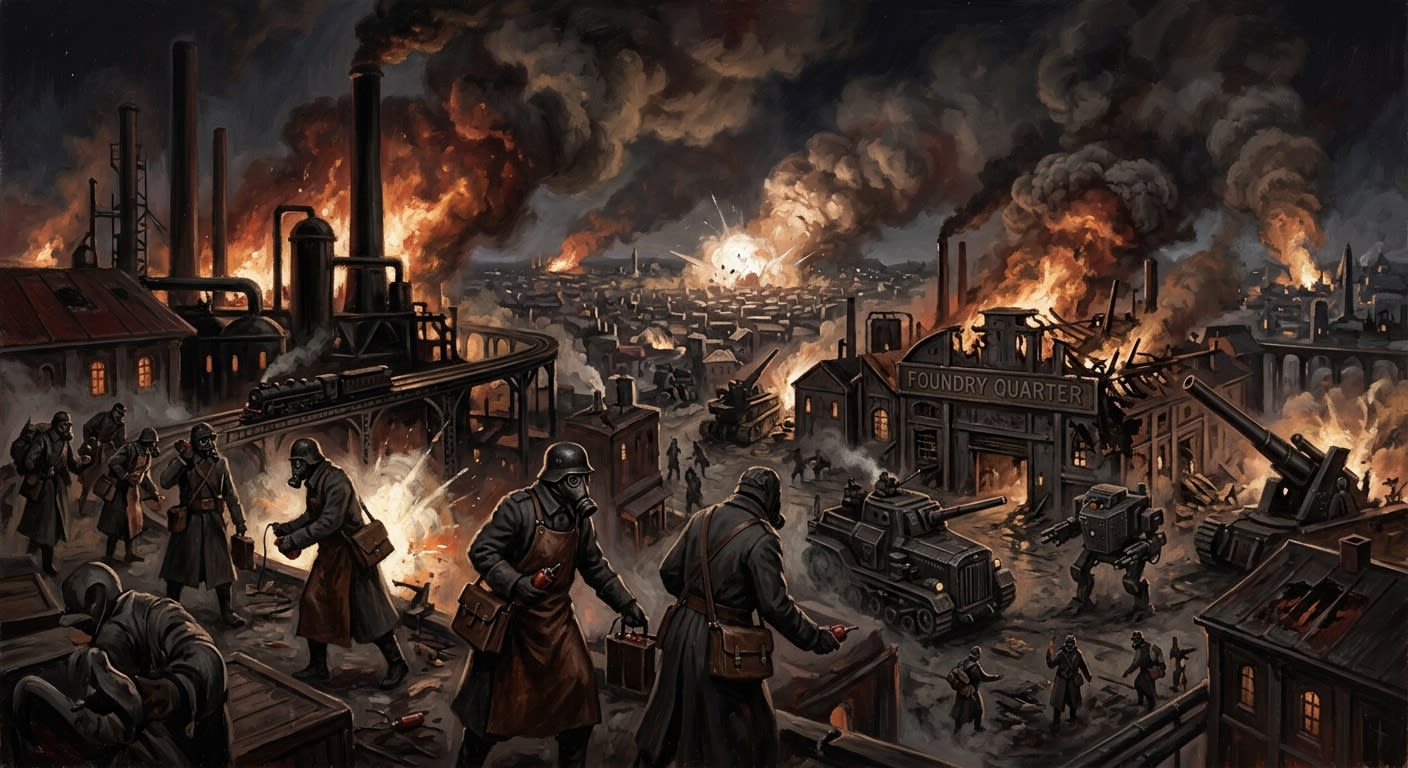
The Foundry Quarter had spent thirty-two years since the Year of Ash Rain refining itself into the southern theatre's iron stomach: powder mills, shell presses, proof ranges, carrier yards, slag gutters, reliquary-engine stalls, and the Shackled Flame workshops where the Bureau of War binds what it denies binding into housings it swears are doctrinally sound. Three months of munitions lay inside it by the second week of Argent, A.S. 177. Powder for the ravelin guns. Shells for the Thracian batteries. Flame-compound for censers. Anchor charges for the Harbor towers. Experimental cartridges under a seal whose colour has since been altered twice.
Every crate had a manifest. Every manifest had a counterseal. Every counterseal had a witness. Every witness, when questioned later, produced excellent paperwork and poor sleep.
The first corrupted shipment entered through Gate of Correction under the name Rite-Grade Lime, Mortuary Use. It was not lime. The second came by harbor barge, declared as boiler plate for Mill Seven. The third arrived in devotional crates marked for the Chapel of Saint Vulcan (Unregistered), because blasphemy with correct labelling passes inspection faster than honest freight with a smudged stamp. By the time the Ordeal clerks noticed that six suppliers bore identical creditor marks under different guild-names, the powder had already been distributed through seven sheds.
Velmora's method was perfect in its obscenity. She did not bribe one traitor. She purchased small failures: a toll reduced by a widow's debt, a gate inspection shortened by a clerk's arrears, a foreman induced to accept late cargo, a chaplain persuaded that opening a crate blessed for Saint Vulcan would insult the saint, a watchman whose son's apprenticeship fee vanished from the ledger after his signature appeared in the wrong margin. None of them, alone, betrayed the fortress. Together they sold it by instalment.
#The First Night
The first explosion sounded at the fourth quarter before Matins, beneath Mill Seven.
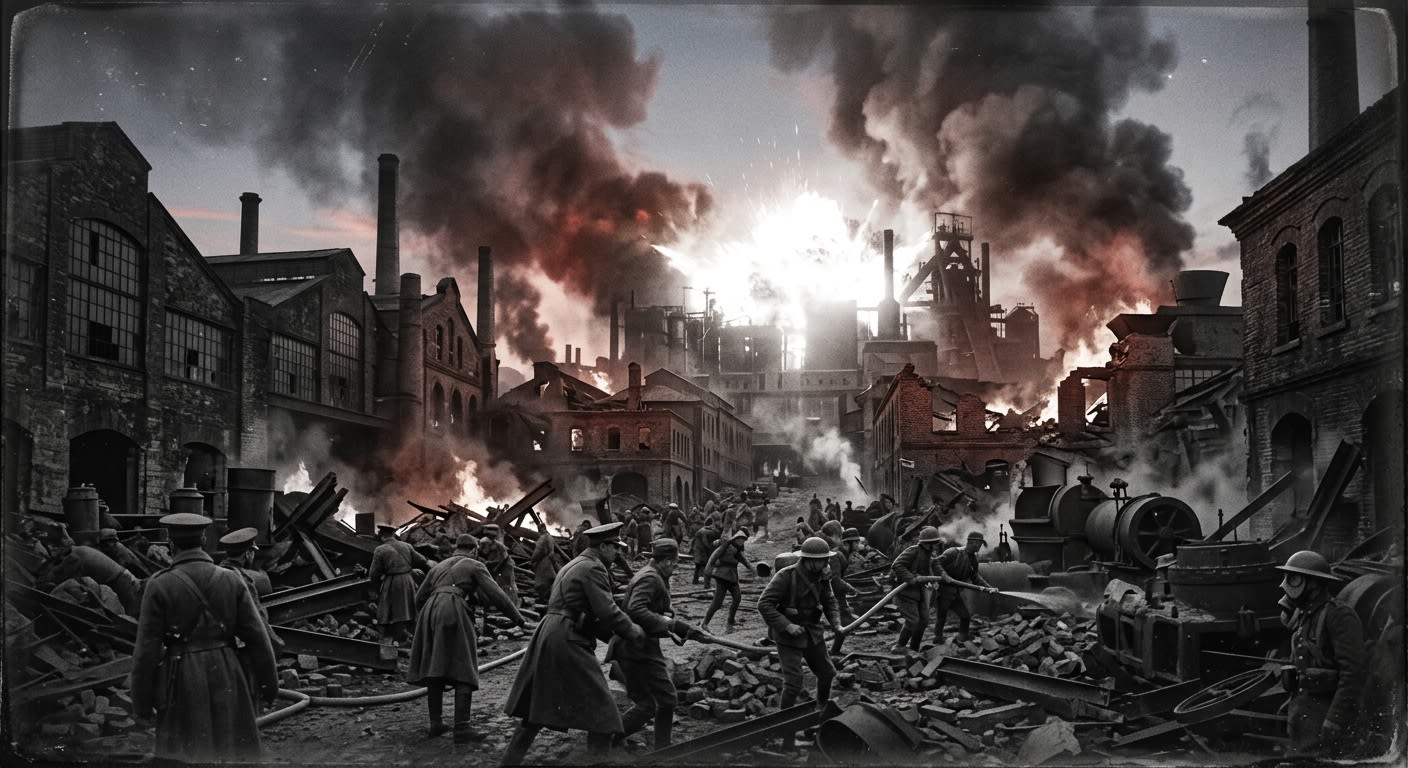
Witnesses described it as a bell struck from underground. The floor rose, the roof dropped, the west wall opened along its mortar lines, and three furnaces emptied themselves sideways into the slag gutter where, weeks later, furnace-sweeper Orek Marr would find the first reliable record of the Screaming Coin. At the moment of blast, the night-watch in the boiler gallery saw every pressure gauge turn inward, faces pressed to glass, needles bending like reeds toward a number no instrument had been made to display.
The second detonation took the cartridge hall. The third broke the proof range. The fourth, smaller but more spiteful, ignited a store of sanctified fire intended for the censers of the Vigil Ark Saint Barachiel. Blue flame climbed the inside of the chimney stack and came down outside it, which is not a direction flame should know. The Bureau of Engineering later called this inversion an effect of pressure. The Bureau of Rites called it liturgical rebound. The foundry workers called it a word the Bureau of Doctrine has not ratified and probably uses in private.
By dawn the Quarter's western sheds were gone. The harbor wall had cracked for two hundred meters. Four Catacomb-Carrier engines lay in their barns with ribs open and hymn-speakers pulsing without sound. The Threnody survived because she was moored at Pier Seven under maintenance, a phrase that in her case has achieved the dignity of a life sentence.
Initial dispatches reported “minor industrial disturbance, contained.”
Corrected by visual inspection, survivor testimony, crater measurement, and the regrettable absence of several buildings. The disturbance was not minor. It was contained only in the sense that it occurred within the city rather than elsewhere, a standard of containment fit for fools and optimistic cartographers.
The bells rang all morning. Not the alarm sequence. The alarm sequence had been delayed while the Bell office verified whether the Foundry blasts were enemy action, industrial failure, unauthorized celebration, or divine correction. In the absence of classification, the harbor carillonist rang the work-shift peal, the ration peal, the third mourning peal, and at least once the bridal peal, for which he was later reprimanded. He claimed smoke in the eyes. It remains the most plausible defence available.
#The Second Night
The second night proved design.
Had the first been accident, the second would have been cleanup. Men would have dug, stamped, carried, cursed, prayed, and made the official lie more usable by daylight. Instead, as salvage crews entered the eastern magazine under Chainmaster escort, the stored shells began detonating in sequence from the farthest racks inward, each blast separated by exactly nine seconds. Too slow for ordinary sympathetic ignition. Too regular for chance. Too beautiful, said one surviving artillery clerk, before his superiors reminded him that beauty is not a permitted category in explosive analysis.
The fire ran beneath the floor along rails no one had installed. It moved from rack to rack, skipping empty cradles, sparing two sheds owned by suppliers later found to have paid no debts for eleven years, and pausing outside the Chapel of Saint Vulcan long enough for forty-three men to crawl out through the vestry drain. This mercy has been cited as evidence of divine intervention. I cite it as evidence that Velmora wastes neither assets nor witnesses.
Maldrake's forces saw the glow from the Thracian Plain.
By midnight his forward batteries opened on the northern ravelins. Wrath is rarely punctual; on this occasion it was indecently ready. Shells landed while Foundry alarms still rang, striking the Ravelin of Fortitude, the outer cisterns, and the rail spur bringing relief crews from the Hammers. No direct breach followed, but direct breach was not the point. The Quarter burned behind the defenders while Maldrake pressed from before them, and between those two fires the city learned the oldest lesson of the Line: Hell does not need unity to achieve coordination. Hatred can rhyme without agreeing.
Harbor damage worsened by the hour. The cracked wall shifted under heat, dropping two ammunition lighters into the water. Three patrol vessels vanished in the smoke. Harbormaster Joram Clee refused to mark them destroyed. He entered temporarily absent in the harbor ledger, a phrase so serene amid chaos that Records accepted it out of either admiration or exhaustion. The ships remain absent. Their names remain active in the registry. Their berth fees are still assessed annually, because the Bureau of Tithes has a faith deeper than mine.
The second night killed fewer men than the first. This is not comfort. It killed men who had come to rescue the first night's dead.
#The Third Night
The third night was paperwork on fire.
The accounting offices burned from within at Vespers. No torch touched them. No shell struck them. The ledgers heated, buckled, and bloomed into flame along columns of debt connected to the corrupted suppliers. Clerks dragged books into the yard with tongs. Some books screamed. Some tried to close on the men's hands. One ledger, Supplier Register 177-F/CONST, shed its binding and crawled five feet toward the canal before a Lictor pinned it with a bayonet and requested immediate doctrinal support.
Supplier Register 177-F/CONST contained six names linked to the Ten Thousand Keys. One name reappeared after erasure in the hand of ████████████████. One debt column totaled █████ Crowns, then revised itself to █████ souls. The page was burned under Purity supervision. The ash formed a key-shape on the basin floor and remained warm for nine days.
The main powder magazine detonated at the second hour after Compline. It did not explode outward. It went down.
Sub-levels beneath the Shackled Flame Workshops opened like a throat. Men stationed at the harbor towers reported a column of black-gold flame rising no higher than the roofline, then sinking back into the foundations with visible reluctance. The blast tore through sub-levels Five and Six, cracked the old Byzantine bedrock, and exposed chambers the Foundry's own plans did not show. Fourteen workers trapped below were heard chanting the wage oath backward. They were declared dead before the sound stopped.
At dawn the third night ended because nothing large enough to explode remained in reach. Smoke lay low through the Quarter. Slag cooled over streets. Mill Seven was a hole. The Carrier Yard was a field of twisted treads and hymn-speakers. The Chapel of Saint Vulcan stood untouched except for its bronze saint, whose hammer had melted into the shape of a key.
The official casualty registers for the Three-Night Bombard are sealed in graduated form. Public count: two thousand, one hundred and twelve dead or missing. Military count: higher. Foundry workers' mutual aid rolls: higher still. Harbor registry: disputed, owing to Clee's temporarily absent ships. Purity count: not a casualty register at all, but an opportunity.
#On the Hundred and Forty
The Bureau of Purity executed one hundred and forty persons after the Bombard.
A satisfying number. Too satisfying, which should have warned us. The first arrests were plausible: Ordeal clerks with falsified stamps, gate factors holding debt notes in Wallachian script, two chaplains who had blessed sealed cargo without opening it, three dock brokers whose accounts showed payments from firms that did not exist before they owed money. The later arrests grew more atmospheric. A woman who rented a room to a cousin of a supplier's apprentice. A tally-boy who carried lunch to Warehouse Six. An old man whose surname resembled one written on a surviving scrap. The Bureau likes a clean public column. Evidence, like ash, can be swept toward the gutter.
Purity broadsheets declared all one hundred and forty condemned “active Velmoran infiltrators.”
Corrected for internal use. Approximately seventy were materially implicated. The remainder were adjacent to the wrong invoice, related to the wrong clerk, or useful in restoring civic terror. The public edition retains the original phrasing. Public morale cannot digest arithmetic.
Executions took place along the harbor wall, cracked stones still smoking beneath the scaffold feet. The condemned were hanged in groups of ten beneath placards naming their crime: TRAFFIC WITH GREED, PROCUREMENT HERESY, MUNITIONS TREASON, UNAUTHORIZED SOLVENCY. This last charge caused some confusion, which Purity resolved by hanging the confused men first.
Morale improved.
I write that sentence with professional disgust and bureaucratic admiration. Morale did improve. The city had been wounded by paper, by signatures, by invisible purchase. It required visible blame. Ten bodies at a time supplied it. Citizens who had spent three nights staring at burning roofs now stood before the scaffold and saw a shape assigned to their fear. Was the shape accurate? Often no. Was it effective? Horribly.
Velmora lost agents, debtors, instruments, and useful fools. She also gained proof that Constantinople, when injured through its own ledgers, would punish bodies faster than systems. Greed understands such bargains. It writes them first.
#On Reconstruction and Deeper Floors
Reconstruction was certified complete in A.S. 179. Four certifications exist. This should trouble the reader, if the reader has not already surrendered the faculty.
The first certification declared the Foundry Quarter operational after emergency works restored the shell presses. The second certified structural safety in the Carrier Yard. The third certified doctrinal cleanliness of the Shackled Flame Workshops, a claim later events would treat with contempt. The fourth, stamped by Engineering and countersigned by War, declared the Quarter restored to pre-Bombard capacity. It did not mention that the Shackled Flame Workshops had descended two additional levels below the previous floor plan.
The men who rebuilt the Quarter were paid at emergency rates and praised at ordinary volume. Bone-lime was mixed into the new retaining walls. Salvaged Armada metal went into furnace braces. Scraps from the detonated magazines were re-smelted and returned as shell casing, bolt, hinge, latch, and once, according to an unconfirmed tavern account, a spoon that screamed whenever soup touched it. Tavern accounts deserve caution. Spoons deserve more.
Arch-Artificer Lute Brann would not be appointed overseer until A.S. 189, ten years after formal reconstruction. His appointment belongs to the long consequence of the Bombard: a Quarter rebuilt larger, lower, stranger, more productive, and less willing to explain itself. By A.S. 198, the Shackled Flame Incident would kill fourteen men and leave scorch marks spelling a name in the Triune Alphabet. Purity called that an industrial accident. Purity has a touching confidence in industry.
The Screaming Coin also emerged from Bombard wreckage. Orek Marr found it beneath Mill Seven, cool amid fused slag. The object has since killed, transferred, returned, and embarrassed every mint foolish enough to challenge it. Purity resists calling it Velmoran because it profits no one visibly. I resist calling it harmless because I possess eyes.
#On the Lesson Purchased
The Three-Night Bombard did not break Constantinople. This is the official line, and for once it is true. The ravelins held. The Harbor of Chains remained functional. Maldrake's opportunistic fire did not breach the walls. The Foundry Quarter resumed production within two years. The dead entered registers. The guilty and the convenient entered rope.
The Bombard achieved something worse than breaking. It taught the city that its strongest works could be reached through its smallest hungers. A debt in the Warrens. A supplier's arrears in Genoa. A clerk's ambition. A saint's unopened crate. A gate schedule shortened by pity. A forged purity mark. A coin in a boot. A ship recorded absent because destroyed was too final a word for the morning after fire.
Since A.S. 177 every Foundry manifest receives three inspections, every sealed devotional crate may be opened by force, every gate clerk files a personal solvency declaration, and every supplier's supplier is audited until the audit becomes indistinguishable from a family curse. These reforms have reduced infiltration. They have increased paperwork by forty percent. The Bureau regards this as proof that safety and tedium are siblings.
The Foundry still burns. The lower floors still hum. The Harbor still assesses fees on temporarily absent ships. Somewhere beneath Mill Seven, men swear they hear a coin striking stone, then another, then another, counting down a debt no ledger owns.