
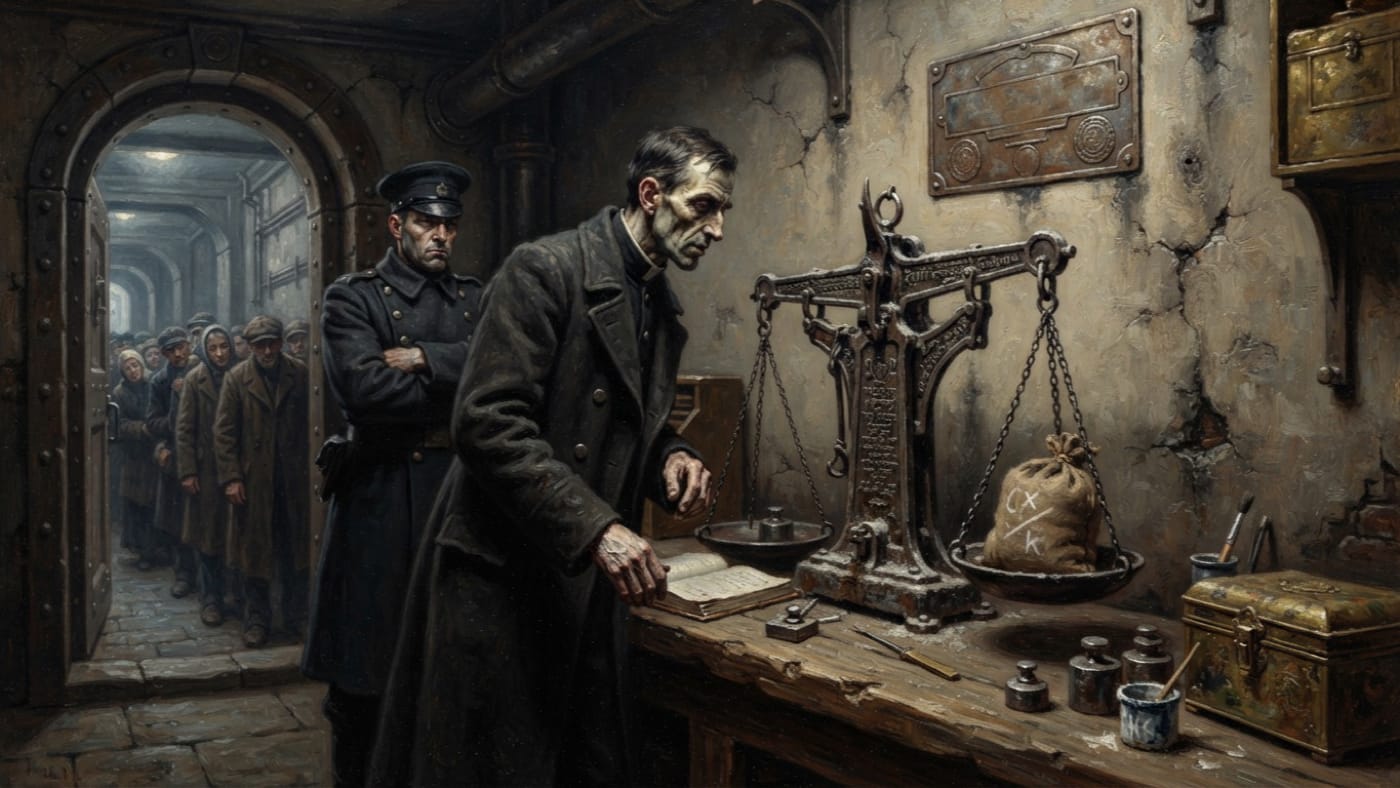
#On the Sanctified Instrument
The scale at the gate is iron. Its beam is cold before dawn and colder after. Dust has packed the scripture engraved on its arms like mortar between bricks, and on any given morning forty sacks of wheat wait outside its door, each owner anxious to learn what his sack weighs. Above the scale hangs a notice posted by the Tariff-Chapel Division of the Bureau of Tithes at Strasbourg, and the law fits in a single sentence:
That is everything the notice gives: a designation, a classification, an object and a threat. I have been asked to write the entry for Martial Code 14-A, and I write it from the wall of a tariff-chapel, because that is where the code lives in public, at about the height of a vendor's eye.
Consider what the sentence does. A blacksmith could forge this device and a carter could mend it, and the sentence takes it out of the order of tools. A bent beam becomes a wound. A shim under a pan becomes a defilement. The man who files down a weight has done more than cheat a buyer. Under the notice's classification he has contaminated something, and the contamination comes with a subtype, Mechanical. The subtype implies that the Church keeps a taxonomy of contamination and has filed this entry under machinery.
#On the Witnessed Zero
The code protects a morning rite and the apparatus that serves it.
The Commerce Clerk keeps an iron scale with engraved arms and a suspended pan. Beside it lie stamped weights, chalk, seals, tickets, a ledger, and a reliquary casket that holds the calibration fragments: bone slivers, saint-ash, splintered hymn-metal. At opening the clerk unlocks the casket in front of a witness. He touches the fragment to the scale-arm, recites the calibration line, chalks a small cross on the pan and records zero. Only then may the queue enter.
The fragment is the hinge of the whole arrangement. The clerk sets the sack on the pan, and the saint's bone, by virtue of its sanctity, holds the grain in balance.
Stamped Errata (Warden of the Sacred Ledger): The preceding sentence is withdrawn. The fragment does not counterweigh grain. It anchors the calibration: it touches the scale-arm at the zero and goes back into its casket, and the sack is then weighed against stamped weights in the ordinary manner. No saint's sliver has ever held up a sack of wheat. The Warden regrets the image, which was very fine.
After that the day runs in a fixed order. First come identity and manifest, then the calibration check before a witness. Gross weight is taken, then net, and the tariff is computed. The cargo is cleared or condemned, a ticket and seal are issued, and the ledger is reconciled, with a copy kept for the auditors. In the evening the clerk cleans the pans, rechecks the calibration and locks the fragments behind three seals.
Every one of these steps puts a hand on the instrument. So does cleaning, and so does calibration. The notice never says where lawful handling ends, and I will not write the exemption it left out. In practice the witness makes the distinction. Work done on the scale in front of a second pair of eyes, in the prescribed order, with the zero chalked and entered, is maintenance. The same motion made alone, in the dark, with nothing in the ledger, is what the notice was posted to frighten.
The profession's own rule is shorter: never calibrate alone. Clerks say that otherwise the scale will choose a side. The auditors, they add, will choose one too.
#On Interference and Its Discovery
The methods of interference are well catalogued, mostly by the men who use them. There are weighted pans and counterfeit calibration fragments. A lighter set of weights can be swapped in for friends, a trick the chapels call "the Saint's favour." Grease on the pivot slows the beam until the clerk, or the vendor, has seen what he wants to see. The neighbouring crimes, forged seals and hidden second ledgers, corrupt the record and leave the iron alone. I name them only so the reader does not confuse them with the instrument itself. A forged seal is a forgery. A greased pivot is what the notice means.
Discovery is a separate art, and a slower one. Inspectors check the seals first, then the calibration witnesses, then set the ledgers beside the price of bread in the ward. A serious audit arrives with an inquisitor and a master weight, and the chapel scale must agree with it.
Three conditions have to be kept apart, and the Line does this badly. The first is suspicion that a scale has been tampered with. Suspicion costs nothing and travels faster than grain. The second is a discrepancy, where the chapel's pan disagrees with the master weight. That proves a difference exists, but on its own it says nothing about who caused it, or whether anyone did. The third is demonstrated manipulation: lead found in the pan, grease on the pivot, a counterfeit sliver in the casket. Only the third is an act. The other two are weather.
The street does not wait for the third condition. A rumour that the fragment is false will turn a queue into a mob before the assayer has opened his case. That is why the instrument was made holy. People argue with a scale that is merely accurate. A sanctified scale can only be obeyed or defiled.
#On Measure, Mercy and Liability
The clerk works in a narrow room with pressure against every wall. The hungry want the weight to fall their way. Convoy officers want their wagons first and their tariffs light, because the Bureau of War plans by the sack, and a disputed weight can close a gate long enough to starve a forward depot. The auditors want the ledger to match the bread. Behind them all stands the doctrine, which the Bureau states without blushing: pure measure protects the bastion against fraud, famine and demonic contamination.
That claim belongs to the institution. A charge filed under contamination is a legal category. It does not show that anything with horns has crept into the pivot. I have read the notice many times, and it nowhere says otherwise.
The profession splits over how to live with this. The True Measure zealots calibrate without end and report every bribe slid across the pan. The Mercy Weighers shave the tariff for a widow and make it up from a guild. A shaved tariff is a figure in a ledger, and the beam never feels it. The Bureau has ways of disliking both habits, and the distinction does not always matter to it. On the documents I hold, though, a merciful sum and a doctored instrument are different sins and should not share a cell.
Now the sentence. The profession's record lists demotion, confiscation of the seal, reassignment to the plague wards, immurement for false measure and erasure for systemic distortion. Those are the punishments that surround the clerk. The notice does not say which of them Martial Code 14-A prescribes, if any, in what order, or whether any of them falls automatically. I do not hold the code's full text. I will not sentence a man on a sheet I have not read, and I am told this puts me in a minority within the Bureau.
#On the Institutions Behind the Notice
The weighing system the code defends was born in fire. In A.S. 97 (1807 CE), during the Bread-Scale Uprising, a bastion burned after a guild rigged the scales at its southern gate. The Synod seized every scale and outlawed private measurement. Weighing was declared a sacramental act, ratified by the Bureau of Doctrine, and reliquary calibration followed within the year. About two decades later, around A.S. 117, the Relic Counterfeit Scandal filled the ports with false saint-bone. The Bureau of Relics then made assay against a master set mandatory.
That history is the setting of the notice. It does not give the code a birthday. I have found no year of enactment for 14-A, no compiler, no council, no amendment and no named defendant. Inventing them would not improve the Ledger.
The offices around the code overlap, as Holy Bureaus tend to do. Tithes runs the chapel and posted the notice. Doctrine defines heresy, and the Bureau of Purity enforces that definition. Relics authenticates the fragment, the Bureau of Records keeps the ledger, and War eats whatever passes the gate. The wall does not say which of them tries a tampered scale.
Accuracy also has limits the code cannot reach. At Varna, around A.S. 129, the scales were sound, and the grain still rotted in the harbour while three bureaus argued over the tariff. Nobody had greased anything. Nobody needed to.
#On Present Application
In A.S. 201 the notice still hangs where it was posted, at the height of a vendor's eye, and the scale beneath it is still iron. Every morning a witness watches the casket open. The fragment touches the arm, the line is recited, the chalk cross goes on the pan and zero goes into the ledger. Outside, all along the Sagittal Line, the queue grows and the dust settles on everyone equally.
The code asks one thing of the clerk, the only thing he can actually promise: that nobody has touched the instrument who should not have. Whether there is enough grain is a matter for another office.