
#On the Bone That Lied
The Relic Counterfeit Scandal arrived around A.S. 117 with a crate from Thessaloniki, a customs clerk's cough, and a saint's finger that smelled, under lamp heat, unmistakably of pig.
This should have been impossible. After the Bread-Scale Uprising of A.S. 97, every tariff-chapel scale in the Synod had been anchored to reliquary calibration: bone sliver, saint-ash, hymn-metal, or certified martyr dust sealed in a casket and used to witness the zero. The doctrine was beautiful. Pure measure guarded against fraud. Sacred fragments could not lie. Commerce, placed under bone, became obedient.
The pig disagreed.
The first false fragments were crude. Pig-bone whitened with lime. Ground pumice packed into reliquary hollows to adjust weight. River teeth filed into knuckles. Brass filings mixed with saint-ash to make a dead man's residue more fiscally productive than the man had been alive. The later work improved. Too much. By the time the scandal reached Calais, one counterfeit ulna had passed three chapel inspections, two port audits, and a visiting Relic examiner who later claimed eye fever, candle glare, and spiritual ambush, in that order.
#On the Ports of False Sanctity
The counterfeit stream ran along the same routes as lawful sanctity. Reliquary crates came through southern sea lanes, northern ports, trench depots, pilgrim wagons, guild consignments, and chapel exchanges whose paperwork had the solemn thickness of truth. Every crate bore seals from the Bureau of Relics. Many bore counter-seals from the Bureau of Masks and Seals. Several bore both, plus devotional ribbons, witness slips, handling oaths, and enough wax to drown a mouse.
Wax is persuasive. It is not omniscient.
At Thessaloniki, assayers found calibration dust bulked with ground pumice. At Calais, port clerks opened a casket of “Saint Alaric's third metacarpal” and discovered three third metacarpals, which indicated either fraud, miracle, or a saint with an exuberant hand. At Hamburg, a chapel scale drifted toward generosity for six weeks before anyone asked why every wool bale had become pious enough to lose weight. At Varna, a disputed fragment squealed under the hot needle. The report says “audible fatty discharge.” The dockmen said what dockmen say, and were fined for accuracy.
The scandal's terror lay in its target. A forged saint in a shrine cheats the devout. A forged saint in a tariff scale cheats bread, salt, powder, cloth, rations, convoy priority, tithe yield, and the daily arithmetic by which a bastion remains alive. False sanctity entered the pan, and the pan entered the city.
#On the Assay Rite
The Synod's remedy was immediate, expensive, and magnificently inconvenient: the mandatory relic assay.
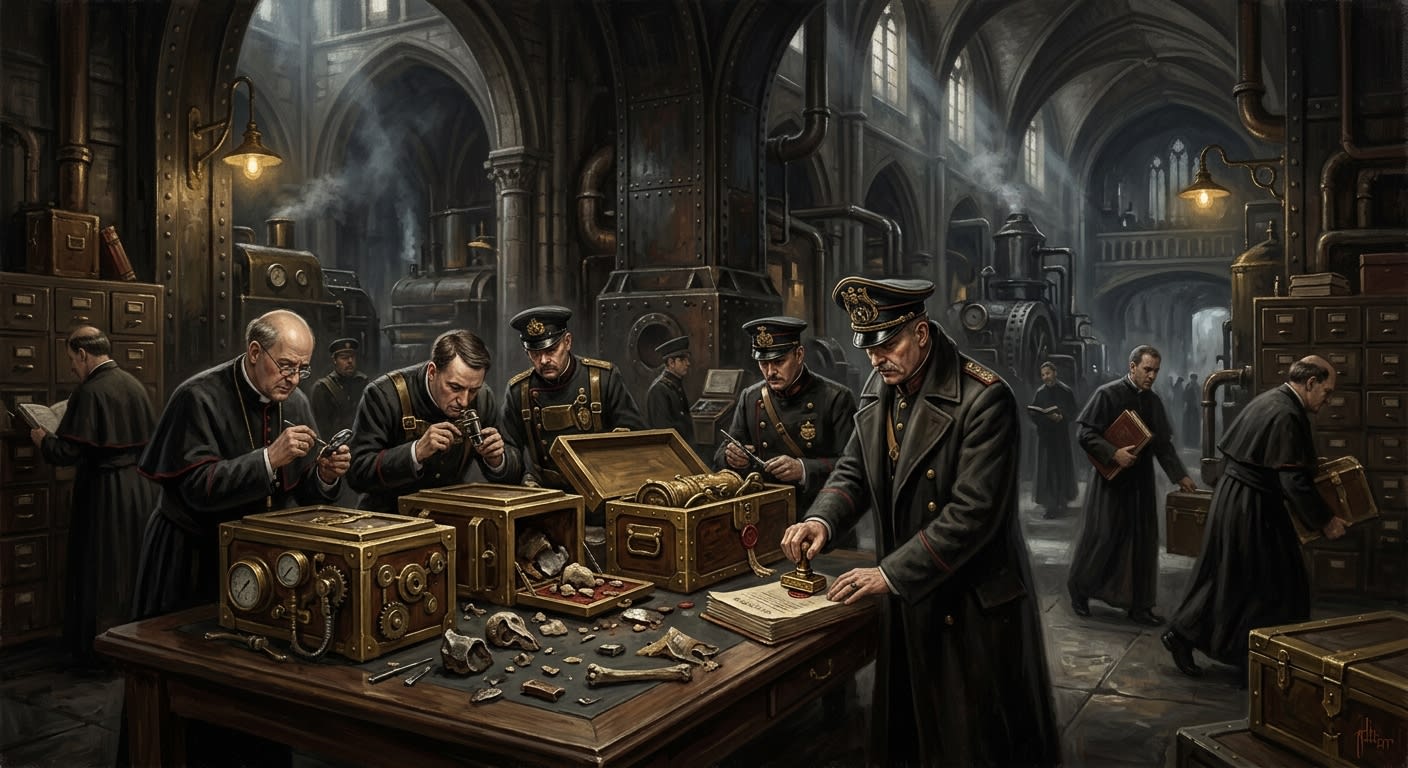
Every calibration fragment now had to be tested against a master set held in Strasbourg. The Bureau of Relics examined density, grain, scent under low flame, ash colour, marrow channel, hymn response, and provenance chain. The Bureau of Masks and Seals applied the counter-seal that made the result legally binding. The Bureau of Tithes paid for the delay, which means vendors paid for the delay, which means the poor paid for the delay, which means the Bureau of Tithes suffered with exemplary dignity.
First instructions stated that assay would add “no meaningful time” to chapel operation.
Corrected after the first quarter's queues doubled in six ports. “No meaningful time” has been replaced with “spiritually acceptable time.” The difference is chargeable.
The rite began as science wearing a chasuble. A fragment was weighed against the master zero, touched with brine, warmed over a protected flame, scratched with a consecrated needle, and held before a trained nose. Relic technicians learned the difference between martyr bone and market bone. Chapel clerks learned new curses. Vendors learned that a holy delay costs more than a secular one because holiness arrives with forms.
#On Masks, Seals, and Profitable Indignation
The Bureau of Masks and Seals entered the scandal as a reluctant saviour and left with a new fee schedule, which is the usual arc of Synodal virtue. Its counter-seal became mandatory for relic assay because no Bureau may authenticate its own instruments without supervision. Relics could declare a bone holy. Masks had to make the declaration real. Tithes had to accept the cost. Everyone complained in triplicate.
The counter-seal did what Doctrine could not. It made disbelief punishable. A merchant might doubt a relic examiner; he would hesitate before doubting a wax impression registered in the Sigillary, cut from an authorised die, recorded under active seal law, and defended by clerks who regard a misaligned border as a personal insult against Creation.
The counterfeiters adapted. False counter-seals followed false bones. Crude ones failed. Better ones passed until Seal-Walkers began inspecting assay sheets with callipers and the expression of men hoping to find treason because treason at least justifies the afternoon. The Black Ledger learned from the scandal, as every criminal school in Europe did. A saint in a casket was no longer enough. The paper around the saint had become holier than the saint.
#On the Clerks Who Lost Their Saints
The scandal split the tariff-chapels into factions that had already been waiting for names. The relic-trusters insisted the fraud proved the need for stricter devotion: more assay, more witness, more prayer over the zero, more Calibrus icons above the pan. The technicians argued for mechanical standards, repeatable weights, controlled metal, dull instruments that did not require hagiographic confidence before breakfast. The relic-trusters called this Rationalist seepage. The technicians called it surviving audit.
True Measure Zealots emerged from the affair with sharper teeth. They could point to pig-bone and say, correctly, that drift kills. Mercy Weighers learned a different lesson: a perfect procedure can still starve a queue while proving itself clean. Both factions claim Saint Calibrus. The saint, being dead and usefully silent, continues lending authority to mutually hostile arithmetic.
PURITY INTERVIEW, RELIC TECHNICIAN ██████: “I knew it was pig before the second lamp. I also knew the convoy had waited nine hours, and the children outside were licking salt from the wall. I stamped provisional clearance.”
Verdict: pending for six years, then filed under “resolved by natural attrition.” Cause of death: █████████████████
The ordinary clerk suffered most. Before the scandal, a casket held certainty. Afterward it held an accusation waiting for heat. Every morning zero became a trial of bone against bone, wax against wax, nose against shame. The chapel smelled of flour, tallow, fear, and the faint pork-sweet reek of doctrine learning anatomy.
Public sermons described the scandal as an attack from foreign merchants upon Synodal purity.
Amended under sealed commerce review. Several counterfeit batches originated inside licensed Synod reliquary workshops. Public sermons remain unchanged, because foreign merchants are more useful than licensed workshops in moral instruction.
#On the Scandal's Settlement
No final culprit was named. This was mercy of a sort, though not for the guilty. Naming one workshop would have implied the others were clean. Naming one port would have spared the rest. Naming one Bureau would have required a meeting no sane clerk wished to minute.
The settlement was administrative. Assay became permanent. Counter-seal became mandatory. Calibration caskets received new locks. Port relic rooms gained assay tables, guarded furnaces, sealed scraping trays, and small brass signs reminding personnel that saint-bone is not to be tasted except by licensed mouths. The queues lengthened. The tariffs rose. The scales grew holier and less trusted.
As of A.S. 201, every tariff-chapel still lives inside the scandal's correction. A fragment enters. A clerk warms it. A technician sniffs. A seal falls. A counter-seal follows. Somewhere in Strasbourg, a master set waits behind glass, and every bone in Europe is invited to measure itself against the dead more fortunate in paperwork.