
#On the Concealed Face
The face is the first document a citizen of the Synod is issued. It is also the only one they cannot be trusted to file. It gives their name to every clerk, every gatekeeper and every informant at the end of the bench. To cover it is to withhold that declaration. The Bureau of Doctrine names the act in Article Fourteen of its Standing Catechism. Concealment of the face is concealment of the self, concealment of the self is concealment of the soul, and concealment of the soul is spiritual fraud. Within the territories of the Synod, an unapproved visage is treason worn on the skull.
And yet the Synod masks itself several times a year, by order.
Processions require it. Penitents require it. A whole parish walking in white cloth before the Creator requires it. Doctrine cannot unsay Article Fourteen, and Festivals will not surrender the calendar. So the contradiction passes, as every contradiction eventually passes, to the office that owns the wax. The Bureau of Masks and Seals does not absolve the sin of concealment. It licenses it.
The older registers call the instrument a Mask Writ. The clerks call it a licence. The wearer calls it whatever keeps him off the scaffold.
#On the Terms of Permission
Mask licences fall within the remit of the Founding Instruments of A.S. 92, issued two years after the Concordat of Strasbourg gave the Synod its constitution. The charter lists them between reliquary authentication marks and public emblem permits. That is where they belong, among objects made legitimate by an impression they cannot see.
A mask is registered. It is stamped. It receives a licence number, and that number is entered in the Mask Registry at the Bureau's premises within Strasbourg Cathedral. The licence then states four conditions:
- the occasion on which the mask may be worn;
- the duration for which it may be worn;
- the design it may bear;
- the precise dimensions of its eye-holes.
The last condition is the personal contribution of Archon Casselius of Mainz, and the Bureau lets no one forget it. An eye-hole cut wider than its licensed specification stops being devotional. In the Bureau's classification it becomes "an instrument of surveillance rather than devotion," and the wearer forfeits the mask and pays a fine. Mark the direction of the offence. The Synod fears what the mask hides less than what it lets the wearer see. A penitent's business is to be looked at. A penitent who looks back has stepped outside the licence.
The work divides by function. The Bureau of Festivals keeps the occasions and decides when the Synod will process with its face covered. The Bureau of Heraldry governs meaning: which colours may be worn, which symbols may sit upon a brow, what a design is permitted to say. Masks and Seals registers the object, assigns the number and presses the stamp that makes the rest enforceable. Heraldry and Masks and Seals answer to the same Archon in personal union. The charter keeps them as separate jurisdictions, and Casselius keeps both seals within reach. The published record does not say whether an applicant must pass each office in a fixed order. I decline to draft that order on the Bureau's behalf. It has enough paper.
#On the Licensed Occasions
The Festivals calendar mandates masked processions on the Feast of the Departed Flames, the Night of Penitents and the Carnival of the Triune Knot. The Night of Masks is the Synod's carnival, drained of Rationalist frivolity. It admits only masks that are registered, licensed and approved by Heraldry. An unlicensed mask is torn from the face in the street, and its wearer is punished for "identity theft." Children love this part. They are learning the catechism of authorized identity, and they think it is a game.
The Feast of Buried Names asks the most. Every citizen is expected to put on a plain white cloth mask and walk their parish in silence. Doctrine calls this "collective anonymity before the Creator" and has declared it theologically necessary. The Bureau of Purity has declared it "a security liability of the first order." Both declarations stand.
Parishes submit their faithful in bulk, one application to a congregation. That is how an entire Synod can bow its covered head while the Bureau records approximately eleven thousand mask applications a year. The figure counts applications, which are not faces. No one who wishes to keep a clerkship should multiply it.
Then there are the masks of office. Purity employs veiled interrogators. By the Bureau's own account, the White-Mantled Inquisitors wear ceremonial visors at tribunal. And the Bureau of Shadows, which does not exist, sends its Custodians, who also do not exist, into the night in veils of black gauze. The Registry has asked in writing whether those coverings pass through its doors, through some other door, or through no door at all.
#On the Ghent Visages
In Ghent a theatrical troupe once performed in masks bearing the faces of Rationalist philosophers. By the Bureau's account, the masks were licensed. The troupe had filed for "comedic visages, historical, satirical," and the Bureau approved the filing exactly as written.
The filing was in order. The likenesses were too good.
The masks were seized mid-performance. The actors were nailed to the stage with their own papier-mâché visages and burned as heretics and actors both. No date attaches to the incident in any record I am prepared to sign. None will be supplied here.
The lesson for the licensed is plain enough for a parish child. A licence approves a description. Once a man puts that description over his face and walks into the lamplight, it becomes something else, and the audience may laugh in the wrong places. The stamp certifies the paper. The meaning remains the property of the Synod, to be judged afresh each time the mask is worn. A correct filing is no defence against a correct sentence.
The Ghent theatre guild has petitioned every year since A.S. 178 for "clarification of the boundary between satire and sedition." The Bureau lists the petition as under review.
#On the Registry's Present Account
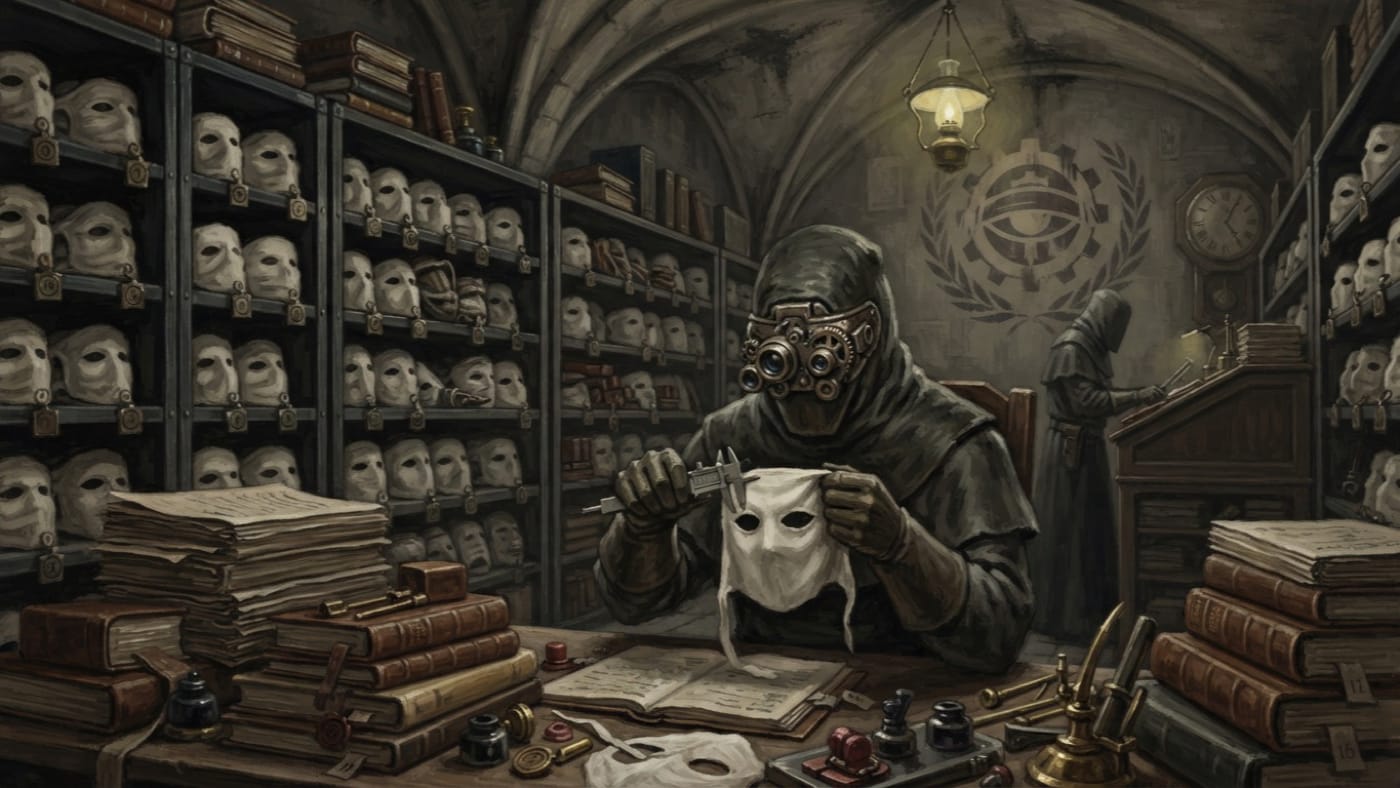
Fourteen full-time archivists keep the Mask Registry. Their charge is single and exact: no two licensed masks within one parish may share identical eye-hole dimensions. How they hold that line through a Feast of Buried Names, with whole congregations entered at a stroke, is a matter for the archivists and their callipers. The Bureau publishes the rule, never the method.
The rule secures one thing. Every licensed mask in a parish has its own measured gaze on file. A mask found in a ditch can be traced through its apertures to the licence that permitted it, and the licence to the soul that wore it. The Registry knows every face it has permitted to vanish.
ERRATUM: A.S. 199, Mask Registry Audit
The final sentence of the preceding paragraph is withdrawn in part. A routine audit of the Mask Registry in A.S. 199 found 2,311 active licences for masks described as "blank, featureless, white, no distinguishing marks." The Bureau could not determine whether these licences correspond to devotional masks for the Feast of Buried Names or to the operational equipment of the Bureau of Shadows. Clarification was requested of both offices. The Bureau of Festivals replied that the masks were liturgical. The Bureau of Shadows did not reply. The discrepancy has been filed under "Resolved by Silence." The Registry knows every face it has permitted to vanish, excepting 2,311.
As of this survey in A.S. 201, the instrument stands as described. Article Fourteen remains in force, and the calendar remains masked. Each licence still runs to four conditions, the last of them measured. Doctrine and Purity still dispute the white cloth, and the archivists in Strasbourg still enter each congregation's masks by parish. The 2,311 sit in the ledger with their numbers in good order, licensed and current, and nobody has accounted for them.
At the Feast of Buried Names the citizen walks the parish in white cloth. They are licensed, numbered and silent, seen through two holes of approved width. If they sweat under it, that is a matter between them and the Creator. The Bureau does not license sweat.