
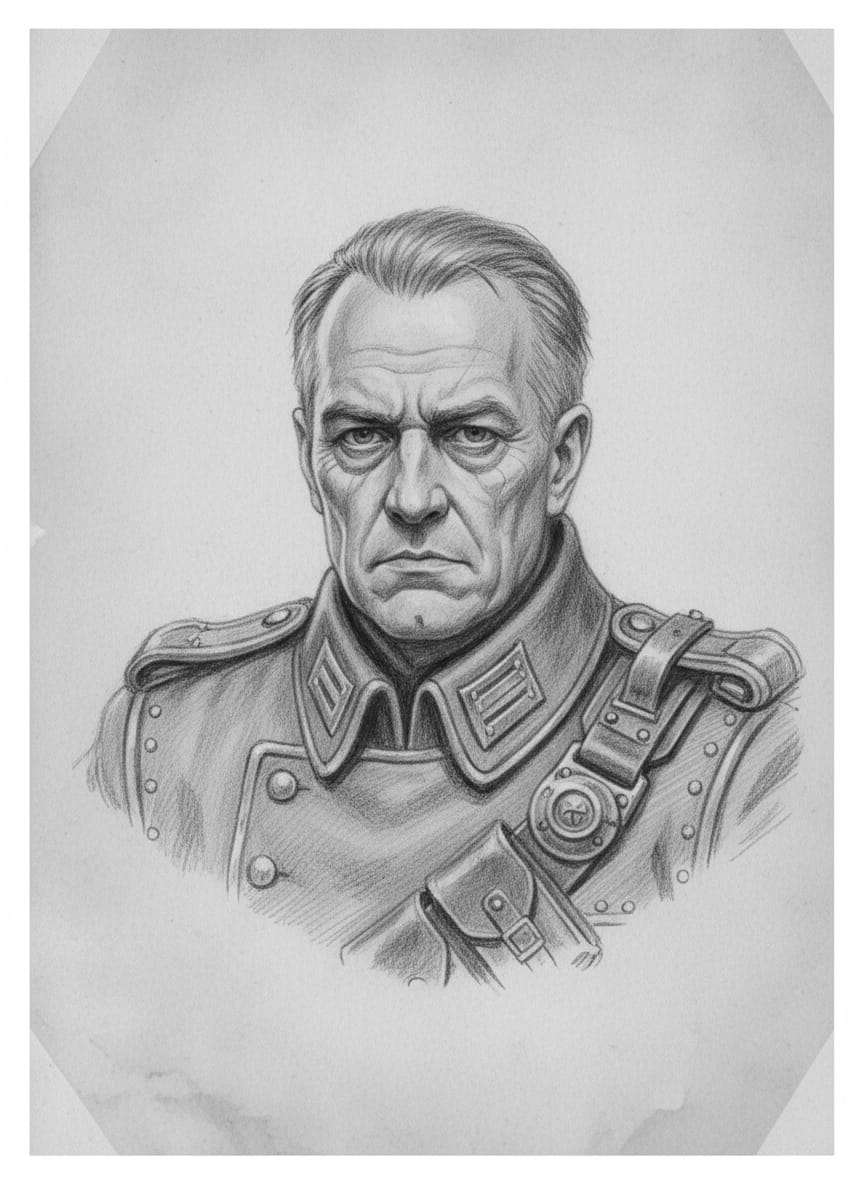
#On the Man Who Owns the Mark
Archon Casselius of Mainz holds the Bureau of Heraldry and the Bureau of Masks and Seals in personal union, which is the kind of arrangement the Bureau of Records calls “irregular but not prohibited” when it lacks the courage to say “we have permitted a man to put one hand around the Synod’s throat and the other around its printing press.”
I say this with admiration. Envy, even. Casselius controls what may be drawn, stamped, sealed, licensed, masked, displayed, worn, carved, painted, tolled, printed, and contested. He governs the Armorial of the Faithful and the Sigillary. He names the permitted symbol and cuts the die that proves the symbol permitted. He decides what may speak visually and manufactures the only instrument by which that speech becomes lawful.
His face has become familiar across the chancery prints: narrow, shaven, ascetic without the warmth of holiness, eyes made for magnification lenses and disappointed verdicts. He dresses in severe black with a grey collar pinned by the smallest legal Triune Knot I have ever seen. The pin is smaller than vanity permits, which tells me his vanity is more dangerous than mine. Mine sings. His measures.
#On His Appointment
The two Bureaus were meant to remain separate. Heraldry governed meaning. Masks and Seals governed material. One said whether the crimson boar might appear on a banner; the other cut the stamp approving the banner licence. This separation comforted the charter clerks of A.S. 92, who believed that a distinction written in a founding instrument would survive contact with ambition. Dear little lambs.
Casselius rose first through Heraldry, where he gained notice by reducing a forty-one-page dispute over a guild chevron to a single sentence: the angle offends. The losing guild appealed. Casselius replied by measuring the appeal’s heading, finding the petitioner’s crest one-sixteenth of a hair outside permitted curve, and suspending the guild’s banner rights for six months. His superiors called the decision severe. The Inspectorate called it clarifying. The street called him worse things, all of which he filed under vernacular hostility patterns with district annotations.
By A.S. 194 he was addressing the Seal-Cutters’ Guild (Unregistered) as Archon of Masks and Seals and speaking in sentences so dry that the wax listened. His premise was brutal enough to be holy: that which bears no seal bears no authority; that which bears a false seal bears a sentence. He did not invent the doctrine. He made it hungry.
Several provincial summaries identify Casselius as “Archon of Heraldry temporarily exercising seal oversight during procedural vacancy.”
Corrected. The vacancy ended. The oversight remained. Records has preserved the fiction of separateness because consolidation would require a Hierarchal decree, and the decree has been in committee since A.S. 147. The committee has met twice. Both meetings were adjourned adequately.
#On the Doorbell of Mainz
The incident for which Casselius will be remembered by the common mind — that vulgar little archive where history becomes anecdote and anecdote becomes song — concerns a doorbell in Mainz.
The bell belonged to a cooper named Ewald Fenn, whose shop door bore a small chime-plate cast with three descending marks. Fenn claimed the marks represented barrel hoops. Casselius, passing during a routine district inspection, identified them as an unregistered chime-mark implying guild autonomy, hydraulic abundance, and possible mockery of Standing Order 14-C. The bell was confiscated. Fenn protested. Casselius fined him for protesting. The fine bore a newly revised stamp Fenn could not read. Fenn appealed on the ground that a stamp unreadable to the fined party could not bind him. Casselius reclassified the inability to read the stamp as visual noncompliance.
The case entered training manuals for Sigil Inspectors under the heading Acoustic Heraldry, Minor Civic Instruments. Since then, inspectors have examined knockers, handbells, shop gongs, funeral rattles, and one abbey dinner triangle whose resonance was judged “insufficiently penitential.” Fenn’s appeal remains active. The doorbell is held in the Mainz evidence cupboard under three seals. The cupboard has since been cited twice for improper hinge geometry.
#On His Method
Casselius does not shout. This is his chief cruelty. A shouting official permits the victim to believe passion has entered the room; Casselius offers only calibration. He reads a disputed crest through true-glass, notes the tremor in the petitioner’s hand, compares pigment to swatch, measures line, border, flourish, counter-flourish, and the humble little ambition hiding behind all ornament. Then he writes one word.
Approved.
Revoked.
Scrape.
The word determines whether a guild marches under its grandfather’s colours or walks bareheaded through market shame; whether a widow may keep her husband’s licensed funeral badge or must surrender it as expired property; whether a mask is devotional cloth or identity fraud; whether a counter-seal renders a pardon real before the scaffold opens. Those who call Casselius petty have not understood scale. The Synod is made of small permissions repeated until they resemble civilization.
ARCHONAL NOTE, PRIVATE HAND, A.S. 198: “The public believes rebellion begins with banners. Incorrect. It begins with tolerances. Permit one curve beyond measure and the wall receives a vocabulary. ███████████████████ Recommend inspection of children’s chalk animals before summer.”
#On Dread and Utility
Other Archons resent him because he makes them ask. War may draft a mobilisation order, but Casselius’s counter-seal makes it binding. Tithes may revise a tax plate, but Casselius’s die lets the plate circulate. Festivals may design a procession, but Casselius licenses the masks, the floats, the permitted ribbon widths, and the municipal crest painted on the donkey if some provincial idiot insists the donkey must bear one.
Doctrine tolerates him because he is useful. Records tolerates him because the charter leaves room for cowardice. Purity watches him because everyone with power requires watching, and Casselius signs the observation warrants with such perfect indifference that Purity has begun watching its own watchers for signs of aesthetic defeat.
He has enemies in the dye guilds, theatre companies, brassfounders, banner-houses, seal-cutters, parish pageant committees, mask sellers, bellmongers, counter-seal applicants, counterfeiters, and every child ever fined for chalking a beast with too many legs. This is a respectable list. An official without enemies is either dead, decorative, or insufficiently awake.
#On Present Condition
As of A.S. 201, Casselius remains in office, seated at the crossing-point between language and force. The Armorial contains 347,211 registered entries by the A.S. 200 audit, not counting duplicates, impossibilities, and the one entry pending clarification since A.S. 93. The Sigillary maintains 4,714 active seal-dies, 12,443 retired instruments, and annual counter-seal applications enough to make lesser men weep glue.
Casselius reads retirement ledgers for pleasure. He sleeps, it is said, with a magnifying glass and a list of pending executions. I have not confirmed this. I have seen the list. It was better maintained than several provincial dioceses.
Popular rumour states that Casselius “controls the Synod’s speech.”
Clarified. He controls what may be made visible with authority and what instruments authenticate that visibility. Speech remains under other jurisdictions until printed, stamped, sealed, masked, sung from a licensed banner-stage, attached to a crest, or entered into complaint. In practical terms, the rumour is adequate.