
#On the Outer Maze
"The lakes defend us. The lakes also confine us. The Bureau sees no contradiction." — Attributed to Colonel-Warden Bruhns, Northern Garrison Command, A.S. 189
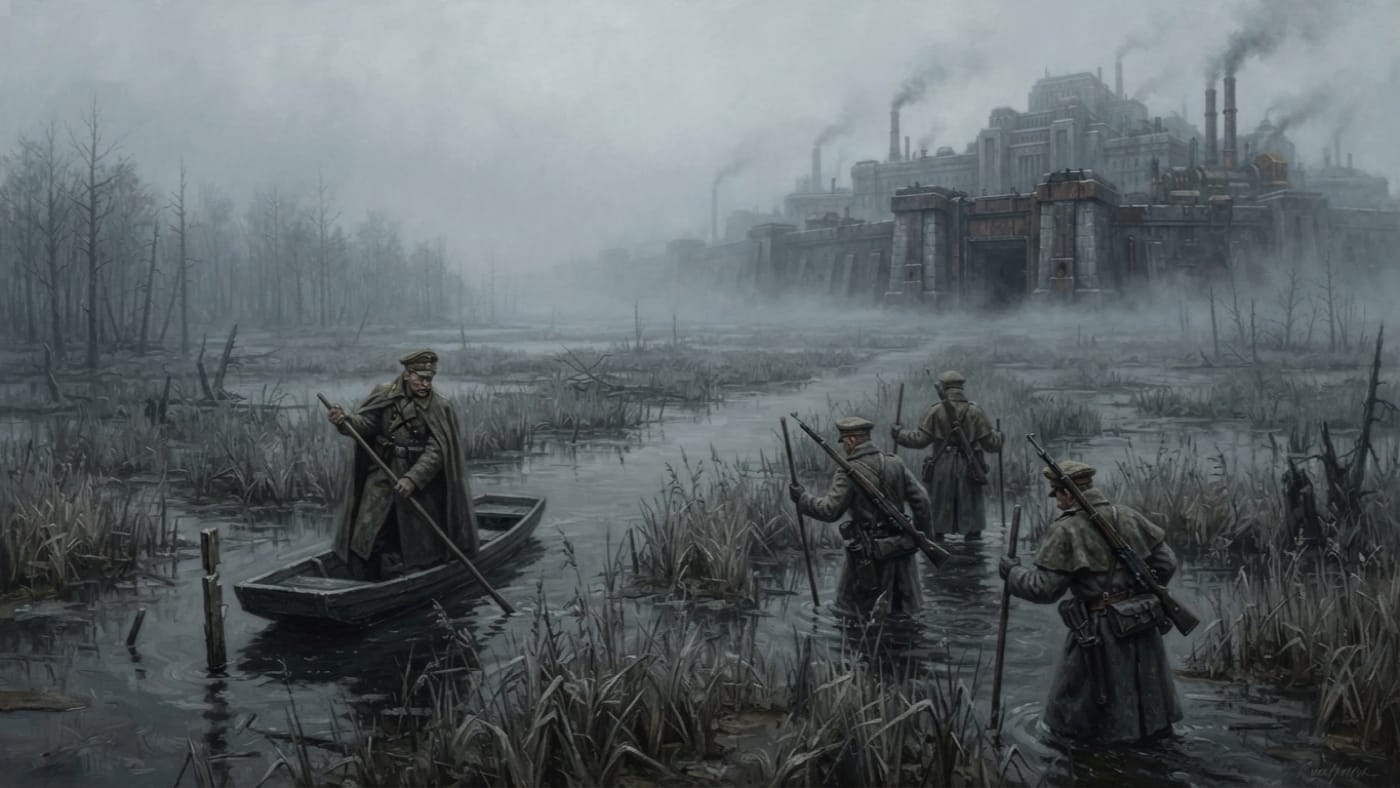
The Masurian Lakes are the outer maze of Bastion-Königsberg. They lie east and southeast of the city in the low country of East Prussia. The country holds thousands of waters joined by channel and marsh, with reed-beds tall enough to hide a section of riflemen and drowned forest standing grey in the shallows. This Codex has already filed the same ground as the Masurian Lake District and as the Masurian Lake Maze. The soldiers call it the Drowning Garden. The Bureau of Engineering calls it the Primary Hydrological Defensive Zone. That makes four names for one country of water. Records has asked whether a fifth entry was strictly necessary. It was, because the garrison uses none of the other four. The garrison says "the lakes," as in the lakes are open or the lakes have taken another one, and the Castellan-Warden says it in her orders.
Königsberg holds the Baltic end of the Sagittal Line, some two thousand miles of wall and wire running south to the Bosphorus. The lakes are no bastion and keep no garrison of their own. They are terrain, and terrain must be commanded like anything else that cannot be trusted. That command is the business of this entry. The water has been described elsewhere at length, and it has not changed its testimony.
#On Water and Ice
In the open season the lakes break whatever enters them in order. In the reeds a column becomes a file, the file becomes a string of separate men, and each man's fate depends on who knew where the bottom was. Some submerged ridges let a soldier stand chest-deep and fire with his carbine held dry above the waterline. In some places the bottom drops to thirty feet one pace further on. These are examples and do not amount to a survey. Depth in Masuria is settled one channel at a time, by men born beside the channel. Guns do not travel there. Carts sink to the axle in what looked like meadow from the saddle. Boats help less than a southern officer expects, because a hull that floats in one channel runs aground in the next.
Winter reverses the arrangement, though only in places. Ice over a channel can carry men straight across water they had to wind around for hours in August. The same ice fails where reeds rot it, where a current thins it from below, and where drowned timber keeps a pocket of warmth under the surface. The garrison therefore maintains two doctrines of engagement, one for open water and one for ice. Neither promises that every channel will float a boat or that every sheet will bear a man. Between them come the weeks of freeze and thaw, when the lakes are neither moat nor road and both doctrines go quiet.
The Bureau of War lists the lakes as favourable defensive terrain and credits them with the modest size of Königsberg's garrison. That is a fair entry for any enemy that marches. It has nothing to say to the Watcher who must decide, in the first week of a frost, whether the sheet in front of him belongs to the winter doctrine or is the summer water in disguise.
#On the Men Who Know the Channels
The Masurian Watchers hold the lakes. They are light infantry, recruited only from the lake villages that were absorbed into frontier service at the original requisition of approximately A.S. 67 / 1777 CE. They keep the lake-posts and deploy through the Lake Gate. They find their way by reed-pattern, by bird-call, and by notched stakes driven into the lake-beds. The Watchers know what the notches mean. The Bureau of Records has tried five times to catalogue the stakes and has abandoned four of those attempts. The state of the fifth has not been established. Records also holds seven maps of the lakes. All seven contradict one another, and all seven are canonical.
This Codex's entry on Bastion-Königsberg records that "the Synod requisitioned" the city approximately A.S. 67 and that the lake-district villages were "absorbed" by the Synod during the initial requisition.
Corrected. The formal Synod was constituted under the Concordat of Strasbourg in A.S. 90 / 1800 CE. The requisition of approximately A.S. 67, the lake villages included, was carried out by the emerging Church's provisional frontier administration, in the years when the Line was defensible but unfinished. The Watchers' grandfathers were taken into service by an authority that did not yet sign with the name it uses now.
Lake-Captain Kaspar Dreyse commands them. The record describes him as a third-generation lake native. He has been cleared nine times by the Bureau of Purity, which cannot decide whether his men's methods are ordinary skill or heterodox practice. Purity therefore examines the methods at intervals and has never classified them. In my judgment Dreyse is the most effective field officer at Königsberg. The judgment is my own. No campaign ledger stands behind it, and I do not offer one.
The arrangement is the familiar northern bargain. For its eastern flank the Church relies on knowledge it has never written down, and every few years it examines that knowledge in case it has become sin. Each examination sends the men back to the water. The water has always been waiting for them.
#On Halvorsen's Orders
Castellan-Warden Ingrid Halvorsen has commanded the bastion since A.S. 191. Dreyse commands the Watchers. Halvorsen commands Dreyse, and with him the Lake Gate, the Sea Wall, the rotations and the twenty-two thousand. Nowhere does this division matter more than in the lakes. A castellan on the Sea Wall can see her sentries. No castellan can see a lake-post. From the Ordensburg there is only one way to command the outer maze, and it is to decide which of her own rules the men who can see the ground may set aside.
The record shows one such decision. The Masurian Watchers are authorized to disregard bell-schedule conflicts during fog pursuit, and that is the whole of the dispensation. It names one circumstance and settles one conflict. It gives no general licence against orders. It leaves the tuning of the Northern Carillon untouched, and every Scandinavian custom with it, whatever the fishermen mutter by the harbour. When a patrol is in pursuit in fog and the bell-schedule requires something else of it, the pursuit governs.
The order's logic needs no confidant to explain it. The Bureau of Bells keeps the Line's hours and does not accept weather as an argument. A man waist-deep in reed, able to see a few yards, cannot keep an hour fixed in Strasbourg. An officer who made him keep it would be keeping the hour at the man's expense. Halvorsen sided with the man in the water. The record ties no incident to the order and no result either, and I will supply neither. The order rests on its reasoning, which is more than most orders can claim.
Nothing beyond the chain of command sets out how castellan and lake-captain divide the work. Nothing more is needed. She sets the limits, and he works inside whatever room the water leaves him.
#On the Uncovered Approach
The Lake Gate faces the maze behind twelve metres of stone, iron and fill, the thickest walls on the bastion. No attack on Königsberg from that direction has been recorded. That fact proves only that none has been recorded. It does not show that the walls deterred anyone, that the lakes threw anyone back, or that a crossing cannot be made.
The Grey is reported from elsewhere: the northeastern and Baltic approaches, along the coast and out of the sea fog, where the maze gives no cover. The Grey was first formally classified in A.S. 190 as Unknown Forces, Extradoctrinal Classification Pending, and the classification is still pending. Nobody has observed it crossing the lakes, in summer or in winter. Its origin, intention and nature have not been established. Sharing a colour with Syrion's time-fog does not make it that fog, and the Codex will not tie it to any other terror for the sake of a tidier file.
"Unobserved" is the strongest word the record will bear. Lake-posts look where the channels let them look, and a thing can be called absent only where someone was watching. The maze guards the east and earns its keep there. It spares Halvorsen the regiments an open eastern plain would demand, and she sends them instead to the Sea Wall, which faces the direction the reports come from.
#On the Present Holding
The assessment of A.S. 201 records that Königsberg holds and that the Masurian Watchers maintain their lake-posts. They go out under the open-water doctrine in the warm months and the ice doctrine in the cold ones. In the weeks between, they go by whatever the Watchers judge to be sound. Dreyse commands between clearances. The seven maps remain canonical, and no office of the Church has read the stakes. The dispensation remains in force. The bells keep their hours everywhere except in fog among the reeds.