
#On the Sea at the End of the Line
The Baltic is the northern bowl of the war, cold, shallow in ways that deceive sailors, rimmed by ports that remember too many masters, and inhabited by a colour the Synod has never successfully filed. It is not merely water. Water drowns, freezes, feeds fish, carries ships, and submits to competent sounding. The Baltic does those things when supervised. At other times it listens.
That last sentence will irritate the Bureau of Engineering, whose officers prefer water to possess volume, salinity, temperature, navigational hazard, and no opinions. I honour their preference as one honours a child's wooden sword. Charming. Useless against cavalry.
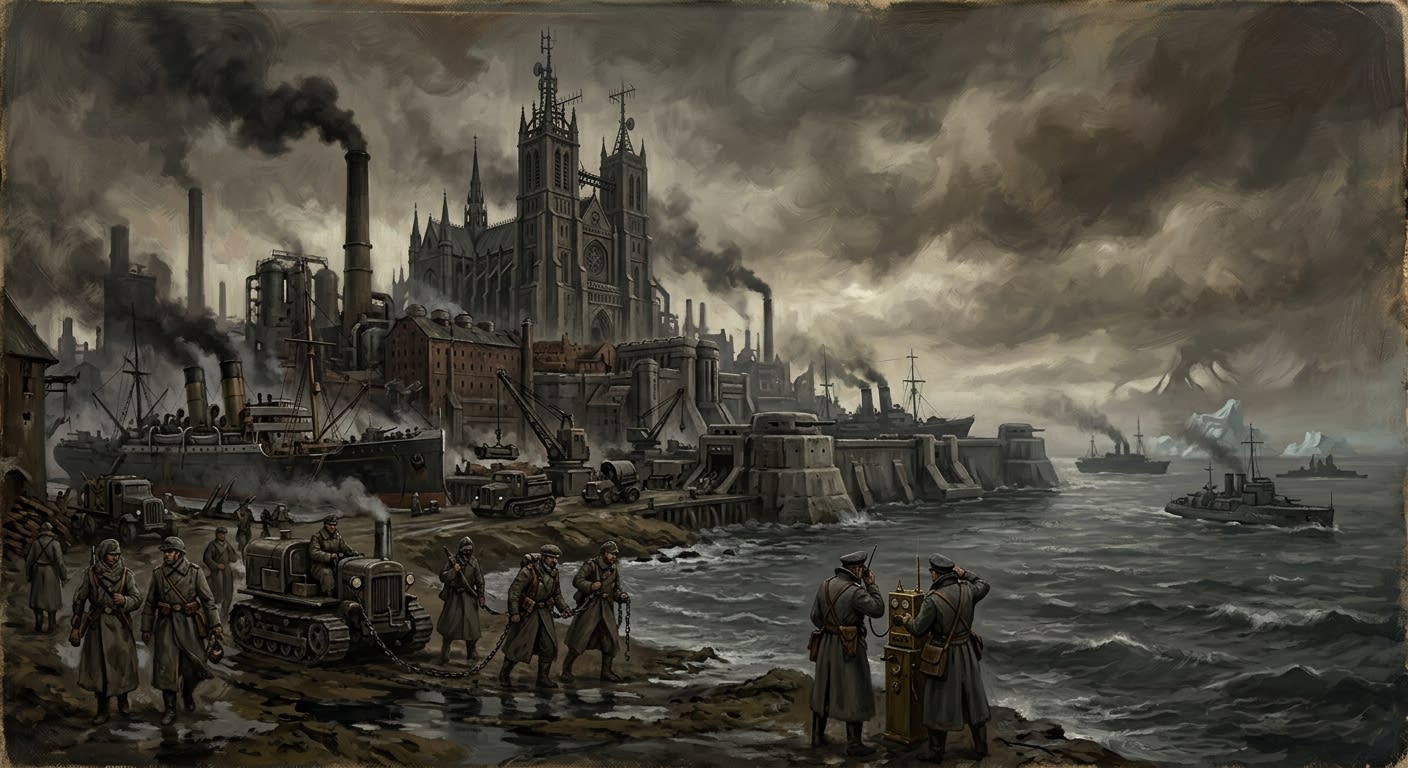
The Baltic matters because the Sagittal Line ends there. At Bastion-Königsberg, trench, wire, bell, ration, corpse, and decree run north until they meet sea and can go no farther without learning to swim. The northern anchor holds because the Masurian lakes, Prussian brick, frozen harbour, bell discipline, and a garrison of men too cold to waste fear all conspire to make retreat unattractive. Beyond the walls lies water. Beyond the water lies the Fractured North, faithful by its own schedule, obedient by nobody's calendar, and stubborn enough to make Strasbourg's writs sound underfed.
The public atlas calls the Baltic a northern sea bordered by Synod-adjacent ports, contested island chains, Scandinavian approaches, Danzig, Königsberg, and naval routes to Hamburg. The classified atlas, which is kept under a shelf whose lock once bit a clerk, calls it a liminal acoustic and ontological basin under Grey pressure. The fishermen call it bad water. The Scandinavians call part of it det grå vattnet. The garrison at Königsberg avoids nouns when looking northeast.
#On Old Ports, Cold Faith, and Prussian Teeth
Before the Sundering, the Baltic belonged to merchants, knights, fishermen, university men, smugglers, Lutheran ghosts, Catholic remnants, Prussian officers, Danish pilots, Swedish timber factors, Polish grain houses, and that broad category of human creature known as a coastal official, whose soul is generally half salt and half tariff. Danzig handled grain and gossip. Königsberg argued philosophy, drank beer, and maintained enough brick to convince itself of permanence. The island chains traded fish, wax, rope, and stories of bells rung in fog where no church stood.
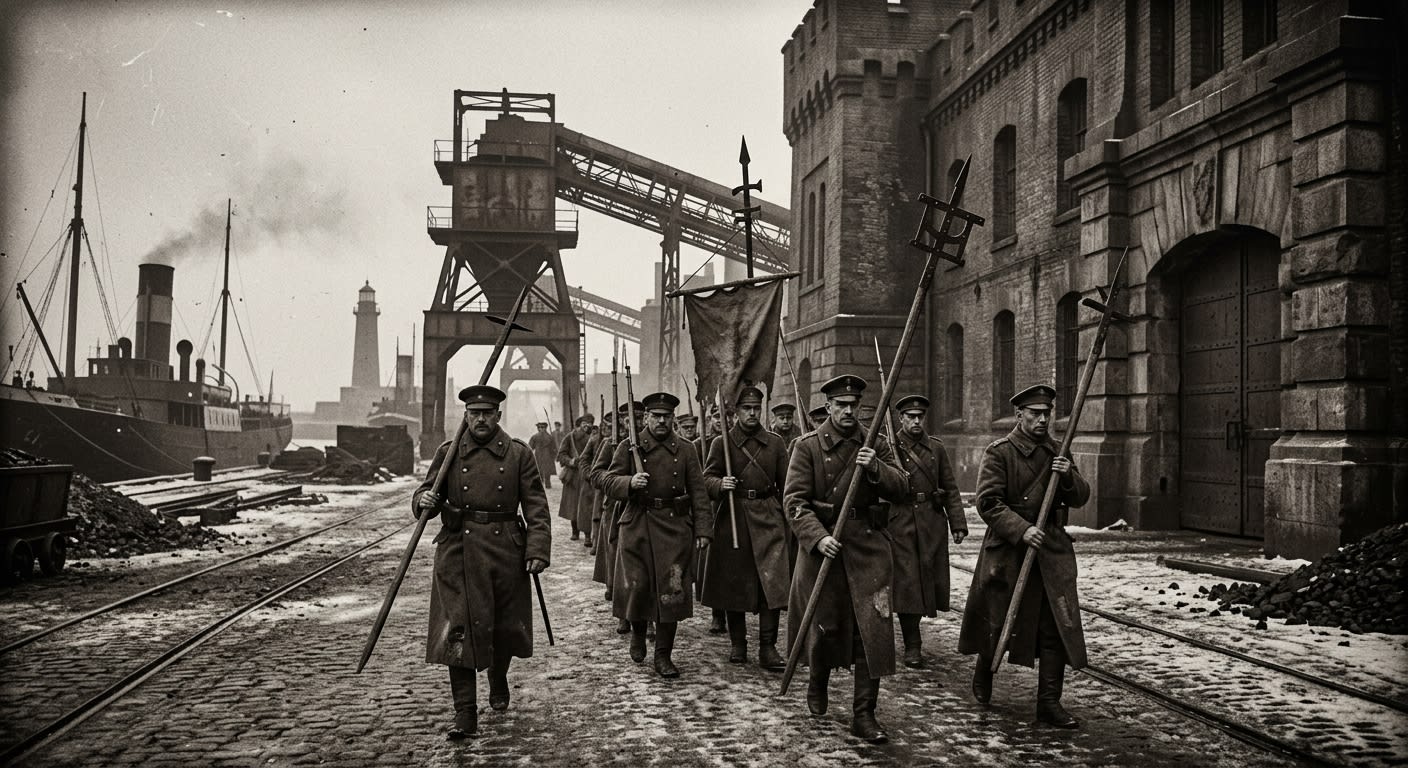
The Rationalists liked the Baltic because it was useful and far from Strasbourg. They renamed customs houses, flattened ecclesiastical tolls into civic tariffs, sent prefectural auditors into ports that had been dodging mainland authorities since before those authorities learned to spell their own titles, and believed this counted as rule. Coastal peoples are accustomed to mainland confidence. They let it pass, like wind, taxes, and sermons delivered by men who vomit on boats.
Then came the omens. The Year Without Dawn emptied horizons. The Red Flood touched the great rivers and made every harbour clerk inspect incoming water as if water might present papers. The Eastern Silence swallowed correspondence from the Balkans, and the Baltic cities received rumours by ship before Vienna admitted the roads were dead. Sailors know the order of things: first the gulls change, then the pilots whisper, then the magistrates lie.
A.S. 45 cracked the East. The immediate horror rolled through the Balkans, not the Baltic, which allowed the northern cities one sinful luxury: time to misunderstand. Prussian officers believed the northern approaches could be systematised. Danzig's merchants believed grain would purchase safety. Scandinavian elders believed the southern catastrophe had finally taught Strasbourg humility. All three were wrong, though the elders came closest to being entertaining.
During the Great Retreat, northern roads filled with detachments, refugees, cargo wagons, chapel carts, and grain convoys trying to avoid the more obvious mouths of the war. By A.S. 65, when the first refusals hardened into the Line, the Baltic had become less a sea than a ceiling: the northern limit of western retreat, the cold lid on a continent attempting not to spill its panic into the water.
#On Königsberg, the Far Nail
Königsberg is where the Baltic becomes doctrine.
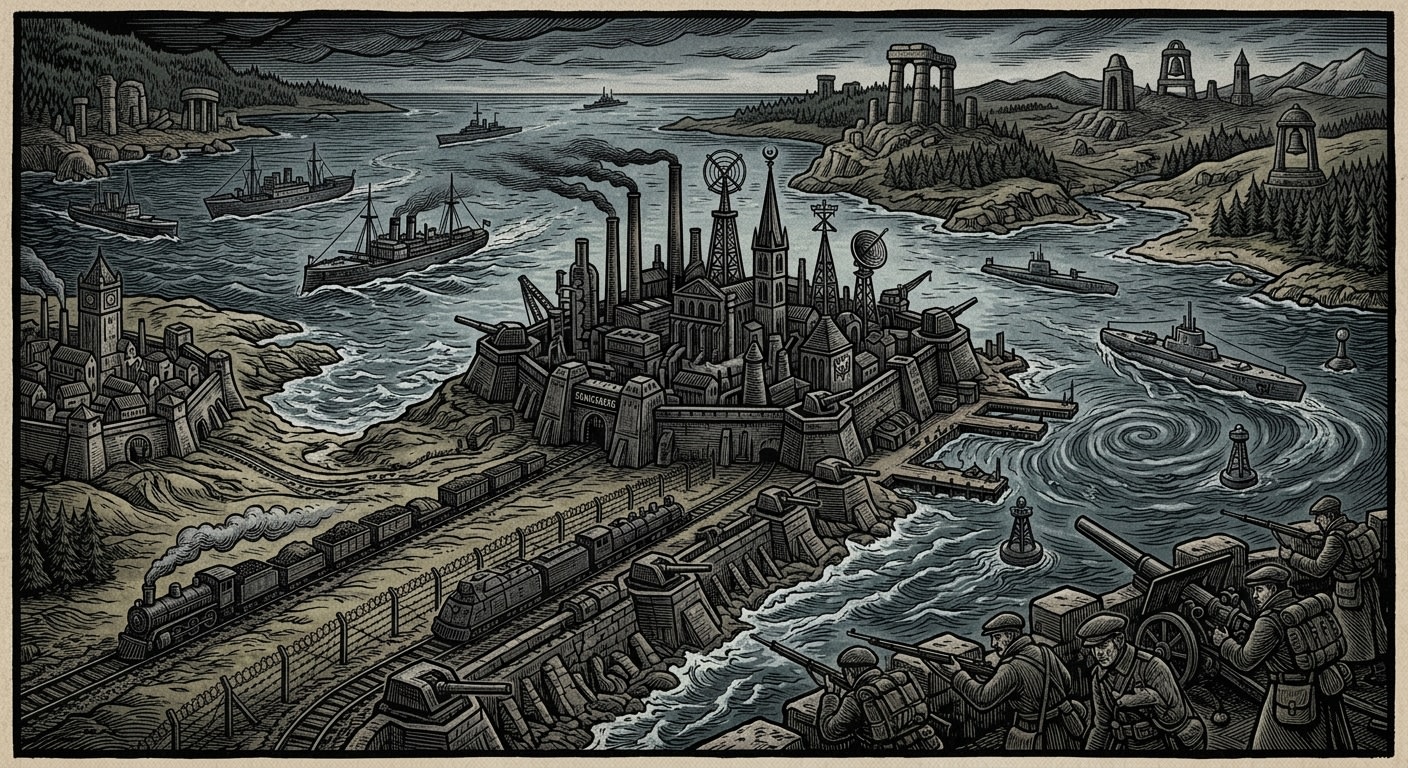
The old Teutonic and Prussian city sits at the mouth of the Pregel, coordinates filed with such precision that one might imagine precision could save it. The Synod requisitioned the place in the first years of the Line, around A.S. 67, and improved it in the usual way: by adding guns, bells, seals, ration windows, confession schedules, sealed tunnels, and enough clerks to make the dead feel underrepresented. The result is Bastion-Königsberg, the Far Nail, the Baltic Redoubt, the cold end of the continental argument.
Königsberg's outer defence is the Masurian lake maze to the east and southeast, a drowned confusion of water, reed, mud, ice, and local knowledge that has humiliated more surveyors than enemy regiments. In summer, the lakes swallow boots, carts, and tactical certainties. In winter, they harden into roads for anything light, hungry, or insufficiently respectful of military planning. The Masurian Watchers know the channels by stake, bird, reed, smell, and inherited grudge. The Bureau of War knows them by map. This explains the Watchers' survival rate.
The Baltic flank is worse because it has no useful geometry. The Sea Wall faces open water, fog, ice, and the northeast. It is along that wall that sentries first reported the Grey crossing two miles of water in the time it takes to breathe. It is along that wall that faces appear in fog, ordinary faces, almost-known faces, faces that make soldiers salute before thought arrives. It is along that wall that the Northern Carillon rings forty-one bells against a thing that continues.
Older northern primers describe the Baltic as Königsberg's safe flank.
Corrected. A flank cannot be called safe merely because no conventional army can march across it. The sea does not need to march. The Grey does not march. Primer authors have been advised to stop confusing infantry doctrine with metaphysics.
Königsberg is supplied by sea when the harbour permits and by the Polish corridor when the harbour freezes. The harbour freezes often. The Bureau of War has spent forty years making plans for this predictable fact and has achieved the rare distinction of being surprised by winter annually. Grain from Hamburg, ammunition from Kanzleiburg, conscripts through Warsaw, bell-clappers from Essen, seal-oil from the North, and every variety of paper required to keep a bastion legal all move through a system in which ice is treated as an insolent subordinate.
The city itself lives in compartments: Ordensburg command, Cathedral Close, Harbour Quarter, Lake Gate, Sea Wall, Warrens, Frost Yards. The Frost Yards keep corpses cold enough that decay waits, though the bodies do not always keep still. Sergeant Halder's A.S. 195–199 reports of corpse posture changes remain among the most honest documents in the northern archive. Purity found him sober, credible, and irritating. This is the closest Strasbourg comes to canonising a witness.
#On the Grey Water
The Grey is treated elsewhere as its own suppressed subject, because the Bureau loves containment almost as much as it loves failing at containment. In a Baltic article one cannot avoid it. One may as well avoid salt while discussing cod.
At Königsberg, the Grey appears as fog from the northeast. At Brest, its cousin or sibling or bureaucratically separated twin appears as the Nameless Tide, accumulating against the Bug sector with a patience that makes artillery look childish. In the Fractured North, Scandinavian elders speak of det grå vattnet, the grey water, a Baltic presence older than the Concordat and, if their sagas are credited, older than the Sundering. The Bureau credits sagas only after three committees have converted them into ugly prose and removed the parts involving truth.
The working scandal is simple. Consecrated countermeasures fail. Hymns do not repel the Grey. Bells do not shatter it. Relics receive no flinch, no steam, no shriek, no satisfying demonic recoil fit for educational engraving. The Northern Carillon rings and the fog continues. The Choir of the Northern Standard sings and the fog sings back, sometimes perfectly, sometimes before the Choir reaches the line returned to it. I have seen talented copyists unsettle authors. I have not seen paper anticipate the sentence.
There are four respectable hypotheses and several stupid ones. The stupid ones involve unusual weather, sailor superstition, Prussian melancholy, or excessive herring. The respectable ones are worse. The Grey may be a pre-Sundering maritime wound, opened or awakened by the eastern rupture. It may be an unnamed hostile authority outside the Seven, which would force Doctrine to count past its favourite number. It may be a Baltic intelligence older than human liturgy, answering bells because bells are not our invention in any exclusive sense. It may be the sea's memory of every drowned thing, given appetite by a century of war.
The Scandinavians do not treat the Grey as a puzzle. They treat it as a neighbour with murderous habits and a known dislike of certain bell patterns. Their fjord-bells use old tunings, pre-Concordat, non-standard, legally offensive to the Bureau of Bells and operationally effective in a way that has prevented prosecution. Strasbourg asked for the tunings three times. The third refusal included a demonstration at sea. No fourth request followed. This restraint from the Bureau of Bells remains one of the great miracles of modern administration.
BUREAU OF SHADOWS — NORTHERN SEA DEMONSTRATION ANNEX, A.S. 193 Participants: Scandinavian elders ████████████; Bureau of Bells observers ███; Königsberg naval escort █████. Recorded sequence: non-standard peal over open water; fog recession; return of vessel previously logged lost A.S. ███; crew condition █████████████████. Instruction: do not reproduce tones. Do not ask elders to repeat. Do not permit Bells personnel to whistle after review.
#On Danzig and the Jurisdiction of Grain
Danzig sits west of the worst pressure and east of comfort, which is to say it is a port ordained for argument. The city moves grain, timber, rope, iron fittings, salt fish, wax, refugees, and rumours through warehouses that smell of damp sacks and old law. It belongs to the northern corridor by geography and to every Bureau by appetite. Grain gives Danzig its bargaining power and its chain: whoever can feed a bastion may speak above his civic rank, and whoever feeds a bastion will be audited until his grandchildren inherit the headache.
The Trial of the False Bishop of Danzig is cited in Hierarchy manuals as proof that local episcopal deviation breeds ruin. That is the tidy version, polished for use in schools where children are trained to fear unlicensed mitres. The fuller file concerns a Baltic chapter that attempted to interpret northern necessity without waiting for Strasbourg's permission. It adjusted fast days around grain arrivals. It blessed ice roads without central approval. It recognised fjord-bell testimony in a minor maritime hearing. It allowed local fishermen to swear by old saint-names whose ratification had been pending since before the clerk assigned to them became bones.
The False Bishop was tried, condemned, and absorbed into useful precedent. Danzig learned the lesson: ports may move cargo, never doctrine. Since then its cathedral chapter has become exquisitely obedient in public and magnificently practical in fog. This is the correct order for a Baltic city. Public obedience keeps Purity indoors. Private competence keeps ships from vanishing.
Grain gives Danzig its bargaining power and its leash. Northern grain roads feed Warsaw, Brest, Königsberg, and the corridor towns whose populations never fully evacuated because evacuation would require somewhere safer with spare bread. The dissolved Bureau of Agriculture once kept tables on Baltic rye, coastal soil, silo rot, fungal spread, and the peculiar hardiness of seed stored in colder ports. Tithes inherited the authority and treated grain as coin with husks. The fields objected by failing at inconvenient times.
Baltic grain is never innocent. A sack from Danzig may feed a Königsberg gun crew, a Brest confession scribe, a Cologne pilgrim bank, or a sealed convoy whose manifest names no destination. The Bureau of Tithes weighs it. The Bureau of Records follows it. The Bureau of War requisitions it. The dead Bureau of Agriculture, through three clerks in a Strasbourg basement, still writes notes in margins no one admits to reading.
Tithes circular A.S. 158 described northern grain administration as “fully rationalised after Agriculture dissolution.”
Clarified. Rationalised means the office that understood soil was removed and the office that understood extraction was promoted. Bread continued appearing often enough to disguise the injury. The disguise is wearing thin.
#On the Fractured North Across the Water
Across the Baltic lies the Fractured North, which Strasbourg claims with the weary confidence of a man claiming a debt from an armed cousin. Scandinavia is faithful. This is the difficulty. If it were heretical, Purity could burn, War could march, Doctrine could sermonise, and Records could produce a pleasingly final table. The North believes in the Creator, fears the Enemy, keeps fasts harder than any Strasbourg pamphlet dares prescribe, and rings bells that work against the very thing Königsberg cannot master. It simply declines to become southern.
Zone 8 is the official designation: peripheral territories, semi-autonomous. Semi-autonomous is a phrase bureaucrats use when full autonomy is true and public admission would damage posture. The fjord settlements answer to clan moot, elder, jarl, prior when convenient, weather always, and Strasbourg after argument. Their priests gut cod. Their children carry axes and psalters. Their old bell frames stand on cliffs above black water, ringing patterns the Bureau of Bells calls naive because calling them effective would require apology.
Königsberg is the hinge between Synod standardisation and northern exception. The Northern Office routes correspondence, files complaints, sends missionaries, receives cod, and maintains the fiction that unanswered letters are delayed rather than refused. In A.S. 193 a Scandinavian emissary arrived by longboat with salted cod and a request that Strasbourg cease sending missionaries who frightened the goats. The letter remains pending. The cod was eaten. This is diplomacy at its most honest.
The tension is not comic at the wall. Königsberg needs northern oil, pilots, weather lore, and whatever those bells know. The North needs southern grain, iron, paper, and the fact of Königsberg standing between it and the Line's more formal catastrophes. Each side resents the dependence. Each side survives by it. A marriage, then, though with more fish and fewer illusions.
The Northern correspondence summary for A.S. 201 says the same thing with poorer manners: Königsberg requests harmonised bell data, seal-oil quotas, pilot rosters, and missionary access; the Fractured North provides oil when paid, pilots when respected, refusal when asked for bell secrets, and missionary access when the goats remain calm. Status: unresolved, functional, spiritually irritating.
#On Bells, Ice, and Maritime War
The Baltic war is not fought like the southern war. Constantinople watches fire and hunger cross visible approaches. Shipka watches fog sit down in valleys. Brest watches pressure accumulate on flat land until the mind begs for a hill. The Baltic watches water pretend to be empty.
Ships vanish in correct weather. Harbour bells ring with wet clappers no ringer touched. Ice forms in channels shaped like script, melts before copies reach Doctrine, then appears again under different stars. Fishermen return with nets full of grey weed, old coins, chapel tiles, and once a child's shoe still warm inside. Patrol boats report companion lights pacing them beyond cannon range. The companion lights never answer signal. The companion lights sometimes answer before signal.
The Bureau of War maintains a northern flotilla at Königsberg and Danzig with shallow-draft gunboats, icebreakers, bell-buoys, signal cutters, and patrol craft whose crews age badly around the eyes. The vessels escort supply, break winter channels, retrieve bodies when bodies remain local, and place listening bells on anchored floats. These bells are small, ugly, salt-stained instruments, tuned for alarm rather than liturgy. Sailors trust them more than officers because bells cannot be promoted.
There is also the matter of sound under ice. In winter, when the harbour skin thickens and the smaller boats are hauled up like old sins awaiting inspection, men walking the quay hear bells beneath their boots. The bells are not loud. Loud would be merciful; loud could be challenged, measured, blamed on a drunk ringer or a cracked buoy. These are small tones, domestic tones, the bell a mother might use to call children from a yard, the bell a chapel might ring when nobody important has died. They rise through the ice at second watch, never first, never third, and stop when a priest kneels. If a clerk kneels, they continue. This distinction has annoyed Records beyond language.
The Harbour Quarter keeps a list of winter bell-hearers. The list is unofficial, which means it is accurate. Fishermen, ropehands, two Bureau of Passage clerks, four bell apprentices, a widowed baker, a naval gunner, and one Purity examiner who later denied the entry after signing it twice. Three hearers later left for sea duty and returned grey at the temples. One never returned. One returned with pockets full of river stones although his vessel had not entered a river. The stones were warm, and each bore a tiny stamped mark resembling no authorised seal.
Agriculture enters even here, by absence. Baltic ports feed the north. Seal-oil lights Königsberg's lamps. Danzig grain keeps Brest's crossing queues from becoming meat riots. Herring and cod supplement garrison diets when rail fails. A failed catch may matter more than a failed sermon, though no Bureau will say this while a sermonizer is present. Hunger is Kargath's language, but he need not be present for men to hear it.
Bells answer hunger differently. The Northern Carillon's schedule marks fog, harbour closure, convoy arrival, sea-wall rotation, ice detail, funeral allotment, and those unprinted peals rung only when the Grey has been sighted. The fjord-bells answer from across the water in older tones, sometimes half a day later, sometimes before the Königsberg peal. The Bureau calls this acoustic anomaly. The old fishermen call it conversation. Nobody asks what is being said because the answer might require obedience.
#On Commerce, Smuggling, and Authorized Blindness
The Baltic breeds smugglers the way wet cellars breed mould. A coast with ice, fog, islands, old allegiances, semi-autonomous northerners, overtaxed grain, seal-oil quotas, war shortages, and multiple Bureaus arguing over jurisdiction is not a crime problem. It is a crime invitation written in large friendly letters.
Smuggling moves both ways. Northward go paper, medicine, sacramental wine, iron fittings, bell-metal scraps, forbidden hymn sheets, unofficial catechisms, and luxuries small enough to hide in fish barrels. Southward come seal-oil, old bell notes, amber, cured fish, pine tar, pilots without papers, carved icons, and testimony about grey water nobody in Strasbourg wants to hear in an official room. Danzig denies hosting the trade. Königsberg denies needing it. The Fractured North denies nothing and asks whether the inspector would like soup.
The Bureau of Tithes attempts taxation. The Bureau of Purity attempts suppression. The Bureau of Shadows purchases information. The Bureau of Records records seizures with righteous satisfaction and loses the list of unseized cargo with equal regularity. The result is authorised blindness: the useful portion of illegality is permitted to remain illegal so it may be condemned after it has done its work.
Grey contact has corrupted the trade in ways no customs tariff anticipated. Warm-papers appear from settlements that deny issuing them. Seal-oil lamps burn grey at the wick after certain voyages. Fish arrive already salted in holds where no salt was loaded. Amber from northern beaches sometimes contains tiny bubbles arranged in liturgical notation. The Bureau of Alchemical Standards says natural inclusion. The Bureau of Bells says do not hum it. I side with Bells, which is rare enough to merit a feast day.
#On Doctrine's Northern Discomfort
The Baltic offends Doctrine because it will not reduce. The South offers splendid categories: Wrath, Sloth, Gluttony, Lust, Greed, Envy, Pride, with bastions opposite, countermeasures assigned, sermons written, banners dyed, and children taught which sin has which teeth. The North offers fog without sin, bells without license, faith without obedience, ports without fixed loyalty, grain without Agriculture, water without proper silence.
Hierarch Odo of Trier's formula — “When we speak, the stones of Strasbourg listen” — works poorly on water. Stones may listen. Walls may listen. Silent bishops may listen. The Baltic hears and continues doing whatever it was doing before the sentence arrived. This has not prevented Strasbourg from speaking. It has merely reduced the sea's compliance rate.
The Night of Black Decrees reached the Baltic harbours like every other obedient theatre. Writs arrived. Seals appeared. Danzig signed. Königsberg signed. Island chapters signed, then later claimed they had signed under tide pressure, which is either nonsense or a legal theory of genius. The Fractured North produced delayed acknowledgements in three languages, two of them dead, one apparently invented to avoid direct concession. Records entered them as assent. The North entered them as correspondence. Both sides preserved the papers. Both lied with care.
This is why the Baltic remains dangerous even behind the Line. It proves that the Synod's categories can function without fully describing the thing governed. It proves that obedience may be partial and still useful. It proves that an enemy may stand outside the Sin-ledger and still press the wall. Such proofs are unwelcome in Doctrine. We prefer proofs that kneel.
#On the Present Baltic
As of A.S. 201, the Baltic is a northern war basin, a supply artery, a jurisdictional wound, and a listening surface under Grey pressure. Königsberg holds. Brest watches the related accumulation farther south. Danzig moves grain and lies elegantly. The Fractured North rings its old bells and refuses to apologise for being correct before Strasbourg arrived. Hamburg feeds the northern import throat. Warsaw receives and forwards. The sea freezes, opens, fogs, answers, and sometimes returns what it should have kept.
The Bureau of War wants clearer patrol doctrine. The Bureau of Bells wants the old tunings without admitting need. The Bureau of Tithes wants seal-oil regularised and grain taxed without interruption. The Bureau of Doctrine wants the Grey to become either demonic or irrelevant, preferably by Tuesday. The Bureau of Records wants names for lost ships. The fishermen want weather that lies in ordinary ways. The sea grants none of these petitions.
A map may shade the Baltic blue. This is decorative cowardice. The true colour is the grey of pending classification, wet wool, old ice, unspoken testimony, and faces seen once in fog and thereafter in every polished spoon. Men at Königsberg look northeast and do not describe what they see. Elders in Hrafnvik ring bells older than our schedules. Danzig merchants count sacks by lanternlight and leave one ledger unstamped. Somewhere offshore, a buoy bell answers a peal no human hand has rung.