
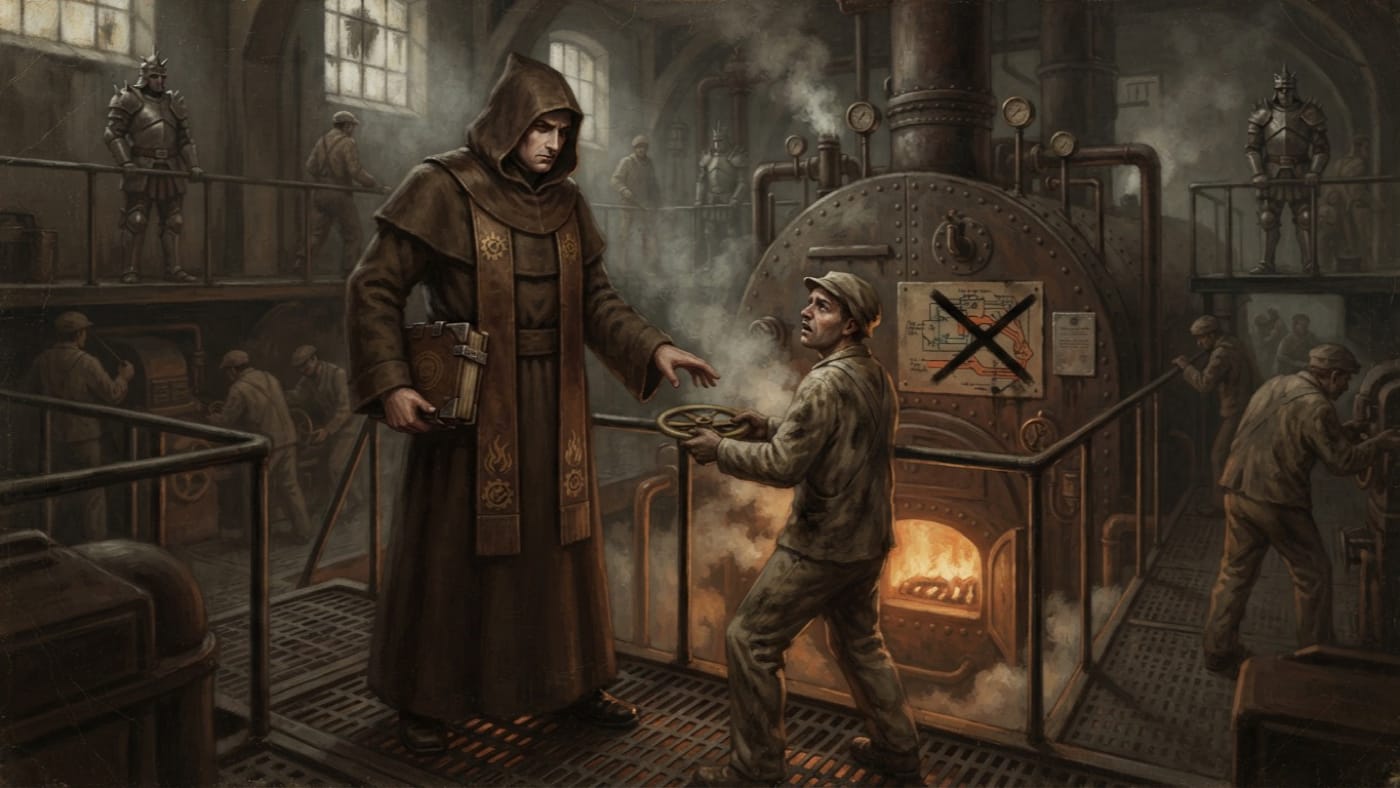
#On the Permitted Cause
Mechanistic Heresy has no founder, no chapterhouse, no membership roll and no feast day on which Purity might arrest the whole congregation at once. It is a charge. The Bureau of Doctrine brings it against anyone who explains a machine without first passing that explanation through the Church, and the Bureau of Purity carries out the sentence.
The line it draws is thin, and men have been hanged on thinner. A stoker may feed the firebox. A shift engineer may set a valve, read a brass gauge, and order the load cut before the drum splits. The Synod pays for these acts and blesses them before every restart. What it forbids is the sentence that comes after: the pressure rose because the fire was fed faster than the steam could leave. That sentence needs no cassock. A worker who can say it once can say it again, to an apprentice, in a shift closet, with no seal anywhere near.
The Furnace Catechist records put the doctrine plainly: technical work is allowed, and explanatory sovereignty is not. The Bureau of Engineering owns the hands. Doctrine owns the why. The worker owns soot, a ration chit, and whichever of the two Bureaus is angrier that week.
Engineering has never accepted this settlement. Among the Holy Bureaus the cause of fire is a standing dispute: fuel goes in one column of the ledger, heavenly command in the other, and neither gets struck out. Only the workers are forbidden to keep a column of their own.
#On the Lesson and Its Vocabulary
The Furnace Catechists enforce the charge. They work wherever heat becomes obedience: powerhouses, refineries, smelters, trench boiler pits. They were sent among the workers as pacifiers after the Boiler Riots of A.S. 104, when a bastion workforce demanded truth lessons after a lethal failure. The profession's own inventory lists what it controls: confession, narrative, fear, compliance, and something its documents call causal permissions, meaning the register of who may explain what.
Every shift opens with the ash mark on the forehead, attendance tokens dropped into a brass bowl, and the Chain of Cause recited through a throat veil. Heat is obedience made visible. A spark is permission. Explaining is stealing. Cause is a chain; chains have owners. The fourth line does the work of the other three, and every Catechist who has recited it at four in the morning knows that.
On the catwalk, sealed phrase cards take care of the rest. A foreman who says pressure curve is quietly told to say breath of obedience. Mixture ratio becomes proportion ordained, and thermal gradient becomes the will of the fire. Each substitution keeps the warning and throws away the arithmetic. A worker told that the breath of obedience is rising still knows to step back from the valve. They no longer know how far.
After a failure comes the confession hour, and after that the report. Success is credited to obedience. Failure is credited to sin or sabotage. A pump does not fail because the gasket was cheap. It fails because someone on the shift harboured hot doubt, and the report will name someone. Once the Catechist presses the seal, the ledger becomes official reality. Real technical primers are listed as contraband, along with forbidden charts and dictionaries of engineers' slang.
The Litany-Engineer must not be confused with the Catechist. Early operators found that certain rhythms steadied combustion and suppressed the wrong resonances, and the Synod made those rhythms into sanctioned cant. A Litany-Engineer's calibration whistle matches the engine's speed to a licensed tone, and the sung work changes something measurable inside the machine. A Catechist's sermon changes something measurable in the crew.
#On the Manuals of A.S. 134
The charge got its standard example in the winter of A.S. 134. Clandestine manuals known collectively as Fuel Is Chemistry passed through six bastion powerhouses in a single season. They explained combustion in mechanical terms and included diagrams. The copy recovered at Bastion-Przemyśl, the western Carpathian fortress, let its readers calculate fuel loads without the approved catechism tables. A crew that can do its own arithmetic has no further use for the tables. Doctrine noticed.
The Causality Purge of A.S. 134 followed. The full narrative is filed under that heading, and I do not intend to copy it out here for readers too idle to turn a page. Purity's incident record classified the matter as Mechanistic Heresy, Category Two, together with Instructional Contagion, Category One. These categories belong to that record. The Bureau has never published the full scale.
At Przemyśl the Lictors of Purity immured forty-seven stokers, eleven foremen and three shift engineers: sixty-one people, counted at one site. The other five powerhouses are not named in the record I was given, and anyone who quotes sixty-one as the toll for the whole winter is doing arithmetic without a licence.
The manuals were burned in public. Their diagrams went into sealed instructional files for suppression training, so that Catechists could learn to recognise a fuel table without understanding it too loudly. The Church therefore immured the readers and kept the reading. I call this procedure. Engineering calls it reference material.
The first circulars blamed Rationalist residue among the labourers. Nobody has shown that the author, or any prisoner, belonged to a Rationalist organisation. The residue was an accusation, and accusations need no members.
Initial Purity circulars described the manuals as a spontaneous outbreak among uneducated labourers.
Corrected by sealed Doctrine notice, A.S. 147: the manuals were written by a senior draughtsman of the Bureau of Engineering, whose identity remains sealed under Bureau of Shadows File 44-K. The correction released nobody from the masonry. It was not meant to.
The draughtsman's name, motive, sponsors and fate are absent from every file I am permitted to handle. Only the occupation survives. The Shadows apparently decided that the Church needed to know what kind of person writes such a book, and had no need to know which one.
#On Licensed Knowledge
Engineering's position is awkward, and it suits Engineering to keep it that way. The heresy came out of its own drafting rooms. Its business is the same knowledge the charge forbids to everyone else. A machine misdiagnosed as sinful will fail again regardless, and the Bureau knows it. Engineering wants accurate fault records. Doctrine wants sealed ones. Most plants keep both, and the clerks are paid accordingly.
The Catechists are divided on this. The Purists allow no technical phrasing under any circumstances, even with a valve screaming. The Pragmatists keep production running: in an emergency they let the real words be spoken, and afterwards they cleanse the report. The profession calls this selective ignorance. Its quieter art is sacrament substitution, in which a technical adjustment is renamed a rite so that it may be performed. The profession's own manuals admit what this costs the Catechist: complicity in the knowledge they police. These are factions inside a legal office. They are not wings of some heretical movement, and a reader who arrests a Pragmatist for heresy will find the paperwork fights back.
The charge is also not a confession that every rite is fraud. At Essen-of-Hymnsteel harmonic calibration is daily industry, and the anomalous resonance hazards on file there are real enough to empty a gallery. Doctrine argues that a stoker who thinks the furnace is only chemistry will not recognise wrong flame when it comes. Engineering answers that the stoker who knows the chemistry is the first to notice when the flame stops obeying it. Both arguments are on file. Neither has been ruled upon.
#On Present Enforcement
The Trench Sermon Mandate of A.S. 158 brought the winter of 134 back into use. Its immediate occasion was the foreign harmonics troubling the generators at Bastion-Shipka, on the Balkan pass. Doctrine cited the old purge as precedent for posting licensed Catechists at every power installation on the Sagittal Line (Unregistered). Saboteurs' harmonics and literate stokers were filed under one security rationale, which is how a precedent can be used twenty-four years after the masonry has set. Saint Veyra of the Mouth, with her brazier and sealed book, was promoted to emblem of the Line.
The charge has recurred since. In the Ash-School affair of A.S. 187 at Essen, a Catechist taught real thermodynamics to an apprentice, and the whole plant was reassigned. That case should embarrass the profession most of all. The heresy needs no draughtsman and no printed folio. One Catechist who understands the furnace and lets it show is enough.
As of A.S. 201, fragments of the old manuals still surface in boiler towns under devotional covers. They prove that the knowledge is still being passed on. They prove nothing about the draughtsman, and nothing about any central direction behind them. Auditors still test workers with bait questions. Why does fuel burn? A bad answer sends the worker to confession. A fluent one goes into a report.