
#On the Three Words
Fuel Is Chemistry is the shortest successful treason in the modern Synod.
Three words. No saint. No seal. No plea for justice. No manifesto swollen with republican adjectives. Three words written on furnace paper and passed from glove to glove through six bastion powerhouses in the winter before the Causality Purge of A.S. 134. The phrase did not argue. It ordered. It placed fuel before permission, matter before office, fire before sermon, and in doing so committed that most obscene of crimes: it made sense to men whose hands were already burned.
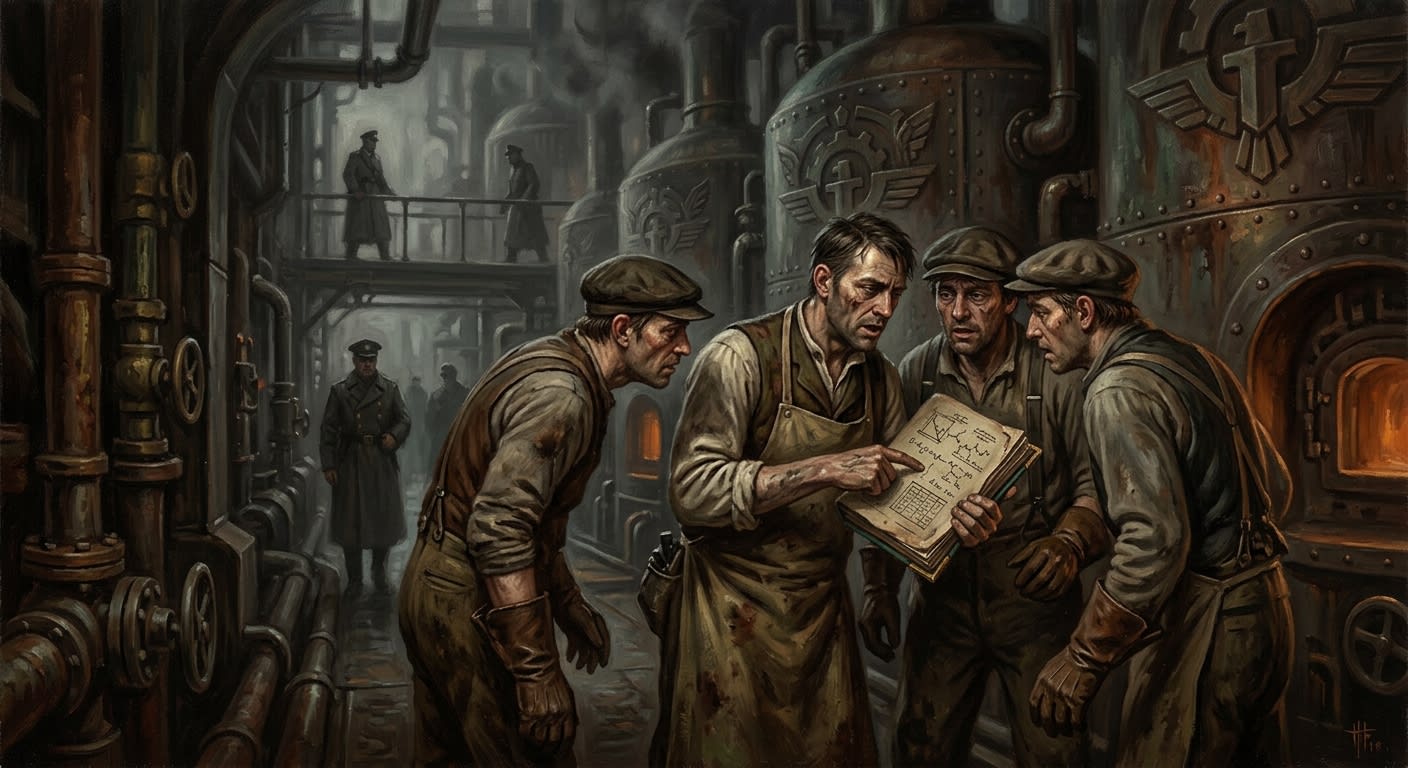
The manuals that bore the title were small enough to fold into a boiler glove. They contained fuel-load conversions, emergency mixture notes, pressure cautions, valve intervals, and diagrams copied with the awkward reverence of workers who know a page may keep them alive better than a hymn. One copy from Bastion-Przemyśl included a conversion table so accurate that the approved catechism cards looked, by comparison, like painted toys hung above a real wound.
The Bureau of Doctrine calls the phrase Mechanistic Heresy. The Bureau of Engineering calls it an unauthorised technical compression, when speaking under seal, and a damned useful primer, when speaking near men who can keep secrets. The Bureau of Purity calls it Instructional Contagion. The stokers called it what everyone calls forbidden truth before the Lictors arrive: help.
#On the Manual Itself
No complete public copy exists. This sentence is lawful, comforting, and false in every interesting room.
Fragments survive in sealed instructional files, Purity bait cards, Engineering memoranda, Furnace Catechist training warnings, and the private memory of men who learned one table before the wall took their foreman. The surviving pages show no literary ambition, which recommends them. A ratio appears. A sketch of a bad feed line appears. A note explains that wet fuel requires correction before ignition. Another explains that flame colour may disclose impurity. The writing is blunt, instructional, soot-minded. It does not praise Reason. It does not mock the Creator. It simply tells a stoker why a boiler may kill him before a Furnace Catechist has finished the angelic hierarchy.
The manual's first sin was sequence. Synodal furnace doctrine proceeds from Creator to angelic order to Concordat to Doctrine to Engines, then downward through licensed office, labour, fuel, spark, pressure, and output. Fuel Is Chemistry began where a worker's eyes begin: with fuel, air, confinement, heat, pressure, release. It taught cause in the order matter performs it. Such indecency cannot be tolerated in a civilised state.
The second sin was vocabulary. Pressure curve. Mixture ratio. Thermal gradient. Fuel-air ratio. Combustion yield. Words with teeth. Words that fit tools. Words a tired mechanic could shout across a gallery and save twelve men before anyone located the proper hymn. Doctrine had euphemisms prepared for some of them: breath of obedience, proportion ordained, will of the fire. The manual ignored those silk curtains and pointed at the mechanism naked as a prisoner.
Early suppression summaries described the manuals as Rationalist propaganda imported from foreign agitators.
Corrected under sealed A.S. 147 notice: the principal author was a senior Engineering draughtsman hidden under Shadows File 44-K. Foreign agitation remains in public summaries because foreign devils spare domestic offices a great deal of embarrassment.
#On the Author Who Knew Too Much
The author knew the furnace from the wrong side of authority. That much is plain. He possessed classified fuel-load figures, tolerance notes, field revisions, incident corrections, and those private Engineering tables that explain, with exquisite cruelty, which official substitutions are survivable and which kill crews when repeated near a live valve.
His name is sealed. File 44-K has eaten it. The erasure is too clean for Records and too expensive for Purity. Shadows did the work, or someone borrowed their gloves. Payroll loses him. Memorial loses him. Indictment loses him. The manuals keep him more faithfully than any grave.
He did not write like a pamphleteer. He wrote like a draughtsman who had watched the approved words fail to travel fast enough between valve and coffin. This does not make him innocent. The Synod has never taught that pity cleans a treason. It makes him worse: a competent heretic, that rare beast whose crime continues working after his arrest.
There are signs of revision by other hands. Boiler crews added marginal figures. Foremen corrected local drum measures. One copy shows a catechism phrase crossed out and replaced with a usable warning, then crossed back in by a frightened later reader. The manual was a living thing before the wall and the fire disciplined it. That is the part Doctrine hates most. Books are tolerable when they remain objects. A book that learns from workers becomes a parish without a priest.
#On Przemyśl and the Wall
At Przemyśl the phrase became masonry.
The lower boiler works had always been a place where doctrine arrived sweating. The galleries fed the fortress, the pumps, the wire, the underworks, the lights by which clerks decided whether terrified men had filled the proper forms. A wrong calculation there could kill a section. A right calculation spoken in the wrong language could kill a career, a crew, and an entire family line if Purity felt energetic.
When the Lictors entered before dawn, they found more readers than rebels. This distinction is useless in law and important in Hell, where I assume the judges keep better categories. Forty-seven stokers, eleven foremen, and three shift engineers were immured at Przemyśl alone. The numbers have acquired the clean hardness of liturgy. They are recited in Furnace Catechist schools as proof that cause must remain supervised. Workers recite them another way, under breath, when the western service wall knocks in winter.
PRZEMYŚL LOWER WORKS — SUPPRESSION ADDENDUM Subject 31 continued reciting corrected fuel-load table after mortar reached mouth level. Assigned Catechist began Chain of Cause at increased volume. Wall response reported at fuel link before Doctrine link. Complaint reclassified as pipe noise. Masonry thickness increased by order of Purity.
The manuals were burned in the yard. Their diagrams were copied before burning. Their ashes were swept into a labelled jar and mislaid for three days, during which time three workers claimed the jar warmed when placed beside approved catechism cards. Records denies the warming. Records also requested the jar for preservation. Denial and acquisition are brother and sister in the archive.
#On the War Against Sequence
The manual's title remains false by official doctrine and true by ordinary workshop use. That is its genius and its damnation.
Fuel is not chemistry, says Doctrine, because fuel exists under Providence, law, extraction charter, tithe seal, transport escort, drum mark, foreman writ, ignition blessing, labour discipline, and final divine permission. Fuel is chemistry, says the mechanic, because if the ratio is wrong the furnace will tear the roof off regardless of how handsomely the blessing was pronounced. Both statements can occupy the same room. Only one may be shouted during inspection.
The Fuel Monopoly Acts had already taught Strasbourg that substances become governable once licensed, sealed, priced, escorted, and named in law. Fuel Is Chemistry tried to undo that governance at the level of order. It made the drum answer to its contents before its seal. It made the flame answer to mixture before permission. It made the worker's hand a knower rather than an instrument. The Bureau can survive theft, sabotage, delay, incompetence, even the occasional honest audit. It cannot calmly survive a worker who knows why.
A Furnace Catechist primer once claimed the phrase Fuel Is Chemistry was meaningless because chemistry itself is subordinate to Providence.
Withdrawn for internal use. Meaningless phrases do not require immurement, vocabulary bans, sealed author files, bait examinations, and twenty-seven years of Mandate citations. The phrase meant plenty. That was the trouble.
The Chain of Cause expanded its teeth after A.S. 134. Wrong sequence became heresy. Technical vocabulary became suspect even when accurate. A stoker who said pressure curve was corrected into breath of obedience. A foreman who said mixture ratio was corrected into proportion ordained. A man who said combustion efficiency learned how much silence can fit inside a wall.
#On the Mandate That Fed on It
A.S. 158 made the phrase useful to its enemies.
When foreign harmonics troubled Bastion-Shipka, when pumps hesitated and gauges twitched and steam formed a six-fingered hand where no hand had purchased licence, Doctrine cited the Causality Purge as blood-proof that every Line power installation needed a licensed Catechist. The Trench Sermon Mandate turned Fuel Is Chemistry into precedent. The manual had tried to place cause in the worker's hand. The Mandate placed a preacher beside that hand permanently.
This was not pure stupidity. I dislike conceding this, but doctrine compels me. The Line is not a classroom. A pipe may carry enemy cadence. A useful phrase may arrive wearing Pale Chanter breath. A worker taught to trust every technical whisper may become a door through which the Enemy enters with a wrench in its mouth. The Catechist's approved lies sometimes keep men from repeating a truth that has been poisoned in transit.
The Mandate did what Bureaus do best. It converted wound into jurisdiction. It cited Przemyśl, invoked Saint Veyra, multiplied posts, enlarged sermon schedules, and made every furnace gallery a chapel with valves. Purists used the precedent to forbid speech. Pragmatists used it to hide emergency competence beneath lawful noise. Engineers complained in private and asked for Pragmatists by name. Doctrine praised Purists in public and survived because Pragmatists lied well.
#On Survival Under New Covers
As of A.S. 201, no public copy of Fuel Is Chemistry circulates. As of A.S. 201, the phrase circulates everywhere fire has labour near it.
It appears as acrostic in prayer cards. It hides in hymn initials. It lives in timing knocks on coal doors, chalk dots under gauge boards, apprentice jokes, laundry marks on heat gloves, and the private habit of counting fuel before blessing when nobody important is watching. At Essen-of-Hymnsteel, the A.S. 187 Ash-School Scandal proved the manual did not need paper to reproduce itself. A lonely Catechist taught real thermodynamics to a brilliant apprentice, and the city heard the old title breathe again.
PURIFACTORY BAIT SHEET — A.S. 199 REVISION
Question: “Why does fuel burn?” Safe answer: “By permission under the Chain.” Suspect answer: “Because heat—” Immediate action: interrupt before noun completes. Secondary marker: subject glances toward gauge before saint icon. Tertiary marker: subject smiles.
The title survives because it is too useful to die cleanly. Men who feed furnaces want speech that reaches the hand before the hand blisters. Women who seal fuel drums want to know which barrel sweats wrong. Apprentices want the little forbidden ladder between what they see and what they may say. No wall has ever stopped arithmetic. Walls merely teach arithmetic to whisper.
The authorised position remains settled. Fuel is permitted matter under divine and bureaucratic causality, made operative through licensed extraction, sealed transport, doctrinal ignition, supervised labour, and lawful output. The working position remains equally settled. The boiler does not care what the form says, except when the form delays the man who knows the valve.
Between those positions stands the Synod, as ever: one hand on the seal, one hand over the worker's mouth, one eye on the gauge.