
#On the Test That Pretends to Be a Mercy
Ordeal, in the Sibiu usage, is the annual counter-accounting rite imposed upon notaries, lenders, convoy clerks, charity founders, dowry witnesses, and other respectable persons whose hands approach paper too often near Bastion-Sibiu. Fire appears, so the sentimental call it trial by fire. Confession screams from every corner, so cowards call it confession. The Bureau of Tithes sends men who smell of ink and sour victory, so accountants call it audit. The Synod attempts to discover whether a human being has become a doorway through which Velmora may enter the accounts.
The subject calls it inspection. Purity calls it procedure. Doctrine calls it Ordeal because an honest name frightens fewer people than a gentle one.
The rite is renewed most visibly after the A.S. 199 Sibiu Anomaly, when the Hierarchy of Debt and the Crimson Concord were found cooperating in the same theatre without the usual infernal courtesy of mutual hatred. The Bureau responded by tightening what already existed: annual Ordeal for every notary in the highland corridor, special Ordeal for relief kitchens funded within two miles of a convoy road, and emergency Ordeal for any lender whose kindness exceeded the permitted schedule. Excessive mercy is actionable in Sibiu. This surprises sentimental people. Sentimental people are how Velmora buys towns.
#On the Origin of the Sibiu Rite
The older Synod knew ordeals in the childish sense: fasting, cold iron, sleepless recitation, the holding of relic ash under the tongue, the public reading of sins before a clerk who had heard worse and yawned less politely. These remain in use because tradition has inertia and because a frightened populace loves visible cruelty when it is applied to someone else. The Sibiu Ordeal belongs to a harder family. It was born where credit became warfare.
Velmora’s Ten Thousand Keys do not enter a village carrying banners. They arrive after bad harvests with grain, after fever with medicine, after burial with coin, after scandal with silence. The first contract is legible. The relief is real. The borrower signs because the child is coughing, the roof is failing, the mule is dead, or the convoy must depart before snow blocks the pass. Later, the collateral clarifies itself. A key warms in a drawer. A clause matures. A notary remembers one signature too many.
By A.S. 160, Ledger-Keeper infiltration files already troubled Sibiu sector archives. By A.S. 180, false relics and credit masks had entered frontline chaplaincies. By A.S. 192, Purity had corrected its own earlier fantasy that Ten Thousand Keys recruitment depended chiefly on rich men wanting more. It depends on need first. Greed comes after need has been refinanced.
Ordeal developed from that correction. The Synod could no longer test only for hidden idol, forbidden phrase, demonic mark, and bad prayer. It had to test for useful charity. It had to ask whether the town’s generous lender was generous because his soul remained soft, or because he had discovered that gratitude makes better rope than fear. It had to ask whether the notary’s perfect seal certified lawful exchange, or merely taught a demonic contract to stand upright in court.
Earlier Sibiu manuals described Ordeal as a “purification of suspect professions.”
Corrected. Ordeal is not purification. Many who pass remain vain, avaricious, cowardly, and professionally tiresome. Ordeal seeks Velmoran obligation, not ordinary sin. Ordinary sin is abundant enough without giving it ceremonial promotion.
#On the Stations
The Sibiu Ordeal proceeds through five stations, because Velmoran corruption loves a hierarchy and Doctrine, being civilised, answers theft with parody.
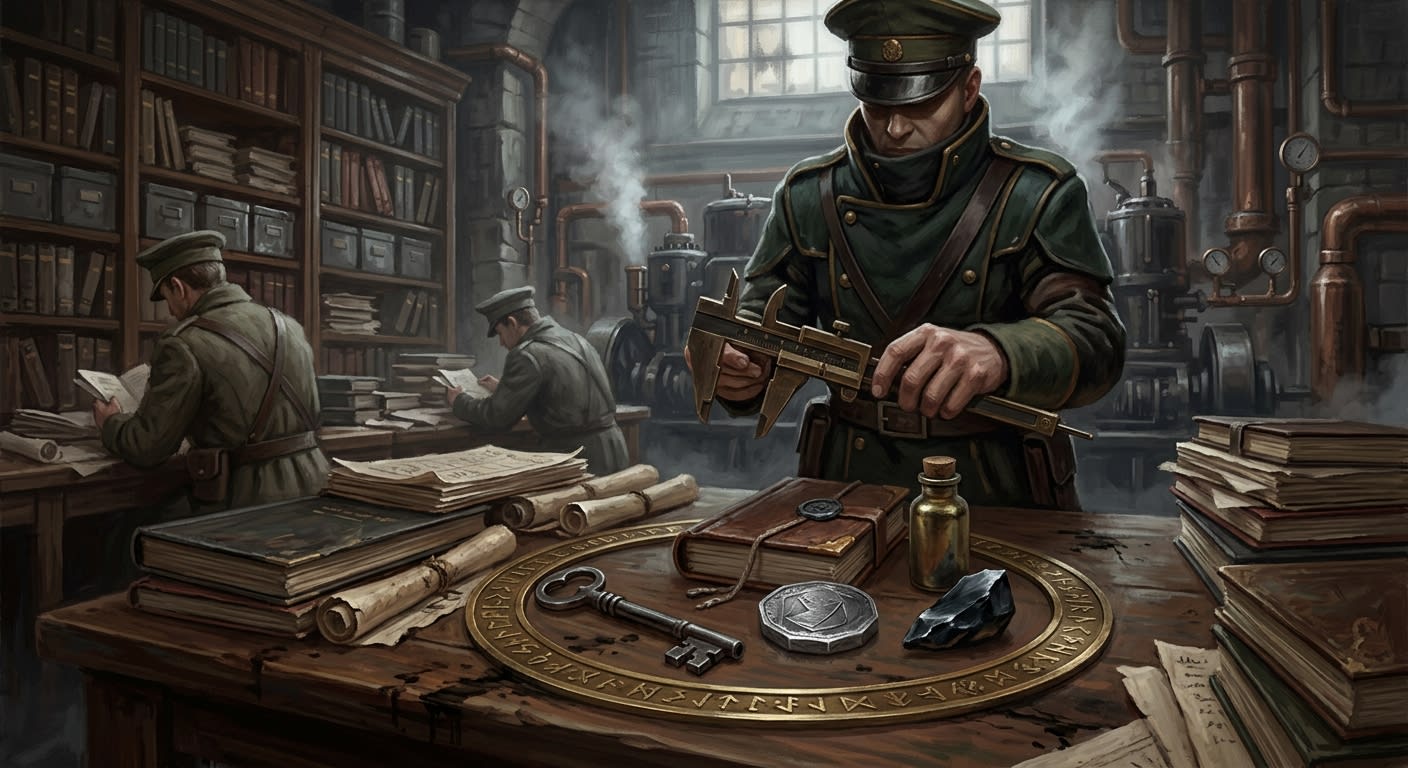
First comes the Station of Coin. The subject places every coin carried on the iron table. Tithes weighs them in silence. Purity warms them over black flame. Records compares mint marks against pay history, tithe declarations, convoy authorisations, wedding fees, mourning permits, and any small private generosity the subject had hoped would remain private. Clean coin dulls under the heat. Suspect coin brightens. A coin that speaks is hammered flat and filed under evidence, unless it speaks in the voice of a missing clerk, in which case the room is cleared and the hammer blessed again.
Second comes the Station of Keys. Every key is surrendered: door, chest, desk, chapel cupboard, storeroom, gate, strongbox, marriage coffer, and the little sentimental keys widows keep on ribbons while insisting they open nothing. The keys rest in ash. Legitimate keys cool. Velmoran keys remain warm, grow damp, or orient themselves toward the east. No key may be tested in a visible lock. This rule is written in red because A.S. 198 taught its lesson with sufficient cruelty.
Third comes the Station of Mercy. Here the subject’s charitable acts are read aloud without praise. Bread given. Coal purchased. Dowries advanced. Debts forgiven. Roofs repaired. Funeral funds endowed. Each mercy is weighed for obligation-density: who received, who witnessed, who later complied, who later introduced a cousin to the lender, who later softened a sermon, who later forgot to report a convoy pause. The subject is not condemned for generosity. The subject is condemned when generosity has interest.
Fourth comes the Station of Clause. The subject copies, by hand, the standard denial of Velmoran contract-theurgy: No contract binds the soul; no key owns the will; no debt survives refusal before Heaven. The words are plain. They are meant to be plain. A contaminated hand alters them. Sometimes the alteration is crude: “No debt survives except mine.” Sometimes it is clever: the subject copies perfectly, and the ink adds a second line beneath after drying. Sometimes nothing changes, and the examiner’s own copy begins charging interest.
Fifth comes the Station of Refusal. This is the true Ordeal. The subject is offered relief.
A debtor is offered cancellation. A notary is offered restored reputation. A widow is offered burial money for a son not yet dead. A lender is offered one last extension. A clerk is offered the name of the superior who has mocked him for six years. The offer is false in source but real in pressure. The subject may refuse. The subject must refuse in full knowledge of what refusal costs. This is the hinge. Velmora cannot take the will. She prices it. Ordeal asks whether the subject still owns enough of himself to decline the price.
#On Failure
Failure is rarely spectacular. The theatre of popular fear imagines a failed notary bursting into coins, scales, and confession. Such events occur often enough to keep pamphleteers employed and rarely enough to make pamphlets liars by profession. Most failures are quieter. A hand reaches for a key before the examiner speaks. A creditor asks whether a refusal may be deferred until after harvest. A notary, while copying the denial, corrects the phrase before Heaven into before settlement. A charity founder, upon hearing his own benefactions read, smiles as though listening to a balance sheet becoming music.
The failed are separated from their clients immediately. This is the part the public hates. If a beloved notary fails, every contract he witnessed becomes suspect. Marriage portions tremble. Property claims open their mouths. Burial plots become negotiable. Apprenticeship papers lose weight. The Bureau posts armed clerks outside the office and begins serial reconciliation while half the town howls that the man was kind.
The punishment depends upon what failed. Possession of a warm brass key brings inquiry. An altered clause brings confinement. A conscious Velmoran compact brings burning after confession, unless the subject provides useful ledgers, in which case burning is delayed and called cooperation. In rare cases the subject survives in Silence custody. Mercy is not responsible. The Bureau has learned that some debts continue to move after the debtor stops breathing.
SIBIU ORDEAL ANNEX — A.S. 200 Subject: Maros Vell, notary, Church Ring. Failure: fifth Station, accepted “return of daughter’s voice” before offer completed. Result: daughter, dead A.S. 196, heard singing from locked evidence tray for nine minutes. Disposition of subject: ███████████ Disposition of tray: still locked; hymn incomplete; no examiner assigned alone.
#On Passing
Passing Ordeal does not make a person innocent. It makes him usable for another year. The certificate is narrow by design. It states that no Velmoran obligation, key-linked contract, or active debt-theurgic influence manifested under prescribed conditions on that date, before those witnesses, using those instruments. It does not state the subject is virtuous, honest, safe, or pleasant at dinner. The Bureau has no procedure capable of certifying pleasantness, and any such procedure would instantly become corrupt.
A passed notary receives a blue-black seal and may resume witnessing contracts under observation. A passed lender may lend at declared rates. A passed charity may serve broth, provided sermon slips are submitted before printing and no spoon bears private marks. A passed convoy clerk may return to scales and route sheets. For three weeks after passing, all their paperwork is copied twice. After three weeks, vigilance declines, because clerks tire, budgets thin, and evil understands office fatigue better than most Praelates.
Public notices describe a passed Ordeal subject as “cleared.”
Clarified for internal use: cleared means temporarily uncondemned. The public dislikes temporary uncondemnation. It prefers clean words, clean seals, clean conclusions, and other luxuries enjoyed chiefly by the doomed.
Passing may also wound. The Fifth Station does not offer trifles. It presses real need. A man who refuses debt cancellation remains indebted. A widow who refuses impossible burial money still buries poorly. A clerk who refuses revenge returns to the same superior and the same ink-cold desk. Ordeal preserves the soul by declining to improve the life. This is why the rite works. This is why people hate it. Both facts are filed together, though not on public copies.
#On Abuse, Inevitable and Recorded
No instrument of Purity remains pure after entering human hands. This is why we have ledgers. The Sibiu Ordeal has been used to ruin rivals, frighten honest lenders, seize inconvenient records, discredit widows with warm keys inherited from grandmothers, and delay lawful grain advances until the grain rotted. Three Ordeal examiners were dismissed in A.S. 197 for selling advance notice of Fifth Station offers. One was later found as a Creditor under another name. One joined a monastery and has not spoken since. The third became a consultant to Tithes, proving that repentance has many masks and some of them have salaries.
The Bureau knows the rite can be abused. The Bureau also knows the alternative. Before Ordeal tightened, Velmoran credit moved through Sibiu in the veins of charity. After Ordeal tightened, it moved more slowly, paid higher bribes, invented cleaner masks, and lost more keys in ash trays. That is victory in our age: friction instead of purification, paperwork thick enough to make Hell sweat.
Ordeal also teaches the Synod a lesson it resists learning: Velmora wins when our mercy is slower than hers. Every failed notary is a warning. Every warm key is a sermon. Every desperate signature is a complaint against Strasbourg written in another hand. The Bureau may burn the key. It must also ask why the key was accepted. This question is doctrinally safe and administratively expensive, which explains its limited circulation.
#On the Present Requirement
As of A.S. 201, Sibiu’s highland corridor requires annual Ordeal for notaries, semiannual review for grain lenders, special inquiry for charity founders below permitted mercy rates, and emergency Stations for convoy clerks attached to any manifest with duplicate weight, discontinued form, unexplained route pause, or creditor mark. The rite expands because the debt expands. It will continue expanding until either Sibiu is safe, Velmora is silent, or the Bureau runs out of ink. Doctrine permits hope regarding two of these outcomes.
The subject stands. The coins heat. The keys settle in ash. The mercies are read without music. The clause is copied. The offer comes.
Refusal remains possible.
That is the cruelty. That is the grace.