
#On the Name of the Mercy
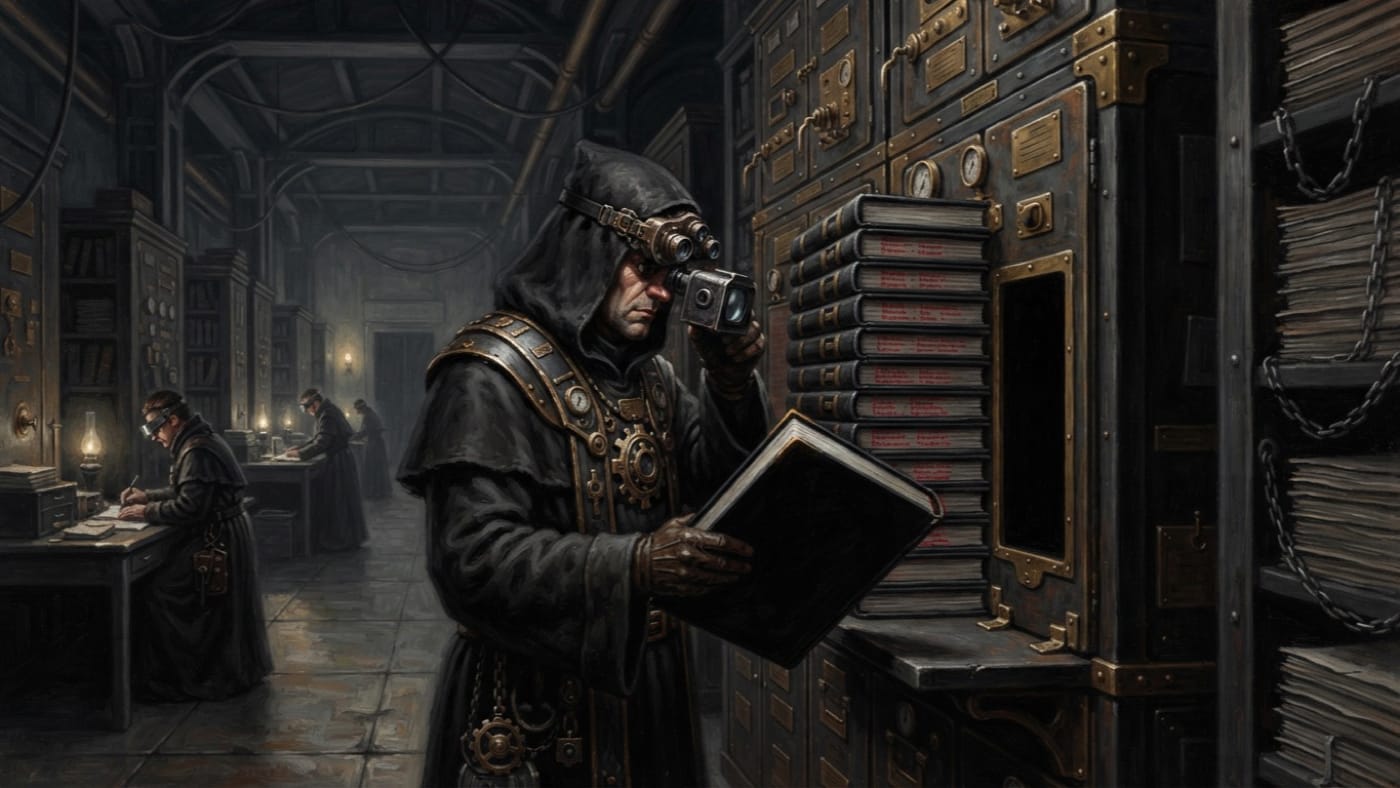
The phrase belongs to the Priors of the Order of the Shroud, and they apply it to a cabinet. In the Order's chapter house at Strasbourg, the black folios stand in cases of cedar and iron. Their cut windows are aligned leaf upon leaf, so a Prior who lifts a closed volume looks through name after red name to the bare panel at the back of the case. The Priors call that sightline the Mercy of No Martyrs. I have stood where the Prior stands. The view is shorter than one expects, and it does not leave.
A mercy needs a beneficiary, and the doctrine is coy about naming one. The condemned gets nothing a mercy usually gives: no hearing, no confessor in public view, no grave his kin may tend. The answer printed for parishes is that the faithful are spared a spectacle. Read the folios the way an archivist reads them and the real beneficiary shows itself. A martyr is a debt the Church must service for generations. It is paid in feast days the calendar never authorised, in relics passed hand to hand at the well, and in a sullen hostility in the bread queue that no homily can collect. Refuse to make the martyr and the debt is never contracted.
The creditor is the one shown mercy.
#On the Witness Made by Punishment
The Bureau of Purity likes to say it was born at the Witch-Hunts of Toulouse, and every Bureau embroiders its own christening gown. Records had been remade by A.S. 78, and the Index and its organs had been growing since A.S. 80. Purity marched into the armed campaign of A.S. 93 with its teeth already in, and it came out with a sum it disliked.
The sum runs like this. Burn a heretic in a square and ten thousand learn fear, a cheap product that spoils within a season. A few dozen learn his face. A handful learn his last words, and at least one of them writes the words on a scrap and carries it in a boot. In a generation that scrap is a relic small enough to pass through a keyhole and heavy enough to bring down a parish. The stake teaches the many and preserves the few. Over time the few are the ones who matter.
The internal memorandum preserved as De Subtractione Misericordiae answered with three categories. The first was heresy of low public value, whose burning would teach the square nothing worth the firewood. The second was heresy of high contagion risk, where a trial would broadcast the argument it condemned. The third was heresy of inconvenient sympathy, where the accused was loved, pitied, or simply too good at dying. Such persons were to be removed without procession, trial, proclamation or corpse. Each of those four nouns is a public instrument, and the memorandum withdrew all of them.
The copy is a proposal. It survives under the redactions of the Bureau of Silence, which holds it in custody without being its author. No author's name appears in it, and no record of enactment. Its fourth page is a rectangle cut out of the vellum. I cannot say whether the Priors' phrase was ever written on those pages. The Priors speak it, and that is the only attribution I will sign. What the Order built afterward is practice, and I treat it as practice.
#On the Household Afterward
The wagon takes the body. The doctrine stays to deal with the house.
The Order calls its secondary visit aftercare. A team arrives once the extraction is finished, and it works like movers who have been told the tenant never lived there. Written names go first: the flyleaf of a psalter, a debt chalked behind the door, initials scratched into a bench. Then the tools of a trade go, and the comb with its hairs still in it, and the shoes that kept the shape of one particular foot. Stitched initials are unpicked from linen. Half-finished letters leave in a satchel. The bed is the hardest object to explain, so it is never explained. The frame is taken and the room is reassigned to storage, and in a month the household is storing turnips where a son used to sleep.
What a household needs, the team replaces. An empty place at table raises a question, while a stranger's cup at that place soon becomes habit. The Shroud has studied which absences people notice. It fills those and lets the rest go hungry.
Paper follows the furniture out. The ration book comes back corrected by one mouth. The baptismal list is amended so that the household count matches the leaf. Then the family receives the most refined document in Purity's catalogue: an approved explanation for its grief. A condolence arrives for some relative whose death is now on record, so that red eyes at Mass have a lawful cause. Grief is allowed provided it carries the wrong name.
Some households do not settle. Mothers are the usual trouble, along with brothers, dogs that wait by a door, and old women who cannot read the correction and so go on believing what they saw. The Order classes these people as remainder witnesses. The remedy escalates in steps. First come visits, then instructions, then bread, then threats, and finally a wagon if the arithmetic requires one. The Order regrets having to widen a case, the way a surgeon regrets having to widen an incision: in the interest of the patient, whom nobody consulted.
The final instrument is the prohibition of mourning. No black cloth may be hung, no funeral bell rung, no Mass said, no grave dug. Any one of these is treated as evidence of unauthorised recollection. The doctrine has followed its logic to the end: once a person is removed, the bleeding of the wound left behind becomes an offence.
That remainder witnesses must be classed at all is the Order's own admission. It confesses in its own forms that memory outlasts the method.
#On the Permitted Memory
Readers who imagine the Mercy destroys every name do not understand the Shroud. The Order is the best-informed office in the Church on the subject of who is missing.
Each removal is entered in an Extraction Folio with a name, parish, charge and date, written in red beneath a cut window. The entry records that a removal took place and withholds what the case contained. The Order can count without keeping dossiers, and dossiers are dangerous because they grow fat, attract readers, and gather sympathy in their margins. The mutilated registers then go to the Bureau of Records, which reconciles its master rolls to agree with the cut and charges the household a fee for the amendment. The office that exists to preserve thus certifies the removal in its own hand.
So knowledge is shared out, and the shares are unequal. The institution knows the name, keeps it, and counts it. The household knows the name and may not speak it. The parish is given a corrected roll and learns nothing. The doctrine is a rule about who may hold a memory, and it leaves the memory itself in place.
From my account of the black folios: "I asked a Shroud Prior if he considered this murder."
Corrected for public editions to purge, on a stamped instruction that gave its reason: clarity breeds panic. So the Mercy extends to vocabulary. A martyr needs a murder, and a purge supplies none.
Its rivals understand the doctrine perfectly well and despise it. The Order of Ash wants the village seen from the hill, and holds that a heresy burned in public has been refuted in public. Ash says the Shroud leaves roots, and the Shroud says Ash leaves witnesses. Both are right, and that is why neither can bear the other. The Order of Saint Ephrath wants shame displayed before death, so that communal memory brands the condemned as a warning. The Shroud replies that communal memory is the infection. The quarrel is over what a witness is worth to the Church. All three Orders agree that the witness is the pivot of the matter, and they disagree over whether to feed the witness or starve him.
The Mercy should not be confused with the methods of the Bureau of Shadows. Shadows denies that it exists, works through deniable authority, and leaves blank receipts. The Shroud signs under Purity's acknowledged seal and keeps its red ledger where only the permitted may read it. The notaries of administrative dissolution cancel identities under their own warrants and keep their own files. The Shroud borrows nothing from either, and it lends nothing to them either.
#On Necessity Under Seal
I have to concede the premise. I have conceded it before under seal, and I concede it here for the codex, which is a smaller audience but a more permanent one.
Some heresies grow when they are named. Read a doctrine of the Great Deceiver aloud in a tribunal and the transcript becomes its catechism. Some officials are compromised in ways that, if exposed in public, would crack ministries, quartermasters' rolls and regimental confidence at a time when the war cannot spare any of them. Some condemned men would make magnificent martyrs, and a magnificent martyr does more damage than any sermon can repair. Against cases like these, the Mercy works. I have watched it work. I have filed the evidence of it working, in a ledger whose integrity I am paid to defend.
That last clause is the confession, so I put it plainly. The Mercy is not carried out by Priors alone. Clerks carry it out, ruling the white lines and reconciling the rolls, and archivists like me, who write handsome tracts explaining why the windows are counted correctly. The Shroud holds the knife. Records holds the pen that makes the cut lawful. The Bureau of Doctrine holds the definitions. Its seal sits at the foot of this article, and so does my name.
The cabinets are still kept. The windows are still aligned, and a Prior who lifts a folio still sees through the red names to the back panel. The extracted have not been returned. The ledger has no column for their return.