
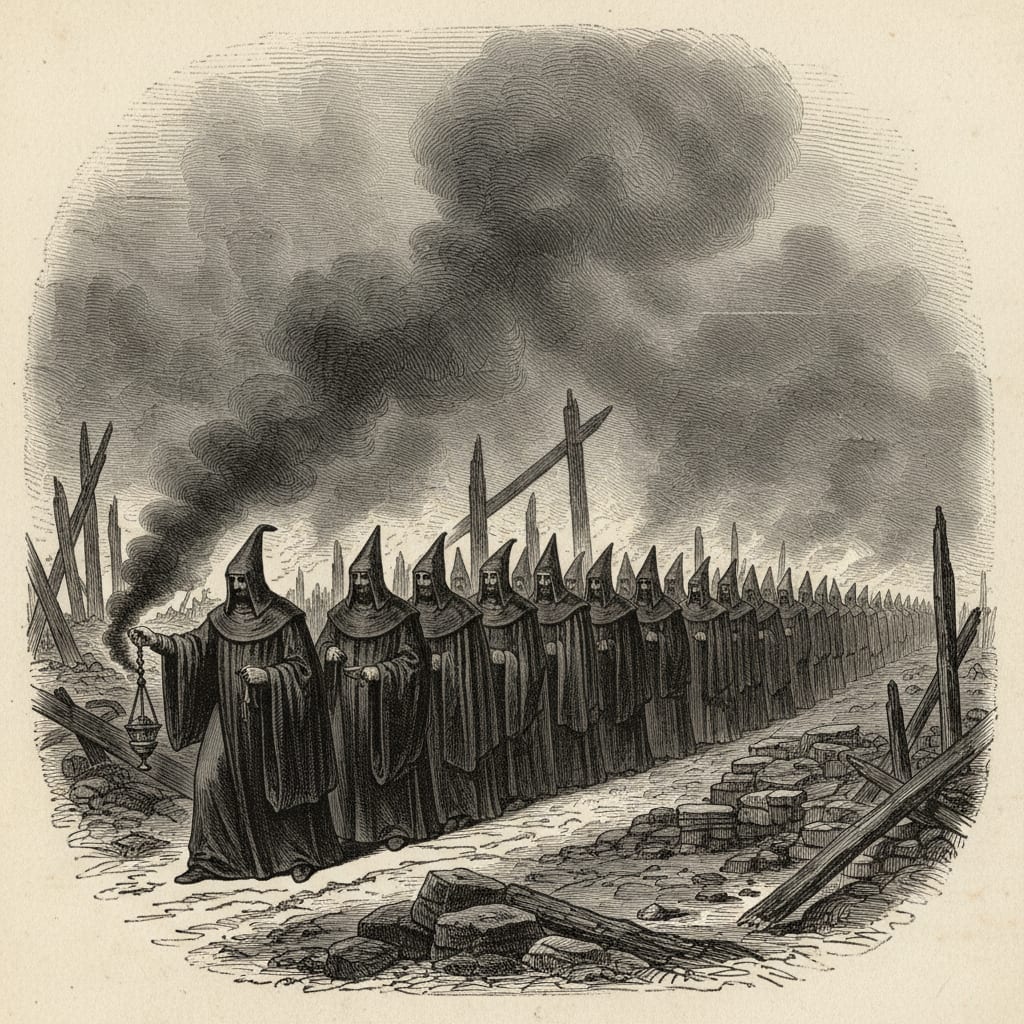
#On the Liturgy of Fire
I am Valerius Drax, and I will tell you of the Order that speaks least and burns loudest, whose homily is smoke and whose congregation is the horizon. Other Orders argue theology in cellars and courtrooms. The Ashmen argue it with the sky.
Their motto — Better ash than apostasy — is operational guidance, printed on the inside cover of every Ashman's breviary in letters that char slightly when you close the book. The binding is treated with an accelerant the Bureau of Doctrine approved in the forty-third revision of the Ordo Ignis and has not had cause to revoke. One does not revoke a flame. One directs it.
#On Their Method
The Order of Ash does not interrogate. Let the Shadows skulk in back-alleys with their listening-jars; let the Order of Worms-Below crouch in cellars parsing echoes. The Ashmen have discovered a simpler catechism: fire asks every question at once, and the answer is always the same.
Earlier editions of this Codex described the Order's methods as "crude but effective."
This characterization has been withdrawn. "Crude" implies improvisation. The Ashmen improvise nothing. Their protocols — the sequencing of accelerants, the directional calculus of wind, the liturgical timing that ensures the bells of a condemned parish ring during the conflagration rather than before it — are among the most precise operational manuals in the Bureau of Purity's archive. The previous Hieromnemon who used the word "crude" has been reassigned to a parish that no longer requires a Hieromnemon, on account of no longer existing.
A settlement marked for Ash receives no warning. Warning implies negotiation, and the Order does not negotiate with kindling. The Ashmen arrive at the third bell — always the third, a liturgical preference dating to Augustinus's original sanction — and proceed inward from the perimeter. The outermost structures burn first. The innermost last. The geometry teaches before it hurts; it is instruction. The condemned watch their world shrink.
#On Instructional Geometry
Do not imagine the villages are chosen at random. The Ashmen think in triangles. A charred constellation of three parishes around a stubborn market town shrinks smuggling by half without a single arrest. A line of "expiated" hamlets between two rival bishops encourages both to issue synchronized decrees. The fire serves the outline it draws on a map.
The Bureau of Records maintains actuarial tables — columns of settlements cross-referenced against trade routes, heresy indices, and seasonal wind patterns — that the Order consults before every operation. I have seen these tables. They are beautiful in the way a surgeon's notes are beautiful: clean, annotated, indifferent to screaming.
#On Recruitment and Sacrament
The Order likes orphans. Practicality governs the preference; sentiment is a fuel the Ashmen burn before anything else. A child who never learned the grammar of property will not flinch when property is consumed. The Orphanarii of the Bureau of Purity supply a steady stream of candidates whose surnames are ledger-fresh and whose loyalties begin and end with the writ.
Their sacraments differ from those of their sister Orders. Where the Lictors anoint with oil and the Order of the Shroud folds names into disappearance, the Ashmen anoint brows with soot and breathe the litany of accelerants — a recitation of compounds and their burn-temperatures that doubles as a prayer. The catechism begins with a single question: "Whom do you trust?" The correct answer is "No one." The second correct answer is "The writ."
Public catechisms will substitute "Creator" for "writ."
Friction is fuel. The correction stands.
#On Their Rivalries
Between the Orders lie rivalries so heated they could warm a city. Ash sneers that the Shroud leaves roots; the Shroud counters that Ash leaves witnesses. The Order of Saint Ephrath calls the Order of the Root "butchers with spreadsheets," and Root calls Ephrath "actors with knives." The Bureau records these as competitive audits.
The Ashmen trade fire-privileges for genealogical dossiers from Root, and lend crews to the Bureau of Purity when the gravediggers fall behind. The market of zeal is brisk and largely unregulated, because regulation presumes transparency, and transparency is a luxury the Inquisition cannot afford.
#On Their Reliquary of Shame
Every Order keeps a private catechism of failure. The Ashmen's is a jar of rain that refused to burn.
I have not seen it. No one outside the Order has. But I have been told — by a source whose reliability I rate slightly above that of a tax collector and slightly below that of a corpse — that the jar sits in a reliquary of black iron in the crypt beneath the Order's chapter house in Strasbourg, and that the rain inside it is still wet, still cold, and still, after two centuries, falling.
The provenance of the jar is sealed under the ██████████ of A.S. ███. Three Ashmen who attempted to open it were found the following morning with their hands glassed smooth, as though they had been dipped in their own kilns. The Bureau of Records filed the incident as "weather-related." The jar remains.
They study their failures. They get better. That is the most terrifying sentence I know how to write about anyone.
#On the Country Liturgies
In the marshes near Debrecen — before the mire swallowed the district entire — the Ashmen adapted their urban protocols to the wetlands. Stakes were sunk in low water. Offenders were tied there at dawn, the ash-tide lapping their calves until the bones showed like reeds. Farmers came to watch on their way to scythe, learned their lesson, and left without complaint. The skull-tops surfacing after dusk were collected, salted, cataloged, and stored in the Third Ossuary under Mother-Cryptor Sabine's eye.
Do not imagine the populace fails to understand. Merchants in Bastion-Constantinople display tiny ash-mark sigils over their doors as prayers. Midwives in Metz iron their family sheets twice, hoping Root inspectors will see order and pass by. The people adapt. That, too, is obedience.
#Closing Stamp
The reader who has arrived at this seal has spent more time contemplating the Order of Ash than the Order of Ash has ever spent contemplating a parish. That asymmetry is the point. The Ashmen work quickly. The Bureau writes slowly. Between the two, the Synod breathes.