
#On the Meaning of the Word
"No kin but the Synod." — Registrar's maxim, chalked above intake desks
In the vocabulary of the Bureau of Mercy, orphan names a legal condition and says nothing about whether the parents are alive. A child comes into the Mercy Orphanarii because a mother died of trench fever, or a father was condemned for apostasy, or because the Bureau of Purity visited a street and left fewer adults on it than it found. Foundlings come in by the wheel and displaced children by the cartload after a breach. A respectable number come from households that are still breathing. These children were removed for disobedience, or because their family's allegiance was found defective on inspection, and their parents are alive two parishes away, petitioning a desk that does not accept petitions.
By the time the ink dries, all of them are orphans. The Bureau does less finding of orphans than completing of them.
What the house gives in return is real. The child gets a cot, broth twice a day, bread on better days, and a grey smock that was boiled before it was issued. There is a roof in winter. The condition attached is total: from intake onward, every mouthful, every blanket and every future is drawn against a paper identity that the child did not choose and cannot give up.
#On Intake
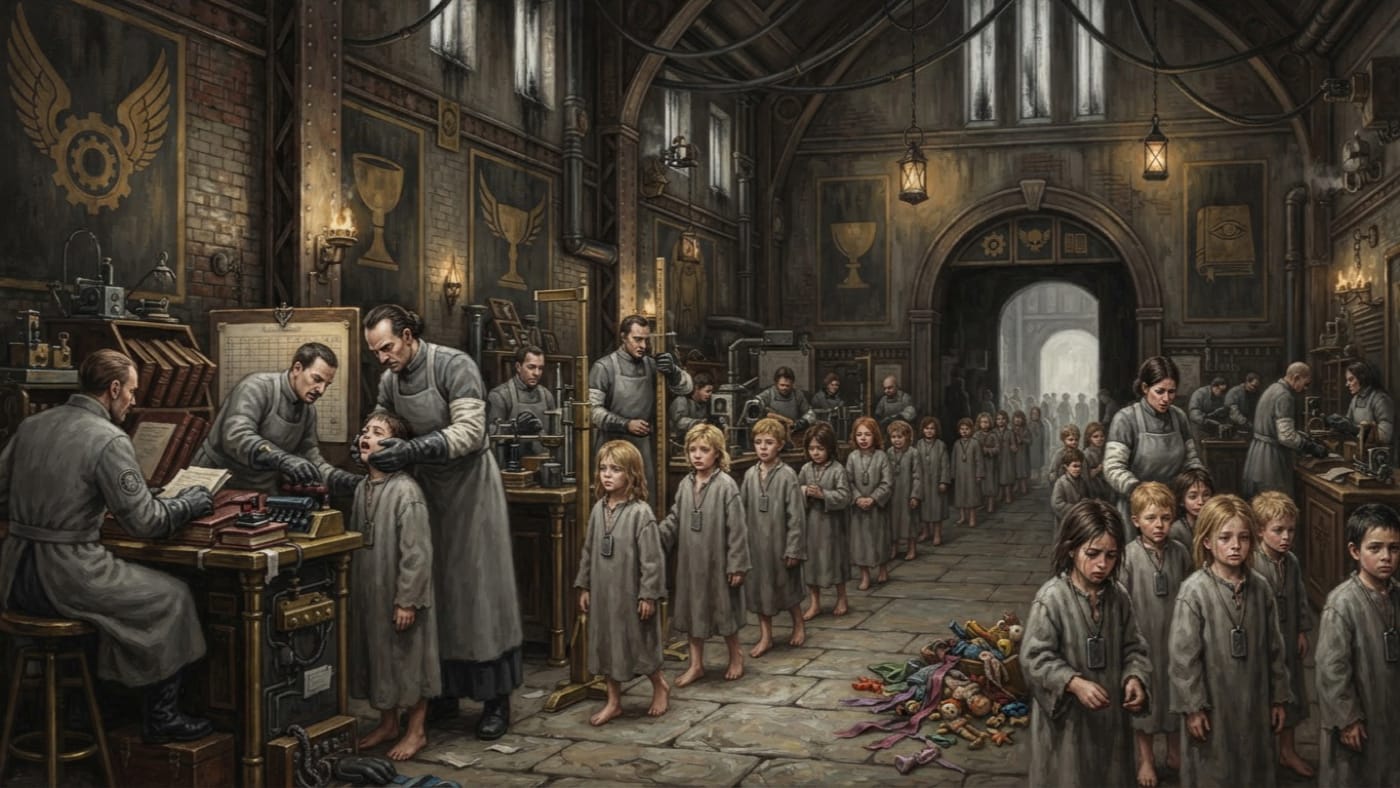
Every Mercy intake corridor keeps the same order, because the Orphanage Registrar is drilled in it the way a priest is drilled in the rite.
The washing bench comes first: lye, cold water, the lice comb, and a quarantine annex for any child whose cough the attendant dislikes. Attendants wear grey aprons and white sleeve wraps. Registrars wear plain grey coats with a seal patch at the cuff, keys on a cord at the throat, and the gloves the profession calls "safe-hands."
Next comes identification. Age is read from the teeth against a printed chart, height from the measuring rod, and origin from scars and dialect. The desk's maxim is "Teeth don't lie," which means that a child's own account of their age is inadmissible. Belongings are catalogued as evidence, because they will become evidence: a ribbon, a carved bird, a scrap of collar embroidered with a family initial. Heirlooms are not returned.
The Registrar then enters a provisional name, an origin code and a lineage-risk designation. Then the tags are issued.
House tradition credits the Three-Tag System to Saint Moriah of the Ledger-Cradle, and records the invention and very little else about her. Each child receives three disks punched with the same code. The name tag tells the house who the child is. The ration tag tells the kitchen whether the child eats. The labour tag tells the Bureau of Conscription, in due course, what the child is for. One ledger entry matches all three, and a tag missing at evening count locks the house down.
The cot comes last. Siblings are separated on the first night. The Registrar manuals give the reason without embarrassment: brothers and sisters kept together become a faction, and a dormitory faction becomes a street gang. The same manuals tell the Registrar to write down the child's dialect and any lullaby the child sings in sleep, since a lullaby marks lineage better than a surname does.
The Bureau of Records finishes the work at a distance. Parents of the condemned are filed under Administrative Dissolution, and the child is issued a fresh natal registration writ to replace the old one.
#On Instruction and the Assigned Future
The day is cut into bells: rising, washing, catechism, broth, labour drill, catechism, broth, evening count, dormitory. The Bureau of Doctrine licenses what is taught and in which words: the approved chants, the Creator's ordering of the world, the Great Deceiver's appetite for the unregistered, and the Sacraments at their set intervals. Songs not on the house list are corrected. So is dialect, more slowly.
The house manuals fix the age of five for the first sorting. The assessment does not ask what a child wants. It records what the child will become. A clear voice goes to the choir, a steady hand at letters to the clerical schools, and a strong back to ward labour or a guild apprenticeship. The rest are routed toward the militia and levy pipelines, to be delivered at whatever age the Bureau of Conscription specifies when it is ready. The desks say: "Cot today, trench tomorrow."
Sometimes a child gives a name that matches no entry and repeats it with a certainty that unsettles veteran staff. By then the writ is new, the chants are learned and the tag hangs at the throat. Still, at night count, a girl answers to a name the ledger has never heard, and the attendant must decide whether to correct her or pretend not to have heard. The paper rewrote her record. It did not rewrite what she remembers, and a remembered family name stays a liability long after every writ issued to replace it.
#On Lineage and the Morning Strip
The Order of the Root holds that heresy is hereditary and travels in the blood as fever travels in water. The Order is entitled to its doctrine. No surgeon of the Bureau of Mercy has yet located the vein. Practice follows the doctrine anyway. Children of uprooted families arrive with a lineage-risk designation that follows them through every review. The Bloodline Hawks among the Registrars score those designations like men auditing a granary for rot. Their rivals, the Name-Givers, hold that a new writ and a sound catechism can remake a child entirely. The two parties have argued for as long as the profession has kept minutes, and the children are the evidence on both sides.
Each morning an Index Damnatus Runner arrives at the gate with the day's amendment strips from the Index Damnatus. These are the names newly condemned, to be struck from rolls, lessons and wall-chalk. The Registrar signs the courier's receipt and revises the rolls before first broth. A child whose mother's name appears on the strip at breakfast carries a heavier designation by supper.
In the Codex entry on the Bureau of Mercy, this Warden wrote that the Orphanarii "are not cruel," and wished to be precise about it.
The sentence is withdrawn as imprecise. The children are fed, clothed and instructed, as stated. They are also separated from their siblings on the first night, stripped of their parents' names by writ, sorted into futures before they can spell them, and re-scored each morning against a list of the newly damned. Precision requires both columns.
The Bureau's position on culling is that it does not occur. The Order of the Root's own literature speaks of children "culled if deemed irredeemable." I have recorded elsewhere a locked cabinet in the basement of the Strasbourg Central Orphanarium whose contents put the figure at about four in a hundred. That figure belongs to that cabinet. It states neither its denominator nor its years, and it is not a rate for every Mercy house on the continent. The Bureau would prefer that it not be read at all.
#On Placement, Commerce and the Quiet Cot
Placement hour falls at midday, and so do the bribes.
Guild masters come for apprentices and describe what they want as frankly as men buying horses. Respectable families come to adopt, and ask quietly for a clean lineage: an origin code that will not embarrass them at an audit twenty years on. The Registrar's seal can supply one. A risk designation can be softened, and "trenchline, unknown" can stand where a condemned surname stood. The fee is paid in soap, blankets, fuel chits or medicine. Coin leaves a record.
The same instruments serve opposite purposes, and the desk cannot tell which one is in play. A Registrar who launders a lineage for a merchant's money uses exactly the method of a Registrar who launders one to keep a condemned man's daughter out of the Root-coded wing. Tag-splitting makes a child exist twice in the ledger, once for the auditors and once for the door. It has saved children. It has also sold them, and adoption rings and labour brokers have done well wherever the tag cabinet was kept by someone in debt.
The Ward-Sisters keep a quieter ledger of their own. Their rule is to hold back one ladle for the unexpected child, and many sew salt or sweets into their apron seams for children whose ration tag came up short. None of it is recorded, and all of it is technically theft.
The Pale Kin Runner occasionally reaches into this economy. Her Cradle Brokers exist to keep infants out of the Orphanarii altogether. In desperate seasons, though, when the hidden families are full or a route has collapsed, some Brokers lean on contacts inside particular houses: an attendant who will miscount, a tag clerk who will lose a disk, a Registrar who will enter a smuggled infant under an origin code that leads nowhere. These are private arrangements between individuals. The Bureau of Mercy does not assist the Pale Kin, and the Pale Kin would not trust it to.
#On the Present Condition
In the survey year A.S. 201, the Mercy Orphanarii run as they have run for as long as any serving Registrar can remember. They are short of cots, soap and witness ribbons, and never short of intakes. Audit teams walk the Ribbon Walk and trace a sample from tag to ledger entry to ration draw to placement order. Names can be forged; what is hard to forge is consistency over months. A missing child is the one failure no Registrar survives. Demand for placements outruns supply in every direction. The choirs want voices, the guilds want hands, the clerical schools want letters, and the Bureau of Conscription wants all of it, eventually, by levy count.
The children still sing at the appointed bells. Some still answer, at night, to the wrong name.