
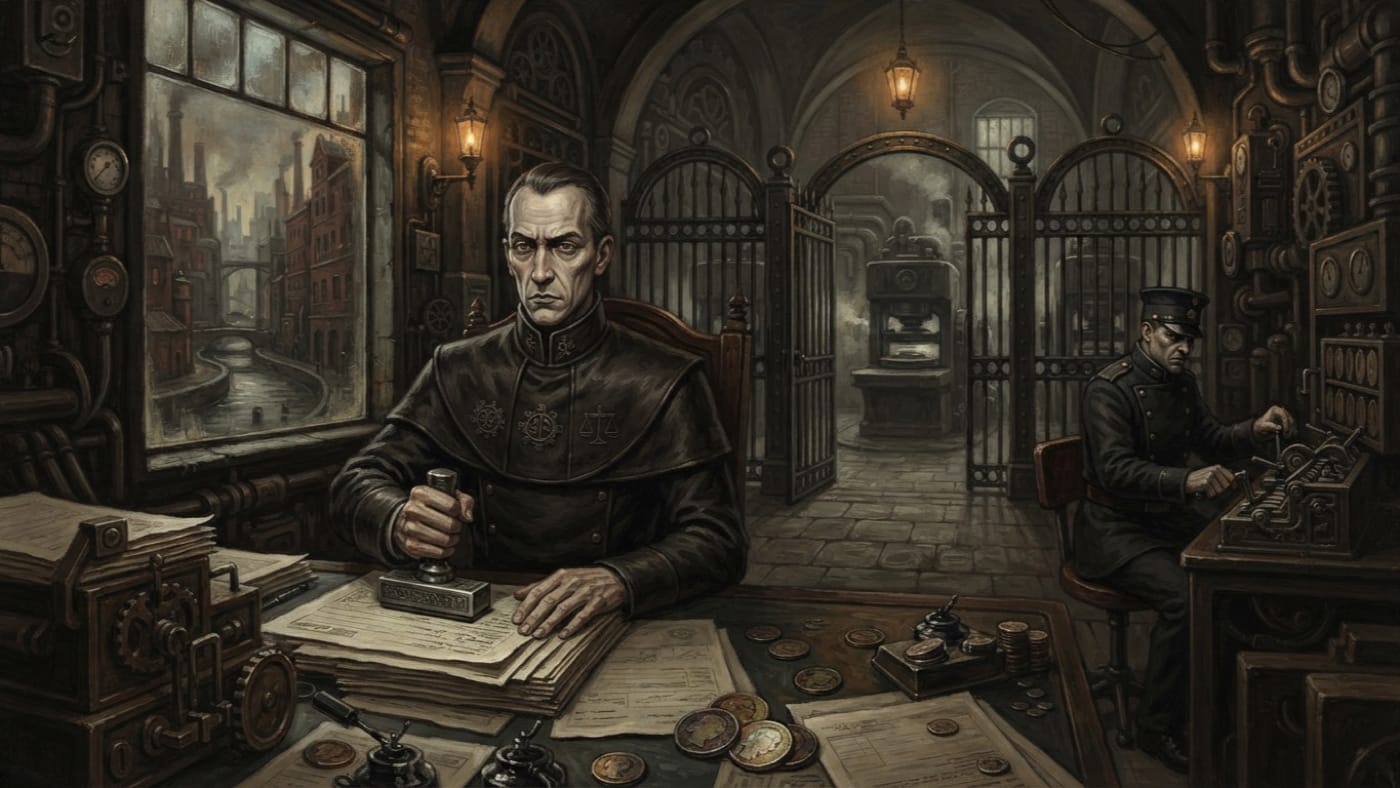
#On the Mint-Prelate's Station
The Mint-Prelate of Sable Court is the Synod's priest of the coin-face. The office sits inside the Crownwright Diehouses of Cologne, behind mirrored windows and three rings of gates, and its present holder is Varo Sable. It does not engrave. It does not judge. It recognizes. A coin leaving the Strike Floors is warm metal bearing a profile; the Mint-Prelate's recognition makes that profile lawful, and from that moment the coin can be spent and remembered and entered into account. Withdraw the recognition and the coin weighs exactly what it weighed before. It has simply stopped being anyone.
The quarter's formal government has three parts: the Synod Mint-Prelate, the Crownwright Master-Engraver Council, and the Mint Tribunal. The first authorizes, the second cuts, the third adjudicates. Visitors who arrive believing the Mint-Prelate rules Sable Court alone usually leave having met all three, generally in the wrong order.
The office is local. I have found no warrant for a Mint-Prelate of Strasbourg, of the River-belt, or of any other diocese of the Church, and the reader who imagines a continental hierarchy of coin-priests should consult the Bureau before consulting his imagination.
#On Recognition and Correction
Sable Court's theology of money is brief enough to fit on a gate placard: a coin carries a face, the face carries a name, and the name carries a soul's account in the Great Ledger. The Mint-Prelate's office does its work at the first link of that chain. It never claims to touch the soul, which is why it can keep its fees so modest and its consequences so total.
Its instruments are made of paper. They include assay appointments and exchange permissions, intent declarations attached to those permissions as a form of filed confession, face-confirmation papers, correction orders, and vault manifests. Each is stamped. Each costs something. The quarter collects seigniorage on every strike, identity fees on every confirmation, and correction levies on every disputed face, so the citizen pays to be recognized and pays again when recognition is questioned. The sources do not tell me how the Synod's share and the officers' shares are divided, so I will not invent a tariff, which is a restraint the Wardenate has never shown.
Everything bottlenecks at the Face Archive. No approved face, no lawful circulation.
An unpaid fine becomes an identity hold. A citizen under hold keeps his body, his lodging, his cough and his children, but the bread seller refuses his coin, the exchange broker turns him from the line, and the gate clerk asks him to narrate his name-history again, more slowly. The street calls this a facehold. A recall goes further, because it withdraws lawful recognition from a face while its owner still lives. Merchants then hesitate halfway through his name, witnesses misplace him, and families argue at table over who was ever there. The quarter's records describe these effects plainly. They explain the mechanism nowhere, and neither shall I.
The trade is corrupt in exactly the places one would expect. Correction orders, assay delays and exchange-rate "errors" are all for sale. Face Archive plates are not. Touching them is the only crime in Sable Court that nobody has found a way to price.
#On the Other Hands of Sable Court
A Mint-Prelate who cannot engrave depends on people who can. Master Engraver Irena Coilhand decides whose likeness is struck into permanence, and she does it with veiled fingers that the guild considers sacred and the Tribunal considers evidence. The Master-Engraver Council keeps the apprenticeships, the bottlenecks, and the right to declare a die well cut. When the Bureau of Doctrine condemned mechanised die-cutting as spiritually imprecise in A.S. 134, the ruling secured the hand-cut die and the guild's monopoly together. The presses still pound on the Strike Floors. Only the cutting stayed holy.
The Mint Tribunal sits in the Tribunal Hall of Corrections and gives each correction the dignity of a verdict. The Bureau of Records watches over the Ledger's administration from outside the quarter's walls. Warden-Captain Joss Kline holds vault access and controls raids, along with the procedure the quarter politely calls disappearance. A recognition nobody enforces is only an opinion, and Kline is how the Mint-Prelate's opinions arrive at people's doors.
The office belongs to the settlement made after the formal Synod's Concordat. The Mint-Chapter Compact of A.S. 94 joined the Crownwright Guild's craft to the Synod's authority. The old guild district of Cologne was walled and gated between A.S. 94 and A.S. 100, and the Face Archive followed in A.S. 102. The quarter's red lines show where its power really lies. They are stealing a blank die, altering the Archive, and bringing foreign coin onto the Strike Floors. All three are offences against things held in other people's custody.
#On Varo Sable and the Choir
The quarter's own guide describes Varo Sable in one line: he smiles like a stamp. I find it the most exact portrait in the archive. The smile comes down once, evenly, and leaves an impression that cannot be argued with afterward.
The same source records a fear, namely a die bearing his own face without authorization. This is a pressure on the man and nothing more. No such die has been reported found, and the reader who quotes this paragraph as evidence of one will be corrected.
In public the Mint-Prelate condemns the Clipped Choir. In private he gains from its existence, and the reasons are political rather than mysterious. Every illegal face-swap sold behind the soap stalls of Clipper's Market shows that the registry matters. Every counterfeit raid justifies emergency verification. Every frightened citizen at the gate accepts one more inspection because a clipper somewhere might have shaved reality. The office's authority grows from the Choir's crimes the way a pyre grows from the kindling brought to it.
Benefit is not conspiracy. This office holds no proof of payment between the Mint-Prelate and the Choir. It holds no proof that he is a member, and none that he commands them. Drax does not certify what the Ledger has not received.
The Choir is in the same position from the other side. It sells recognition that the lawful mint has denied or restricted, and its trade is worth something only because a working registry stands above it. If recognition fails entirely, the Choir's forgeries become worthless too. Its own conduct needs no softening by comparison. The Candle Tribunal beneath the canal brands thumbs with acid notches, and the Widow Queue sold forgetting to mourners. Two predators share one herd here. They are not partners.
This office previously advised, in its notice on the Clipped Choir, that the Choir could be dismantled through market arrests and the seizure of clipping instruments.
Corrected, as already recorded in that notice. Arrests reach the clippers. The brokers, assayers and canal judges remain, along with those respectable men who buy their deniability by the ounce. The Mint-Prelate's office endorsed the original advice. It now endorses the correction, with equal conviction and unchanged personnel.
#On the Present Emergency
The Face Theft crisis began in A.S. 199 and was still unresolved at this office's assessment in A.S. 201. Lawful citizens found their coins changing, with familiar faces taking on the wrong eyes and the wrong mouths. The Mint-Chapter ordered recalls across seventeen denominations. The wardens doubled their circuits. Doubt inspections spread until whole queues forgot what they were queuing for.
The Choir had a hand in some of it. Its brokers supplied washed coins to three outer districts, and its assayers certified two counterfeit batches that got through outer-gate inspection. Nobody has shown the Choir authored the whole campaign. Equally, the Mint-Prelate's gain from emergency authority proves no authorship. The Bureau of Purity wants a public burning anyway. The Bureau of Engineering wants to reopen its sealed A.S. 187 survey of the vaultwork beneath Sable Court's Black Canal, a local channel that should not be confused with the Candlewick waterways of the same name.
Under all of it lies a rumour of a master die. It is said to bear no face and every face, and the quarter fears it more than any proven thing. I record the fear. I record no maker, no holder, no hiding place and no proof, because the report is unresolved and the Bureau does not seal rumours as fact, however useful they are.
The office functions in the meantime. Correction orders are stamped and identity fees collected. Doubt inspections go on at every gate, each one paid for by the citizen being doubted. The instruments of recognition are as vulnerable as the faces they recognize, and the Mint-Prelate goes on recognizing at the standard rate. The Mint-Prelate smiles.