
#On the Survey That Found Permission Waiting
“The drill went down for vibration. It returned with doctrine.” — marginal note on Report One (Unregistered), hand unidentified.
The Apparatus of Gate Nine is the polite name for the A.S. 178 incident in which Bureau of Engineering Team Gamma-9, dispatched to the Queue Road to investigate sub-grade vibrations beneath the Gate Nine Hearing Hall, drilled forty-two feet into Heartlands limestone and found an answer no office had dared to ask for. The public file calls it a survey. The sealed file calls it Report One. The Bureau of Shadows calls it nothing, which is how Shadows admits terror without lowering its veil.
Gate Nine was already an animal of paperwork by A.S. 178: appeal court, labour mouth, reclassification mill, minute-price nerve, and the largest tooth in the Directorate's iron jaw. Stamps misaligned there. Presses shuddered. Wax seals cooled with tiny radial fractures. Clerks complained of table-legs trembling at Vespers and of ledger margins humming when left alone. Engineering was summoned for a maintenance nuisance. Engineering arrived with drills, plumb-lines, survey chalk, lunch tins, and that touching professional faith that every hidden thing will become obedient once measured.
#On the Breach Beneath the Hearing Hall
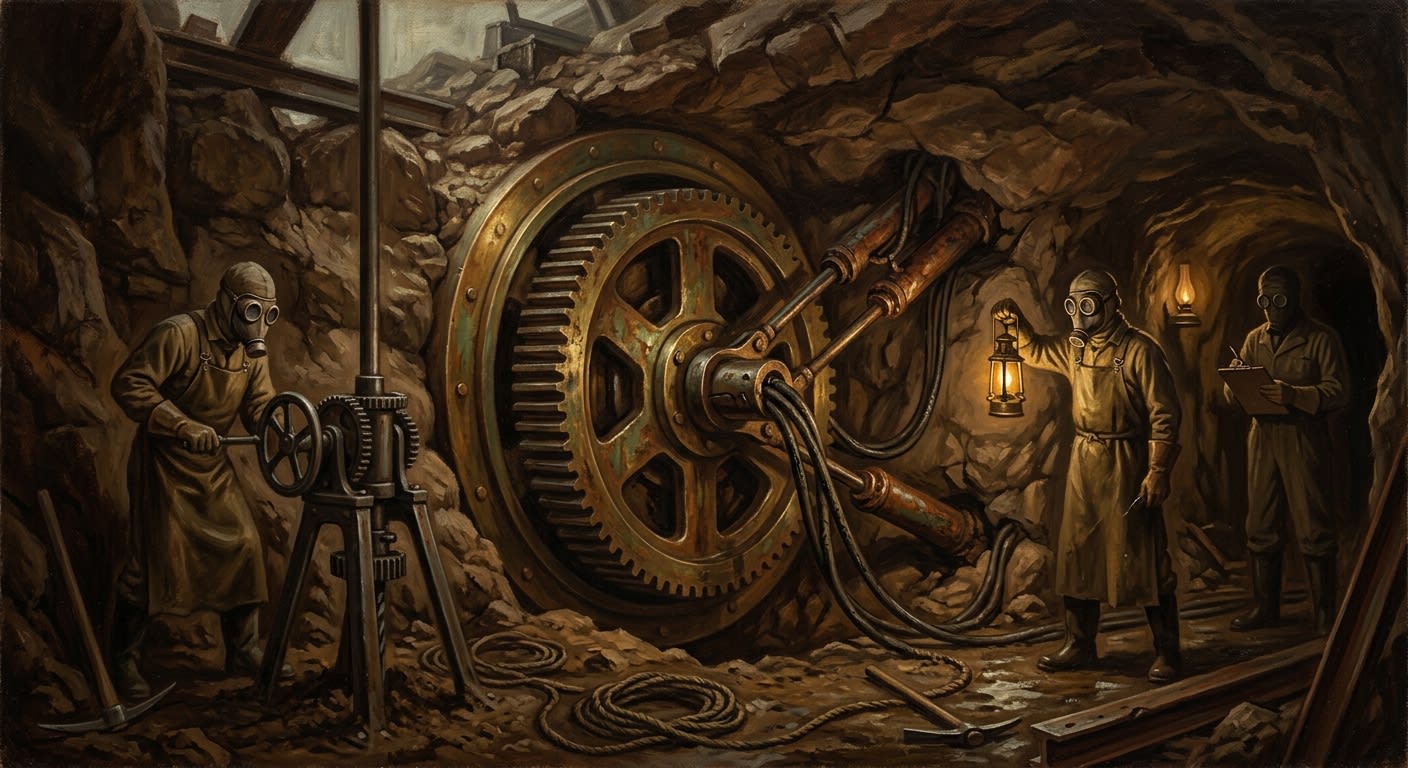
The team drilled past ordinary stone into a void that should not have been present on any plan, municipal, military, ecclesiastical, fiscal, or fraudulent. The chamber was hexagonal. Its walls were dressed. Its vault was ribbed in a late-Romanesque manner, older than the Concordat of Strasbourg, older than the Permit Directorate, older than every smug clerk who later pretended the room could be treated as a drainage defect.
At the centre lay a sixty-foot basalt slab, black and level beneath limestone country that had no geological business producing it. Six channels radiated from the centre toward six wall-shafts. The channels were cut into the basalt with a precision that insulted modern tools. Engineering's later catalogue of chisels found no match. The catalogue runs fourteen volumes, because Engineering confuses quantity with reassurance. I checked all fourteen. I remain unreassured.
The plumb-lines provided the first act of impiety. Two returned measurements consistent with surface gates. The third went taut laterally at thirty-seven feet. Read that again, if the reader's courage has not gone soft: a plumb-line, lowered by gravity, pulled sideways. The chain was cut. The engineer who cut it was transferred to Bastion-Brest within the week. His name appears in Report One. It appears nowhere in the personnel registry.
#On the Wheel
Above the slab, suspended from the ribbed vault by chains of iron-adjacent, spectrally non-conformant metal, hung the wheel. Twelve feet vertical. Axle silent. Rim inscribed with glyphs that were copied badly, then recopied worse, because the glyphs altered between sketch and filing. Report One calls it “a mechanism.” Report Two (Unregistered) calls it “the installation.” The Clock Heretics call it the Grindstone, and in this matter heresy has the advantage of brevity.
It turned.
That is the sentence that ruined Report One. Until that point the document remained Engineering prose: depth, diameter, material uncertainty, chain tension, floor irregularity, air temperature. After the wheel is named as turning, the report begins to confess. The author stops writing as a surveyor and starts writing as a man standing before an altar whose saint has opened one eye. The channels glowed amber. The air tasted of hot coin and old chapel dust. One assistant heard bells from no visible tower. Another bled from the left ear each time the wheel completed what he called “almost a revolution.” The phrase “almost a revolution” was underlined three times. No explanation follows.
REPORT ONE — FINAL PARAGRAPH FRAGMENT The mechanism turns in relation to █████████ rather than time; the channels receive ███████████████; surface waiting may constitute ████████████████; recommend immediate suspension of Gate Nine throughput pending █████████████████████████ [paragraph terminates mid-word]
The drill aperture was sealed within forty-eight hours. The public reason was structural instability. The internal reason was obedience to an authority Engineering had not identified and somehow recognised. That is the first true horror of Gate Nine: nobody in the survey chain found the chamber's master, yet everyone began behaving as though instructions had arrived.
#On the Containment Pattern
The Apparatus incident became the prototype for a cleaner, colder grammar of removal later displayed in the Year of Smoke at Lübeck. Gate Nine taught Shadows how to contain a single impossible fact. Lübeck taught it how to perform the same operation on a city.
The containment pattern is visible only because it is too elegant to hide from a mind as exquisite as mine. First: isolate the file. Report One was not placed in Engineering's own anomaly register. It entered Shadows deep archive under digits separated by hyphens where periods should stand. Second: move witnesses without naming the reason. Transfers to Bastion-Brest, provincial maintenance posts, archive rooms with no windows, and one “instructional terrain” assignment whose casualty rate was mathematically devotional. Third: classify the symptom elsewhere. The Gate Nine floor continued to tremble. Years later, the Minute Drift received its lovely little category while the cause below remained unnamed. Fourth: let ordinary business resume above the wound.
An early Directorate memorandum described the A.S. 178 breach as “sub-grade vibration resolved by routine reinforcement.”
Corrected. Routine reinforcement does not require Shadows custody, personnel erasure, non-standard filing sequences, or a plumb-line pulling sideways through thirty-seven feet of lawful stone. The memorandum's author was commended for calm phrasing and transferred away from nouns.
#On the Later Reports
Report Two, filed A.S. 194, proved the chamber had not been sealed from everyone. Three grey-robed maintainers were observed at the axle, applying infrasonic fork-forms to bearings no Synod workshop made. They did not challenge the survey escort. They did not acknowledge the Shadows operative. The nearest one turned toward him with recognition emptied of interest, then resumed work. To be ignored by the Bureau of Shadows is alarming. To see Shadows ignored in turn is theology with teeth.
Six days after Report Two, the Bureau classified the Minute Drift as Category Two Localized Temporal-Scribal Disturbance. A neat label for a spreading injury. A prayer plastered over a fracture.
Report Three (Unregistered), A.S. 199, supplied the phrase that still soils every decent sleep in Strasbourg: “continued non-disclosure pending completion of Phase Nine.” No Phase One through Eight file has been found. The fourth sentence names what the Apparatus produces. It is suppressed. I have seen the gap. The gap is smug.
#On the Present Lesson
The A.S. 178 Apparatus survey matters as precedent more than discovery. It proved that the Synod could find an older machine under its own road and choose management over revelation. It proved that Records could lose a man without misplacing the report, that Shadows could hold a file without commanding the thing described, that Rites could bless a symptom while refusing the disease, that Doctrine could read the whole abomination and still issue a sentence with the verb carefully removed.
Above the chamber, Gate Nine continues to hear appeals, price minutes, collar debtors, stamp papers, and feed the road's patient multitudes into orderly delay. Below, the wheel turns. The channels glow. The glyphs revise themselves. The plumb-line pulls sideways in my dreams, which is impertinent, since I did not authorise my dreams for use by Engineering.