
#On the Hall
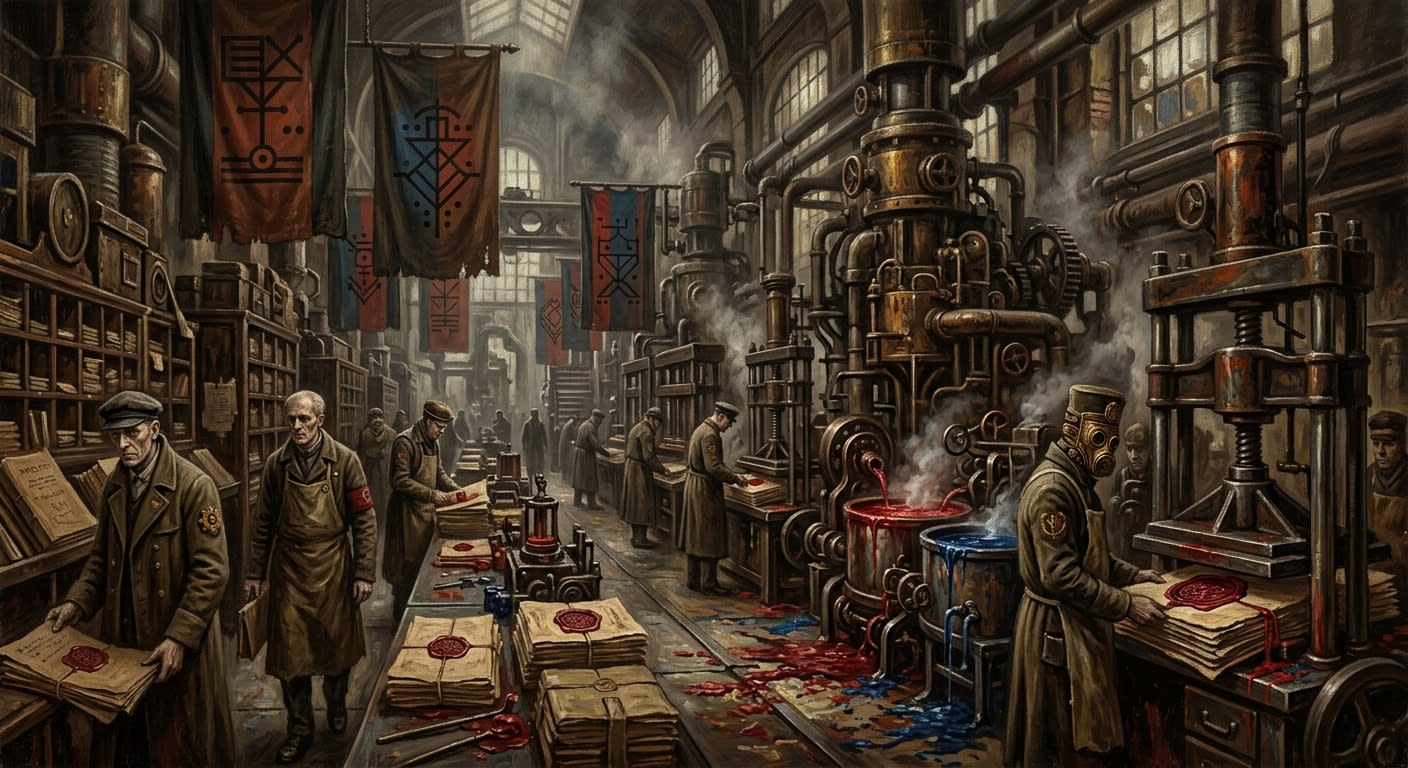
From the Gallery of the Quill, the Hall of Seals lies beyond the Palatine Counting House like a box of knives left beside a money-chest. It is lower than the Tower, broader than the Cloister, and less theatrical than the Basilica of the Ledgered Saints, which is precisely why sensible men distrust it. Tall buildings announce ambition. Low buildings keep instruments.
The Hall belongs, by charter, to the intertwined tyranny of Heraldry and Masks and Seals. Strasbourg's clerks call the pairing irregular. The street calls it Casselius's house. Both are correct enough to be irritating. Within those walls the Synod decides which colours may hang above a gate, which crests may survive a procession, which masks may cover a face, which wax impression makes a document real, and which citizen has committed treason by wearing blue with excessive confidence.
The Hall was formalised after the A.S. 92 charter arrangements left Heraldry and Masks and Seals separate on paper and married in practice. The first rooms were adapted from old registry chambers west of the Cloister, close enough to Doctrine that disputed symbols could be condemned without wasting carriage hire. Later expansions joined palette rooms, die cupboards, hearing bays, wax stores, and a small chapel to Saint Verral of the Clean Field, patron of scraped paint and disappointed banner-men.
#On Colour Rationing
Here, colours are not chosen. They are rationed.
The Chancellery of Colors maintains its palette rooms in the Hall's eastern wing, where swatch folios arrive in sealed packets, dye-lot samples hang under calibrated lamps, and clerks compare cloth against law until eyesight becomes a form of penance. A washed red from Avignon may be forbidden if it leans toward riot. A merchant blue may be suspended if it creeps toward Rationalist ink. Mourning black must be dead enough, but not theatrical. Festival yellow must be cheerful under supervision.
Guilds send banners by courier. Parishes send altar cloths. Regiments send patch boards, coffin cords, triumph ribbons, shame sashes, gate placards, orphanage uniforms, brothel curtains, and the occasional municipal awning whose owner has discovered that shade is cheaper than doctrine until doctrine notices the shade. Each item receives a docket. Each docket receives a fee. Each fee receives a receipt whose seal has been approved elsewhere in the same building, lest reality escape through the side door.
The Hall's colour windows open at Second Peal and close at Fifth. Citizens queue beneath painted lintels displaying forty-three authorised variants of the Triune Knot, each angle sharp enough to discourage sentimental interpretation. Behind the windows, Swatch-Clerks sit with lamps, knives, solvents, ash-slips, and the small contempt that accumulates in officials who spend their lives correcting other people's sleeves.
A civic guidebook once described the Hall of Seals as “the place where colours are approved.”
Corrected. Colours are not approved. Colours are spared, licensed, suspended, condemned, tolerated, or held pending assay. Approval suggests affection. The Hall has none.
#On Seals, Dies, and the Warm Wax of Authority
The western wing houses the seal courts: not courts in the judicial sense, for justice would only slow the queue, but bays of counter, grille, clamp, brazier, die-press, wax ladle, witness desk, and complaint niche. Every chartered body in the Synod's dominions must keep its seal registered here or in one of the regional sub-offices: guild, chapter, ferry company, shrine, hospital, regiment, mortuary kitchen, penitential laundry, municipal rat office. The Hall keeps master impressions in locked drawers, each drawer indexed by office, district, year, expiry, and suspicion.
A seal reaches the Hall as metal, wax, or sin. New dies arrive wrapped in oiled cloth. Retired dies arrive under escort, as though old authority might run if given stairs. Disputed impressions arrive on documents trembling in the hands of petitioners who have learned too late that a stamp one hair too shallow can invalidate a marriage, a pardon, a shipment, a levy exemption, or a death that everyone had found convenient.
The smell is unforgettable: beeswax, pine resin, hot brass, lamp soot, vellum, old wool, and the faint vinegar breath drifting from the palette rooms. Men entering with confidence leave holding forms. Women entering with forms leave holding debts. Clerks enter young and, after a decade, acquire the expression of furniture that has learned secrets.
#On Casselius's Crossing
Casselius of Mainz keeps no formal throne in the Hall. That would be vulgar, and Casselius's cruelty is many things, but rarely vulgar. He has instead a crossing-point: a narrow chamber between the palette rooms and the seal courts where petitioners from both halves of visual law may be made to wait under two lamps of slightly different colour. The difference is deliberate. Under one lamp, vermillion looks legal. Under the other, it begins preparing a confession.
Here Casselius hears the cases too small for councils and too dangerous for clerks: a bishop's glove suspended pending assay; a tavern sign whose blue suggests naval independence; a widow's funeral badge bearing a crest expired with her husband; a procession mask whose eye-holes imply surveillance; a guild seal that resembles, after magnification, a doorbell chime-mark in miniature. He listens. He measures. He writes one word.
ARCHONAL CROSSING INCIDENT — A.S. 199 Subject: municipal seal submitted from ███████. Finding: authentic impression from die retired in A.S. 147. Secondary finding: wet wax warm on arrival. Casselius marginal note: “Ask the dead who authorised this.” Disposition: file transferred to Bureau of Shadows; courier reclassified as evidence; municipal office closed for repainting.
A Judge once entered the Hall and weighed the Synod's seven sigils in silence. Three days later, the Council of Veils met in smoke, and three vicars were declared never to have existed. This episode is recorded in the official documentation because even the Bureau understands that terror, when properly filed, becomes precedent.
#On Neighbourhood and Petty War
The Hall's neighbour to the east is Doctrine, whose Tower can see its roof and whose Hieromnemon can see rather more when the weather is good and curiosity is unimpeded by professional courtesy. Its neighbour to the west is Tithes, whose Counting House resents any institution that can make a receipt invalid without first asking what it cost. Between them the square performs daily liturgy: money enters, seals fall, colours are corrected, petitions are denied, and by Ninth Peal the stones have absorbed enough despair to qualify as minor relics.
The Hall and the Counting House conduct a courteous war. Tithes wants stamps fast, durable, cheap, and incontestable. The Hall wants stamps precise, expensive, slow, and dependent upon its continuing displeasure. Tithes files urgency memoranda. The Hall returns them for improper margin width. Tithes threatens audit. The Hall suspends the ink colour used on audit notices. Both sides then appeal to Doctrine, which issues a statement so splendidly ambiguous that both departments cite it as victory.
Popular speech calls the Hall of Seals “the Synod's stationery cupboard.”
False. A cupboard contains supplies. The Hall contains permission. Confuse the two and you will leave without either.
#On the Present Condition
As of A.S. 201, the Hall of Seals remains active, watched, hated, necessary, and dangerously clean. Its public counters process seal petitions, colour appeals, mask licence disputes, crest revisions, die retirements, disputed counter-seals, forbidden pigment seizures, and the quiet little tragedies by which a citizen learns that his family mark was never registered, his guild ribbon expired, his mourning cord is three shades too alive, and his grandfather's seal has been retired for reasons the Hall declines to mourn.
From my desk in the Gallery I can see its roof at dawn. The first smoke rises from the wax rooms before the bells finish Second Peal. Clerks cross the square with folios hugged to the ribs. Sigil Inspectors enter by the south door. Petitioners gather beneath the lintel and look upward, as if the carved Knot might pity them.