
#On the Name and the Approaches
"In the Waste, count your fingers before you count your friends."
The name comes in two sizes, and the Codex keeps both. In the Church's descriptive files on Morwen, the Weeping Host, the Mirror Waste means the whole corrupted country that was once Bulgaria and parts of Romania. That was a land of old monasteries and mountain fortresses, and its ground has gone glass-smooth under a sky that is not there. The trench-scholars and the garrison of Bastion-Irongate use the same two words for something narrower and nearer: the contested strip between the Hollow Vale and the Sagittal Line. This entry concerns the second. A soldier does not need the first in order to die in it.
On the zone maps the strip falls in the Fifth Zone, the no-man's-land east of the Line, which is the Fourth. The demonic territories of the Sixth begin somewhere beyond it, and somewhere is the exact word. Neither usage comes with a surveyed perimeter, and no clerk has signed for an edge. Nobody recorded who first called it the Mirror Waste, or in what year. Men crossing ground name it, and they do not date what they say.
The broad usage is a description, not a deed of title. It does not give Morwen every hill in old Bulgaria. The highlands south of Bastion-Shipka belong to Syrion and his fog.
So, for the reader with a map: to the west stands the Irongate, cut into both cliffs of the Iron Gates gorge near Orșova, where the Danube is squeezed between the Carpathian foothills. Counting from the Baltic, it is the fifth of the Line's seven bastions, between Sibiu and Shipka. To the east lies the Hollow Vale, with its hollow trees and mirror-lakes, and somewhere inside it the Palace of Echoes, Morwen's seat. The Waste lies between them. It is the only part of her domain that most of the garrison will ever walk on.
#On the Ground and Its Reflections
"Keep walking. Don't look too long at any reflection."
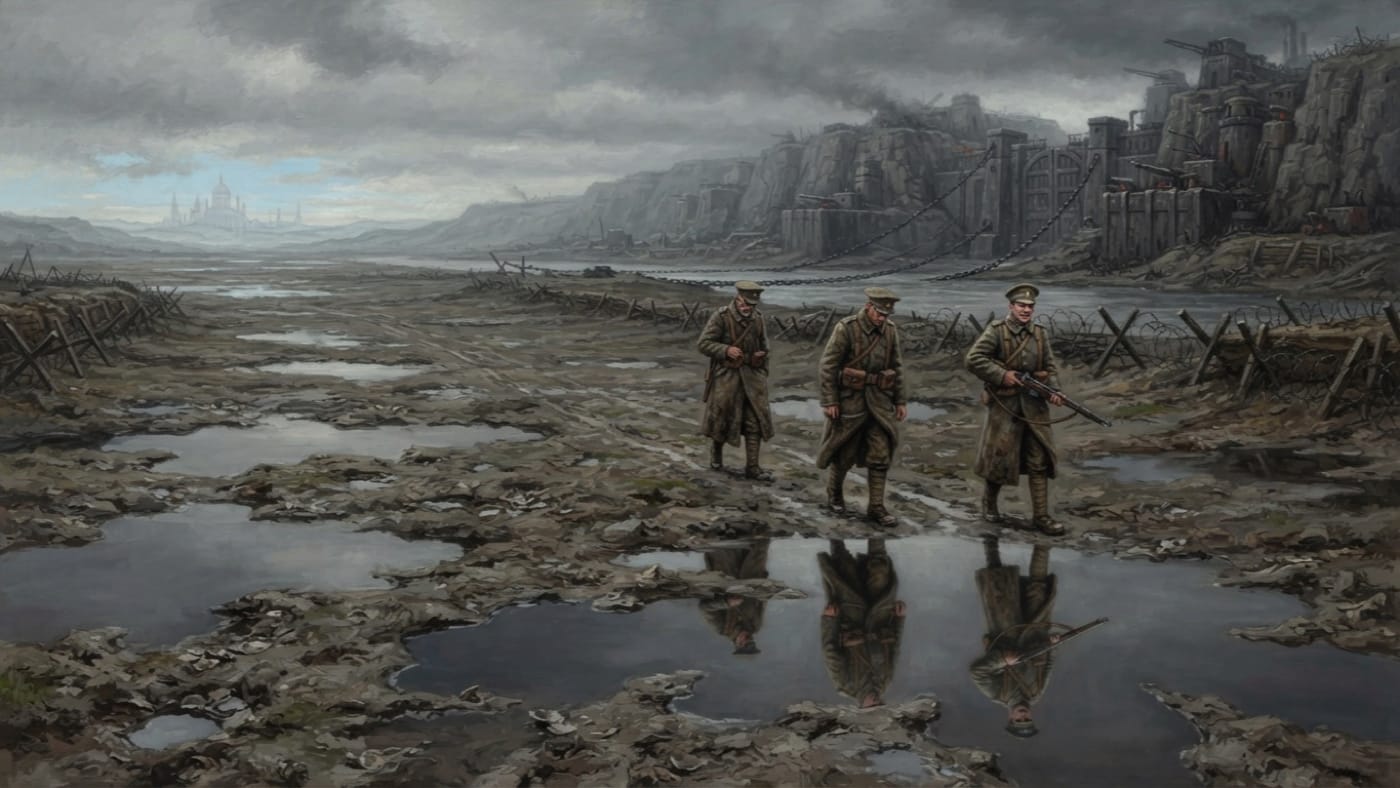
It begins as an ordinary ruined field. A man going east from the wire puts his boots into cracked grey-brown mud, split into plates the size of hymnals. The cracks hold rainwater, spent brass and the rest of the litter of a war fought over the same acres for a century and a half. Any veteran of any sector would know it.
Then the mud stops, with no seam, and the ground goes smooth.
The smooth patches lie among the mud the way spilt wax lies on a vestry floor. They are irregular and dark, silver at the edges, some small enough to step over and some too wide to walk round. They reflect, and the first thing they reflect is a wrong sky. Overhead the Danubian cloud sits low and pewter-coloured. In the ground the sky is clear, or it is evening there, or the weather belongs to another season. The files do not say what the surface is made of. They say it is smooth, that it reflects, and that what it shows disagrees with what is above it. I will not improve on them by calling it glass.
Then the man sees himself, from more angles than one surface should allow. The first reflection is exact down to the buttons: the cap, the chinstrap, the mud dried pale on the puttees, the sling worn shiny at the shoulder. That exactness is the bait. The next is taller by the width of a thumb. Another is broader through the chest, as though someone had fed it better. One smiles while he does not. One weeps. One stands like a man who has never been afraid. One wears the uniform of the enemy, and wears it well. Some look more alive than he feels, and some look less.
Further east, the files describe ground glass-smooth to every horizon. On the approaches it is a patchwork of mud and mirror, so a patrol passes in and out of reflection a dozen times in a morning and never gets used to distrusting it. The difference is one of scale. I suspect the patchwork is worse.
#On Those Who Cross
"They study. They watch. They learn. They copy."
The Waste is crossed by patrols and by sappers bound for the listening posts. Runners cross it with dispatches. Chaplains cross it to reach men who cannot be brought in. The displaced of the eastern marches cross it too, and reach the wire with their papers in order and their faces in doubt. None of them goes for the view.
The danger lies in the comparison. A man who has watched himself stand straighter in the ground starts wondering, on the walk back, which of the two of them is slouching. That is enough to start with. Morwen's servants find the work half done.
The Bureau classes the Mirror-Stalkers as things that live in reflections and watch through them. They come out as copies of whoever looked too long, and the copy is always the better soldier. The Hollow Ones need only to be near a man. They take his mannerisms first, then his phrases, then his memories, and he is left with less of each. The Face-Thieves are patient: each picks one target and studies him for months. Ground that the same patrols cross on the same rotation gives them a lectern to study from.
So a runner comes back and his sergeant cannot swear that he walks the way he did. A corporal uses a turn of phrase he never used before and cannot remember where he heard it. Nothing in the Waste certifies what has happened to either man, or whether anything has.
The Bureau of Doctrine holds that Morwen takes only what is freely surrendered, and that no demon overrides the will. I record that because it is sealed. Beside it I record that the runner did not choose to look at the ground. He was ordered across it with a dispatch case, and the ground was in his way. Doctrine also holds that a man can look away, keep looking away, and come home as himself. It does not claim that looking away is easy. Neither does the garrison.
A smiling reflection proves nothing about the man above it, and a sergeant's suspicion proves nothing about the runner. The Waste supplies doubt in quantity and evidence not at all.
#On the Defence of the Irongate
"We can hold the walls. We cannot hold ourselves."
Morwen presses the Irongate out of spite. She envies its beauty: the cliff batteries, the chain-booms across the river, the cannon cut into living rock. What she cannot have, she means to hollow out. Against the walls themselves she makes little headway. They are kept in good order, and the engineers who keep them have earned their pride.
The difficulty is that a fortress must send men out and let men back in. Every relief, patrol and runner that crosses the Waste comes back through the same gate. The gate can check a man's papers and his face, and both can be copied. The Synod keeps a fortress with great skill. It has never learned how to verify the men inside one.
These are the countermeasures. Under Mirror Discipline no man looks at his own reflection for longer than three seconds. Any reflective surface larger than a hand-span within three hundred yards of the perimeter is to be shattered, covered or dulled. The latrine mirrors have been replaced with polished tin that distorts on purpose. The price is that soldiers forget their own faces. When a man back from the Waste is asked at the gate to describe himself, he hesitates, and the hesitation goes into the log.
The Ledgers of Self record each man's appearance, habits, scars and most recently confessed sins. A ledger is a document, though, and documents can be altered. When the man at the gate and the man on the page disagree, the page cannot object. The challenge phrases and the Confession of Identity assume that only the original knows his own history. Good copies know it as well, and confessors have been known to accept whichever confession is more fluent.
The last measure is the execution of duplicates. When two men show the same face and neither can be proved the original, both are shot. That is Synodal policy, and the Codex records it as policy. Look at it from the original's side. He kept his eyes off the ground, counted his fingers, recited his ledger without a mistake, and came home. An hour later something wearing his face walks up to the gate and lets itself be noticed. By morning both are dead. With one appearance the copy has done what months of study could not. The Bureau knows about the flaw. The flaw has been filed.
Mirror Discipline was introduced after the Incident at Sector Nineteen. I know the details. The Morwen dossier withholds them, and so do I.
Earlier editions of this Codex described Morwen's campaign against Bastion-Irongate as "containable by conventional fortification and sufficient prayer."
The Morwen dossier withdrew this assessment, and it is withdrawn here for one more reason. Fortification has held the gorge, and prayer has been offered in sufficient quantity. But fortification stops at the wire, and the patrols do not.
#On the Present Condition
"Draw your own conclusions."
What follows is the condition attested in the Bureau of Doctrine's ratified Morwen dossier of A.S. 201, the present year. No new survey of the Waste was sent out for this entry, and I will not pretend otherwise. The date marks the dossier summarised here. It does not mark an expedition, a founding, or any sealing of the ground.
The gorge is held. The batteries on both cliffs are manned, the booms are across the river, and the Irongate is still the finest engineering on the Line. The approaches are still dangerous to cross and impossible to avoid. No map the Bureau of Records will seal gives the Waste a settled boundary. A man who has walked into it and back has no reliable way to prove who he is. He has the gate, the ledger, the challenge and his own word, and each of these has failed at least once.
The garrison goes on counting its fingers. The saying promises only that they are probably still yours. Nobody at the Irongate expects better odds.